CNEX Zones and Their Impact on Crane Kit Design Guide
Content Quick Link
CNEX Zones and Their Direct Impact on Crane Kit Design
Comprehensive Buyer’s and Engineering Guide
Most Important Takeaway
CNEX zone classification is the starting point of every explosion-proof crane kit design, because it determines the electrical protection level, mechanical safety structure, certification cost, and whether the crane is actually legal and safe to operate in hazardous environments.
Key Takeaways
- How CNEX zones define explosion risk levels in industrial environments
- Why crane kit design must change based on Zone 0/1/2 and 20/21/22 classifications
- What components of a crane kit are directly affected by CNEX requirements
- How explosion-proof overhead crane systems are configured for different hazard levels
- How CNEX classification impacts cost, lead time, and certification process
- How buyers avoid common mistakes when selecting hazardous environment cranes
Questions This Guide Solves
- What are CNEX zones and how are they classified in real industrial environments?
- How do CNEX zones affect explosion-proof overhead crane kit design?
- What changes in crane electrical systems, motors, and controls under different zones?
- What is the difference between Zone 1 and Zone 2 crane requirements?
- How do dust explosion zones (20/21/22) affect crane structure and sealing design?
- What should crane buyers confirm before requesting an CNEX crane quotation?
- Why do some explosion-proof crane kits cost significantly more than others?
CNEX Zones in Industrial Safety Context
CNEX zones are defined to classify areas where explosive gases, vapors, or dust may exist. In crane applications, these zones are not abstract labels—they directly determine whether a crane kit is safe for installation in environments such as chemical plants, oil refineries, grain storage facilities, or paint workshops.
Gas environments are divided into Zone 0, Zone 1, and Zone 2 depending on how frequently explosive gases are present. Dust environments follow a similar structure with Zone 20, Zone 21, and Zone 22, where combustible dust may accumulate or be suspended in air.
For crane buyers, understanding whether the working area is a gas hazard zone or a dust hazard zone is the first step before selecting any explosion-proof overhead crane system or crane kit configuration.
How CNEX Zones Directly Influence Crane Kit Design
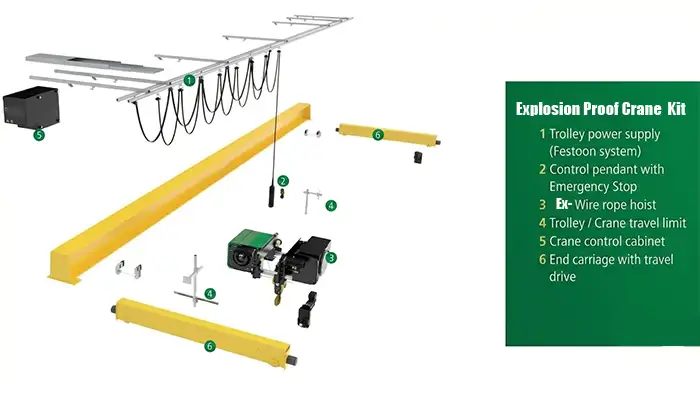
CNEX zones define how an explosion-proof crane kit must be designed and built. Once the hazardous level of the area is known, the crane configuration changes mainly to eliminate ignition risks from electrical and mechanical sources.
Below is a clear breakdown for easier understanding in real project selection and engineering communication.
Electrical System Design in CNEX Crane Kits
| Design Area | What Changes in CNEX Crane Kits | Why It Matters in Practice |
|---|---|---|
| Motors | Explosion-proof (Ex-rated) motors are used in Zone 1 and Zone 21 | Prevents internal sparks or overheating from reaching explosive gas or dust |
| Control Panel | Fully sealed electrical cabinet with high protection rating (e.g., IP66 or Ex enclosure) | Stops dust or gas entering and isolates internal faults safely |
| Cable Entry Points | Explosion-proof cable glands and sealed junction boxes are required | Avoids gas/dust leakage and prevents spark risk at connection points |
| Wiring Layout | Cables are routed with controlled bending radius and protected paths | Reduces wear, overheating, and accidental damage during crane movement |
| Electrical Protection Level | Higher zones require stricter certification and component selection | Ensures compliance with CNEX safety rules for hazardous environments |
Simple interpretation for buyers:
In real applications, the higher the CNEX zone level, the more controlled and strictly engineered the electrical system becomes.
- Zone 2 / 22 → flexible design, partial explosion protection
- Zone 1 / 21 → full explosion-proof electrical system required
- Zone 0 / 20 → extreme protection with highly restricted design
In short, the electrical system of an CNEX crane kit is not just upgraded — it is redesigned from the ground up based on the hazard level of the working environment.
Mechanical Structure Adaptation
Crane kits used in CNEX environments require mechanical design adjustments to reduce ignition risks such as sparks, static discharge, and excess heat.
These changes are built into the crane structure from the design stage, especially for explosion-proof overhead crane systems used in chemical, gas, and dust-prone industries.
| Mechanical Area | What Changes in CNEX Crane Kits | Why It Matters in Practice |
|---|---|---|
| Contact Points & Wheels | Use of non-sparking materials or treated surfaces | Reduces risk of sparks during metal contact or movement |
| Grounding System | Integrated anti-static grounding across bridge, trolley, and runway | Safely discharges static electricity during crane operation |
| Friction Design | Controlled friction at moving and contact parts | Prevents overheating and reduces surface temperature buildup |
| Hook & Trolley Assembly | Spark-resistant design with protected contact surfaces | Minimizes ignition risk during lifting, lowering, or load swing |
Practical note:
In CNEX crane applications, mechanical safety is not added as separate protection. It is built directly into the structure design. This helps the crane operate safely even in continuous industrial use where gas or dust may be present.
Temperature and Heat Control
In CNEX crane kit design, temperature control is not a secondary detail. It is a core safety requirement.
Explosion-proof crane systems must ensure that no surface or component reaches a temperature that could ignite gas, vapor, or dust in the working area.
| Heat Control Area | What Changes in CNEX Crane Kits | Why It Matters in Practice |
|---|---|---|
| Motors and Brakes | Designed according to T-class temperature limits | Ensures surface temperature stays below ignition levels of surrounding gases or dust |
| Heat Dissipation System | Improved cooling design for motors, gearboxes, and control components | Prevents overheating during long or heavy-duty lifting cycles |
| Continuous Operation Design | Upgraded thermal management for frequent start-stop working conditions | Keeps stable temperature even under high workload or long shifts |
Practical note:
In chemical plants and dust-heavy environments, ignition can happen at relatively low temperatures.
That is why CNEX crane kits are designed not only to lift loads safely, but also to control heat generation during every movement, braking action, and duty cycle.
CNEX Zone-Based Crane Kit Configuration Differences
CNEX zones directly decide how a crane kit is configured. The higher the risk level, the more complete the explosion-proof design becomes.
In practice, this means different zones lead to different system structures, certification depth, and component selection for explosion-proof overhead cranes.
| CNEX Zone Level | Crane Kit Configuration | Main Design Features | Typical Applications / Notes |
|---|---|---|---|
| Zone 2 / Zone 22 | Selective explosion-proof crane kit | - Standard crane structure with partial Ex components - Reduced certification requirements - Basic grounding and safety protection | Suitable for low-frequency hazardous exposure areas. Often used in general industrial workshops where explosive atmosphere appears only occasionally. |
| Zone 1 / Zone 21 | Fully explosion-proof crane kit system | - Ex-certified motors, hoists, and control systems - Reinforced sealing and enclosure protection - Anti-static grounding and spark prevention design | Common in chemical plants, grain processing, and refinery environments where explosive gas or dust may exist during normal operation. |
| Zone 0 / Zone 20 | High-level explosion-proof crane system | - Fully encapsulated electrical and mechanical systems - Maximum protection design level - Remote or isolated operation control | Used in highly restricted environments with continuous explosive atmosphere. Applications are limited due to strict safety requirements. |
Impact on Crane Selection and Procurement Decisions
For crane buyers, CNEX classification is not just a technical detail. It directly shapes how the crane kit is selected, priced, and delivered.
Once the zone level is confirmed, it affects both engineering decisions and procurement planning, especially for explosion-proof overhead crane systems used in hazardous industries.
| Procurement Factor | How CNEX Zones Affect It | What It Means in Practice |
|---|---|---|
| Crane Kit Pricing & Project Cost | Higher CNEX zones require more Ex-certified components and stricter design | Zone 1/21 and Zone 0/20 systems are significantly more expensive than Zone 2/22 solutions due to full explosion-proof requirements |
| Lead Time | Specialized components and certification processes extend production time | Explosion-proof motors, control systems, and third-party approvals can increase delivery time compared to standard cranes |
| Engineering Complexity | Higher zones require deeper customization and stricter safety design | Installation planning becomes more detailed, including grounding layout, cable routing, and enclosure positioning |
| Maintenance Requirements | More protection systems require structured inspection and servicing | Regular checks on sealing, grounding, and electrical protection become more important for long-term safety |
Practical warning for buyers:
One of the most common procurement mistakes is underestimating the actual CNEX zone level of the working environment.
When this happens, the crane may be designed with the wrong protection level, which can lead to re-certification work, project delays, or even rejection during safety inspection before commissioning.
Certification and Compliance Requirements for CNEX Crane Kits
Explosion-proof crane kits are not only designed for performance, but also for legal and safety approval before they can be used in hazardous areas. In CNEX environments, compliance is part of the product itself, not something added later.
For crane buyers, this means a crane is only “ready to use” when both the design and the certification documents are complete.
Key certification requirements for CNEX crane systems
| Requirement | What it means in crane kit supply | Why it is important in real use |
|---|---|---|
| CNEX Directive 2014/34/EU | Equipment must be designed and tested according to EU explosion protection rules | Ensures the crane is legally allowed to operate in gas or dust hazardous zones |
| CE marking for hazardous equipment | The crane system must carry CE marking specific to CNEX use | Confirms conformity with European safety and health standards |
| Third-party inspection (TÜV, SGS, BV or equivalent) | Independent inspection of design, manufacturing, and testing process | Adds verification that the equipment meets safety requirements, not only manufacturer claims |
| Explosion protection technical file | Complete documentation including drawings, calculations, and safety analysis | Used for audits, approvals, and long-term traceability of the crane system |
Why certification cannot be ignored in CNEX crane projects
In CNEX applications, technical performance alone is not enough. Even if a crane kit is well designed, it cannot be installed or operated without valid certification.
- Local safety authorities may reject non-certified equipment
- Insurance coverage often depends on proper CNEX documentation
- Plant safety audits require full traceability of explosion protection design
Practical understanding for buyers
In real procurement situations, certification is often what determines whether the crane can actually be commissioned on site.
Without proper CNEX approval documents and inspection records, even a correctly built explosion-proof crane kit cannot legally enter service in hazardous environments.
COMMON BUYER MISTAKES IN CNEX CRANE SELECTION
In CNEX crane procurement, many issues do not come from the equipment itself, but from how requirements are understood at the beginning. Explosion-proof crane systems depend heavily on correct classification and detail accuracy, and small misunderstandings can easily lead to incorrect configuration or compliance problems.
Treating all explosion-proof cranes as identical regardless of zone level
One of the most frequent mistakes is assuming that "explosion-proof crane" means the same thing in every application.
In reality:
- Zone 2 / 22 cranes may use partial protection systems
- Zone 1 / 21 cranes require full Ex-certified configurations
- Zone 0 / 20 applications require highly specialized designs
If this is ignored, the crane may appear correct in specification documents but fail compliance during inspection or commissioning.
Confusing dust zones with gas zones
Another common issue is mixing up dust and gas classification systems.
- Gas zones (Zone 0 / 1 / 2) relate to flammable vapors or gases
- Dust zones (Zone 20 / 21 / 22) relate to combustible particles such as flour, coal, or chemical powders
These two systems follow different safety principles, especially in ignition temperature and protection design. Treating them as the same often leads to incorrect motor, enclosure, and sealing selection.
Ignoring temperature class (T-class) limitations
Some buyers focus only on explosion-proof labels and overlook temperature classification requirements.
- Every CNEX motor and component has a maximum surface temperature rating (T1 to T6)
- If this is not matched with the ignition temperature of the surrounding material, safety cannot be guaranteed
This is especially important in chemical and dust-heavy industries where ignition points may be relatively low.
Not planning for future expansion of hazardous areas
In many industrial plants, CNEX zones are not fixed permanently. They may expand due to:
- Process changes
- Production capacity increase
- New material handling requirements
If the crane is designed only for the current zone without considering future expansion, it may require modification or replacement later.
Focusing only on price instead of compliance requirements
Cost is always part of the decision, but in CNEX crane selection it should not be the only factor.
A lower-cost crane may:
- Lack proper certification for the required zone
- Use incomplete or incorrect explosion-proof components
- Cause delays or rejection during inspection and approval
In practice, the real cost often appears later if compliance is not correctly handled from the beginning.
In summary, most CNEX crane issues do not come from manufacturing quality, but from early misunderstanding of zone requirements, safety classification, and certification scope.
PRACTICAL INDUSTRIAL APPLICATIONS
CNEX-rated crane kits are used in industries where explosive gas or combustible dust may exist during operation. In these environments, the crane is not only a lifting tool—it becomes part of the plant's safety control system. Different industries also carry different risk levels, which is why crane design, protection level, and certification scope vary from one application to another.
Oil and gas refineries with continuous gas exposure zones
In refineries, explosive gas may be present during normal operation, especially around processing units, storage tanks, and transfer areas.
- Typically associated with Zone 1 or Zone 2 environments
- Requires full explosion-proof motors and sealed electrical systems
- Strong focus on anti-spark design and controlled temperature rise
These cranes are often installed in maintenance workshops or pipe handling areas where strict safety supervision is required.
Chemical processing plants with volatile compounds
Chemical plants often handle solvents, acids, and reactive materials that can release flammable vapors during processing stages.
- Mixed CNEX zones depending on production process
- Requires sealed control systems and corrosion-resistant components
- High focus on ventilation conditions and ignition prevention design
Even small details such as cable routing and enclosure sealing can significantly affect safe operation in daily use.
Grain silos and flour mills with combustible dust
Dust explosion risk is a key concern in food processing and bulk material handling industries.
- Usually classified as Zone 21 or Zone 22 areas
- Fine dust particles may ignite under heat or static discharge
- Requires grounding protection and controlled surface temperature design
In these environments, the crane must also reduce dust accumulation and static buildup during lifting and travel operations.
Offshore platforms and hazardous material handling terminals
Offshore platforms and port terminals combine explosion risk with harsh environmental conditions such as moisture, wind, and corrosion.
- Combined gas exposure and heavy-duty lifting requirements
- High-level sealing and corrosion protection systems
- Designed for long operating cycles with minimal downtime
Maintenance access is often limited, so reliability and durability are critical design priorities.
Paint and solvent production facilities
These facilities handle flammable liquids and vapors during mixing, storage, and transfer processes.
- Commonly classified as Zone 1 or Zone 2 areas
- High sensitivity to ignition sources such as sparks or overheating
- Requires strict control of electrical systems and ventilation conditions
Crane operation is often closely integrated with production flow to reduce manual handling risks and improve process safety.
Practical summary
Across all industries, the key difference is not the crane structure itself, but the required level of explosion protection.
Each application requires a tailored combination of:
- Electrical protection level
- Mechanical anti-spark design
- Temperature control limits
- Certification scope based on zone classification
This is why CNEX crane kits are always selected based on the real working environment, not only lifting capacity or span requirements.
Conclusion
CNEX zones are not just regulatory definitions—they are the foundation of explosion-proof crane kit engineering. They determine how every component, from motors to structural design, must be configured to ensure safe operation in hazardous environments.
For crane buyers, correctly identifying the CNEX zone before selecting a crane kit is essential to avoid compliance risks, unnecessary cost escalation, and operational safety failures. A properly matched explosion-proof overhead crane system ensures not only regulatory approval but also long-term reliability in demanding industrial conditions.

Article by Bella ,who has been in the hoist and crane field since 2016. Bella provides overhead crane & gantry crane consultation services for clients who need a customized overhead travelling crane solution.Contact her to get free consultation.
Yuantai Cranes
Overhead Crane Manufacturer with CE, ISO, SGS, CNEX Certificates.
- Main Specifications - Capacity: 0.5–550 tons | Span: up to 40m | Speed: 0.8–12 m/min | Duty: A3–A7 | Power: 380–690V, 50/60Hz | Control: pendant/remote/cabin
- Full engineering: FEA/PLC/VFD + in-house build + global delivery + on-site support, for workshops, factories, EPC contractors, industrial projects, etc.
- Support: design, manufacturing, testing, service – end-to-end, customized lifting solutions worldwide.
How to Get an Accurate Crane Price for Your Application?
Tips: Copy the spec list, fill in your details, and paste it into the form on the right/ down-below for a quick price.
- Crane type:_____ . (e.g., overhead crane, gantry crane, jib crane)
- Max weight to lift:_____ tons. (e.g., 2t, 5t, 10t, 20t, 50t)
- Lifting height:_____ m. (How high does the hook need to reach?
- Workshop width (span):_____ m . (Distance between the two crane rails)
- Travel distance:_____ m . (How long does the crane need to move along the runway?)
- Control type:_____. (Pendant / remote / cabin Control)
- Power supply:_____. (Local voltage & frequency – e.g., 380V, 50Hz, 3-phase)
- What will it be used for?_____ (e.g., steel fabrication, concrete products, mold handling, general manufacturing, etc.)
- Any special requirements?_____ (e.g., extreme temperature, dusty or explosive environment, special paint color, etc.)
Just leave a message via the contact form and our hoist and crane engineer will contact you with in 24working hours.
Get Your Custom Quote–Quick & Easy
Fill in what you know. Skip what you don't – we'll help.Any question will be reply with 24 working hours