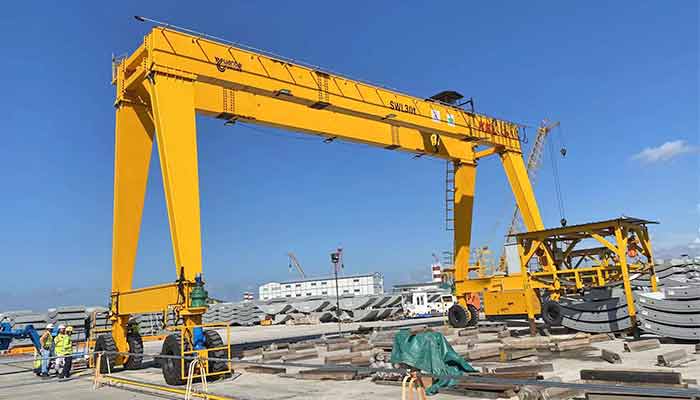
Rubber Tyred Crane Swaying Causes & Engineering Analysis Guide
Content Quick Link
Key Takeaway
Crane swaying in rubber tyred gantry systems is not usually a quality defect, but a system-level engineering mismatch involving power, structure, wheels, hydraulics, and site conditions.
- Swaying is often linked to power system mismatch, not equipment failure
- Structural clearance and design directly affect operational stability
- Wheel size, ground flatness, and load distribution significantly influence motion behavior
- Hydraulic flow stability impacts smooth lifting and traveling performance
- Most cases are engineering configuration issues, not manufacturer defects
Power System and Load Response Mismatch
In rubber tyred gantry crane operation, the swaying issue is often noticed right at the moment of lifting start, load pickup, or when the crane slows down. It doesn’t always show up during steady movement. It shows up when force changes quickly.
This is usually connected to how the drive system is matched with the actual working load. If the motor power, torque output, or control response is not well aligned with the load demand, the crane will not move in a smooth way. It reacts a bit late, or too suddenly, and that creates visible shaking.
- When the load comes in faster than the system can respond, the torque output becomes uneven
- The crane may feel like it “hesitates” for a moment before lifting steadily
- During braking, the stop may feel slightly abrupt instead of soft and controlled
- Operators often describe it as a “small jump” or “light shake” at the start or stop
From an engineering point of view, this is not treated as a structural failure. It is more about response balance between load demand and drive output. The system is simply not moving at the same rhythm as the force being applied.
In many field situations, once the drive parameters, motor sizing, or control curve are adjusted to match the actual duty cycle, the shaking reduces or becomes much smoother.
Structural Fit and Assembly Stability
Another point that directly affects stability is the way the structural parts are fitted together. This includes supporting legs, telescopic sleeves, guide sections, and sliding interfaces. These parts are supposed to move or carry load while keeping alignment under control.
If the clearance between inner and outer components is too large, even slightly, the movement will not stay tight. Over time and under repeated load changes, those small gaps become noticeable during operation.
- Loose fit between sleeve and column can create side-to-side movement
- Uneven contact surfaces may lead to small repeated vibration during travel
- If guiding parts are not properly aligned, the structure can feel less “steady” during lifting
- The effect is more obvious when the crane is carrying mid to heavy loads
To manage this, practical design usually includes sliding and guiding details such as wear-resistant blocks and controlled lubrication points. These are not there for decoration, they serve a simple purpose: keep contact stable while still allowing smooth movement.
- Sliding blocks help reduce metal-to-metal clearance impact
- Lubrication layers reduce friction fluctuation during motion
- Proper assembly tolerance keeps the structure aligned under load changes
When these details are not well controlled, the result is not a visible breakdown, but a mild oscillation during operation. It feels like the crane is “not fully tight”, especially when it starts moving or changes direction.
In many cases, once the structural fit is corrected or re-aligned during maintenance, the movement becomes noticeably calmer and more consistent.
Wheel System and Ground Condition Interaction
Rubber tyred gantry cranes behave differently from rail-mounted systems because they do not run on a fixed track. The whole movement depends on wheel contact with the ground, and this contact is never perfectly uniform. That is where many of the small vibrations or swaying feelings come from.
When the ground is not fully level, or when the surface has soft and hard patches, the wheels do not roll with the same resistance. One side may feel slightly higher, another slightly rougher. The crane reacts to these small differences during travel, and the motion can feel less steady than expected.
- Uneven concrete surface can create small lifting and dropping effects during travel
- Poor ground compaction may cause slight sinking under heavy wheel load
- Different wheel contact points may lead to uneven rolling resistance
- These small variations add up and appear as vibration or side sway
Wheel diameter also plays a practical role that is often overlooked. Smaller wheels tend to “read” the ground more directly. Every small bump or joint on the surface becomes more noticeable through the structure.
- Smaller wheel diameter increases sensitivity to surface roughness
- Larger wheels generally pass over minor irregularities more smoothly
- Narrow wheel spacing can amplify imbalance under load
- Uneven load sharing between wheels can create intermittent shaking during movement
In some cases, the equipment itself is operating normally, but the ground conditions are not fully ready for stable travel. When wheel load distribution and ground flatness are not aligned with the crane’s working requirement, the motion naturally becomes less smooth.
So in many site discussions, what looks like equipment instability is actually a simple mismatch between wheel configuration and real ground conditions. Once the surface is improved or the wheel setup is adjusted to match the site, the movement often becomes noticeably more stable without changing the main structure.
Hydraulic and Control Flow Stability
In rubber tyred gantry crane systems that use hydraulic or electro-hydraulic control, the smoothness of movement is closely tied to how the oil flow behaves inside the system. It is not only about pressure, but also about how steadily the flow is delivered through valves and pipelines during operation.
When everything is in good condition, the motion feels controlled and continuous. But if the hydraulic oil condition or flow regulation is not stable, the movement can become slightly uneven, especially during lifting start, load holding, or speed changes.
- If oil viscosity is not suitable for the working temperature, flow response becomes inconsistent
- Poor filtration can allow small impurities to affect valve sensitivity
- Valve response that is not well tuned may create small delays in flow adjustment
- These small variations often appear during start-stop or speed transition phases
When the hydraulic flow is not steady, the force transmitted to the mechanism is also not steady. The crane may still complete the movement, but the motion does not feel fully smooth. Operators may describe it as slight “jerk” or “pulse” during lifting or traveling.
- Load lifting may feel slightly uneven at the beginning
- Speed changes may not transition smoothly
- Small oscillation can appear during holding or fine positioning
- The overall feeling is less continuous motion control
In practice, this type of behavior is sometimes misunderstood as structural vibration. But in many cases, the structure itself is fine. The real issue is in the control response inside the hydraulic system, where flow stability is not fully consistent with the operation demand.
Once the oil condition, filtration level, or valve calibration is improved, the movement usually becomes more stable without any change to the main crane structure.
Engineering Perspective Summary
In actual industrial use, rubber tyred gantry crane behavior is never driven by a single factor. It is usually the result of several systems working together at the same time. When one part is slightly out of balance, the effect can show up as swaying, vibration, or less stable movement during operation.
Each part of the system has its own role, but they also influence each other during real lifting and traveling work. That is why the same crane can feel different depending on the site, load, or operating style.
- Drive and power system configuration affects how smoothly force is delivered during start and stop
- Structural design and assembly precision influence how tightly the crane maintains alignment under load
- Wheel selection and ground conditions directly affect traveling stability and vibration level
- Hydraulic control stability determines how consistent the motion feels during lifting and speed changes
- Real working load patterns and operation frequency shape how the system behaves over time
When these elements are not fully matched, small inconsistencies do not stay isolated. They combine and appear in operation as swaying or uneven movement.
In practical engineering understanding, this kind of behavior is better seen as a system integration result. It is not usually traced back to one single defective point. Instead, it reflects how well the whole configuration fits the actual working environment, load demand, and operating conditions together.
FAQS
Q: Why does a rubber tyred gantry crane sway during lifting or traveling?
A: Because the motion stability is affected by a combination of drive response, wheel-ground contact, and structural alignment rather than a single fault.
- In many "rubber tyred gantry crane swaying during operation" cases, the issue appears during lifting start, load engagement, or traveling transitions when force changes quickly.
- If the drive system response, ground condition, and structural fit are not fully balanced, small irregular forces accumulate and show up as visible sway instead of smooth motion.
Q: Why does the crane feel unstable even under rated load capacity?
A: Because rated capacity does not guarantee stability if system matching and site conditions are not properly aligned.
- In real "RTG crane instability under rated load" situations, the crane may still operate within design limits but feel less steady due to uneven wheel load distribution or ground variation.
- Structural tolerance, wheel selection, and working environment all influence how stable the crane feels during continuous operation, even when lifting within rated tonnage.
Q: Why does vibration appear during start, stop, or load change?
A: Because these are dynamic transition stages where force output and control response are most sensitive.
- During "rubber tyred gantry crane vibration at start and stop," the system experiences sudden changes in torque and hydraulic or electric response.
- If the power system, hydraulic flow, or control tuning is not smooth enough, the transition feels like small jerks or oscillation instead of continuous movement.
Q: Why do different sites show different performance on similar cranes?
A: Because site conditions and installation environments directly affect how the same crane behaves in operation.
- In practice, "why same gantry crane performs differently on different sites" is usually related to ground flatness, wheel condition, load patterns, and even operation frequency.
- A crane installed on well-prepared concrete behaves differently from one operating on uneven or partially compacted surfaces, even if the equipment specification is identical.
Q: How to distinguish between design issues and site condition influence?
A: By checking whether the abnormal behavior comes from system configuration or from working environment factors.
- Engineering evaluation of "crane swaying causes analysis" usually separates equipment-related factors (power, structure, hydraulic system) from external factors (ground, load pattern, installation accuracy).
- If the same behavior varies across sites or load conditions, it is often linked to environment or system matching rather than structural defect.
Conclusion
Rubber tyred gantry crane swaying is a common field phenomenon that appears across different manufacturers and working environments. It is typically caused by system-level mismatch between equipment configuration and site conditions, rather than a direct equipment fault.
Proper evaluation requires analyzing power matching, structural design, wheel-ground interaction, and hydraulic stability together. Only by understanding the full working environment can the true cause be identified and an effective optimization solution be implemented.

Article by Bella ,who has been in the hoist and crane field since 2016. Bella provides overhead crane & gantry crane consultation services for clients who need a customized overhead travelling crane solution.Contact her to get free consultation.
Yuantai Cranes
Overhead Crane Manufacturer with CE, ISO, SGS, CNEX Certificates.
- Main Specifications - Capacity: 0.5–550 tons | Span: up to 40m | Speed: 0.8–12 m/min | Duty: A3–A7 | Power: 380–690V, 50/60Hz | Control: pendant/remote/cabin
- Full engineering: FEA/PLC/VFD + in-house build + global delivery + on-site support, for workshops, factories, EPC contractors, industrial projects, etc.
- Support: design, manufacturing, testing, service – end-to-end, customized lifting solutions worldwide.
How to Get an Accurate Crane Price for Your Application?
Tips: Copy the spec list, fill in your details, and paste it into the form on the right/ down-below for a quick price.
- Crane type:_____ . (e.g., overhead crane, gantry crane, jib crane)
- Max weight to lift:_____ tons. (e.g., 2t, 5t, 10t, 20t, 50t)
- Lifting height:_____ m. (How high does the hook need to reach?
- Workshop width (span):_____ m . (Distance between the two crane rails)
- Travel distance:_____ m . (How long does the crane need to move along the runway?)
- Control type:_____. (Pendant / remote / cabin Control)
- Power supply:_____. (Local voltage & frequency – e.g., 380V, 50Hz, 3-phase)
- What will it be used for?_____ (e.g., steel fabrication, concrete products, mold handling, general manufacturing, etc.)
- Any special requirements?_____ (e.g., extreme temperature, dusty or explosive environment, special paint color, etc.)
Just leave a message via the contact form and our hoist and crane engineer will contact you with in 24working hours.
Get Your Custom Quote–Quick & Easy
Fill in what you know. Skip what you don't – we'll help.Any question will be reply with 24 working hours