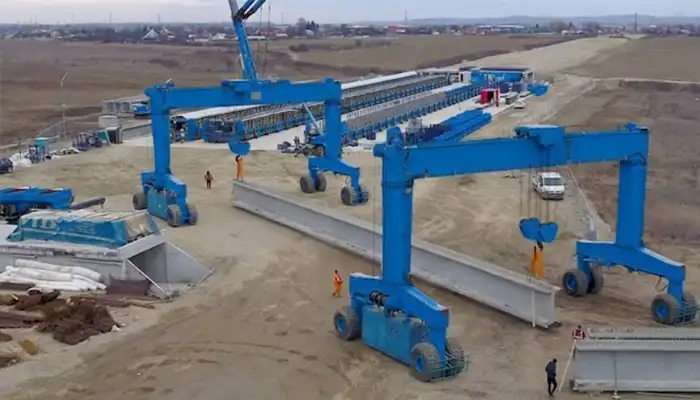
Rubber Tyred Gantry Crane for Precast Concrete Yards Guide
Content Quick Link
Most Important Takeaway
Rubber tyred gantry cranes are one of the most practical solutions for modern precast concrete yards because they combine high-capacity lifting with full yard mobility, eliminating rail constraints while improving efficiency, safety, and flow of heavy beams, slabs, and segmental structures in large outdoor production environments.
This guide helps solve the most common buyer and project planning questions:
- How does a rubber tyred gantry crane improve precast concrete handling efficiency?
- When should RTG cranes be used instead of rail-mounted gantry systems?
- How can heavy precast beams and segments be lifted without cracking or damage?
- What crane capacity, span, and configuration fit different precast yard layouts?
- How does RTG mobility improve yard planning and material flow?
- What are the real industrial applications and project environments for RTG cranes?
- What safety systems are required for outdoor precast lifting operations?
- How can yard layout design reduce congestion and improve productivity?
Introduction: The Role of RTG Cranes in Precast Concrete Yards
Precast concrete production involves continuous movement of large structural elements such as bridge beams, tunnel segments, slabs, and wall panels between casting, curing, storage, and dispatch zones.
Traditional fixed rail systems can limit flexibility and increase civil construction cost. In contrast, a rubber tyred gantry crane provides a mobile overhead lifting system that can operate freely across large yard areas, making it ideal for modern high-output precast production environments where layouts frequently change and handling frequency is high.
Why Precast Concrete Yards Need Flexible RTG Systems
Precast concrete production has become more demanding over the years. Components are larger, heavier, and more sensitive during handling. At the same time, yards are often tighter in space and faster in turnover. In this kind of working environment, the way materials move inside the yard starts to matter just as much as how they are produced. A rubber tyred gantry crane fits into this situation because it is not fixed to a rail line. It can travel across different zones of the yard, follow the production flow, and adjust to layout changes without requiring new civil work. This flexibility is one of the main reasons many precast yards gradually shift away from fixed lifting points.
Growing size and weight of infrastructure components such as bridge girders and tunnel segments
Modern infrastructure projects are not dealing with small precast parts anymore. Bridge beams are getting longer, tunnel segments are getting thicker, and lifting weights are going up with each new project requirement.
In many yards, a single beam can reach tens of tons, and sometimes over one hundred tons depending on the design. These pieces cannot be handled safely with light lifting equipment or narrow working ranges.
- Bridge girders often require long-span lifting with stable balance control
- Tunnel segments need precise alignment during stacking to avoid deformation
- Large slab elements need wide lifting clearance to prevent edge stress
- Some components require multi-point lifting to avoid bending during transport
When loads grow like this, the lifting system must move with the material, not force the material to move to a fixed lifting point. That is where RTG cranes start to make sense.
Frequent movement of materials between production stages
A precast yard is not a static storage area. Materials are constantly moving between casting, curing, inspection, storage, and dispatch.
If the lifting system is fixed in one location, every movement becomes a small detour. Over time, this slows down the whole production rhythm.
Typical movement patterns include:
- Freshly cast elements moved to curing zones
- Cured components transferred to storage stacks
- Quality-checked units repositioned for dispatch loading
- Re-stacking based on delivery schedules or project sequencing
With a rubber tyred gantry crane, these steps can be handled in a more direct path. The crane follows the material instead of waiting for it to arrive at a fixed point. This reduces waiting time between processes and keeps the yard flow more continuous.
Limited yard space in high-density manufacturing sites
Many precast facilities are built in industrial zones where land cost is high. Yard space is often tight, and every square meter needs to be used efficiently.
Fixed crane systems usually require defined travel paths or rail installation. That layout does not change easily once installed. In a busy yard, this can become restrictive.
A mobile gantry system changes how the space is used:
- No permanent rail alignment is needed
- Storage zones can be adjusted based on project demand
- Multiple stacking layouts can be created within the same yard
- Travel routes can be adapted as production changes
In practice, this means the yard can "shift shape" depending on what is being produced. That flexibility becomes useful when handling different projects in the same facility.
High risk of surface cracking or damage during lifting and transport
Precast concrete looks strong, but during handling it behaves differently. Long beams can bend slightly under uneven lifting. Edges can chip if pressure is not distributed correctly. Even small impact or vibration can create hidden cracks.
This is especially important for:
- Long bridge beams with mid-span stress sensitivity
- Thin slabs with edge fragility
- Tunnel segments that require precise alignment during stacking
- Finished components ready for transport and installation
RTG cranes help reduce these risks when paired with proper lifting tools:
- Spreader beams to distribute load evenly across lifting points
- Multi-hook or multi-point lifting systems for long components
- Smooth acceleration and braking to avoid sudden force impact
- Stable positioning during stacking and unloading
The goal is simple: keep the concrete stable from pick-up to final placement, without introducing unnecessary stress.
Inefficient material flow when using fixed-position lifting equipment
When lifting equipment is fixed in one location, the yard layout often has to adapt around it. That sounds simple at first, but in daily operation it creates friction.
Materials may need to be moved multiple times just to reach the lifting zone. Trucks may wait longer at loading points. Storage areas may become congested because of limited access paths.
Common issues include:
- Multiple handling steps for a single component
- Bottlenecks near crane working radius
- Uneven workload distribution across the yard
- Delays during peak dispatch periods
A rubber tyred gantry crane helps reduce these steps because it can move directly to where the material is located. It does not require everything to pass through a single fixed lifting point. The flow becomes more direct, and the yard feels less constrained.
Why mobile gantry systems are more practical in modern precast yards
When all these factors are combined—heavier loads, faster production cycles, limited space, and sensitivity of concrete products—the limitations of fixed lifting systems become more visible.
A mobile gantry system such as a rubber tyred crane is preferred because it:
- Moves with the production flow instead of restricting it
- Covers a wider working area without fixed infrastructure
- Reduces repeated handling steps inside the yard
- Adjusts to changing project layouts and storage needs
- Supports safer handling of long and heavy precast elements
In practical terms, it allows the yard to operate more like a flexible workspace rather than a fixed mechanical layout.
How Rubber Tyred Gantry Cranes Work in Concrete Handling
A rubber tyred gantry crane is built around a mobile wheeled structure, which allows it to travel directly across the precast yard without relying on rails or fixed tracks. In practical terms, it works more like a moving lifting bridge that can stop, lift, carry, and place heavy concrete elements wherever they are needed in the yard. Unlike fixed cranes that serve only one working zone, this type of system follows the material flow. It moves with the production rather than forcing production to adjust around it. That difference changes how the whole yard operates on a daily basis.
Working principle in a precast yard environment
In a precast concrete yard, the crane is used as a central handling unit between production stages. It connects casting areas, curing zones, storage stacks, and loading points in one continuous movement path.
- The crane travels on rubber-tyred wheels across compacted yard surfaces
- A gantry structure provides overhead lifting clearance for large components
- Lifting is performed using hooks, spreader beams, or custom lifting frames
- Movement is controlled by operator cabin, pendant control, or remote system depending on configuration
The key idea is simple: one machine covers multiple working zones without needing fixed infrastructure.
Lifting precast beams, slabs, or segments from casting or curing zones
Fresh or cured concrete elements are first lifted from molds, curing beds, or temporary storage areas. This step often requires careful handling because the concrete may still be sensitive or not fully stress-resistant.
- Lift points are selected based on structure type and length
- Spreader beams are used for long girders to prevent bending
- Slow lifting speed is applied to avoid sudden stress on fresh concrete
Transporting heavy components across open yard areas
Once lifted, the crane travels across the yard to relocate the component. This movement replaces multiple short handling steps that would otherwise require different machines.
- Direct transport reduces intermediate transfers
- Wide travel lanes allow movement of oversized beams
- Load stability is maintained during slow and controlled driving
In practice, this step is where a lot of time is saved compared to fixed lifting systems.
Stacking, repositioning, and storage management in yard zones
After transport, precast elements are placed into organized storage areas based on size, type, or project batch.
- Beam stacks are arranged by length and weight class
- Slabs are stored in layered positions with proper spacing
- Tunnel segments are grouped to match assembly sequence
Precast production is not always linear. Orders may change, and project priorities can shift. RTG cranes allow easy repositioning of stored elements without disrupting the entire yard layout.
- Materials can be moved between storage zones
- Older batches can be reorganized for earlier dispatch
- Production flow adjustments can be handled without delay
This flexibility is especially useful in multi-project yards.
Loading finished precast products and improving overall yard operation
The final step is loading materials onto trucks, trailers, or specialized transport systems.
- Direct loading reduces additional handling steps
- Alignment with transport vehicles is easier due to mobility
- Larger components can be positioned accurately before lifting release
When all these steps are combined, the RTG crane creates a continuous handling loop inside the precast yard. Instead of breaking material flow into separate stages handled by different machines, everything is managed by one mobile system.
- Fewer handling transfers between production stages
- Reduced waiting time between lifting and transport operations
- More stable workflow during peak production periods
- Better control over heavy and oversized components
- Smoother coordination between casting, storage, and dispatch zones
Over time, this type of workflow helps the yard operate in a more organized and predictable way, especially when dealing with large infrastructure components like bridge beams and tunnel segments.
Typical Industrial Applications of RTG Cranes
Rubber tyred gantry cranes are not limited to one type of construction site. They are mainly used wherever precast concrete is produced in large volumes and where components are too heavy or too long to be handled efficiently with simple lifting equipment. The common factor across all applications is the need to move heavy structural elements safely, repeatedly, and across changing yard layouts. In most cases, these cranes are chosen because the working environment is not fixed or standardized. The yard grows with the project, the product mix changes, and the handling points are spread across different zones.
Precast Manufacturing Facilities
Precast production plants are one of the most common environments for RTG crane systems. These facilities handle continuous production cycles where beams, slabs, and panels are cast, cured, and stored in large quantities.
Typical applications include:
- Beam production and storage yards where long bridge girders are stacked and rotated for curing and dispatch
- Slab and wall panel fabrication plants that require frequent lifting of flat concrete elements between molds and storage areas
- Modular building component factories where prefabricated structural units must be moved carefully without surface damage
In these yards, the crane is used daily for repeated lifting cycles, often working in coordination with casting schedules and curing times.
Infrastructure Construction Projects
Large infrastructure projects often require temporary or semi-permanent precast yards close to the construction site. These yards handle fast-moving production demands and changing project phases.
Common use cases include:
- Highway bridge construction yards where precast girders are lifted, stored, and later installed in sequence
- Elevated expressway segment assembly zones where large structural segments are positioned and prepared for final installation
- Railway viaduct precast yards that require precise alignment of long beam structures before transport
- Metro tunnel segment production sites where circular segments are produced and stacked in assembly order
In these environments, flexibility is important because production layouts often change as the project progresses.
Large Civil Engineering Projects
Some of the most demanding applications involve large-scale civil works where components are both heavy and structurally critical.
Typical RTG crane usage includes:
- Tunnel lining segment fabrication yards where segmented rings must be lifted and organized in precise sequence
- Airport runway and apron concrete panel projects where large slabs are handled for ground infrastructure installation
- Power plant foundation precast yards where heavy foundation blocks and structural supports require stable lifting and transport
These projects usually involve strict handling control because component quality directly affects structural safety after installation.
Industrial Construction Zones
RTG cranes are also widely used in industrial development areas where large structural precast elements are needed for buildings and infrastructure expansion.
Typical applications include:
- Industrial warehouse precast yards where columns, beams, and wall panels are produced and stored
- Port and dockyard concrete structure production areas handling heavy marine and structural components
- Large-scale commercial infrastructure developments where repeated lifting of standardized precast units is required
In these zones, cranes often operate in high-frequency cycles due to continuous construction demand.
Why these applications rely on RTG crane systems
Across all these industries, the handling conditions are similar. The components are large, the production volume is high, and the yard layout is often temporary or evolving.
Rubber tyred gantry cranes are preferred because they can:
- Move freely across different working zones without rail limitations
- Handle long and heavy precast components safely with controlled lifting
- Adapt to changing yard layouts and project phases
- Support continuous production flow from casting to dispatch
- Reduce the need for multiple handling machines inside the yard
In practice, this makes them suitable for almost any precast environment where heavy structural components must be moved repeatedly and safely under changing working conditions.
Typical Precast Objects and Weight Ranges Handled
Rubber tyred gantry cranes are built for handling concrete elements that are not only heavy, but also long, thin, or uneven in weight distribution. In precast yards, the challenge is rarely just lifting weight. It is more about controlling deformation, keeping balance, and moving large structural parts without introducing cracks or stress during handling. That is why RTG cranes are commonly paired with spreader beams, lifting frames, and multi-point rigging systems. The crane itself provides mobility and lifting power, while the rigging setup ensures the concrete element stays stable throughout the entire movement cycle.
Bridge and Infrastructure Components
Bridge construction is one of the most demanding applications for RTG crane systems. The components are long, heavy, and sensitive to bending during lifting.
Typical handling items include:
- Precast bridge beams: usually around 20–120 tons depending on span length and design
- Box girders used in highways and elevated expressways, often requiring balanced lifting across multiple points
- T-beams and U-beams designed for large-span structures where stiffness and alignment must be maintained during transport
- Segmental bridge sections used in viaduct construction, where each segment must align precisely during stacking and installation preparation
In practice, these components often exceed 20–30 meters in length. A single lifting point is never enough. Operators rely on multi-hook lifting beams to distribute load evenly and prevent mid-span stress.
Tunnel and Underground Structures
Tunnel projects involve repetitive production of standardized segments, but each piece still requires careful handling due to its ring structure and precision fit requirements.
Common items include:
- Tunnel lining segments typically ranging from 10–40 tons per piece
- Circular ring segments used in shield tunneling systems, where multiple segments form a full structural ring underground
- Precast underground structural modules such as entry sections, junction pieces, and support frames
These components are usually lifted in sets or sequence groups. Even a small imbalance during lifting can cause edge damage, which affects later assembly accuracy in tunnel alignment.
Flat Structural Elements
Flat precast components may look simpler, but they bring their own handling challenges because of their surface area and thickness variation.
Typical loads include:
- Concrete slabs ranging from 5–30 tons depending on thickness and reinforcement design
- Wall panels and floor plates used in industrial and commercial buildings
- Large precast platforms used in infrastructure or equipment foundation bases
These elements are more prone to edge cracking or surface stress marks if lifting points are not evenly distributed. RTG cranes are often used with suction-assisted frames or wide-span lifting beams to keep pressure balanced across the surface.
Modular and Special Structures
In modern construction, precast is no longer limited to beams and slabs. Many projects now use fully or partially assembled structural modules.
Typical examples include:
- Prefabricated building modules that combine walls, floors, and embedded systems into a single unit
- Staircase systems and vertical circulation cores used in multi-storey construction
- Heavy foundation blocks and columns used in industrial and infrastructure projects
These components are often irregular in shape and weight distribution. That makes lifting more complex than simple vertical lifting. Operators usually adjust sling positions on-site to achieve balance before full lifting begins.
Why these loads require RTG crane systems
Across all these categories, one thing is consistent: the combination of heavy weight and structural sensitivity.
A rubber tyred gantry crane becomes suitable because it allows:
- Controlled movement across long travel distances in the yard
- Flexible positioning directly above irregular or oversized loads
- Use of multi-point lifting systems for long or uneven components
- Stable transport without repeated re-handling between zones
- Adaptation to different product sizes without changing fixed infrastructure
In real working conditions, it is not only about lifting capacity. It is about keeping large concrete structures stable from the moment they leave the mold until they reach storage or transport.
Typical Locations Where RTG Cranes Are Required
Rubber tyred gantry cranes are usually not tied to one fixed industry. Instead, they appear wherever precast concrete production is large in scale, time-sensitive, and spread across wide working areas. In most cases, these locations share one common condition: heavy structural elements must be moved frequently between production, storage, and installation stages, often under tight project schedules. Because of this, RTG cranes are widely used in both temporary project yards and long-term industrial production bases.
Transportation Infrastructure Corridors
Large transportation projects are one of the most common environments for RTG crane deployment. These projects often require continuous precast supply for long structural routes such as bridges, viaducts, and elevated road systems.
Typical locations include:
- Highway bridge construction zones where precast girders are lifted, stored, and prepared for segmental installation
- High-speed rail infrastructure projects that rely on standardized beam and slab production along long corridors
- Urban expressway expansion sites where construction often takes place in narrow or space-limited urban environments
In these projects, precast yards are usually set up close to the construction line. RTG cranes help maintain a steady flow of components without requiring fixed lifting infrastructure.
Industrial Manufacturing Regions
Industrial zones often host permanent or semi-permanent precast production facilities. These sites focus on high-volume output and consistent product quality, where material flow efficiency directly affects production cost.
Common application areas include:
- Large precast production bases serving multiple infrastructure or building projects at the same time
- Construction material industrial parks where different manufacturers operate in a shared logistics environment
- Structural fabrication yards producing beams, slabs, and modular components for regional distribution
In these locations, RTG cranes are used as core handling equipment inside the yard, operating daily across multiple production cycles.
Coastal and Port Developments
Coastal engineering and port construction projects involve some of the heaviest precast components due to marine load requirements and large structural spans.
Typical usage includes:
- Port expansion and dock construction projects where heavy concrete blocks and structural elements are handled for quay and terminal construction
- Marine concrete structure fabrication sites producing breakwaters, caissons, and wave protection units
- Offshore support infrastructure yards where large precast foundations and support structures are assembled before installation
These environments often expose equipment to wind, humidity, and uneven ground conditions, so stability and mobility become important operating factors.
Urban Mega Infrastructure Projects
Large urban developments tend to have limited space but very high construction density. Precast components are often produced off-site or in nearby staging yards and then transported in sequence to installation points.
Typical locations include:
- Metro and subway construction staging yards where tunnel segments and station components are stored and organized in strict installation order
- Airport expansion precast facilities handling runway slabs, apron panels, and structural support elements
- Smart city and high-rise infrastructure developments where modular precast systems are used to speed up construction cycles
In these projects, RTG cranes help manage fast-changing logistics and tight coordination between production and installation teams.
Why these locations depend on RTG crane systems
Across all these environments, the working conditions share a few consistent characteristics:
- Large and heavy precast components that require controlled lifting
- Frequent material movement between production and installation stages
- Limited or changing yard layouts depending on project phase
- High demand for fast and continuous material flow
A rubber tyred gantry crane is commonly selected because it can move freely within these complex environments, adapt to different yard layouts, and support continuous handling without relying on fixed rail infrastructure.
Core Advantages of Rubber Tyred Gantry Cranes
In precast concrete yards, the performance of the handling system directly affects how smooth the entire production line runs. A rubber tyred gantry crane is often selected not only for lifting capacity, but for how it changes the way materials move through the yard. It connects different working zones in a more flexible way, especially when layouts are not fixed or when production demand changes from project to project. Below are the main practical advantages seen in real precast handling operations.
No rail installation required, reducing civil construction cost
One of the first practical benefits is that RTG cranes do not depend on rail tracks. This removes a large part of civil construction work that is normally required for fixed gantry systems.
- No rail beam foundation or track alignment work
- Reduced ground preparation and long-term infrastructure cost
- Faster installation and commissioning of the yard system
- Easier relocation if the production site layout changes
In many projects, especially temporary precast yards, this reduces both time and initial investment pressure.
Full mobility across large and irregular yard spaces
Unlike fixed cranes, rubber tyred gantry systems can move freely across the entire yard area. This flexibility becomes important when precast products are stored in different zones or when the yard is divided into multiple working areas.
- Can travel directly to casting, curing, or storage zones
- Adapts to changing stacking layouts without system modification
- Supports mixed-product handling in one yard environment
- Works well in both rectangular and irregular yard shapes
In practice, this allows operators to follow the material instead of reorganizing the yard around the crane.
High-capacity lifting for heavy concrete structures
Precast components such as bridge girders, tunnel segments, and large slabs can easily reach tens or even hundreds of tons. RTG cranes are designed to handle these loads with controlled lifting stability.
- Suitable for heavy bridge beams and box girders
- Stable lifting of long-span structural elements
- Supports multi-point lifting for weight distribution
- Reduces stress concentration during hoisting
This is especially important in infrastructure projects where structural integrity cannot be compromised during handling.
Efficient stacking and vertical storage capability
Precast yards often need to store large quantities of finished components before dispatch. RTG cranes support organized stacking systems that improve space utilization.
- Enables multi-layer stacking of beams and slabs
- Keeps different product types separated by zone
- Improves access for later retrieval and loading
- Helps maintain order in high-volume production yards
Good stacking practice also reduces unnecessary re-handling, which saves time in daily operations.
Reduced yard congestion and improved traffic flow
In busy precast yards, multiple operations often happen at the same time—casting, curing, lifting, loading, and transport. Without flexible movement, congestion becomes a common issue.
RTG cranes help reduce this by:
- Allowing direct movement to required locations
- Avoiding fixed bottlenecks around lifting points
- Reducing overlap between transport and lifting routes
- Improving coordination between different working zones
The result is a more open and predictable yard flow, even during peak production periods.
Faster transfer between production stages
Precast production is a continuous process, and delays in one stage often affect the entire workflow. RTG cranes help shorten the gap between each step.
- Direct transfer from casting to curing zones
- Faster movement to storage after inspection
- Reduced waiting time for loading operations
- Smoother coordination with transport schedules
In practical terms, this keeps the production rhythm more stable, especially in large infrastructure projects.
Scalable layout for future expansion
Precast yards are often expanded over time as project demand increases. Fixed rail systems can limit this expansion, while RTG cranes allow more flexibility.
- Yard layout can be adjusted without changing lifting infrastructure
- New storage zones can be added gradually
- Equipment can continue operating during expansion
- Suitable for phased project development
This makes the system more adaptable for long-term industrial use rather than a single fixed project cycle.
How RTG Cranes Operate in Precast Workflows
In a precast concrete yard, the rubber tyred gantry crane usually sits at the center of daily material movement. It is not used for a single task only. Instead, it connects each production stage—casting, curing, storage, and dispatch—into one continuous flow. When this flow is well organized, the whole yard feels easier to manage, even when handling heavy and oversized concrete elements. The operation is typically repetitive, but each step needs careful control to avoid damage and delays.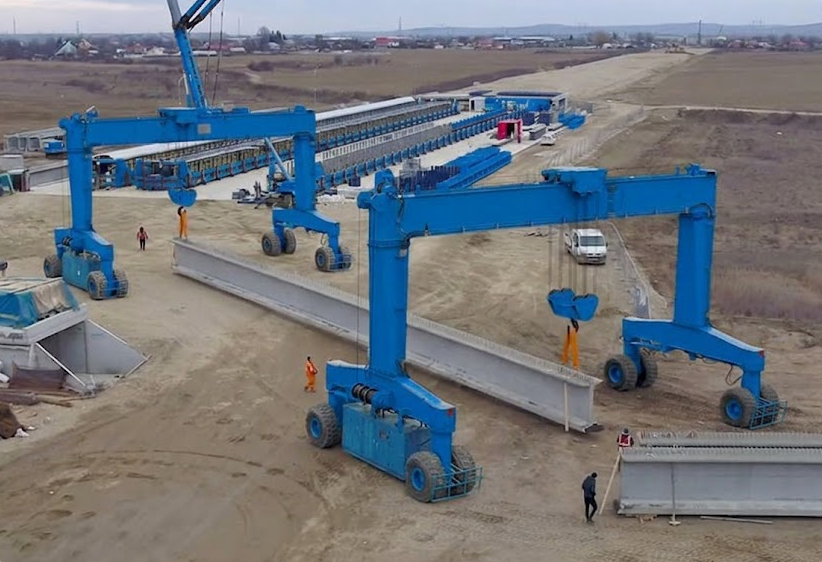 T frame rubber tyred gantry cranes , Tailored rubber tyred gantry crane for sale
Lifting components from casting beds or curing zones
The process usually starts at the production end, where fresh or cured concrete elements are ready for movement. At this stage, handling conditions are important because concrete strength and surface condition may vary depending on curing time.
- Precast beams are lifted directly from casting beds after initial curing
- Slabs and panels are removed from molds and moved for inspection or storage
- Tunnel segments are lifted in sequence to maintain production order
- Lifting points are carefully selected to avoid stress on weak zones
In many yards, this is the most sensitive part of the workflow because early handling errors can affect final product quality.
Transporting precast elements across yard areas
After lifting, the RTG crane moves the component across the yard to the next destination. This is where its mobility becomes practical.
- Movement between casting area and curing storage zones
- Transfer from temporary stacking to long-term storage areas
- Direct transport toward dispatch or loading points
- Coordination with yard traffic to avoid congestion
Unlike fixed systems, the crane does not require materials to be brought to it. It goes directly to the load, which reduces unnecessary handling steps.
Organizing stacking based on type and delivery schedule
Once materials are transported, they are placed into organized storage zones. This is not random stacking; it follows production planning and delivery sequencing.
- Beams are grouped by length, type, and project assignment
- Slabs are stacked with proper spacing to avoid surface pressure
- Tunnel segments are arranged in installation sequence
- High-priority orders are positioned closer to loading zones
This type of structured stacking helps reduce future re-handling and keeps dispatch operations more predictable.
Supporting loading operations for transport trucks
Loading is often a time-sensitive part of precast logistics. Delays here can affect transport schedules and on-site installation progress.
- Direct lifting from storage stacks to transport vehicles
- Precise alignment with trailer position for long beams
- Stable lowering to avoid impact damage during placement
- Coordination with truck arrival timing to reduce waiting time
Because RTG cranes can travel across the yard, loading does not need a dedicated fixed point, which improves flexibility during peak dispatch periods.
Repositioning materials based on production sequencing
Precast production plans often change depending on project progress. Orders may be adjusted, and priorities can shift quickly.
- Materials can be moved between storage zones when schedules change
- Older batches can be reorganized for earlier dispatch
- High-demand components can be repositioned closer to loading areas
- Yard layout can be adjusted without stopping production
This flexibility helps keep the yard responsive instead of locked into a fixed workflow pattern.
How this workflow improves overall yard efficiency
When all these steps are connected through a mobile RTG crane system, the yard operation becomes more continuous and less fragmented.
- Fewer intermediate handling steps between production stages
- Reduced waiting time for lifting and transport operations
- Smoother coordination between casting, storage, and dispatch
- Better control of heavy and oversized precast components
- More stable production rhythm during high-volume periods
In practice, the main improvement is not only speed, but also consistency. The workflow becomes easier to plan, easier to adjust, and more stable under changing production demands.
Safe Handling of Precast Concrete Elements
Precast concrete may look solid and strong once it has cured, but during lifting and transport it behaves differently. Long beams can flex slightly, thin slabs can crack at the edges, and uneven weight distribution can create internal stress that is not always visible immediately. For this reason, handling is not only about lifting capacity, but more about control, balance, and how the load is supported throughout the entire movement. In rubber tyred gantry crane operations, safety depends heavily on how the lifting arrangement is set up before the crane even starts moving.
Spreader beams to distribute load evenly
One of the most important tools in precast handling is the spreader beam. It is used to spread the lifting force across multiple points instead of concentrating it in one area.
- Reduces stress concentration on a single lifting point
- Helps maintain straight alignment of long beams during lifting
- Protects edges and corners from localized cracking
- Improves stability during transport across the yard
For long bridge girders or box beams, lifting directly from hooks without a spreader is rarely safe. The beam structure needs support along its length, not just at two ends.
Multi-point lifting for long beams and segments
For larger precast elements, especially those used in bridges and tunnels, a single lifting point is not enough. Multi-point lifting systems are used to keep the structure stable during hoisting.
- Lifting force is distributed across three, four, or more points
- Reduces bending stress in long structural elements
- Keeps segment alignment consistent during movement
- Prevents twisting during lifting and rotation
This method is commonly used for bridge girders and segmental box beams where length-to-thickness ratio is high.
Controlled acceleration and deceleration to minimize vibration
Even if the load is properly balanced, sudden movement can still cause internal stress. RTG crane operation is usually slow and controlled during key stages.
- Smooth start reduces sudden force impact on lifting points
- Gradual acceleration avoids swinging of long components
- Controlled braking prevents sudden load shift during transport
- Stable speed during movement keeps structure steady
Experienced operators avoid fast movement when handling newly cast or freshly cured components.
Balanced lifting and transport positioning
Before and during transport, the position of the load must remain stable. Even small tilts can create uneven stress across the concrete element.
- Load center must align with crane lifting point
- Long beams must remain level during travel
- Slabs should be kept flat to avoid edge stress
- Adjustments may be made before full lifting begins
This step is often checked twice—once before lifting and once after the load is slightly raised off the ground.
Proper rigging systems for irregular geometries
Not all precast elements have simple shapes. Some are curved, segmented, or include embedded structural features. These require customized rigging solutions.
- Adjustable sling positions for uneven weight distribution
- Special lifting frames for circular tunnel segments
- Custom clamps or fixtures for modular components
- Protective padding to avoid surface damage during contact
Without proper rigging, even a well-designed crane system cannot fully prevent damage during handling.
Why these methods matter in real precast operations
When all these safety measures are applied together, the handling process becomes more controlled and predictable. The goal is not only to move the concrete, but to preserve its structural integrity from production to installation.
- Reduces risk of surface cracking during lifting
- Prevents hidden internal stress in long components
- Improves consistency in repeated handling cycles
- Helps maintain quality before final installation on site
In precast yards, safe handling is not optional. It is part of the production process itself, especially when dealing with heavy bridge, tunnel, and infrastructure components.
Yard Layout and Workflow Optimization
In a precast concrete yard, the rubber tyred gantry crane can only perform well if the yard itself is arranged in a practical and logical way. The crane provides mobility, but the layout decides how smooth or how complicated that movement becomes. When zones are clearly planned, the crane spends more time handling loads and less time waiting, reversing, or adjusting position. Good yard design is not only about space, it is about how materials move from one stage to another without interruption.
Separation of casting, curing, storage, and dispatch zones
A precast yard usually works in stages, and each stage needs its own space. Mixing these areas together often leads to confusion and slower handling.
- Casting zone placed close to raw production molds for direct lifting after curing
- Curing area separated to avoid interference with active production
- Storage zone organized for medium or long-term stacking of finished components
- Dispatch zone positioned near road access for truck loading
Clear separation allows the RTG crane to follow a predictable route instead of constantly crossing mixed working areas.
Optimized travel lanes to reduce congestion
Since RTG cranes move across the yard on rubber tyres, the ground layout becomes part of the working system. Travel lanes must be wide enough and kept clear to avoid delays.
- Defined driving paths for heavy loaded movement
- Separate lanes for empty return trips when possible
- Avoiding crossing points between active production zones
- Ensuring enough turning space for long beam handling
Poor lane planning can easily create bottlenecks during peak lifting hours.
Dedicated stacking areas for different product types
Precast components are not all the same. Mixing them in one storage area can lead to re-handling, delays, or even damage during retrieval.
- Separate stacks for bridge beams, slabs, and tunnel segments
- Grouping by size, weight, and installation sequence
- Clear spacing between stacks for safe lifting access
- Organized layout to support fast identification during dispatch
Structured stacking reduces unnecessary repositioning and streamlines crane operation.
Shortened transport distances between production stages
Reducing the distance the crane travels between key zones improves operational efficiency.
- Casting area positioned closer to curing storage
- Storage zones placed between production and loading areas
- Dispatch point located at the edge of the yard for direct truck access
- Frequent-use materials stored in more accessible locations
Shorter travel distances reduce cycle time significantly, especially in high-output precast production.
Efficient truck loading and dispatch planning systems
Loading is often the final and most time-sensitive step in precast logistics. Proper planning prevents bottlenecks.
- Loading area designed for direct crane access without obstruction
- Trucks scheduled to match production output timing
- Pre-arranged stacking based on delivery sequence
- Clear waiting zones to avoid blocking crane movement
Aligned dispatch planning ensures a smooth and steady flow of materials.
Why yard layout directly affects RTG crane performance
Even a well-designed RTG crane cannot perform efficiently in a poorly arranged yard. Layout directly impacts flexibility and productivity.
- Better layout reduces unnecessary crane travel
- Clear zones improve lifting cycle speed
- Organized stacking reduces re-handling work
- Shorter paths increase daily handling capacity
A structured environment allows the RTG system to operate smoothly, especially when handling heavy bridge beams, slabs, and tunnel segments under continuous production demand.
RTG Crane vs Other Concrete Handling Systems
In precast concrete yards, equipment choice goes beyond lifting capacity. It also depends on yard layout, frequency of material movement, and operational flexibility. Different systems may lift concrete, but daily efficiency varies greatly. Rubber tyred gantry cranes often offer a balanced solution between fixed high-precision systems and highly mobile transport equipment.
Rail-mounted gantry cranes: high precision but limited flexibility
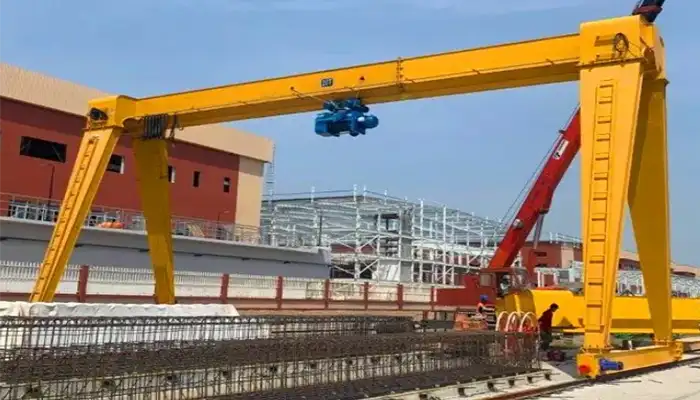 These rail travelling gantry crane cranes excel in fixed production environments with stable layouts. Accuracy is high, but movement is confined to rails.
- Very stable for repetitive lifting in a fixed working zone
- Suitable for standardized production lines with consistent product flow
- Limited adaptability to yard layout changes
- Requires civil work for rail installation and alignment
- Difficult to expand or modify once installed
In dynamic precast yards, this rigidity can limit operational flexibility.
Straddle carriers: strong for transport, less efficient for stacking
Straddle carriers move heavy elements over long distances but are less precise in stacking.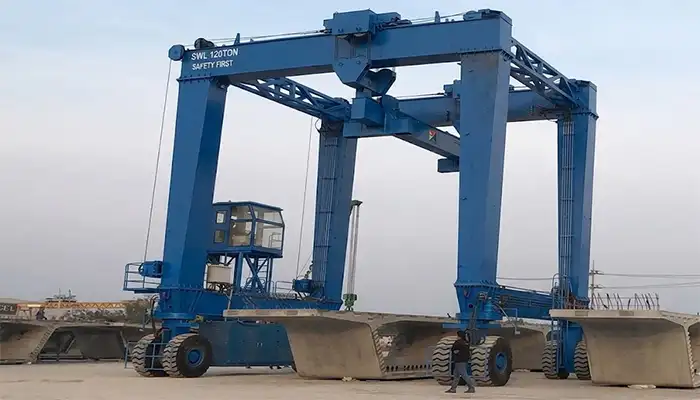
- Good for transporting heavy precast components across long yard distances
- Efficient for point-to-point movement between zones
- Less precise positioning for stacking
- Not ideal for high-accuracy vertical placement
- Often used alongside other lifting systems rather than alone
They are essentially transport units rather than comprehensive lifting solutions.
Forklifts and mobile cranes: limited capacity for heavy precast loads
These machines are flexible for small components but limited for heavy, long, or irregular precast elements.
- Suitable for smaller slabs and light precast components
- Easy to deploy without complex infrastructure
- Limited lifting height and capacity for heavy beams
- Higher risk when handling long or uneven elements
- Less stable for precision stacking of heavy segments
Best used as auxiliary machines rather than primary handling equipment in large-scale precast yards.
RTG cranes: balanced solution for lifting and yard mobility
Rubber tyred gantry cranes combine lifting strength with mobility, handling both movement and precise positioning tasks in one system.
- Lift heavy beams, slabs, and tunnel segments
- Move freely across working zones without rails
- Support precise stacking with controlled lowering
- Adapt to changing yard layouts and production demands
- Reduce dependence on multiple handling machines
This balance simplifies yard coordination, improves handling consistency, and allows a single crane system to cover both transport and lifting efficiently.
Engineering and Safety Considerations
In RTG crane operations for precast yards, long-term safety and stability depend on an integrated engineering approach. Ground condition, structural design, control systems, and routine maintenance work together to ensure consistent performance under heavy loads and changing outdoor conditions.
Reinforced ground structure for heavy wheel loads
RTG cranes transfer all load through rubber tires, making ground strength critical.
- Concrete pavement must withstand repeated heavy wheel pressure
- Subgrade compaction prevents long-term settlement
- Uneven ground causes crane tilt or uneven load distribution
- Reinforced travel lanes needed in high-traffic areas
Weak or uneven ground may not fail immediately but affects crane stability over time.
Anti-sway control systems for load stability
Long or heavy precast elements can swing during movement; anti-sway systems help maintain balance.
- Reduces swinging during starts and stops
- Improves stacking and positioning accuracy
- Maintains stability for long or uneven loads
- Protects product and surrounding structures
Critical when stacking at height or operating in narrow yard lanes.
Emergency braking and overload protection
Safety systems prevent incidents when lifting loads near crane capacity limits.
- Overload sensors prevent lifting beyond rated capacity
- Emergency brakes stop movement if control fails
- Limit switches control lift height and travel range
- Alarms alert operators to unsafe conditions
These features ensure daily operational safety, not just extreme cases.
Weather-resistant design for outdoor environments
Outdoor operation exposes cranes to wind, moisture, dust, and temperature changes.
- Wind load protection for large-surface elements
- Anti-corrosion treatment for structural steel
- Electrical systems protected against dust and moisture
- Stable operation under seasonal temperature changes
Daily exposure requires cranes to perform reliably in all weather conditions.
Regular inspection of tires, structure, and lifting systems
Continuous movement and heavy loads necessitate frequent maintenance checks.
- Inspect tire pressure and surface condition
- Check structural connections for fatigue or deformation
- Regularly examine wire ropes, hooks, and hoisting systems
- Schedule hydraulic and electrical system maintenance
Routine inspections maintain lifting precision and long-term reliability.
Why engineering and safety must work together
Stable operation comes from integrating design, controls, protection, and maintenance.
- Strong ground ensures consistent movement
- Control systems reduce risks during dynamic lifting
- Protection systems prevent overload and operational errors
- Maintenance ensures long-term reliability under repeated use
When aligned, these elements allow RTG cranes to handle heavy precast components safely and predictably over extended periods.
Questions Solved Here
This guide addresses practical planning and operational questions for engineers, buyers, and contractors when designing or upgrading precast yards. The focus is on keeping material flow stable from casting to installation using RTG cranes.
How does a rubber tyred gantry crane improve precast concrete handling efficiency?
RTG cranes allow precast beams, tunnel segments, and metro components to move freely across yard zones without rail constraints.
- Reduces waiting time between casting, storage, and loading for continuous production
- Supports flexible workflow in mixed-product or changing yard layouts
When should RTG cranes be used instead of rail-mounted gantry systems?
RTG cranes are ideal when yards require cross-zone movement, frequent layout changes, or flexible expansion without fixed rails.
- Rail-mounted systems suit fixed linear layouts; RTG cranes suit mixed or expanding projects
- Enables flexible yard planning and future expansion
How can heavy precast beams and segments be lifted without cracking or damage?
Safe lifting depends on balanced loads, proper lifting points, and smooth crane motion during transport and placement.
- Controlled movement and correct rigging are more important than crane capacity alone
- Multi-point lifting and spreader beams protect structural integrity of long or heavy elements
What crane capacity, span, and configuration fit different precast yard layouts?
Selection depends on maximum precast weight, yard width, and distance between casting, storage, and loading zones.
- The correct configuration ensures full yard coverage without unreachable areas or inefficient travel paths
- Matching crane span and capacity to workflow reduces unnecessary repositioning
How does RTG mobility improve yard planning and material flow?
RTG mobility allows yard design to follow workflow needs instead of fixed lifting points, improving material flow between all stages.
- Reduces congestion and waiting times across casting, storage, and transport
- Enables flexible adjustment to production changes and layout modifications
What are the real industrial applications and project environments for RTG cranes?
RTG cranes are widely used in bridge beam yards, tunnel segment production bases, and metro precast facilities requiring continuous handling of large volumes of components.
- Different projects have unique load types, space limitations, and production rhythms, but all require stable material flow
- Flexible crane operation simplifies coordination in complex yard layouts
What safety systems are required for outdoor precast lifting operations?
Outdoor lifting requires anti-sway control, overload protection, stable braking, and clear separation between crane and transport zones.
- Essential due to wind exposure, heavy loads, and repetitive lifting cycles
- Prevents structural stress and maintains operational safety under all conditions
How can yard layout design reduce congestion and improve productivity?
Clear separation of casting, storage, and loading zones with direct crane access minimizes congestion and improves workflow.
- Reduces unnecessary crane travel and re-handling
- Prevents blocking between production stages and supports predictable material flow
Conclusion
Rubber tyred gantry cranes are a core handling solution for modern precast concrete yards and large infrastructure projects, offering the flexibility to move heavy beams, slabs, and segmental structures efficiently across wide outdoor production areas.
By combining mobility, high lifting capacity, and adaptable yard integration, RTG cranes improve production flow, reduce material damage risk, and optimize space utilization in precast manufacturing environments.
For successful implementation, the most critical factor is aligning crane capacity, yard layout, and handling workflow with real production demands to ensure safe, efficient, and scalable operations in both industrial and infrastructure applications.

Article by Bella ,who has been in the hoist and crane field since 2016. Bella provides overhead crane & gantry crane consultation services for clients who need a customized overhead travelling crane solution.Contact her to get free consultation.
Yuantai Cranes
Overhead Crane Manufacturer with CE, ISO, SGS, CNEX Certificates.
- Main Specifications - Capacity: 0.5–550 tons | Span: up to 40m | Speed: 0.8–12 m/min | Duty: A3–A7 | Power: 380–690V, 50/60Hz | Control: pendant/remote/cabin
- Full engineering: FEA/PLC/VFD + in-house build + global delivery + on-site support, for workshops, factories, EPC contractors, industrial projects, etc.
- Support: design, manufacturing, testing, service – end-to-end, customized lifting solutions worldwide.
How to Get an Accurate Crane Price for Your Application?
Tips: Copy the spec list, fill in your details, and paste it into the form on the right/ down-below for a quick price.
- Crane type:_____ . (e.g., overhead crane, gantry crane, jib crane)
- Max weight to lift:_____ tons. (e.g., 2t, 5t, 10t, 20t, 50t)
- Lifting height:_____ m. (How high does the hook need to reach?
- Workshop width (span):_____ m . (Distance between the two crane rails)
- Travel distance:_____ m . (How long does the crane need to move along the runway?)
- Control type:_____. (Pendant / remote / cabin Control)
- Power supply:_____. (Local voltage & frequency – e.g., 380V, 50Hz, 3-phase)
- What will it be used for?_____ (e.g., steel fabrication, concrete products, mold handling, general manufacturing, etc.)
- Any special requirements?_____ (e.g., extreme temperature, dusty or explosive environment, special paint color, etc.)
Just leave a message via the contact form and our hoist and crane engineer will contact you with in 24working hours.
Get Your Custom Quote–Quick & Easy
Fill in what you know. Skip what you don't – we'll help.Any question will be reply with 24 working hours