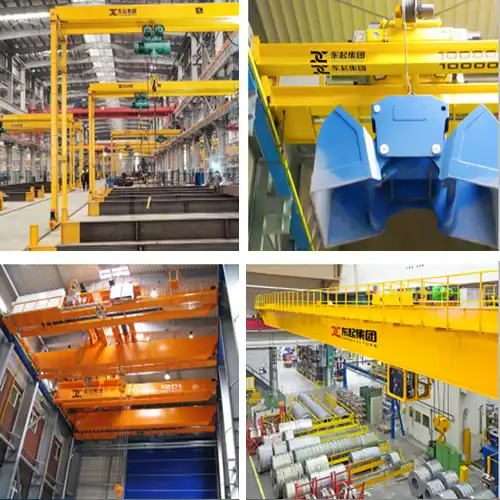
Industrial Overhead Crane Project Case Guide- Performance List
Comprehensive overhead crane project guide across steel mills, wind power, foundry, and heavy industry with industrial 2T–200T applications.
| Crane Type | Tailored overhead cranes, gantry cranes and jib cranes for various industrial sectors. - Industrial overhead/EOT or gantry crane; single- or double-girder; wire rope hoist or open winch; ISO A3–A8 / FEM 1Am–5M; 380/400/415V, 50Hz, 3Ph; |
| Crane Capacity | 3 ton to 320 Ton capacity selected according to the maximum load, lifting attachment weight, handling cycle, and project requirements. |
| Span Length | 7.5–35 m+; customized according to workshop dimensions, yard layout, runway length, and required coverage. |
| Lifting Height | 6–30 m+; customized according to building height, equipment dimensions, storage requirements, and lifting path. |
| Coverage Area Type | Production bays, workshops, steel yards, warehouses, assembly areas, maintenance bays, fabrication zones, loading areas, storage yards, and large industrial work areas. |
| Application | Steel mills, wind power manufacturing, power plants, energy projects, fabrication, machinery manufacturing, shipyards, mining, warehouses, logistics, and heavy industrial material handling. |
| Certifications | CE / ISO / SGS / Other third-party inspection |
| Customization | Customized single- or double-girder structure, overhead/EOT or gantry crane, wire rope hoist or open winch,pendant/radio/cabin control, C-hook, clamp, magnet, grab, spreader beam, ladle hook, positioning, weighing, anti-collision, and automation systems |
Crane Manufacturer: Yuantai Cranes – 30+ Years Professional Crane Manufacturer from China
Category: Featured
Tags:
Your Trusted Industrial Overhead Crane Manufacturer & Supplier
Overhead Cranes & Gantry Crane Projects Performance List-Yuantai Crane
Industrial Overhead Crane Project Case Study Guide for Steel Mills, Wind Power, Energy & Heavy Industry Applications
Comprehensive overhead crane project guide across steel mills, wind power, foundry, and heavy industry with industrial 2T–200T applications.
MOST IMPORTANT TAKEAWAY
Industrial crane selection is not only about tonnage or price — it is about proven application experience in similar industries, working conditions, and duty cycles.
This guide helps buyers understand how industrial crane projects across steel, wind power, nuclear, and manufacturing industries can be used to:
- Reduce procurement risk
- Select the right crane type and capacity
- Compare European vs standard crane designs
- Evaluate supplier engineering capability
- Understand industrial-world crane applications from 2 ton to 200 ton+
- Identify suitable crane solutions based on industry and working condition
FAQ
Common questions and answers for overhead crane buyers and industrial applications.
How do I choose the right overhead crane for my factory?
You need to match the crane with real working conditions in your workshop, including load type, lifting frequency, span, and production flow. In practice, buyers usually rely on similar industrial project references (steel, machinery, wind power, etc.) to avoid mismatched configurations.
What type of crane is used in steel mills and foundries?
Steel mills and foundries typically use YZ foundry cranes, QD heavy-duty double girder cranes, and high-temperature resistant overhead cranes. These are designed for continuous operation, high heat exposure, and molten metal handling.
What crane capacity is required for wind power manufacturing?
Wind power projects commonly require 100t–200t+ overhead cranes, including dual-hoist and synchronized lifting systems. Capacity depends on whether the application involves tower sections, nacelles, or complete assembly operations.
What is the difference between European and standard overhead cranes?
European cranes focus on compact structure, lower building height requirements, smoother operation, and higher precision control. Standard cranes are more cost-effective, easier to maintain, and widely used in traditional industrial plants.
How do span and duty class affect crane performance?
Span affects structural stability and workshop coverage, while duty class defines how frequently and heavily the crane operates. Larger spans require stronger deflection control, and higher duty classes ensure longer service life in continuous production.
Which crane type is suitable for heavy lifting environments?
Heavy lifting environments such as steel mills, machinery plants, and fabrication yards typically use QD double girder cranes, MG gantry cranes, and high-capacity foundry cranes depending on indoor or outdoor conditions.
What industries require intelligent or automated cranes?
Intelligent crane systems are widely used in steel production, wind power manufacturing, large equipment assembly, and modern fabrication plants where anti-sway control, remote operation, and monitoring systems improve safety and efficiency.
How do I evaluate crane manufacturers using industrial project references?
Buyers should check whether the supplier has delivered cranes in the same industry, similar capacity range, and comparable working conditions. Real project references are more reliable than product specifications alone.
What crane configuration fits my workshop layout?
The correct configuration depends on workshop height, span, production flow, and lifting path. European cranes are often used for compact or low-headroom workshops, while standard or heavy-duty cranes suit larger industrial spaces.
How do I reduce risk when selecting a crane supplier?
Risk is reduced by verifying real project experience, matching industry application cases, checking duty classification suitability, and confirming whether the supplier has delivered batch or large-scale projects in similar environments.
INTRODUCTION
Why Real Overhead Crane Project Experience Matters in Industrial Procurement
Why Real Overhead Crane Project Experience Matters in Industrial Procurement
In overhead crane procurement for steel plants, manufacturing workshops, wind power factories, and heavy industry projects, buyers usually already understand the basic specifications such as lifting capacity, crane span, and workshop height.
But in industrial purchasing decisions, these technical parameters are not the only focus. Buyers often ask a more practical question first: has this overhead crane supplier completed similar industrial crane projects before?
This is because an industrial overhead crane does not operate in a controlled environment. It works in steel mill production lines, foundry workshops with high temperature, heavy steel handling areas, and continuous manufacturing operations. These conditions directly affect crane performance, service life, and safety.
That is why overhead crane project references are widely used by buyers when evaluating suppliers of:
- Steel mill overhead cranes
- Foundry overhead cranes
- Wind power workshop cranes
- Heavy duty double girder bridge cranes
- European type overhead cranes
- Intelligent overhead crane systems
A crane that works well in a light workshop may not perform the same in a 100 ton steel handling environment. So buyers prefer suppliers with proven industrial overhead crane application experience.
In many industrial procurement processes, especially for 75 ton, 100 ton, 150 ton, or 200 ton overhead cranes, project experience becomes one of the key decision factors before technical comparison even starts.
- Industrial buyers trust industrial overhead crane project cases more than catalog specifications or marketing descriptions
- Overhead crane performance depends on industrial working conditions such as duty class, temperature, and operation frequency
- Steel mill cranes, wind power cranes, and manufacturing cranes require different structural and engineering designs
- Foundry overhead cranes must handle high temperature molten metal environments with continuous operation
- Previous overhead crane installation projects help confirm engineering capability and manufacturing reliability
In practical industrial projects, this evaluation step often determines whether the discussion continues to technical proposal stage or stops at inquiry stage. It is a simple but very common decision process in overhead crane procurement for heavy industry applications.
What This Industrial Overhead Crane Project Guide Covers
This guide is based on industrial overhead crane project references across multiple industries, including steel production, wind power manufacturing, nuclear equipment, heavy machinery factories, infrastructure projects, and general industrial workshops.
The purpose is not only to show past overhead crane supply records, but to help buyers understand how different industrial overhead crane solutions are selected based on industrial working conditions.
This guide covers:
- Overhead crane applications in steel mills, steel structure workshops, foundries, wind power plants, and heavy manufacturing industries
- Real overhead crane capacity range from light duty 2 ton workshop cranes to ultra-heavy duty 200 ton bridge cranes
- Common industrial overhead crane types including QD double girder overhead crane, QDX European overhead crane, YZ foundry crane, MG gantry crane, HD single girder crane, LH electric hoist crane, and intelligent overhead crane systems
- Practical overhead crane selection logic based on workshop layout, crane span, lifting height, duty classification, and production flow requirements
- Engineering considerations in overhead crane design such as long span structure stability, heavy load handling, and continuous operation performance
In industrial crane projects, these factors are always connected. For example, selecting a 100 ton overhead crane for a steel mill workshop is not only based on lifting capacity, but also on:
- High temperature steel handling conditions
- Continuous duty operation requirements
- Steel coil or ladle movement patterns
- Workshop span and rail system design
This is the same in wind power manufacturing overhead crane projects, where 125 ton to 200 ton cranes are selected based on large component handling, long span workshop structures, and synchronized lifting requirements.
We also explain how different overhead crane types are used in industrial environments:
- QD and QDX overhead cranes for general heavy industry, steel fabrication, and machinery manufacturing workshops
- YZ foundry overhead cranes for molten steel handling and high temperature foundry environments
- MG gantry cranes for outdoor yard operations, shipyard lifting, and infrastructure construction sites
- HD and LH overhead cranes for medium duty industrial production lines and assembly workshops
- Intelligent overhead crane systems for automated material handling, anti-sway control, and precision lifting in modern factories
The goal of this guide is to help industrial crane buyers match industrial overhead crane applications with actual workshop requirements, instead of selecting equipment only based on specifications or price. In industrial overhead crane procurement for steel mills, wind power plants, and heavy industrial factories, this practical matching process is what helps avoid incorrect selection and future operational issues.
Your Trusted Industrial Crane Manufacturer & Supplier
Tailored Industrial Overhead Cranes and Gantry Cranes for Your Needs
Selectred Overhead Cranes and Gantry Crane Project Performance List
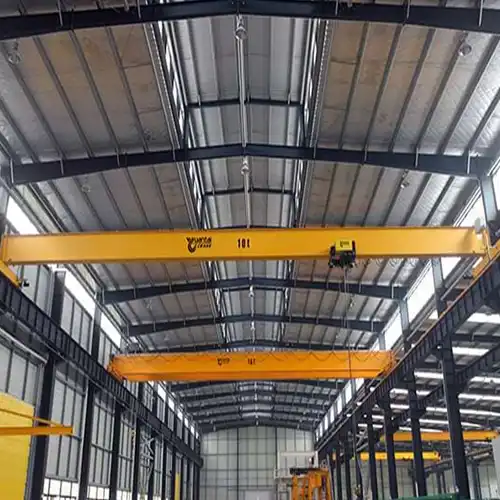
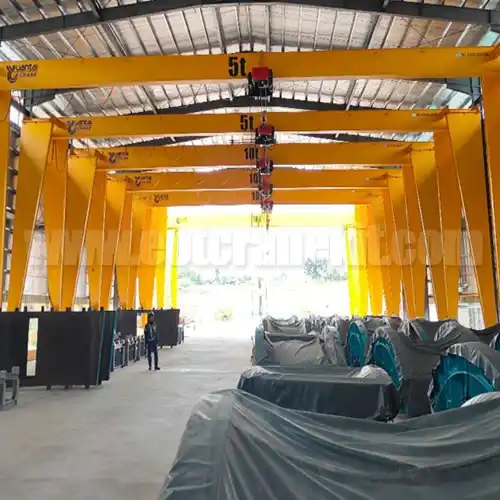
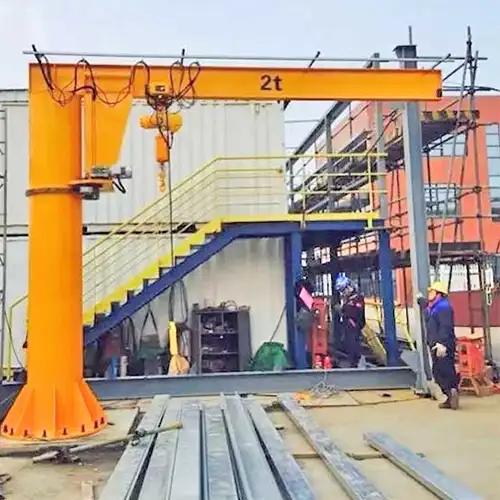
| Company (Masked) | Industrial Sector | Quantity | Crane Type | Model / Capacity | Span |
|---|---|---|---|---|---|
| L**** Intelligent Equipment Co., Ltd. | Intelligent Equipment Manufacturing | 1 set | European-style double girder overhead crane | QD 100/10/3t | 15.553m |
| L**** Intelligent Equipment Co., Ltd. | Intelligent Equipment Manufacturing | 1 set | European-style double girder overhead crane | QD 100/10/3t | 22.163m |
| H******* Crane Equipment Sales Co., Ltd. | Crane Equipment / Material Handling | 1 set | European-style double girder overhead crane | QDX 100/20t | 25m |
| Z**** Nuclear Power Equipment Co., Ltd. | Nuclear Power Equipment | 2 sets | European-style double girder overhead crane | QEX 100 (100+32)/10t | 31m |
| Z**** Nuclear Power Equipment Co., Ltd. | Nuclear Power Equipment | 1 set | European-style double girder overhead crane | QDX 100/32/10t | 31m |
| X******** Special Steel Co., Ltd. | Steel / Metallurgy | 2 sets | Foundry overhead crane | YZ 90/50t | 30.5m |
| B******* Special Steel Co., Ltd. | Steel / Metallurgy | 2 sets | Foundry overhead crane | YZ 80/20t | 22.5m |
| Iron & Steel Co., Ltd. | Steel / Metallurgy | 2 sets | Standard double girder overhead crane | QD 80/20t | 28m |
| L**** Intelligent Equipment Co., Ltd. | Intelligent Equipment Manufacturing | 1 set | European-style double girder overhead crane | QDX 80/10t | 28.7m |
| L**** Intelligent Equipment Co., Ltd. | Intelligent Equipment Manufacturing | 1 set | European-style double girder overhead crane | QDX 80/10t | 20.9m |
| L**** Intelligent Equipment Co., Ltd. | Intelligent Equipment Manufacturing | 1 set | European-style double girder overhead crane | QDX 80/10t | 14.9275m |
| Z******** New Energy Technology Co., Ltd. | New Energy / Energy Storage | 1 set | European-style electric double girder overhead crane | QDX 80/60t | 26.5m |
| Q******* Steel Co., Ltd. | Steel / Metallurgy | 2 sets | Foundry overhead crane | YZ 75/20t | 19.5m |
| F***** Steel Co., Ltd. | Steel / Metallurgy | 1 set | Foundry overhead crane | YZ 75/20t | 25.5m |
| S****** Steel Co., Ltd. | Steel / Metallurgy | 3 sets | Foundry overhead crane | YZ 75/20t | 16.5m |
| S****** Steel Co., Ltd. | Steel / Metallurgy | 4 sets | Foundry overhead crane | YZ 75/20t | 27m |
| Iron & Steel Co., Ltd. | Steel / Metallurgy | 1 set | Standard double girder overhead crane | QD 75/20t | 31m |
| Iron & Steel Co., Ltd. | Steel / Metallurgy | 1 set | European-style double girder overhead crane | QDX 75/25/10t | 33m |
| J****** Industrial Co., Ltd. | Heavy Industry Manufacturing | 1 set | European-style double girder overhead crane | QDX 75/20t | 22.5m |
| B****** Building Materials Industry Group Co., Ltd. | Building Materials / Cement | 1 set | Standard double girder overhead crane | QD 75/20t | 34m |
| Y******* Financial Leasing (Shenzhen) Co., Ltd. | Financial Leasing / Industrial Investment | 2 sets | Standard double girder overhead crane | QD 75/25t | 26.5m |
| L******** Pipeline Engineering Co., Ltd. | Pipeline / Infrastructure Engineering | 4 sets | Standard double girder overhead crane | QD 75/20t | 28.5m |
| X****** Coal Industry Co., Ltd. | Coal / Mining | 1 set | General overhead crane | QX 75/20t | 19.2m |
| X****** Tunnel Equipment Co., Ltd. | Tunnel Equipment / Infrastructure | 4 sets | Fully intelligent European double girder overhead crane | ZNQEX500 (250/16 + 250) | 28m |
| X****** Tunnel Equipment Co., Ltd. | Tunnel Equipment / Infrastructure | 4 sets | Fully intelligent European double girder overhead crane | ZNQEX300 (150 + 150/16t) | 28m |
| F****** Cryogenic Equipment Co., Ltd. | Cryogenic Equipment Manufacturing | 1 set | Electric double girder overhead crane | QD 200/50t | 22m |
| Y****** Chemical Machinery (Group) Co., Ltd. | Chemical Machinery | 1 set | European double girder bridge crane | QD 200/50t | 28m |
| M******* Technology New Energy Co., Ltd. | Wind Power / New Energy | 1 set | Double girder overhead crane | QD 200/100t | 39.5m |
| M******* New Energy Technology Co., Ltd. | Wind Power / New Energy | 1 set | Double girder overhead crane | QD 200/100t | 39.5m |
| M******* New Energy Technology Co., Ltd. | Wind Power / New Energy | 1 set | Double girder overhead crane | QD 200/100t | 39.5m |
| L******* Special Transformer Co., Ltd. | Transformer / Power Equipment | 1 set | Double main girder gantry crane | MG 160/32t | 16m |
| E******* Wind Power Equipment Co., Ltd. | Wind Power Equipment Manufacturing | 2 sets | General overhead crane | QEX 150t + 150t | 33.5m |
| C*** Wind Power | Wind Power / Renewable Energy | 1 set | General gantry crane | MG 150/20t | 18m |
| Y******* Automotive Parts Co., Ltd. | Automotive Parts Manufacturing | 1 set | European electric double girder overhead crane | QDXX 150/60t | 32.6m |
| Z******* Crane Equipment Co., Ltd. | Crane Equipment Manufacturing | 1 set | European double girder gantry crane | MG 125/32+2t | 38.6m |
| China First Heavy Industries Heavy Industry Co., Ltd. | Heavy Machinery Manufacturing | 1 set | Double girder gantry crane | MG 120t | 13.9m |
| F******** Liancheng Heavy Machinery Group Co., Ltd. | Heavy Machinery / Foundry | 1 set | Foundry overhead crane | YZ 100/30t | 16.5m |
| R****** Foundry Co., Ltd. | Foundry / Casting | 3 sets | Standard double girder overhead crane | QD 100/50t | 28.5m |
| A****** Heavy Industry Machinery Co., Ltd. | Heavy Industry Machinery | 1 set | European-style double girder overhead crane | QDX 100/20t | 22.5m |
| Y****** Chemical Machinery Co., Ltd. | Chemical Machinery | 3 sets | European-style double girder overhead crane | QDX 100/20t | 28m |
| F****** Chemical Equipment Co., Ltd. | Chemical Equipment Manufacturing | 2 sets | European-style double girder overhead crane | QDX 100/20t | 32m |
| Y****** Supply Chain Management Co., Ltd. | Supply Chain / Logistics | 1 set | General gantry crane | MG 100t | 11.5m |
| Shenhua Materials Co., Ltd. | Industrial Materials | 1 set | General gantry crane | MG 100/20t | 18m |
| H***** Technology Co., Ltd. | Technology Manufacturing | 1 set | Standard double girder overhead crane | QD 100/20t | 23.5m |
| M******* Smart Energy Co., Ltd. | Smart Energy / Wind Power | 1 set | Double girder overhead crane | QD 75/35t | 31m |
| M******* Smart Energy Co., Ltd. | Smart Energy / Wind Power | 16 sets | Double girder overhead crane | QD 40t | 39.8m |
| MCC South Engineering Technology Co., Ltd. | Metallurgical Engineering | 1 set | Double girder bridge crane | QDX 75/20t | 14.5m |
| Luoyang Crane Factory Co., Ltd. | Crane Manufacturing | 1 set | European-style double girder overhead crane | QDX 75/20t | 22.5m |
| DMC Stamping Technology Co., Ltd. | Automotive Stamping / Manufacturing | 6 sets | European double girder overhead crane | QDX 32/10t | 25.5m |
| J**** Metal Co., Ltd. | Metal Processing | 5 sets | Standard double girder overhead crane | QD 32/5t | 22.5m |
| Sunsea Cable Co., Ltd. | Cable Manufacturing | 8 sets | European double girder overhead crane | QDX 32/5t | 28.5m |
| W******* New Materials Co., Ltd. | New Materials Manufacturing | 8 sets | European double girder overhead crane | QDX 25/5t | 22.5m |
| Z******* Green Construction Technology Co., Ltd. | Green Construction / Steel Structure | 11 sets | European double girder overhead crane | QDX 20/5t | 25.5m |
| B****** Heavy Industry Co., Ltd. | Heavy Industry Manufacturing | 10 sets | Electric hoist double girder overhead crane | LH 20/10 | 26.5m |
| R****** Rubber Products Co., Ltd. | Rubber Products Manufacturing | 8 sets | European electric single girder crane | HD 16t | 27.9m |
| Z******** Environmental Industry Co., Ltd. | Environmental Equipment Manufacturing | 6 sets | European electric single girder crane | HD 5t | 22.5m |
| Huanghelou Liquor Co., Ltd. | Food & Beverage / Liquor | 26 sets | European double girder overhead crane | QDX 5t | 16.5m |
| H****** Aviation Technology Co., Ltd. | Aviation / Aerospace Manufacturing | 5 sets | European electric single girder crane | HD 5t | 19.5m |
| A******** Precision Machinery Research Institute | Aerospace / Precision Machinery | 6 sets | European single girder crane | HD 5t | 22.5m |
| China National Technical Import & Export Corporation | International Trade / Industrial Equipment | 8 sets | European single girder crane | HD 5t | 12m |
| China Railway 11th Bureau H****** Heavy Industry Co., Ltd. | Railway Heavy Industry | 5 sets | Standard electric single girder crane | LDA 2t | 10.5m |
| X******* Mechanical Technology Co., Ltd. | Mechanical Equipment Manufacturing | 16 sets | Wall-mounted jib crane | BB 2t | 5m |
| C******* Crane Machinery Co., Ltd. | Crane Machinery Manufacturing | 6 sets | European single girder overhead crane | HD 2t | 10m |
Why Industrial Buyers Rely on Overhead Crane Project Case Studies
Understanding the importance of project references in industrial overhead crane procurement
Why Industrial Buyers Check Project References First
When industrial buyers look for an overhead crane for a steel mill, wind power workshop, heavy manufacturing plant, or fabrication yard, they usually do not start with price or product brochures. The first thing many buyers check is simple: where has this crane been used before, and in what kind of factory?
From a buyer's point of view, this is not theory. It is risk control. A crane may look suitable in specifications, but what matters is whether it has already worked in a similar production environment. That is why overhead crane project references are often used as a first filter before technical discussion even begins.
For buyers, project cases are not marketing material. They are proof of industrial performance.
Reducing Risk Before Investment
For a buyer, purchasing an overhead crane is a long-term decision. Once installed, it becomes part of daily production. Any mismatch in design can affect output, safety, and maintenance cost for years.
That is why experienced buyers carefully check whether the supplier has delivered similar overhead crane projects in similar industries and working conditions.
From the buyer's side, the benefit is very direct:
- It helps avoid choosing an overhead crane that does not fit the actual workshop layout or lifting flow
- It confirms whether the crane design matches industrial conditions such as span, lifting height, and load distribution
- It shows whether the supplier has industrial experience in steel mills, foundries, wind power plants, or heavy fabrication workshops
- It reduces the risk of selecting a crane that looks correct on paper but performs poorly after installation
This is especially important in medium and heavy duty overhead crane projects like 50 ton, 75 ton, 100 ton, and 200 ton systems, where a wrong choice is expensive to fix later.
From a buyer's perspective, checking project cases early saves time, reduces uncertainty, and avoids redesign later in the process.
Confirming Real Engineering Ability of the Supplier
Buyers also use project references to understand something more important than specifications: can this supplier industrially handle complex industrial crane engineering?
A supplier may claim advanced design capability, but industrial delivered projects show whether that capability is proven.
From a buyer's view, they usually look for evidence such as:
- Experience in large-span overhead crane projects for wide workshops and long production halls
- Ability to design heavy load systems for steel mills, foundries, and continuous production environments
- Successful delivery of intelligent overhead crane systems with features like anti-sway control and synchronized lifting
- Capability to supply multiple cranes for large factories or full production lines, not just single units
This matters because a single crane project is very different from a full workshop crane system. Buyers want to know whether the supplier can handle complete industrial overhead crane solutions, not only isolated equipment orders.
For many industrial buyers, seeing similar past projects gives confidence that the engineering approach is already tested in industrial conditions.
Understanding How the Crane Performs in Real Production
Even when a crane meets all technical requirements, buyers still want to know one thing: how does it actually perform in daily operation?
Project cases help answer this in a practical way.
From a buyer's perspective, the key concerns are usually:
- Whether the overhead crane can run continuously in multi-shift production environments without frequent interruption
- How easy it is to maintain key parts such as hoists, motors, brakes, and electrical systems
- Whether the crane remains stable and safe in harsh conditions such as high temperature, dust, or heavy load cycling
- How the crane performs after long-term use, not just during initial commissioning
In industrial production, these factors often matter more than theoretical design details. A crane that runs smoothly with low downtime is more valuable than a system that only looks strong in technical documents.
This is why buyers pay close attention to overhead crane project case studies from steel, wind power, nuclear, and heavy manufacturing industries before making final purchasing decisions. It helps them understand not only what the crane is, but how it behaves in industrial production environments.
Your Trusted Manufacturer & Supplier
Tailored Overhead Cranes & Gantry Cranes for Industrial Uses
Industrial Overhead Crane Application Sectors
From an industrial buyer’s point of view, this section is not just a classification of industries. It is more about matching industrial overhead crane applications with industrial production problems.
When buyers evaluate a steel mill or foundry crane solution, they are usually thinking in a very practical way: “Will this crane survive our working condition and daily production load?”
That is why steel, metallurgy, and foundry projects are often treated as the most demanding reference cases in overhead crane procurement
Steel Mills, Foundries & Metallurgy Industry Overhead Crane Projects
Industrial project references for buyers in steel, foundry, and metallurgy workshops
Project Overview and Application Areas
From a buyer's perspective, these projects show what kinds of overhead cranes are already running in industrial steel mills, foundries, and metallurgy workshops. The focus is not only capacity, but also whether similar working conditions have been successfully handled before.
| Application Area | Overhead Crane Type | Capacity Configuration | Typical Span | Key Usage in Production |
|---|---|---|---|---|
| Steel melting & ladle handling | YZ Foundry Overhead Crane | 75/20t, 90/50t, 100/50t | 19.5m–30.5m | Molten steel transfer between furnace and casting line |
| Steel mill general lifting | QD Double Girder Overhead Crane | 75t–80/20t | 28m–31m | Steel coil, billet, and general heavy material handling |
| Continuous casting workshop | Heavy Duty QD Crane | 80/20t–100/20t | 22.5m–28.5m | Billet movement and casting line support operations |
| Foundry production line | YZ Foundry Crane | 75/20t–100/30t | 16.5m–25.5m | High-temperature molten metal lifting and pouring support |
| Iron & steel integrated plants | QDX European Double Girder Crane | 75/25/10t | 33m–34m | Precision lifting with improved control and smoother operation |
| Heavy steel processing workshop | Standard QD Crane | 75/20t | 31m–34m | Scrap handling and heavy fabrication lifting |
| Steel structure fabrication yard | QD Double Girder Crane | 75/20t | 22.5m–28.5m | Steel beam, plate, and structural component handling |
| Metallurgy auxiliary workshop | General Overhead Crane (QX series) | 75/20t | 19.2m | Auxiliary lifting and maintenance operations |
Buyer-Oriented Insight
From industrial project applications, steel and metallurgy overhead cranes are mainly selected based on:
- Whether the crane can handle continuous high-temperature operation
- Whether similar 75 ton, 80 ton, 100 ton foundry crane cases already exist
- Whether the structure is suitable for heavy-duty steel mill workflow
- Whether the supplier has delivered cranes for molten metal handling environments
- Whether span and duty class match industrial workshop layout
In industrial procurement, buyers usually compare these project references first before moving into detailed technical specification review.
Steel Mills, Foundries & Metallurgy Industry Cranes
In steel plants and foundries, overhead cranes are not supporting equipment. They are part of the core production flow. If the crane stops, production often stops as well.
From a buyer's perspective, the first concern is not only lifting capacity. It is whether the crane can handle high temperature, continuous operation, and heavy molten material handling safely over time.
Typical overhead crane applications in this sector include:
- Molten steel ladle handling between furnaces and casting stations
- Billet and slab transportation inside rolling mill workshops
- Furnace charging and discharging operations in steel production lines
- Scrap handling and metal charging before melting and refining processes
These are not light or occasional lifting tasks. They are continuous, high-risk operations where stability and safety matter more than anything else.
Crane Types Used in Real Steel and Foundry Projects
In actual steel mill and foundry overhead crane projects, buyers usually see several established crane configurations being used repeatedly. This gives confidence that the design has already been proven in similar conditions.
Common overhead crane types include:
- YZ foundry overhead cranes for molten metal and high-temperature environments
- QD heavy-duty double girder overhead cranes for general steel production and material handling
- High-temperature resistant crane systems designed for continuous exposure to heat and dust
From a buyer's side, the key point is not the model name itself, but whether the crane structure is suitable for steel plant duty conditions and continuous industrial operation.
Capacity Range in Steel Mill Crane Projects
In industrial steel mill and metallurgy projects, overhead crane capacity is usually selected based on production scale and material weight flow, not only single lifting points.
Common observed configurations include:
- 20 ton to 100 ton+ overhead crane systems for general steel production workshops
- 75/20 ton dual hook configurations for ladle handling and flexible lifting operations
- 90/50 ton heavy duty cranes used in high-capacity foundry and steel casting environments
From a buyer's perspective, higher capacity is not always better. The key is whether the crane capacity matches the industrial material flow and production rhythm of the steel plant.
Key Engineering Requirements in Steel and Foundry Cranes
For buyers in steel mills and foundries, technical specifications are important, but engineering reliability under industrial working conditions is even more critical.
When evaluating overhead crane solutions for this sector, buyers usually focus on:
- High heat resistance design to handle molten steel radiation and furnace proximity
- Heavy duty FEM classification suitable for continuous and intensive operation cycles
- Redundant braking systems to ensure safety during heavy load lifting and emergency conditions
- Anti-thermal radiation protection for electrical components and structural parts
- Continuous operation capability for multi-shift steel production environments
In practical terms, these requirements are not optional. They directly affect whether the overhead crane can remain stable and safe in long-term steel mill operation.
For many buyers, seeing similar steel mill overhead crane project references is often the most convincing proof that these conditions have already been successfully handled in industrial use.
Wind Power & Renewable Energy Industry Overhead Cranes
From a buyer's point of view, wind power manufacturing is one of the most demanding applications for overhead cranes. The equipment is not only lifting heavy parts, but also handling long, oversized components that require stability, precision, and controlled movement over large spans. In industrial procurement cases, buyers in wind turbine factories and renewable energy equipment plants usually focus on whether the supplier has already delivered large capacity overhead crane systems for similar wind power assembly workshops.
Steel Mills, Foundries & Metallurgy Industry Overhead Crane Projects (Performance Table)
From a buyer's perspective, these projects show what kinds of overhead cranes are already running in industrial steel mills, foundries, and metallurgy workshops. The focus is not only capacity, but also whether similar working conditions have been successfully handled before.
| Application Area | Overhead Crane Type | Capacity Configuration | Typical Span | Key Usage in Production |
|---|---|---|---|---|
| Steel melting & ladle handling | YZ Foundry Overhead Crane | 75/20t, 90/50t, 100/50t | 19.5m–30.5m | Molten steel transfer between furnace and casting line |
| Steel mill general lifting | QD Double Girder Overhead Crane | 75t–80/20t | 28m–31m | Steel coil, billet, and general heavy material handling |
| Continuous casting workshop | Heavy Duty QD Crane | 80/20t–100/20t | 22.5m–28.5m | Billet movement and casting line support operations |
| Foundry production line | YZ Foundry Crane | 75/20t–100/30t | 16.5m–25.5m | High-temperature molten metal lifting and pouring support |
| Iron & steel integrated plants | QDX European Double Girder Crane | 75/25/10t | 33m–34m | Precision lifting with improved control and smoother operation |
| Heavy steel processing workshop | Standard QD Crane | 75/20t | 31m–34m | Scrap handling and heavy fabrication lifting |
| Steel structure fabrication yard | QD Double Girder Crane | 75/20t | 22.5m–28.5m | Steel beam, plate, and structural component handling |
| Metallurgy auxiliary workshop | General Overhead Crane (QX series) | 75/20t | 19.2m | Auxiliary lifting and maintenance operations |
Buyer-Oriented Insight
From industrial project applications, steel and metallurgy overhead cranes are mainly selected based on:
- Whether the crane can handle continuous high-temperature operation
- Whether similar 75 ton, 80 ton, 100 ton foundry crane cases already exist
- Whether the structure is suitable for heavy-duty steel mill workflow
- Whether the supplier has delivered cranes for molten metal handling environments
- Whether span and duty class match industrial workshop layout
Core Applications in Wind Power Manufacturing
In wind power production facilities, overhead cranes are directly involved in the main assembly process. The lifting work is continuous and often involves large, high-value components. Typical applications include:
- Wind turbine tower section assembly and positioning inside production workshops
- Generator installation and alignment during final assembly stages
- Blade and nacelle lifting for transport and workshop handling
- Large structural steel assembly for turbine frames and supporting structures
Crane Types Used in Real Wind Power Projects
In actual wind power overhead crane projects, buyers often see a combination of heavy-duty and intelligent crane systems. These are not general-purpose cranes. They are designed for long-span, high-precision operation. Common crane types include:
- QD heavy-duty overhead cranes for general lifting and structural handling
- QDX European overhead cranes for controlled, precise movement and improved workshop efficiency
- Large span intelligent overhead crane systems for synchronized and automated lifting operations
Capacity Range in Wind Power Overhead Crane Projects
Wind power manufacturing requires high-capacity overhead cranes because of the size and weight of components involved. Typical observed configurations include:
- 100 ton overhead cranes for standard turbine assembly operations
- 125 ton systems for larger structural components and generator handling
- 150 ton heavy-duty cranes for large-scale wind power equipment manufacturing
- 200/100 ton dual hoist overhead crane systems for synchronized lifting of oversized parts
Engineering Requirements in Wind Power Crane Projects
For wind power plant buyers, technical specifications alone are not enough. The key concern is whether the crane can maintain stability and precision when handling large and sensitive components over long spans. Key engineering requirements include:
- Ultra-large span design, typically 30–40 meters or more, to cover full assembly workshops
- High positioning accuracy for precise installation of turbine components
- Anti-sway intelligent control systems to reduce load swing during movement
- Synchronized lifting systems for dual hook or multi-point lifting operations
- Structural deflection control to maintain stability under heavy and uneven loads
Nuclear Power & High-Safety Equipment Industry Overhead Cranes
From a buyer's point of view, nuclear power and high-safety equipment projects are in a different category compared to normal industrial crane applications. The requirement is not only lifting capacity, but also absolute stability, controlled movement, and strict safety assurance during every operation. In industrial procurement situations, buyers in this sector usually check whether the supplier has experience in high-safety overhead crane projects with strict inspection standards and precision lifting requirements.
Nuclear Power & High-Safety Equipment Industry Overhead Crane Projects (Performance Table)
From a buyer's perspective, nuclear and high-safety overhead crane projects are mainly evaluated by control precision, operational stability, and safety assurance level. These cranes are used in critical lifting stages where even small deviations are not acceptable.
| Application Area | Overhead Crane Type | Capacity Configuration | Typical Span | Key Usage in Production |
|---|---|---|---|---|
| Nuclear equipment installation workshop | High-precision QD Overhead Crane | 100t–200t | 28–39m | Installation and positioning of large nuclear equipment modules |
| Reactor assembly and maintenance zone | Precision Double Girder Crane | 100/50t–150/50t | 30–35m | Reactor component lifting and controlled assembly operations |
| High-safety heavy equipment plant | QDX European Overhead Crane | 100t–125t | 28–34m | Precision lifting with low-speed, stable control requirements |
| Nuclear component manufacturing facility | Heavy-duty QD Crane System | 125t–150t | 33–39.5m | Large component handling with strict positioning accuracy |
| High-precision industrial assembly line | Intelligent Overhead Crane System | 100t–200/100t | 30–40m | Synchronized lifting and controlled movement of sensitive equipment |
| Safety-certified heavy engineering workshop | Customized Redundant Safety Crane | 100t–150t | 28–32m | Redundant braking and multi-layer safety protection lifting operations |
Buyer-Oriented Insight
From industrial procurement experience in nuclear and high-safety projects, buyers usually focus on the following practical factors:
- Whether the supplier has delivered high-safety or nuclear-grade overhead crane projects before
- Whether the crane control system allows slow, precise, and vibration-free lifting movement
- Whether there is redundant safety design in braking, control, and load protection systems
- Whether similar precision heavy equipment installation projects exist in industrial operation environments
- Whether the crane meets strict inspection, certification, and quality control requirements
Core Applications in Nuclear Equipment Handling
In nuclear-related manufacturing and installation projects, overhead cranes are used in critical lifting stages where precision and safety cannot be compromised. Typical applications include:
- Nuclear equipment installation inside controlled industrial environments
- Reactor component lifting and positioning during assembly and maintenance
- Precision heavy equipment assembly where alignment accuracy is required
Crane Features Required in High-Safety Projects
In nuclear and high-safety equipment projects, buyers focus less on standard specifications and more on system reliability, control accuracy, and safety redundancy. Common crane requirements include:
- High safety redundancy systems to ensure stable operation under all conditions
- Precision control systems for slow, accurate, and controlled lifting movements
- Extremely stable lifting performance to avoid vibration or sudden load movement
- Strict quality inspection requirements covering structural, electrical, and control systems before delivery
Buyer Perspective in Nuclear Crane Procurement
From the buyer's side, the decision process is usually more cautious and detailed. It is not only about whether the crane can lift the load, but whether it can maintain repeatable accuracy and long-term operational safety in sensitive environments. Key buyer concerns include:
- Whether the supplier has experience in high-safety overhead crane project delivery
- Whether similar precision lifting systems have been used in nuclear or high-standard industrial environments
- Whether the crane control system allows slow, stable, and precise movement during installation work
- Whether full inspection and certification procedures are consistent with high-safety industrial requirements
Heavy Machinery Manufacturing Industry Overhead Cranes
From a buyer's point of view, heavy machinery manufacturing is a very practical application area for overhead cranes. The focus is not on complex systems, but on whether the crane can run reliably for many years in daily production, assembly, and maintenance work. In industrial procurement, buyers usually ask a simple question first: "Will this crane still perform well after years of continuous factory use?" That is where overhead crane durability, structure strength, and maintenance design become important decision factors.
Heavy Machinery Manufacturing Industry Overhead Crane Projects (Performance Table)
From a buyer's perspective, heavy machinery manufacturing crane projects are mainly evaluated based on long-term reliability, structural strength, and daily production stability. These cranes are used in continuous assembly and maintenance environments, so industrial project experience is very important in procurement decisions.
| Application Area | Overhead Crane Type | Capacity Configuration | Typical Span | Key Usage in Production |
|---|---|---|---|---|
| Large machine assembly workshop | QD Double Girder Overhead Crane | 75/20t–100t | 22–31m | Assembly of heavy machinery frames and large structural components |
| Heavy equipment manufacturing line | QDX European Bridge Crane | 50t–100t | 20–30m | Precision lifting during machining, welding, and assembly stages |
| Industrial maintenance workshop | QD Heavy Duty Crane | 75t–125t | 25–34m | Overhaul and repair of large industrial machines and equipment |
| Heavy fabrication production plant | MG Gantry Crane | 100t–150t | 18–30m | Outdoor handling of oversized machine components and steel structures |
| Equipment integration workshop | European Double Girder Crane | 80t–125t | 28–33m | Final assembly and alignment of large industrial equipment |
| Machinery manufacturing base | Standard QD Crane System | 50t–100/20t | 22–28m | General production support and internal material handling |
| Heavy industrial workshop expansion projects | Custom Long Span Crane | 75t–100t | 30–35m | Multi-zone material handling across large workshop spans |
Buyer-Oriented Insight
From industrial procurement experience in heavy machinery manufacturing, buyers usually focus on:
- Whether the supplier has delivered long-life overhead crane systems for continuous production workshops
- Whether the crane structure maintains stability under daily heavy-load assembly and maintenance operations
- Whether similar large machine assembly crane projects exist in industrial factory environments
- Whether the design supports easy maintenance, spare part replacement, and long-term operation
- Whether the crane performs well in multi-shift industrial production conditions
Core Applications in Heavy Machinery Workshops
In heavy machinery manufacturing plants, overhead cranes are used throughout the entire production cycle. They are not occasional lifting tools, but part of the daily workflow. Typical applications include:
- Large machine assembly, including structural alignment and component installation
- Heavy equipment maintenance and overhaul operations inside workshops
- Industrial production support for moving parts between machining, welding, and assembly areas
Crane Types Used in Real Projects
In actual heavy machinery manufacturing projects, different crane types are selected based on workshop layout and production needs. Buyers often see a combination of bridge cranes and gantry systems. Common overhead crane types include:
- QD double girder overhead cranes for general heavy lifting and assembly operations
- MG gantry cranes for outdoor yards, large components, and flexible loading areas
- European bridge cranes for smoother operation, better control, and improved workshop efficiency
Buyer Requirements in Heavy Machinery Crane Selection
For buyers in this industry, the decision is usually long-term. The crane is expected to work continuously for many years, often under heavy load conditions. Key buyer requirements include:
- Long service life to reduce replacement frequency and overall investment cost
- High structural rigidity to handle heavy machine components without deformation or instability
- Easy maintenance design to simplify inspection, spare part replacement, and long-term servicing
Tunnel, Infrastructure & Engineering Equipment Industry Overhead Cranes
From a buyer's point of view, tunnel construction and infrastructure equipment projects are very different from normal factory lifting work. The crane is often used in large-scale outdoor or prefabrication environments, where components are heavy, oversized, and must be positioned accurately. In industrial procurement, buyers usually focus on whether the overhead crane has already been used in tunnel segment handling or large infrastructure prefabrication projects, because these applications require stable coordination and precise control.
Tunnel, Infrastructure & Engineering Equipment Industry Overhead Crane Projects (Performance Table)
From a buyer's perspective, tunnel and infrastructure overhead crane projects are mainly evaluated by coordination ability, positioning accuracy, and stability under long structural loads. These cranes are used in prefabrication yards and construction support workshops where lifting precision directly affects installation quality.
| Application Area | Overhead Crane Type | Capacity Configuration | Typical Span | Key Usage in Production |
|---|---|---|---|---|
| Tunnel segment production yard | Intelligent Synchronized Overhead Crane | 100t–150t | 30–40m | Lifting and positioning of precast tunnel segments |
| Metro and railway prefabrication workshop | QD Double Girder Crane | 80t–125t | 25–35m | Handling of large concrete and steel structural components |
| Bridge and infrastructure assembly plant | Dual Trolley Overhead Crane System | 100/50t–150/50t | 28–39m | Synchronized lifting of long-span bridge sections |
| Large civil engineering fabrication workshop | QDX European Overhead Crane | 75t–125t | 25–33m | Precision handling during structural prefabrication and assembly |
| Infrastructure construction support yard | MG Gantry Crane | 100t–200t | 18–30m | Outdoor handling of oversized prefabricated components |
| Tunnel construction support facility | High-Precision Control Crane | 100t–150t | 30–40m | Controlled lifting of tunnel lining and segment installation |
| Multi-purpose infrastructure workshop | Custom Long Span Crane System | 80t–125t | 30–35m | Mixed use for prefabrication, assembly, and storage handling |
Buyer-Oriented Insight
From industrial procurement experience in tunnel and infrastructure projects, buyers usually focus on:
- Whether the supplier has delivered tunnel segment or prefabrication overhead crane systems before
- Whether the crane supports synchronized lifting and dual trolley coordination for long structural components
- Whether similar bridge, metro, or infrastructure assembly crane projects exist in industrial construction environments
- Whether positioning accuracy is stable under long span and heavy precast loads
- Whether the crane can operate reliably in continuous construction schedules without downtime
Core Applications in Infrastructure and Tunnel Projects
In tunnel and infrastructure construction, overhead cranes are mainly used to support prefabrication, assembly, and segment installation work. The lifting process is usually continuous and closely linked with construction progress. Typical applications include:
- Tunnel segment handling during production and installation processes
- Infrastructure prefabrication workshops for bridge and metro components
- Large structural assembly for civil engineering and construction projects
Crane Features Used in Real Projects
In tunnel and infrastructure crane applications, the equipment must support coordinated movement and stable positioning, especially when handling long or heavy segments. Common crane features include:
- Intelligent synchronization systems to coordinate multiple lifting points or trolleys
- Dual trolley coordination for handling long tunnel segments or large structural components
- High precision positioning systems to ensure accurate placement during assembly and installation
Buyer Perspective in Infrastructure Crane Procurement
From the buyer's side, the key concern is whether the crane can support continuous construction progress without delays or positioning errors. Key evaluation points include:
- Whether the supplier has delivered cranes for tunnel segment handling or infrastructure prefabrication projects
- Whether dual trolley or synchronized lifting systems have been proven in industrial construction environments
- Whether the crane can maintain positioning accuracy under long span and heavy load conditions
- Whether the system supports stable operation during continuous construction cycles
Automotive, Stamping & Precision Manufacturing Overhead Cranes
From a buyer's point of view, automotive and stamping workshops are not about extreme lifting capacity. The focus is much more on precision, smooth movement, and safe handling of molds and production tools. In these factories, even small positioning errors can affect production efficiency and product quality. That is why buyers in this sector often look for overhead crane projects used in mold handling lines, press shop operations, and automotive assembly workshops, rather than only checking tonnage.
Automotive, Stamping & Precision Manufacturing Overhead Crane Projects (Performance Table)
From a buyer's perspective, automotive and stamping overhead crane projects are mainly evaluated by precision control, smooth operation, and fast mold change efficiency. These cranes are closely connected to press lines and assembly workflows, so stability and positioning accuracy are more important than high tonnage.
| Application Area | Overhead Crane Type | Capacity Configuration | Typical Span | Key Usage in Production |
|---|---|---|---|---|
| Stamping workshop mold handling line | Low Headroom Double Girder Crane | 10t–50t | 10–25m | Mold replacement and die handling for press machines |
| Automotive press shop | QD / QDX Overhead Crane | 20t–75t | 15–28m | Feeding and removing stamping dies in press production lines |
| Automotive assembly workshop | European Single/Double Girder Crane | 5t–32t | 10–22m | Component handling for vehicle assembly and sub-assembly work |
| Precision manufacturing plant | High Accuracy Control Crane | 10t–50t | 18–30m | Precise positioning of mechanical parts and tooling systems |
| Die storage and transfer workshop | Low Headroom QD Crane System | 20t–75t | 12–25m | Storage, transfer, and handling of large stamping molds |
| Press line maintenance area | QDX European Crane | 10t–32t | 15–25m | Maintenance and replacement of press line equipment |
| Automotive parts production base | Light Duty Overhead Crane System | 5t–20t | 10–20m | General lifting for components and production support |
Buyer-Oriented Insight
From industrial procurement experience in automotive and stamping workshops, buyers usually focus on:
- Whether the supplier has delivered mold handling or press line overhead crane systems before
- Whether the crane supports smooth acceleration and deceleration for safe die handling
- Whether low headroom designs fit compact automotive workshop structures
- Whether high positioning accuracy has been proven in industrial press production environments
- Whether the system improves mold change efficiency and reduces press line downtime
Core Applications in Automotive and Stamping Workshops
In automotive production and stamping industries, overhead cranes are mainly used to support fast, repeated, and precise production cycles. The crane must work smoothly with press machines and assembly systems. Typical applications include:
- Mold handling and replacement in stamping workshops
- Press line operations for feeding and removing heavy dies
- Assembly workshop material handling for automotive components and sub-assemblies
Crane Features Used in Real Automotive Projects
In industrial automotive and precision manufacturing environments, cranes are designed to improve control and reduce vibration during operation. The goal is not only lifting, but controlled positioning. Common crane features include:
- Low headroom design to fit compact automotive workshop structures
- Smooth acceleration control to avoid sudden movement during mold handling
- High positioning accuracy for precise alignment with press machines and assembly fixtures
Buyer Perspective in Automotive Crane Procurement
From the buyer's side, the decision is usually based on production efficiency rather than heavy lifting capacity. The crane is expected to support fast, accurate, and stable workflow integration with press lines and assembly systems. Key evaluation points include:
- Whether the supplier has delivered cranes for automotive stamping or mold handling workshops
- Whether low headroom designs have been used in similar compact factory layouts
- Whether smooth control systems can reduce impact during frequent lifting cycles
- Whether high positioning accuracy has been proven in industrial press line operations
Chemical, Cryogenic & Process Industry Overhead Cranes
From a buyer's point of view, cranes used in chemical plants, cryogenic facilities, and process industries are not chosen only for lifting capacity. The industrial concern is whether the equipment can operate safely and steadily in environments where temperature, pressure, and chemical exposure all affect performance. Buyers often check for experience with chemical plant overhead crane projects, explosion-proof crane systems, and corrosion-resistant industrial lifting solutions because mistakes in these environments are difficult to correct after installation.
Chemical, Cryogenic & Process Industry Overhead Crane Projects (Performance Table)
From a buyer's perspective, chemical and process industry overhead crane projects are mainly evaluated by operational safety, corrosion resistance, and stable controlled movement. These cranes are often used in hazardous or sensitive environments, so reliability and safety systems are more important than lifting speed or tonnage alone.
| Application Area | Overhead Crane Type | Capacity Configuration | Typical Span | Key Usage in Production |
|---|---|---|---|---|
| Chemical reactor installation workshop | Explosion-proof Double Girder Crane | 20t–100t | 20–30m | Reactor lifting, positioning, and installation in chemical production lines |
| Pressure vessel handling facility | QD / QDX Process Crane | 32t–125t | 22–35m | Transport and installation of large pressure vessels and process equipment |
| Cryogenic equipment manufacturing plant | Low-Temperature Resistant Crane System | 20t–75t | 18–30m | Handling of cryogenic tanks and low-temperature storage equipment |
| Chemical plant maintenance workshop | Explosion-proof Overhead Crane | 10t–50t | 15–28m | Equipment maintenance and replacement in hazardous areas |
| Corrosive environment production zone | Anti-Corrosion Crane System | 20t–80t | 20–33m | Material handling in chemical exposure and corrosive working conditions |
| Process equipment assembly base | QDX European Process Crane | 32t–100t | 25–34m | Precision assembly of chemical processing systems and modules |
| Safety-critical chemical facility | Intelligent Monitoring Crane System | 50t–100t | 28–36m | Controlled lifting with industrial-time safety monitoring and load management |
Buyer-Oriented Insight
From industrial procurement experience in chemical, cryogenic, and process industries, buyers usually focus on:
- Whether the supplier has delivered explosion-proof or chemical plant overhead crane systems before
- Whether the crane structure provides long-term corrosion resistance in chemical environments
- Whether stable movement and controlled lifting have been proven in industrial reactor or vessel handling projects
- Whether safety monitoring systems are used in hazardous or high-risk operational areas
- Whether the crane meets strict industrial safety and inspection requirements for process plants
Core Applications in Chemical and Process Plants
In chemical and process industries, overhead cranes are used for handling high-value and sensitive equipment. The lifting work is usually slow, controlled, and safety-focused. Typical applications include:
- Pressure vessel handling during installation and maintenance
- Reactor installation and positioning in chemical production lines
- Sensitive equipment lifting where stability and precision are required
Key Requirements in Chemical and Cryogenic Crane Projects
In industrial chemical and cryogenic environments, the crane must operate under conditions that may include corrosion, low temperature, or explosive gas risk. Buyers focus strongly on reliability and protection systems. Key requirements include:
- Stable movement to ensure controlled lifting without sudden load swing
- Explosion-proof design options for hazardous chemical or gas environments
- Corrosion resistance for long-term operation in chemical exposure conditions
- Safety monitoring systems to track load status, movement, and operational limits
Buyer Perspective in Chemical Crane Procurement
From the buyer's side, selecting a crane for chemical or cryogenic projects is usually a cautious process. The main concern is not only performance, but long-term operational safety and compliance with industrial safety standards. Key evaluation points include:
- Whether the supplier has delivered chemical plant or explosion-proof overhead crane projects before
- Whether corrosion protection design has been used in similar chemical environments
- Whether safety monitoring systems are proven in industrial operation
- Whether the crane can maintain stable performance in low-temperature or hazardous conditions
- Whether the design meets strict operational safety and inspection requirements
Steel Structure, Construction & Building Materials Industry Overhead Cranes
From a buyer's perspective, this industry is practical and production-driven. The overhead crane is not just a single workshop machine but part of a larger production network covering steel fabrication yards, precast yards, and construction material plants. Buyers often focus on whether the supplier has experience with batch overhead crane delivery for multiple workshops, because projects are often large-scale and divided into several working zones.
Steel Structure, Construction & Building Materials Industry Overhead Crane Projects (Performance Table)
From a buyer's perspective, this sector is mainly judged by batch deployment capability, workshop coverage, and stable medium-heavy duty operation under continuous production. Overhead cranes here are often installed across multiple workshops, so consistency and reliability matter more than single-unit performance.
| Application Area | Overhead Crane Type | Capacity Configuration | Typical Span | Key Usage in Production |
|---|---|---|---|---|
| Steel fabrication workshop | QD Double Girder Overhead Crane | 20t–75t | 22–30m | Steel beam lifting, welding line support, and structural assembly |
| Large steel structure manufacturing base | Batch Deployed QD/QDX Crane System | 10t–100t | 20–35m | Multi-workshop coordinated production and material flow handling |
| Precast concrete component yard | Medium-Heavy Duty Overhead Crane | 20t–80t | 18–30m | Beam, slab, and wall panel lifting for precast production |
| Construction material storage and logistics workshop | QDX European Overhead Crane | 10t–50t | 15–28m | Loading, unloading, and internal material transfer operations |
| Steel structure assembly plant | Custom Long Span Crane System | 50t–100t | 25–40m | Large steel frame assembly and oversized component handling |
| Building materials production line | LH / HD Crane System | 5t–32t | 10–25m | Continuous handling in light-to-medium duty production flow |
| Multi-workshop steel fabrication project | Coordinated Crane Network | 20t–75t | 22–34m | Synchronized operation across multiple production zones |
Buyer-Oriented Insight
Buyers usually focus on:
- Whether the supplier has delivered batch overhead crane systems across multiple workshops
- Whether cranes maintain consistent performance in medium-heavy duty continuous production
- Whether the system supports multi-zone workshop coverage without operational imbalance
- Whether similar steel fabrication or precast concrete handling projects have been completed
- Whether installation and maintenance are practical for large-scale industrial deployment
Core Applications in Steel and Construction Projects
Overhead cranes are mainly used for repetitive handling, fast turnover, and large batch movement of materials. Typical applications include:
- Steel fabrication workshops for cutting, welding, and assembling structural parts
- Precast component lifting in concrete production yards for beams, slabs, and wall panels
- Construction material handling for storage, loading, and distribution processes
Typical Crane Use in Real Projects
In steel structure and construction material projects, cranes are deployed in groups rather than single units. Common usage patterns include:
- Batch crane deployment across multiple workshops or production zones
- Multi-workshop coverage for large steel structure manufacturing bases
- Medium-heavy duty operation for daily lifting of steel beams, plates, and precast components
Buyer Perspective in Steel Structure Crane Procurement
Buyers focus on how well the crane supports large-scale production coordination and long-term operational stability. Key evaluation points include:
- Whether the supplier has delivered batch overhead crane projects for steel structure factories or construction material plants
- Whether the crane design supports multi-workshop or multi-line operation
- Whether medium-heavy duty performance has been proven in industrial fabrication or precast environments
- Whether the system can handle mixed material sizes and changing production loads
- Whether installation and maintenance are practical for large-scale deployment
Industrial Crane Types
From a buyer's perspective, understanding crane types is not about theory. It's about matching industrial equipment behavior with workshop conditions. The same tonnage can perform very differently depending on structure, control system, and working environment. Selection is usually based on application experience, duty level, and production flow requirements.
QD Double Girder Overhead Crane
The QD double girder crane is widely used for heavy-duty industrial projects and is often seen as the "standard option" for general heavy industry. It is commonly applied in:
- Steel mills and steel structure workshops
- Machinery manufacturing factories
- General heavy industrial production lines
- High-capacity lifting operations
- Strong structural frame for continuous industrial use
- Flexible configuration for different spans and workshop layouts
QDX European Overhead Crane
QDX European cranes are selected when buyers need better control performance and efficient workshop layout usage. Common applications include:
- Precision manufacturing workshops
- Medium to heavy industrial production lines
- Facilities with limited building height
- Compact structure with lower headroom requirements
- Better space utilization
- Smooth operation with improved control accuracy
- Energy-efficient design for long-term use
YZ Foundry Crane
Designed for steel and metallurgy environments, YZ foundry cranes are selected for high-temperature operations. Typical applications:
- Ladle handling in steel mills
- Molten steel transfer and casting
- Continuous foundry production
- High-temperature resistant structure
- Stable operation under thermal radiation
- Suitable for heavy-duty continuous lifting cycles
MG Gantry Crane
MG gantry cranes are used in outdoor or large-scale handling areas where overhead runway structures are unavailable. Applications include:
- Infrastructure construction projects
- Outdoor storage yards and logistics areas
- Heavy fabrication and steel assembly yards
- Suitable for outdoor conditions
- Handles oversized and heavy components
- Flexible installation without building-supported runways
LH Electric Hoist Double Girder Crane
LH double girder cranes are cost-effective solutions for medium-duty workshops. Applications:
- General manufacturing workshops
- Assembly production lines
- Light to medium industrial lifting tasks
- Lower investment cost than heavy-duty systems
- Suitable for standard production needs
- Simple structure for easier maintenance
Intelligent Crane Systems
Intelligent crane systems are designed for precision, automation, and safety control in modern industrial workshops. Applications:
- Advanced manufacturing factories
- Large-scale production facilities
- Automated or semi-automated workshop systems
- Anti-sway control for stable loads
- Remote operation capability
- Integration with automation systems and production lines
- Real-time monitoring for load and system status
Crane Capacity Distribution Across Industries
From a buyer's point of view, crane capacity is not just a number on a specification sheet. It is closely linked to industrial production load, workshop layout, and daily lifting frequency. In actual procurement projects, buyers usually match crane capacity with their industry type first, before looking at detailed technical parameters.
Different industries naturally fall into different lifting ranges. This is why overhead crane selection is often based on application experience from similar industrial projects, not only theoretical calculations.
2–5 ton — Workshops, Maintenance, Light Production
This is the most basic range of industrial overhead cranes. Buyers usually select this capacity for light lifting tasks and internal workshop support.
Typical use cases include:
- Equipment maintenance workshops
- Spare part handling and small component lifting
- Light assembly lines and repair areas
10–32 ton — Manufacturing and Fabrication Workshops
This is one of the most commonly used capacity ranges in general industrial production. Buyers in machinery manufacturing and steel fabrication often operate within this segment.
Typical applications include:
- Machinery component assembly
- Steel structure fabrication workshops
- Production line material handling
50–100 ton — Steel Mills and Foundries
This capacity range is mainly used in heavy industry environments. Buyers in steel plants and foundries usually require cranes that can handle continuous and demanding lifting conditions.
Typical applications include:
- Steel ladle handling and casting operations
- Heavy steel billet and slab transportation
- Furnace-related material handling
125–200+ ton — Wind Power and Heavy Equipment Industry
This is the ultra-heavy lifting range used in large-scale industrial projects. Buyers in wind power manufacturing and heavy equipment assembly plants usually operate in this category.
Typical applications include:
- Wind turbine tower and nacelle assembly
- Large generator installation and positioning
- Heavy structural equipment assembly
Buyer-Oriented Insight
From industrial industrial procurement experience, capacity selection is rarely based only on maximum load. Buyers usually consider:
- Actual working load vs peak load requirements
- Workshop span and building structure
- Duty cycle and production frequency
- Industry-specific lifting behavior
- Previous overhead crane project references in the same capacity range
Large Span Crane Engineering Considerations
From a buyer's point of view, crane span is not only a design parameter. It directly affects factory layout, structural cost, and long-term operating stability. In industrial overhead crane procurement projects, span selection is always connected with workshop design, production flow, and installation conditions.
When the span becomes larger, the engineering requirements increase quickly. That is why buyers often rely on industrial large-span overhead crane project experience when evaluating suppliers, especially for steel plants, wind power workshops, and heavy industrial facilities.
Span Categories in Industrial Overhead Crane Projects
In actual industrial projects, crane span is usually divided based on workshop size and production layout requirements.
Typical span ranges include:
- Small span: 10–20m, commonly used in compact workshops and light manufacturing areas
- Medium span: 20–30m, widely used in general machinery, steel fabrication, and production lines
- Large span: 30–40m+, used in heavy industry, wind power workshops, and large structural assembly plants
Engineering Challenges in Large Span Crane Projects
As span increases, the crane structure must maintain stability under full load and long travel distance. Buyers usually pay attention to whether the supplier has handled similar large span overhead crane engineering projects before, because small design differences can affect performance in industrial operation.
Key engineering challenges include:
- Structural deflection control to ensure the main girder remains stable under full load conditions
- Load distribution stability to avoid uneven stress on wheels and runway beams
- Rail alignment precision to ensure smooth crane movement across long travel distances
- Wheel load optimization to reduce wear on rails and improve long-term durability
Buyer Perspective in Large Span Crane Projects
From the buyer's side, large span crane selection is usually more cautious than standard workshop cranes. The main concern is not only lifting capacity, but also long-term structural stability and installation accuracy.
Key evaluation points include:
- Whether the supplier has delivered 30m–40m+ span overhead crane projects in industrial industrial environments
- Whether structural deflection control has been proven in similar steel mill or wind power workshops
- Whether rail system design and installation support are included in the project scope
- Whether the crane maintains stable operation under full load across long travel distances
- Whether similar large span cases exist in industrial steel, fabrication, or heavy industry applications
How Buyers Should Use Crane Project References
From a buyer's point of view, crane project references are not just a list of past deliveries. They are a practical way to reduce selection risk and confirm whether a supplier has industrial experience in similar working conditions.
In actual procurement decisions, especially for steel mills, manufacturing plants, wind power workshops, and infrastructure projects, buyers usually follow a structured comparison process before moving to final technical confirmation.
Step 1: Match Industry Type
The first and most important step is to check whether the project comes from the same or similar industry.
Typical matching examples include:
- Steel mills and foundries for high-temperature and heavy-duty lifting
- Machinery manufacturing for assembly and maintenance applications
- Wind power industry for large-span and ultra-heavy components
- Infrastructure projects for prefabrication and structural lifting
Step 2: Match Capacity Range
After confirming industry similarity, buyers focus on crane capacity range. This helps verify whether the supplier has industrial experience in handling similar loads.
Key comparisons include:
- Light duty: 2–5 ton workshop cranes
- Medium duty: 10–32 ton manufacturing cranes
- Heavy duty: 50–100 ton steel and foundry cranes
- Ultra heavy duty: 125–200+ ton wind power and large equipment cranes
Step 3: Match Working Conditions
Working conditions often decide whether a crane design is suitable or not. Buyers carefully review whether the reference projects match their environment.
Key factors include:
- High temperature conditions in steel and foundry industries
- Corrosive environments in chemical and process plants
- Outdoor operation in gantry and infrastructure projects
- Continuous production cycles in manufacturing workshops
Step 4: Check Span Similarity
Span affects crane structure, stability, and installation cost. Buyers usually compare span carefully with industrial project data.
Typical comparison ranges:
- 10–20m for compact workshops
- 20–30m for general industrial production
- 30–40m+ for large-scale steel, wind power, and infrastructure projects
Step 5: Verify Duty Classification
Duty classification reflects how frequently and how heavily the crane operates. Buyers often use this to evaluate long-term durability.
Key considerations include:
- Continuous heavy-duty operation in steel mills
- Medium-duty cycles in manufacturing workshops
- Frequent lifting cycles in assembly lines
- Intermittent lifting in maintenance environments
Step 6: Evaluate Batch Delivery Capability
Many industrial projects require multiple cranes across different workshops. Buyers often check whether the supplier has delivered in batches.
Key indicators include:
- Multi-crane delivery for large factories
- Coordinated installation across multiple workshops
- Consistent performance across multiple units
- Standardized production and engineering control
Step 7: Assess Intelligent Features
Modern industrial buyers increasingly focus on control systems and automation features, especially in advanced manufacturing and large-scale production environments.
Key intelligent functions include:
- Anti-sway control for stable lifting
- Remote operation systems for safety and efficiency
- Synchronization systems for multi-hook or multi-crane lifting
- Real-time monitoring and safety feedback systems
Buyer Perspective Summary
In industrial procurement practice, crane project references are used as a decision tool, not just marketing material. Buyers typically ask:
- Has this supplier worked in my industry before?
- Have they delivered similar capacity and span systems?
- Do their cranes operate in similar working conditions?
- Can they support batch delivery and long-term maintenance?
What These Projects Reveal About Industry Trends
From a buyer's point of view, crane project data is more than a list of past deliveries. When you look across steel mills, wind power plants, machinery factories, and infrastructure projects, clear purchasing patterns start to appear. These patterns show how industrial demand is changing in industrial production environments, not just in technical brochures.
Increasing Demand for European Cranes
Across modern industrial projects, more buyers are shifting from traditional standard cranes to European-style overhead cranes.
This is mainly driven by practical workshop needs:
- Lower building height requirements in new factory designs
- Better space utilization inside production workshops
- Smoother operation for assembly and precision handling work
- Improved long-term energy efficiency in continuous production
Growth of Intelligent Crane Systems
Another clear trend is the increasing use of intelligent overhead crane systems in industrial projects.
In industrial applications, buyers are paying more attention to control and safety functions such as:
- Anti-sway control to improve load stability
- Remote operation to reduce operator risk
- Real-time monitoring of load and system status
- Integration with production and automation systems
Larger Capacities in Renewable Energy Sector
Project data also shows a clear increase in crane capacity requirements, especially in wind power and renewable energy industries.
Typical changes include:
- More frequent use of 100t–150t overhead crane systems
- Growing demand for 200t+ ultra-heavy lifting solutions
- Increased use of dual hoist and synchronized lifting systems
Expansion of Automation in Material Handling
Automation is no longer limited to high-end factories. It is gradually expanding into standard industrial crane applications.
In industrial projects, buyers are now requesting:
- Semi-automated or fully automated crane operation modes
- Intelligent positioning systems for repetitive lifting tasks
- Integration with warehouse and production management systems
- Reduced manual intervention in high-frequency lifting environments
Strong Demand in Steel and Wind Power Industries
Even with new technologies emerging, steel mills and wind power projects remain the core demand drivers for overhead cranes.
From project experience, these industries continue to require:
- High-capacity double girder and foundry cranes
- Large-span workshop crane systems
- Continuous duty operation under heavy load conditions
- Reliable performance in harsh industrial environments
Buyer Perspective Summary
Looking at all project data together, one clear direction appears:
- Cranes are becoming more efficient and space-oriented (European design)
- Control systems are becoming more intelligent and automated
- Capacities are increasing in renewable energy and heavy industry
- Industrial demand remains strong in steel and wind power sectors
Representative Crane Project Application Overview
From a buyer's point of view, industrial crane projects are the most direct way to understand whether a supplier can handle different industrial environments. Each industry has its own working conditions, load characteristics, and safety expectations. Looking at applications by sector helps buyers quickly match their own requirements with proven engineering experience.
Steel Mill Crane Projects
Steel mills represent one of the most demanding environments for overhead crane systems. Buyers in this sector usually focus on heat resistance, continuous operation, and heavy load stability.
Typical applications include:
- Ladle handling and molten steel transport
- Billet, slab, and coil handling
- Furnace charging and casting operations
- Whether cranes can operate under high-temperature radiation
- Whether structural design supports continuous heavy-duty cycles
- Whether safety systems are reliable in harsh production environments
Wind Power Crane Projects
Wind power projects are driven by increasing equipment size and installation complexity. Buyers in this sector focus on large-span design and high-capacity synchronized lifting.
Typical applications include:
- Wind turbine tower section assembly
- Nacelle and generator installation
- Blade handling and alignment operations
- Whether the crane supports 100t–200t+ capacity systems
- Whether long-span (30–40m+) performance is stable
- Whether anti-sway and synchronization systems are proven in industrial use
Nuclear Equipment Crane Projects
Nuclear-related projects require the highest level of safety and precision. Buyers in this sector are extremely cautious and rely heavily on proven project references.
Typical applications include:
- Reactor component lifting
- Nuclear equipment installation and maintenance
- Precision heavy equipment assembly
- Whether safety redundancy systems are fully integrated
- Whether lifting control is stable and precise
- Whether inspection and quality standards meet strict requirements
Heavy Machinery Crane Projects
Heavy machinery manufacturing is a stable but continuous-use environment. Buyers focus on durability, structural strength, and long service life.
Typical applications include:
- Large machine assembly
- Heavy equipment maintenance
- Industrial production support
- Whether cranes can operate reliably over long production cycles
- Whether maintenance design is simple and practical
- Whether structural rigidity supports daily heavy use
Infrastructure Crane Projects
Infrastructure projects involve large prefabricated components and construction environments. Buyers often focus on coordination, synchronization, and field adaptability.
Typical applications include:
- Tunnel segment handling
- Bridge and precast component assembly
- Large structural installation work
- Whether dual-trolley or synchronized lifting systems are available
- Whether positioning accuracy is stable under long-span conditions
- Whether cranes can adapt to construction site environments
Manufacturing Crane Projects
Manufacturing industries cover a wide range of production environments, from automotive to general fabrication. Buyers focus on flexibility, efficiency, and production line integration.
Typical applications include:
- Automotive assembly and stamping operations
- Precision machining and workshop lifting
- General fabrication and material handling
- Whether cranes support smooth and accurate movement
- Whether low headroom or compact design is available
- Whether operation integrates well with production flow
Buyer Perspective Summary
Across all industries, one clear pattern appears in industrial project data:
- Steel and wind power projects demand high capacity and strong structure
- Nuclear and chemical projects require maximum safety and control precision
- Manufacturing and machinery industries focus on efficiency and long-term reliability
- Infrastructure projects depend on coordination and synchronized lifting systems
Why Customized Crane Solutions Improve Industrial Performance
From a buyer's point of view, customized crane solutions are not about adding complexity. They are about making the crane fit the industrial workshop instead of forcing the workshop to adapt to a standard design. In many industrial projects—steel mills, machinery plants, wind power workshops, and infrastructure yards—this difference directly affects long-term production results.
Better Workshop Utilization
Every industrial workshop has its own layout, height limits, and production flow. A standard crane design often leaves unused space or creates interference with production lines.
Customized crane solutions help buyers achieve:
- Better use of available building height and span space
- Optimized runway and hook coverage based on industrial workflow
- Reduced dead zones in lifting areas
- Better coordination between multiple production zones
Improved Safety Performance
Safety is one of the main reasons buyers choose customized crane systems, especially in heavy industry and process environments.
In industrial projects, customization allows:
- Matching safety systems to specific load risks
- Adding redundancy features for critical lifting operations
- Adjusting speed control for sensitive or high-value equipment
- Improving operator visibility and control layout
Higher Production Efficiency
Production efficiency is closely linked to how smoothly the crane integrates with the workflow. When a crane is designed based on actual material flow, efficiency improves naturally.
Typical improvements include:
- Faster material handling between production stages
- Reduced waiting time during lifting operations
- Smoother coordination with machines, presses, or assembly lines
- More stable cycle times in repeated operations
Reduced Downtime
Downtime is one of the most costly issues in industrial production. Customized crane systems help reduce it by aligning design with industrial operating conditions.
This includes:
- Selecting suitable duty classification based on actual usage
- Improving structural strength for continuous heavy operation
- Designing easier maintenance access points
- Reducing wear from mismatched load or span conditions
Future Expansion Compatibility
Industrial projects rarely stay the same. Many factories expand capacity, extend workshops, or change production lines over time. Customized crane systems are often designed with this in mind.
Key advantages include:
- Adjustable span and load planning for future upgrades
- Compatibility with additional production lines or workshops
- Support for automation or intelligent system upgrades
- Flexible integration with new industrial equipment
Buyer Perspective Summary
In industrial industrial crane procurement, customization is not about luxury. It is about reducing long-term operational friction.
Buyers usually see clear improvements in:
- Workshop space utilization
- Operational safety control
- Production efficiency and cycle stability
- Maintenance cost and downtime reduction
- Long-term expansion flexibility
Contact Us to Get Your Tailored Solutions
Industrial overhead crane selection is always a practical engineering decision. From a buyer’s point of view, it cannot be based on specifications alone, and it cannot be decided by price comparison in isolation. Real industrial conditions are more complex, and every workshop behaves differently once production starts.
After reviewing industrial project applications across steel mills, wind power manufacturing, nuclear equipment handling, heavy machinery production, infrastructure construction, and general manufacturing, buyers can clearly see what actually works in practice—not just what looks good on paper.
Through this kind of project-based understanding, buyers are able to identify:
- Which crane type truly matches their industry working conditions
- Which capacity range reflects industrial production load requirements
- Which structural design improves long-term operating efficiency and stability
- Which supplier has proven experience in heavy-duty and large-scale industrial projects
- How intelligent crane systems are already changing daily factory operations in industrial production environments
In industrial procurement decisions, these factors are often more important than any single technical parameter. A crane is not just equipment—it becomes part of the production system.
This project-driven approach helps industrial buyers reduce selection risk, avoid mismatched configurations, and make decisions that are more stable, more practical, and more aligned with long-term industrial operation needs.


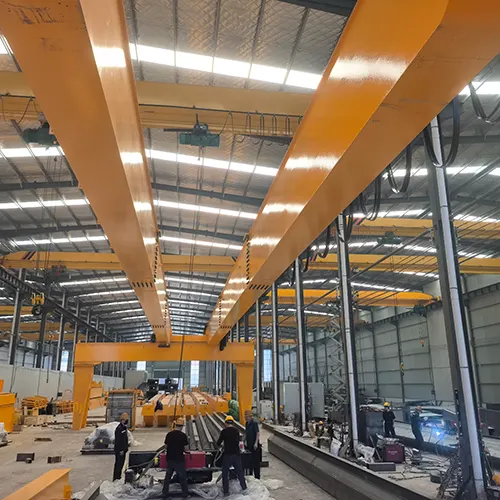

Yuantai Cranes
Overhead Crane Manufacturer with CE, ISO, SGS, CNEX Certificates.
- Main Specifications - Capacity: 0.5–550 tons | Span: up to 40m | Speed: 0.8–12 m/min | Duty: A3–A7 | Power: 380–690V, 50/60Hz | Control: pendant/remote/cabin
- Full engineering: FEA/PLC/VFD + in-house build + global delivery + on-site support, for workshops, factories, EPC contractors, industrial projects, etc.
- Support: design, manufacturing, testing, service – end-to-end, customized lifting solutions worldwide.
How to Get an Accurate Crane Price for Your Application?
Tips: Copy the spec list, fill in your details, and paste it into the form on the right/ down-below for a quick price.
- Crane type:_____ . (e.g., overhead crane, gantry crane, jib crane)
- Max weight to lift:_____ tons. (e.g., 2t, 5t, 10t, 20t, 50t)
- Lifting height:_____ m. (How high does the hook need to reach?
- Workshop width (span):_____ m . (Distance between the two crane rails)
- Travel distance:_____ m . (How long does the crane need to move along the runway?)
- Control type:_____. (Pendant / remote / cabin Control)
- Power supply:_____. (Local voltage & frequency – e.g., 380V, 50Hz, 3-phase)
- What will it be used for?_____ (e.g., steel fabrication, concrete products, mold handling, general manufacturing, etc.)
- Any special requirements?_____ (e.g., extreme temperature, dusty or explosive environment, special paint color, etc.)
Just leave a message via the contact form and our hoist and crane engineer will contact you with in 24working hours.
Get Your Custom Quote–Quick & Easy
Fill in what you know. Skip what you don't – we'll help.Any question will be reply with 24 working hours