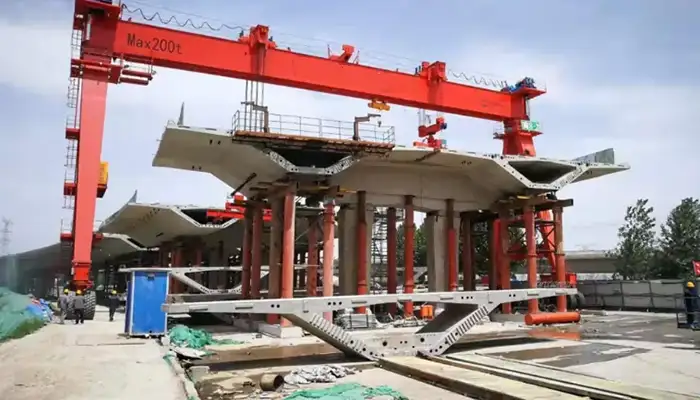
RTG Crane vs Straddle Carrier for Precast Concrete Handling
Content Quick Link
Most Important Takeaway
The real decision between an RTG crane and a straddle carrier is not about equipment price, but about how precast concrete flows through your yard—whether your operation depends more on high-density stacking efficiency or flexible transport and rapid movement.
RTG Cranes vs Straddle Carriers in Precast Yards
What is the real operational difference between RTG cranes and straddle carriers in precast yards?
RTG cranes combine lifting and movement in one system, while straddle carriers are primarily transport machines.
- RTG cranes handle stacking and precise placement within the yard
- Straddle carriers excel at moving large loads over long distances but are less precise for vertical placement
Which system is better for stacking precast beams, slabs, and columns?
RTG cranes are generally better for stacking because of controlled lowering and positioning capabilities.
- Anti-sway control allows precise placement at height
- Can handle irregular shapes or long elements safely
- Reduces risk of damage during stacking operations
Which system improves transport efficiency inside a precast yard?
Straddle carriers can move loads faster across long distances, making them efficient for point-to-point transport.
- Good for large yards with widely spaced casting and storage zones
- Fewer delays when moving multiple elements quickly
- Often paired with cranes for stacking at destination points
How does yard layout influence equipment selection?
Yard layout determines whether mobility, lifting precision, or both are prioritized.
- Fixed linear layouts may suit rail-mounted gantry cranes or straddle carriers for long transport
- Flexible or expanding layouts benefit from RTG cranes with full yard mobility
- High stacking zones require precise lifting equipment like RTG cranes
Can RTG cranes and straddle carriers be used together?
Yes. Many yards combine both systems for optimal workflow efficiency.
- Straddle carriers handle long-distance transport between zones
- RTG cranes manage stacking, precise placement, and cross-zone adjustments
- This combination reduces equipment redundancy and improves yard productivity
Which system reduces handling steps and improves workflow efficiency?
RTG cranes reduce handling steps because they combine lifting and transport within the same machine.
- Less need for transferring loads between multiple machines
- Smoother flow from casting to storage to loading
- Minimizes wait time and congestion in busy precast yards
What type of precast production setup suits each system best?
System choice depends on production type, yard size, and handling needs.
- RTG cranes → mixed production, high stacking, variable layouts, frequent lifting
- Straddle carriers → large yards with long transport distances, standardized products, lower stacking precision needs
- Combination → yards requiring both fast transport and precise stacking
Introduction: Why RTG Crane vs Straddle Carrier Matters in Precast Handling
In modern precast concrete production yards, handling systems directly affect productivity, storage capacity, and delivery efficiency. Many buyers compare RTG cranes and straddle carriers as if they serve the same purpose, but in reality, they represent two different operational philosophies.
An RTG crane focuses on structured stacking and storage optimization, while a straddle carrier focuses on horizontal transport and flexible movement. Understanding this difference is critical for selecting a system that matches your precast workflow instead of simply choosing based on equipment cost or specifications.
RTG Crane in Precast Concrete Handling: A Stacking-Centered System
How rubber tyred gantry cranes organize precast beams, slabs, and columns for efficient storage and workflow in structured yards.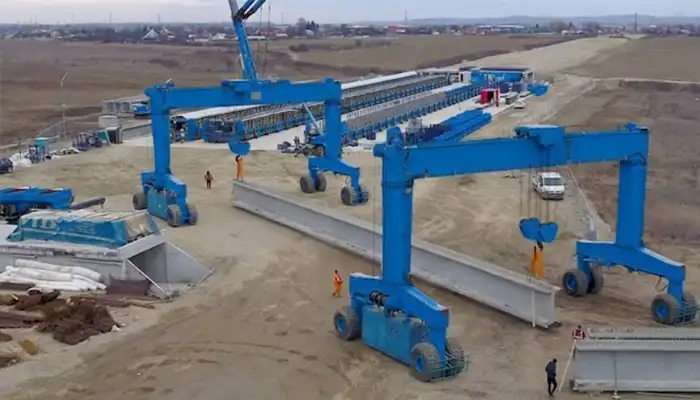
RTG Crane in Precast Concrete Handling: A Stacking-Centered System
RTG crane systems are commonly found in precast yards where the main concern is how to store a large number of concrete elements in an organized way. In many beam and slab production sites, space is not unlimited, so the way materials are stacked directly affects how smoothly the yard runs day to day.
An RTG crane (rubber tyred gantry crane) moves along defined lanes and works like a bridge over storage blocks. It lifts precast beams, slabs, or columns from casting areas or transport trailers, then places them into layered stacks. The movement is repetitive, steady, and follows a planned layout rather than free movement across the yard.
- Works within fixed storage blocks instead of open movement zones
- Handles precast beams, slabs, and segment pieces in organized stacks
- Suitable when materials must be grouped by project, size, or delivery schedule
In many precast yards, this setup helps operators avoid scattered storage. Everything has a position. When a beam is needed later, it can be found by block and layer instead of searching across the yard.
Why RTG Crane Fits Structured Precast Storage
The RTG crane is often selected when the yard needs control over storage density and order. Precast elements are heavy and take up a lot of space, so stacking them efficiently becomes part of the production planning itself.
This type of crane is especially practical when:
- The yard handles a steady volume of precast beams or slabs every day
- Storage areas are divided into clear zones for different projects or clients
- Repetitive lifting is required without frequent changes in working layout
In this setup, the crane follows the same paths again and again. It is not about speed in movement, but about consistency in handling. Over time, operators become familiar with each block and its loading pattern, which reduces confusion during dispatch.
Dependence on Transport and Yard Coordination
Even though the RTG crane handles lifting and stacking well, it does not move precast elements across the yard on its own. It needs support equipment to bring materials in and out of the stacking area.
- Trailers or yard tractors deliver precast components to the crane zone
- The RTG lifts items from transport vehicles into storage stacks
- Another transport step is required when materials are dispatched
This means the system is efficient, but only when coordination between transport and crane operations is well managed. If timing is not balanced, trucks may wait, or the crane may stay idle for periods.
It is not a single-machine workflow. It is more like a chain, where each step depends on the previous one working on time.
Workflow Pattern in RTG-Based Precast Yards
In practice, the material flow in an RTG crane system usually follows a clear sequence. It does not change much from day to day, which is one reason it is widely used in structured precast production environments.
- Casting: precast beams or slabs are produced in molds
- Transport: yard tractors or trailers move elements to storage zones
- Stacking: RTG crane places components into assigned blocks and layers
- Retrieval: crane lifts required items when orders are ready
- Dispatch: materials are loaded again for delivery to site
This loop may seem simple, but in larger yards it requires careful scheduling. One delay in transport can affect the entire stacking rhythm. At the same time, when properly managed, it allows a high level of storage organization without needing excessive yard space.
Practical Role in Precast Operations
In many precast facilities, the RTG crane is not just a lifting machine. It becomes part of the storage planning system. Engineers often design yard layouts around its movement range and stacking height capability.
Its main practical value is:
- Making better use of limited ground area through vertical stacking
- Keeping precast components grouped and traceable
- Supporting continuous production without frequent yard restructuring
It is not designed for flexible movement across irregular spaces. Instead, it works best when the yard itself is designed with order in mind.
Straddle Carrier in Precast Handling: A Transport-Focused System
How straddle carriers provide flexible transport and lifting for precast concrete elements across the yard without fixed zones.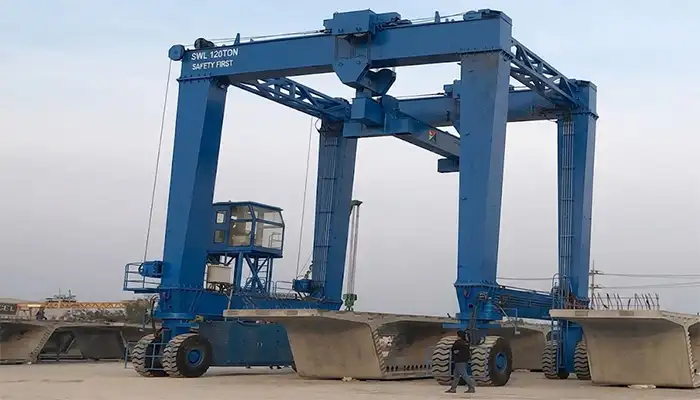
Straddle Carrier in Precast Handling: A Transport-Focused System
A straddle carrier is built for movement first. It is a mobile lifting machine that can travel freely across the yard while carrying precast concrete elements underneath its frame. Unlike fixed systems such as RTG cranes, it does not depend on rails, guide lanes, or defined stacking blocks. The operator can drive it directly to where the load is, pick it up, and move it wherever needed.
In precast concrete yards, this flexibility changes the handling pattern quite a bit. Instead of bringing materials to a fixed crane zone, the machine itself goes to the casting bed, storage area, or loading point. It lifts beams, slabs, or segments directly from the ground or transport trailer, then carries them to the next location without intermediate transfer equipment.
- Can move freely across the entire precast yard without fixed paths
- Lifts precast beams, slabs, columns, or segment pieces directly from ground or trailers
- Performs both transport and lifting without needing separate handling machines
- Works well when yard activities are spread across multiple zones
Because of this structure, the straddle carrier often feels more like a moving workstation than a fixed lifting device. It follows the production flow instead of forcing the production flow to adapt to equipment positions.
How It Works in a Precast Production Flow
In many precast operations, materials do not stay in one place for long. They move from casting beds to curing areas, then to storage or directly to dispatch. A straddle carrier fits into this flow by reducing the number of times a component needs to be touched.
A typical handling process looks like this:
- Pick: the straddle carrier moves to the casting bed or loading point and lifts the precast element
- Move: it carries the load across the yard without switching equipment
- Place: it sets the element in storage, staging area, or directly onto transport trucks
This reduces the need for separate trailers, yard tractors, or fixed crane stations for every transfer step. In practice, the same machine handles what would normally require two or three different movements in a traditional setup.
Why It Fits Flexible and Changing Yard Conditions
Straddle carriers are often chosen when the precast yard layout is not fixed or when production demand changes frequently. Some yards expand temporarily for large infrastructure projects, while others adjust storage space based on project type. In such cases, rigid stacking zones can become limiting.
This system is particularly practical in situations like:
- Precast yards where production volume changes week by week
- Sites where storage areas need to be reconfigured for different projects
- Operations where installation of fixed crane infrastructure is difficult or too costly
- Projects that require fast loading and dispatch without waiting for separate lifting equipment
Since there are no fixed rails or gantry lanes, the machine adapts to the yard instead of the yard adapting to the machine. This makes it easier to adjust working routes as production priorities change.
Reduction of Handling Steps in Daily Operation
One of the main reasons precast operators consider straddle carriers is the reduction in material transfers. In traditional systems, a precast beam might be lifted multiple times: from casting bed to trailer, from trailer to storage, and again from storage to dispatch equipment.
With a straddle carrier, some of these steps are combined.
- No need for separate transport between casting and storage zones
- Fewer transfers reduce waiting time between operations
- Less dependency on coordinated crane and truck scheduling
- Direct handling from production to delivery becomes possible in some cases
This does not mean the system removes all coordination needs, but it simplifies the chain. Fewer handovers usually mean fewer delays caused by equipment mismatch or scheduling gaps.
Practical Workflow Logic in Precast Yards
The working logic of a straddle carrier is straightforward and easy to follow on site. It does not rely on fixed positioning or repeated cycles in one zone. Instead, it operates based on where the material is needed at that moment.
The workflow can be summarized as:
- Pick → Move → Place
This simple sequence allows operators to respond quickly to changes in production demand. If a casting bed is full, the machine can immediately shift to storage. If trucks arrive for loading, it can switch direction without waiting for a separate crane cycle.
In real precast yard operation, this flexibility often helps reduce idle time and keeps material movement more continuous, especially when production schedules are not uniform throughout the day.
RTG Crane vs Straddle Carrier: Core Workflow Difference in Precast Yards
Understanding how RTG cranes and straddle carriers differ in material flow and yard efficiency in precast operations.
RTG Crane: Workflow Built on Fixed Stacking Zones
An RTG crane operates within a defined layout. The yard is divided into storage blocks, and each block has a specific role. Precast beams, slabs, or segments are moved step by step into these zones.
Because of this structure, material handling usually passes through several stages:
- Casting area → transport vehicle → RTG lifting zone
- RTG crane → stacking block (organized by type or project)
- Later retrieval → re-handling → dispatch loading
This multi-stage movement allows the yard to store a large number of precast components in a compact area. Stack height can be used efficiently, and materials can be grouped clearly by project or specification.
However, this also means the system depends heavily on planning. Truck arrival times, crane movement, and stacking space must all be coordinated. If one step is delayed, the whole flow slows down.
In daily operation, RTG-based systems work best when the yard layout is stable and production volume is consistent.
Straddle Carrier: Workflow Built on Continuous Movement
A straddle carrier works differently. Instead of bringing materials into a fixed zone, it moves directly between points in the yard. It can go from casting bed to storage area, or from storage to truck loading area, without changing equipment.
The handling process is usually simple:
- Pick material at casting or storage point
- Move across the yard freely
- Place directly where it is needed
There are no fixed stacking lanes that must be followed. This allows the machine to adjust its route based on real-time demand.
In precast operations where production schedules change or dispatch requests come quickly, this flexibility reduces waiting time between steps. The machine responds to the flow of work rather than forcing work to match a fixed structure.
Key Difference in Material Flow Logic
When comparing both systems in actual precast handling, the difference becomes a matter of flow design rather than equipment capability.
- RTG crane systems are built around controlled storage and vertical stacking
- Straddle carrier systems are built around direct movement and short transfer paths
One organizes space. The other organizes movement.
This leads to very different yard behaviors. In RTG yards, materials are carefully placed and retrieved from specific positions. In straddle carrier yards, materials are constantly in motion between production, storage, and dispatch points.
Impact on Yard Design and Operation
The workflow difference directly affects how a precast yard is planned and operated.
With RTG crane systems:
- Yard layout must be structured into defined storage blocks
- Transport routes need coordination with crane operation cycles
- Stacking height is used to maximize storage efficiency
- Planning is more important than movement speed
With straddle carrier systems:
- Yard layout can remain more open and flexible
- Fewer fixed zones are required for handling
- Movement routes change based on daily demand
- Operation focuses more on speed and responsiveness
Because of this, RTG systems usually suit yards that prioritize storage organization, while straddle carriers suit yards that prioritize fast material turnover.
Summary of Operational Difference in Precast Handling
In practical precast concrete handling, the comparison can be understood in a simple way:
- RTG systems focus on space utilization through stacking and structured storage
- Straddle carrier systems focus on movement efficiency through direct transport
This difference affects not only equipment choice but also how the entire yard is designed, how workers coordinate daily tasks, and how smoothly precast components move from production to delivery.
Yard Design and Infrastructure Requirements
How RTG cranes and straddle carriers depend on yard layout, ground, and infrastructure for effective precast handling.
Overview: Yard Design Impact on Equipment Choice
The choice between an RTG crane system and a straddle carrier system is often decided long before equipment arrives on site. It starts with yard design. Once the ground layout and infrastructure are set, the handling method becomes much easier—or much more limited.
Both systems work well in precast concrete operations, but they depend on very different yard conditions. One needs structure and fixed planning. The other needs space and movement freedom.
Comparison Table: RTG Crane vs Straddle Carrier Yard Needs
| Aspect | RTG Crane System | Straddle Carrier System |
|---|---|---|
| Yard Layout Requirement | Requires structured layout with fixed stacking blocks and defined lanes | Works in open layout with flexible movement routes |
| Ground Condition | Needs heavily reinforced pavement to handle wheel loads and precise crane travel | Needs strong but more uniformly paved surface for continuous driving |
| Storage Organization | Precast beams, slabs, and segments stored in fixed, labeled zones | Storage is flexible, materials can be placed in multiple adaptable locations |
| Movement Pattern | Restricted to gantry lanes and predefined working zones | Free movement across the entire yard without fixed routes |
| Stacking Design | High-density stacking with vertical utilization of space | Limited stacking height, focus on accessibility and flow |
| Infrastructure Dependency | High dependency on pre-planned civil structure and yard design | Lower dependency, can operate in less rigid yard setups |
| Adaptability to Change | Low flexibility once layout is fixed | High flexibility for changing project demands or yard reconfiguration |
| Best Suitable For | Large precast factories with stable long-term production layout | Dynamic precast yards with changing workflows or temporary projects |
RTG crane systems rely on a structured yard built for long-term storage efficiency, while straddle carriers rely on a flexible yard designed for movement and operational adaptability.
RTG Crane: Structured Yard with Fixed Storage Planning
An RTG crane system requires a well-organized yard layout. The crane moves along defined lanes, and every storage area has a clear position. Because of this, the ground must be designed to support both heavy loads and precise movement paths.
- Reinforced concrete pavement designed for repeated wheel loading
- Clearly marked stacking blocks for beams, slabs, or segments
- Straight travel lanes for RTG movement without obstruction
- Pre-planned storage zones based on project type or production sequence
Once stacking blocks are set, they are rarely changed. This layout works well for large precast production bases where operations are stable over time. Materials come in, get stacked, and are retrieved in an organized cycle. The structure of the yard supports crane efficiency.
Straddle Carrier: Flexible Yard with Open Movement Space
A straddle carrier does not rely on fixed lanes or stacking blocks. Instead, it needs enough open space to move freely between casting areas, storage zones, and loading points.
- Wide driving lanes to allow safe turning and load carrying
- Smooth ground surface to support continuous movement
- Open yard layout without strict fixed blocking
- Flexible spacing between casting, storage, and dispatch areas
The yard can be adjusted over time. Storage areas can be expanded, reduced, or relocated depending on project demand, making this system suitable for temporary projects or dynamic precast yards.
Impact on Long-Term Yard Planning
Infrastructure requirements affect how the yard evolves over time.
With an RTG crane system:
- Yard is designed once and used for many years with minimal change
- Expansion usually follows the same structured layout
- Efficiency improves as operators become familiar with fixed zones
- Any redesign requires careful adjustment of stacking blocks and lanes
With a straddle carrier system:
- Yard layout can be adjusted as production needs change
- New storage areas can be added without major reconstruction
- Workflow can shift between projects more easily
- System adapts to the yard instead of the yard adapting to the system
This difference often determines long-term flexibility in precast operations.
Key Design Consideration in Precast Projects
- RTG crane systems fit yards with stable production volume and fixed storage planning
- Straddle carrier systems fit yards that need flexible movement and changing layouts
This is not only a technical decision but also a planning decision that affects how the entire precast facility is built and operated over time.
Operational Efficiency: Handling Steps and Workflow Impact
How RTG cranes and straddle carriers differ in handling steps, workflow, and material flow efficiency in precast yards.
Overview: Handling Steps and Efficiency Comparison
In precast concrete handling, efficiency is often not about how fast one machine moves, but how many times a precast element is handled before it reaches its final position. Every extra transfer adds time, coordination work, and sometimes waiting between operations.
When comparing RTG crane systems and straddle carrier systems, the difference in handling steps becomes very clear once you follow the full material path from casting to dispatch.
| Aspect | RTG Crane System | Straddle Carrier System |
|---|---|---|
| Handling Steps | Multiple stages: casting → transport → stacking → retrieval → dispatch | Fewer stages: pick → move → place |
| Equipment Involvement | Requires separate transport vehicles + RTG crane | Single machine handles lifting + transport |
| Workflow Structure | Segmented and coordinated between multiple units | Continuous and simplified movement flow |
| Coordination Requirement | High coordination between crane, trucks, and storage zones | Low coordination, mostly operator-driven |
| Waiting Time Risk | Higher risk due to dependency on transport scheduling and crane availability | Lower waiting time due to direct handling |
| Operational Efficiency Focus | Storage organization and controlled handling cycles | Material flow speed and reduced transfer points |
| Best Performance Condition | Stable production with high storage demand and planned dispatch cycles | Dynamic production with frequent movement and fast dispatch needs |
| Main Limitation | More handling stages increase complexity in scheduling | Limited stacking efficiency compared to RTG systems |
RTG crane systems achieve efficiency through structured storage and controlled multi-step handling, while straddle carrier systems improve efficiency by reducing handling steps and keeping materials in continuous movement.
RTG Crane System: More Handling Steps, More Coordination
In an RTG-based precast yard, the workflow is usually divided into separate stages. The crane does not move materials across the yard on its own, so transport equipment is always involved before and after lifting.
- Precast element is removed from casting bed
- Transport vehicle carries it to the RTG stacking zone
- RTG crane lifts and places it into storage block
- Later, RTG lifts it again for retrieval
- Another transport vehicle moves it to dispatch or installation area
This means the same precast beam or slab may be handled multiple times before it leaves the yard.
In daily operation, this requires coordination between:
- Crane operator
- Transport vehicle schedule
- Storage block availability
- Dispatch timing
When all parts are aligned, the system works smoothly. But if one step is delayed, such as truck arrival or crane availability, the next step is affected immediately.
Straddle Carrier System: Fewer Steps, Continuous Flow
A straddle carrier changes this pattern by combining lifting and transport in a single machine. Instead of transferring the load between different equipment types, the same unit completes the entire movement.
- Pick from casting bed or storage point
- Move directly across the yard
- Place at storage location or loading truck
There is no need for a separate transport vehicle between lifting stages. This reduces waiting time between steps and makes the flow more continuous.
In precast operations where materials move frequently between casting, curing, storage, and dispatch, this reduces interruptions caused by equipment coordination.
Impact on Workflow Efficiency
The difference in handling steps directly affects how the yard operates on a daily basis.
With RTG crane systems:
- More structured and segmented workflow
- Higher dependency on scheduling between machines
- Efficient when operations are stable and predictable
- Better suited for controlled, high-volume storage environments
With straddle carrier systems:
- Fewer transfer points between processes
- Less coordination between separate equipment
- More continuous movement of materials
- Better suited for fast-changing or smaller-scale operations
It is not only about speed. It is about how many times the material is touched before it reaches its destination.
Balancing Efficiency with Storage Demand
Even though straddle carriers reduce handling steps, RTG cranes still remain widely used because they offer something different: storage efficiency.
When precast yards need to store large volumes of beams or slabs in limited space, vertical stacking becomes important. RTG systems allow this level of density, even if it means more handling steps in the process.
- RTG cranes focus on structured storage efficiency, even with more handling stages
- Straddle carriers focus on flow efficiency, reducing handling stages but using more yard space
In real precast operations, the best choice depends on whether the priority is how much can be stored or how fast materials can move through the yard.
Can RTG Cranes and Straddle Carriers Work Together?
In many precast concrete yards, the choice is not always "either RTG crane or straddle carrier." In larger or more complex projects, both systems are sometimes used in the same site, but they are assigned different roles. The key point is that they do not compete directly—they support different parts of the workflow. An RTG crane is usually placed in the storage area, where its job is to organize precast beams, slabs, and segments into structured stacks. A straddle carrier, on the other hand, works more like a mobile transporter, moving materials between casting zones, storage areas, and dispatch points without being tied to fixed lanes.
How the Combined System Works in Practice
When both systems are used together, the workflow becomes more divided but also more controlled. Each machine handles the part it is better suited for.
Typical division of roles looks like this:
RTG crane handles:
- Long-term storage of precast elements
- High-density stacking in organized blocks
- Retrieval of items from storage zones when needed
Straddle carrier handles:
- Transport from casting beds to storage area
- Movement between different yard zones
- Direct loading onto trucks for dispatch when required
This separation allows each system to operate within its strength, instead of stretching one machine to cover everything.
Why Hybrid Use Appears in Large Precast Projects
This combination is usually seen in larger infrastructure or industrial precast yards where both storage volume and delivery speed matter at the same time.
It becomes practical when:
- The yard stores a large number of precast beams or slabs over long production cycles
- At the same time, project schedules require fast and frequent dispatch
- Storage areas are structured, but production flow is still dynamic
- Reducing bottlenecks between casting, storage, and shipment is important
In such cases, relying on only one system can create limitations. RTG alone may slow down transport, while straddle carriers alone may not provide enough stacking capacity.
Workflow Balance in a Combined System
When both systems are integrated, the material flow becomes more balanced. Each step is handled by the most suitable equipment instead of forcing one machine to cover the entire process.
A simplified flow may look like this:
- Casting → Straddle carrier picks and moves elements
- Storage → RTG crane organizes and stacks materials
- Dispatch → Either system supports loading depending on yard layout
This reduces pressure on any single equipment type and helps avoid congestion in one part of the yard.
Practical Consideration for Buyers
Using both systems also means higher planning requirements. The yard layout must clearly define where each machine operates, and movement paths must be coordinated to avoid overlap.
Before choosing a hybrid setup, it is important to consider:
- Whether production volume justifies two handling systems
- Whether the yard layout can support both structured and flexible movement areas
- Whether long-term operations require more storage focus, transport speed, or a balance of both
A combined RTG crane and straddle carrier system is not about adding more equipment. It is about dividing responsibilities inside the precast yard so that storage efficiency and transport efficiency can operate in parallel without slowing each other down.
Common Buyer Mistakes in Equipment Selection
When selecting between an RTG crane and a straddle carrier for precast concrete handling, many decisions are made too early—often before the full yard workflow is properly understood. In practice, this leads to equipment that looks suitable on paper but does not match how materials actually move on site. The issue is usually not the machine itself, but how the selection is approached.
Focusing Only on Price or Lifting Capacity
One of the most common mistakes is comparing equipment mainly by purchase cost or rated lifting capacity. This sounds reasonable at first, but it does not reflect how precast yards actually operate.
For example:
- A lower-cost RTG crane may look attractive, but it still requires transport vehicles and structured yard space
- A straddle carrier with similar lifting capacity may cost more initially, but reduces the need for separate handling equipment
The real question is not "how much can it lift," but "how many steps are needed before the precast element reaches its final position."
When this is ignored, buyers often end up with equipment that meets technical specs but does not match daily operational flow.
Ignoring Material Flow Inside the Yard
Another frequent issue is not mapping how precast components actually move through the yard. This includes everything from casting to storage to final dispatch.
Without this understanding, equipment is selected without considering:
- How many times each beam or slab is transferred between locations
- Whether storage areas are fixed or flexible
- Whether transport and lifting happen in separate stages or combined
- Where delays are likely to occur—movement, stacking, or loading
For example, RTG crane systems require a structured flow with coordinated transport and stacking cycles. If the yard is not designed for this rhythm, bottlenecks can easily appear between truck arrival, crane availability, and storage space.
On the other hand, straddle carriers depend on movement space. If the yard is too constrained or lacks proper driving lanes, their flexibility becomes limited.
Underestimating Future Expansion Needs
Precast production is rarely static. Many yards start with one production line and gradually expand into multiple lines or larger project volumes. However, equipment is often selected based only on current requirements.
This leads to another common issue:
- RTG systems may reach their storage limits if production volume increases significantly
- Straddle carrier systems may struggle if storage density becomes more important than movement speed
In both cases, the mismatch appears not immediately, but when production scale changes.
Planning only for current demand often results in either limited storage capacity or insufficient flexibility for future yard adjustments.
Mismatch Between Yard Design and Equipment Type
Sometimes the equipment is selected before the yard layout is finalized. This can create long-term operational constraints.
Typical examples include:
- Installing RTG cranes in a yard without proper stacking block planning
- Using straddle carriers in a layout that is too narrow or highly segmented
- Mixing transport logic with storage logic without clear separation
Once the infrastructure is fixed, correcting these issues becomes difficult and costly.
Key Insight for Buyers
Selecting between RTG cranes and straddle carriers is not only a technical decision. It is a workflow decision.
A more reliable approach is to first understand:
- How precast elements move through each stage of production
- How often materials are handled before reaching dispatch
- Whether the yard depends more on storage density or movement flexibility
Equipment choice becomes much clearer once the material flow is defined.
Conclusion: Choosing Based on Workflow, Not Equipment
The decision between an RTG crane and a straddle carrier in precast concrete handling should always be based on operational logic rather than initial investment.
RTG cranes are best suited for structured precast yards that prioritize storage density, organized stacking, and long-term inventory management.
Straddle carriers are better for dynamic environments that prioritize fast transport, flexible movement, and reduced handling complexity.
Ultimately, the most efficient precast yard is not defined by the equipment itself, but by how well the chosen system matches the actual material flow of precast production and delivery.

Article by Bella ,who has been in the hoist and crane field since 2016. Bella provides overhead crane & gantry crane consultation services for clients who need a customized overhead travelling crane solution.Contact her to get free consultation.
Yuantai Cranes
Overhead Crane Manufacturer with CE, ISO, SGS, CNEX Certificates.
- Main Specifications - Capacity: 0.5–550 tons | Span: up to 40m | Speed: 0.8–12 m/min | Duty: A3–A7 | Power: 380–690V, 50/60Hz | Control: pendant/remote/cabin
- Full engineering: FEA/PLC/VFD + in-house build + global delivery + on-site support, for workshops, factories, EPC contractors, industrial projects, etc.
- Support: design, manufacturing, testing, service – end-to-end, customized lifting solutions worldwide.
How to Get an Accurate Crane Price for Your Application?
Tips: Copy the spec list, fill in your details, and paste it into the form on the right/ down-below for a quick price.
- Crane type:_____ . (e.g., overhead crane, gantry crane, jib crane)
- Max weight to lift:_____ tons. (e.g., 2t, 5t, 10t, 20t, 50t)
- Lifting height:_____ m. (How high does the hook need to reach?
- Workshop width (span):_____ m . (Distance between the two crane rails)
- Travel distance:_____ m . (How long does the crane need to move along the runway?)
- Control type:_____. (Pendant / remote / cabin Control)
- Power supply:_____. (Local voltage & frequency – e.g., 380V, 50Hz, 3-phase)
- What will it be used for?_____ (e.g., steel fabrication, concrete products, mold handling, general manufacturing, etc.)
- Any special requirements?_____ (e.g., extreme temperature, dusty or explosive environment, special paint color, etc.)
Just leave a message via the contact form and our hoist and crane engineer will contact you with in 24working hours.
Get Your Custom Quote–Quick & Easy
Fill in what you know. Skip what you don't – we'll help.Any question will be reply with 24 working hours