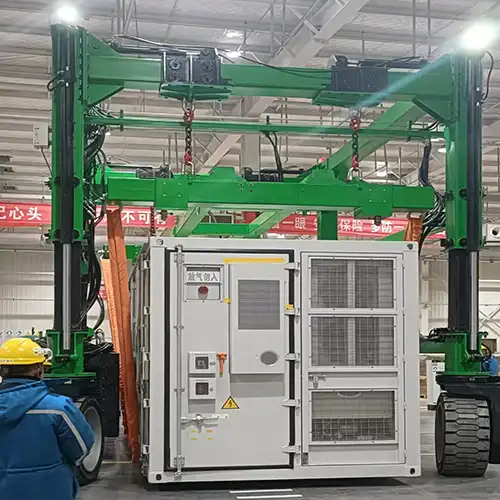
Straddle Carrier for Energy Storage Containers 30–60T
Straddle carrier for energy storage container handling, 30–60 ton capacity. Safe, stable BESS container handling with rubber tyred mobility and precision
| Crane Type | 30–60 Ton Rubber-Tyred Straddle Carrier for BESS Energy Storage Container Handling, with Heavy-Duty Portal Frame, Synchronized Hydraulic Lifting, Multi-Wheel Steering, Diesel-Electric/Hybrid/Electric Power, and Customized BESS Handling System. |
| Crane Capacity | 30–60 Ton (Common: 30 Ton, 40 Ton, 50 Ton, 60 Ton) |
| Lifting Height | Typically 3–10 m (Common: 4 m, 6 m, 8 m) |
| Coverage Area Type | Mobile rubber-tyred lifting coverage for BESS yards and project sites, allowing containers to be lifted and transported without fixed crane rails. |
| Application | Used for BESS container loading, unloading, transportation, positioning, stacking, maintenance, and transfer in battery energy storage manufacturing plants, energy storage yards, ports, logistics areas, and renewable energy projects. |
| Certifications | CE / ISO / SGS / Other third-party inspection |
| Customization | Customized BESS container dimensions, lifting height, spreader/attachment, rubber-tyred steering, synchronized lifting, diesel-electric/hybrid/electric power, remote/PLC control, load monitoring, anti-collision, and battery-safe handling systems. |
Crane Manufacturer: Yuantai Cranes – 30+ Years Professional Crane Manufacturer from China
Category: Straddle Carrier
Tags: straddlecrane
Your Trusted Straddle Container Crane Manufacturer & Supplier
Straddle Carrier for Energy Storage Container Handling 30–60 Ton Capacity
Rubber Tyred Straddle Carrier & BESS Container Solutions
Straddle carrier for energy storage container handling with typical 30–60 ton capacity. Rubber tyred straddle carrier solutions for Battery Energy Storage Systems (BESS), designed for safe and stable handling of 20–45+ ton ESS containers. Ideal for precise, low-vibration movement, flexible yard operation, and efficient handling in modern energy storage projects.
Energy storage containers are different from standard freight containers. Inside the container are lithium battery systems, PCS units, cooling equipment, electrical cabinets, fire protection systems, and cable connections. During handling, the biggest concern is usually not the container weight itself. The bigger concern is vibration, sudden impact, and uncontrolled swinging while lifting or transporting the container. This is why many battery energy storage system (BESS) projects use rubber tyred straddle carriers for energy storage container handling. A straddle carrier crane is a mobile container handling machine that can lift, transport, stack, and position energy storage containers without fixed rails or additional lifting equipment. Compared with forklifts, reach stackers, or mobile cranes, a container straddle carrier provides smoother movement and better load stability for heavy battery storage containers.
What Is an Energy Storage Container Straddle Carrier?
Energy storage containers are different from standard freight containers. Inside the container are lithium battery systems, PCS units, cooling equipment, electrical cabinets, fire protection systems, and cable connections.
During handling, the biggest concern is usually not the container weight itself. The bigger concern is vibration, sudden impact, and uncontrolled swinging while lifting or transporting the container.
This is why many battery energy storage system (BESS) projects use rubber tyred straddle carriers for energy storage container handling.
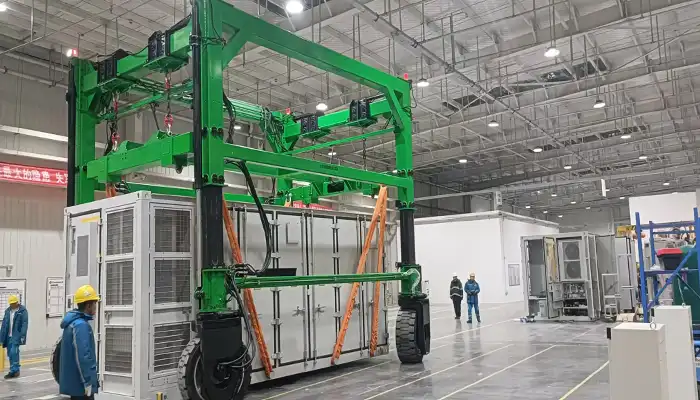
A straddle carrier crane is a mobile container handling machine that can lift, transport, stack, and position energy storage containers without fixed rails or additional lifting equipment. The machine travels over the container using a gantry structure and lifts the load inside the frame.
Compared with forklifts, reach stackers, or mobile cranes, a container straddle carrier provides smoother movement and better load stability for heavy battery storage containers.
Typical applications include:
- Battery energy storage container handling
- Lithium battery container transportation
- Electrical storage cabinet transfer
- Containerized power system installation
- BESS container stacking and positioning
- Renewable energy storage yard operations
These machines are widely used in:
- Battery energy storage power stations
- Solar and wind energy projects
- Containerized energy storage yards
- Battery manufacturing plants
- Renewable energy industrial parks
- Energy storage logistics centers
What Can an Energy Storage Straddle Carrier Handle?
An energy storage container straddle carrier is designed for handling:
| Load Type | Typical Application |
|---|---|
| BESS containers | Battery energy storage projects |
| Lithium battery storage containers | Renewable energy systems |
| Electrical storage cabinets | Industrial energy storage |
| PCS containers | Power conversion systems |
| Inverter containers | Solar and wind energy projects |
| Containerized power systems | Temporary or mobile energy storage |
| Prefabricated electrical equipment containers | Factory and substation projects |
The machine combines the functions of:
- Straddle carrier
- Container straddle carrier
- Rubber tyred straddle crane
- Mobile container handling equipment
into one integrated handling solution.
Why Use a Rubber Tyred Straddle Carrier for Energy Storage Containers?
Stable Handling for Sensitive Battery Systems
Battery storage containers contain sensitive internal components. Excessive vibration during handling may affect:
- Battery modules
- Cooling systems
- Electrical wiring
- Fire suppression systems
- Power control equipment
A rubber tyred straddle carrier helps reduce load sway and sudden impact during movement.
No Rails Required
Unlike rail-mounted container cranes, a rubber tyred straddle carrier does not require fixed tracks.
This provides:
- Flexible yard layout
- Lower infrastructure cost
- Easier site expansion
- Faster project setup
This is especially useful for temporary or expanding BESS storage yards.
Better Movement in Narrow Areas
Many energy storage facilities have closely spaced container rows and narrow access roads.
Features such as:
- All-wheel steering
- Crab steering movement
- Small turning radius
allow the machine to move more easily inside compact project sites.
Fewer Transfer Steps
The machine combines lifting and transportation in one unit.
This reduces the need for:
- Additional mobile cranes
- Yard trailers
- Forklift transfers
- Multiple lifting operations
Fewer handling steps usually mean lower risk during battery container transfer.
Main Functions of a Container Straddle Carrier
Lifting Energy Storage Containers
The machine lifts heavy battery containers smoothly using a hydraulic lifting system and spreader.
Typical lifting capacities include:
- 20 ton straddle carrier
- 30 ton container straddle carrier
- 40 ton rubber tyred straddle carrier
- 60 ton heavy-duty straddle crane
Short-Distance Transportation
After lifting, the machine can transport containers directly across the storage yard.
Common operations include:
- Moving containers to installation areas
- Yard transfer between storage zones
- Relocating battery storage units
- Delivering containers for testing or maintenance
Precise Positioning
Energy storage containers often need accurate alignment with:
- Foundation pads
- Cable interfaces
- Transformer systems
- Installation platforms
Many machines use:
- Anti-sway systems
- Hydraulic balancing
- Slow-speed positioning control
- Camera-assisted alignment
to improve installation accuracy.
Container Stacking
Some projects temporarily stack energy storage containers before final installation.
A container straddle carrier can help:
- Increase yard storage capacity
- Organize project workflow
- Improve space utilization
Warehouse Docking
Some battery manufacturing plants use straddle carrier cranes for indoor handling and warehouse transfer.
The machine can move containers into:
- Assembly workshops
- Testing areas
- Maintenance buildings
- Indoor storage facilities
while maintaining stable and controlled movement.
Difference Between Straddle Carrier, Straddle Crane, RTG Crane, Forklift, and Reach Stacker
Different types of lifting equipment can be used for container handling, but not all of them are suitable for battery energy storage system (BESS) containers and electrical storage cabinets. Energy storage container handling usually requires stable lifting, low vibration, precise positioning, flexible yard movement, and safe transportation of sensitive electrical equipment. The equipment selection depends on container weight, storage layout, stacking requirements, operating space, and project budget.
Straddle Carrier
A straddle carrier is a rubber tyred container handling machine that lifts and transports containers within its gantry frame.
For energy storage projects, it is commonly used for:
- BESS container transfer
- Lithium battery container handling
- Yard transportation
- Container stacking
- Precise installation positioning
Main advantages:
- Stable load movement
- Flexible rail-free travel
- Good maneuverability
- Suitable for narrow storage yards
- Lower infrastructure requirements
Straddle Crane
The term "straddle crane" is often used for heavy-duty gantry-style lifting equipment designed for container handling or industrial load transfer.
Compared with a mobile straddle carrier, a straddle crane may focus more on lifting functions than transportation functions.
Common applications include:
- Heavy industrial equipment handling
- Container transfer operations
- Specialized outdoor lifting areas
Some projects use the terms "straddle crane" and "straddle carrier" interchangeably, especially for rubber tyred container handling equipment.
RTG Crane (Rubber Tyred Gantry Crane)
An RTG crane is mainly used in ports, container terminals, and freight yards for stacking shipping containers.
RTG cranes normally travel on fixed lanes and are designed for high stacking efficiency rather than flexible transportation.
For energy storage projects, RTG cranes may require:
- Larger operating space
- More structured yard layouts
- Higher infrastructure investment
They are less flexible for short-distance container transfer compared with a rubber tyred straddle carrier.
Forklift
Heavy-duty forklifts are sometimes used for small electrical storage cabinets or lightweight containers.
However, forklifts are generally less suitable for large BESS containers because:
- Load stability decreases with height
- Large turning space is required
- Heavy wheel loads affect ground pressure
- Long containers are harder to balance
Forklifts are more common for:
- Small battery cabinet movement
- Indoor warehouse handling
- Short-distance pallet transport
Reach Stacker
A reach stacker is widely used for container loading and unloading operations.
It uses a telescopic boom to lift containers from the top.
Reach stackers provide strong lifting capacity, but for energy storage containers they may create:
- Higher load sway
- Uneven load distribution
- Reduced stability at extended reach
- Larger turning radius requirements
They are commonly used in:
- Freight yards
- Logistics terminals
- Port container handling
rather than precision BESS installation work.
Comparison Table for Energy Storage Container Handling
| Equipment Type | Typical Lifting Capacity | Stability for BESS Containers | Ground Requirements | Turning Radius | Stacking Capability | Precision Handling | Operational Cost |
|---|---|---|---|---|---|---|---|
| Straddle Carrier | 20–60 tons | High | Low | Small | Good | High | Medium |
| Straddle Crane | 20–100+ tons | High | Medium | Medium | Good | High | Medium to High |
| RTG Crane | 40–65+ tons | High during stacking | High | Large operating lane required | Excellent | Medium | High |
| Forklift | 3–25 tons | Low to Medium | Medium | Medium | Limited | Medium | Low |
| Reach Stacker | 10–45 tons | Medium | Medium | Large | Good | Medium | Medium to High |
Which Equipment Is Better for Energy Storage Container Handling?
For battery energy storage system projects, the main concern is usually controlled handling instead of maximum lifting speed.
A rubber tyred straddle carrier is often preferred because it combines stable lifting, low-vibration transportation, flexible yard movement, precise positioning, and rail-free operation into one machine.
This is especially useful for:
- Lithium battery storage containers
- Containerized power systems
- Renewable energy storage yards
- BESS installation projects
- Electrical storage cabinet handling
where safe movement and accurate positioning are critical.
Why Energy Storage Containers Need Specialized Handling Equipment
Energy storage containers are not ordinary shipping containers. Inside the container are high-value electrical systems, lithium battery racks, cooling equipment, fire protection systems, and control cabinets. A fully assembled battery energy storage system (BESS) container may weigh 20 tons, 30 tons, or even more than 40 tons. At the same time, many internal components are sensitive to vibration, sudden movement, and uneven lifting forces. Because of this, energy storage container handling requires more controlled lifting and transportation compared with normal cargo container operations. In many projects, the main handling concern is not only whether the equipment can lift the weight. The bigger concern is whether the container can be moved smoothly and safely without creating hidden damage inside the battery system. This is why many operators use rubber tyred straddle carriers, container straddle carriers, or specialized lifting equipment designed for battery storage container handling.
Sensitive Internal Components
A battery energy storage container contains many precision electrical and mechanical systems packed into a compact space.
Even small shocks or excessive vibration during lifting may affect internal equipment performance.
Lithium Battery Modules
Lithium battery racks are the core components inside the BESS container.
Excessive shaking or impact during handling may:
- Affect battery connections
- Damage module supports
- Increase long-term reliability risks
- Create hidden safety concerns
For large lithium battery storage containers, stable lifting is especially important during loading, unloading, and installation.
Electrical Control Systems
Energy storage containers contain electrical control cabinets, sensors, communication systems, and monitoring equipment.
These systems help manage:
- Battery charging and discharging
- System protection
- Temperature monitoring
- Power distribution
- Emergency shutdown functions
Strong vibration or sudden movement may loosen wiring connections or affect sensitive control equipment.
PCS Systems
The PCS (Power Conversion System) is one of the most important components inside a containerized energy storage system.
PCS equipment controls the conversion between AC and DC power during charging and discharging operations.
Because PCS systems contain electronic components and power modules, careful handling is necessary during transportation and installation.
Cooling Systems
Battery energy storage containers usually include cooling or thermal management systems to control internal temperature.
These may include:
- Air cooling systems
- Liquid cooling systems
- Ventilation equipment
- Cooling pipelines
Improper lifting or excessive container tilt may affect cooling system alignment or piping connections.
Fire Protection Systems
Modern BESS containers often include integrated fire suppression systems and gas monitoring equipment.
Handling impact or structural deformation may affect:
- Fire detection devices
- Suppression pipelines
- Sensor calibration
- Safety protection systems
This is one reason why controlled lifting and transportation are important for energy storage projects.
Main Risks During Handling
Improper handling may create both visible and hidden damage inside the energy storage container.
In some cases, problems may not appear immediately after installation but may affect long-term system reliability later.
Sudden Impact
Hard landing or sudden stopping during transportation can create shock loads inside the container.
These impacts may affect:
- Battery racks
- Electrical cabinets
- Cable systems
- Internal mounting structures
Smooth lifting and slow positioning help reduce this risk.
Swinging During Lifting
Container sway is one of the biggest concerns during BESS container handling.
Excessive swinging may:
- Increase collision risk
- Affect positioning accuracy
- Create uneven internal loading
- Reduce lifting safety
Rubber tyred straddle carriers are often preferred because the load remains more stable inside the gantry structure during movement.
Uneven Load Distribution
Battery storage containers may have uneven internal weight distribution depending on equipment layout.
Improper lifting points or unstable handling may cause:
- Structural stress
- Frame twisting
- Uneven wheel loading
- Lifting imbalance
Specialized container handling equipment helps maintain better load balance during transfer.
Excessive Vibration
Continuous vibration during movement can affect sensitive electrical systems inside the container.
This is especially important for:
- Lithium battery modules
- PCS systems
- Control cabinets
- Cooling pipelines
Low-vibration transportation is one reason why energy storage projects often use specialized container straddle carriers instead of conventional handling methods.
Container Deformation
Improper lifting methods may cause container frame deformation, especially for oversized or modified BESS containers.
Structural deformation may affect:
- Door alignment
- Equipment mounting
- Internal cable routing
- Installation accuracy
Controlled lifting and balanced support points help reduce deformation risk.
Why Stability Matters More Than Speed
For standard freight containers, handling speed is often the main priority.
For battery energy storage containers, stable handling is usually more important than fast handling.
A slower but controlled transfer process helps protect both the equipment and the project schedule.
Safer Transport
Stable movement reduces:
- Load sway
- Collision risk
- Sudden impact
- Emergency handling situations
This improves overall operational safety inside energy storage yards and installation sites.
Reduced Battery Damage
Smooth lifting and transportation help protect:
- Battery modules
- Electrical systems
- Internal wiring
- Cooling equipment
This reduces the risk of hidden damage during installation and commissioning.
Lower Maintenance Cost
Handling-related damage may increase future maintenance requirements.
Better lifting stability helps reduce:
- Repair work
- Component replacement
- Downtime risk
- Inspection frequency
This is especially important for large utility-scale BESS projects with many containers.
Improved Installation Accuracy
Energy storage containers often need precise alignment with:
- Foundation pads
- Cable trenches
- Transformer systems
- Electrical interfaces
Stable positioning improves installation efficiency and reduces adjustment work during project commissioning.
50 ton straddle carrier
60 ton straddle carrier
80 ton straddle carrier- hydraulic straddle carrier
Types of Straddle Carriers for Energy Storage Projects
Different energy storage projects require different types of container handling equipment. The best straddle carrier for a battery energy storage system (BESS) project depends on container weight, yard size, indoor or outdoor operation, working hours, emission requirements, ground conditions, and automation level. Some projects focus on flexible yard transfer, while others require low-noise indoor operation or long continuous working hours. Below are the most common types of straddle carriers used for energy storage container handling and lithium battery storage container transportation.
Rubber Tyred Straddle Carrier
A rubber tyred straddle carrier is one of the most common solutions for energy storage container handling.
The machine uses rubber tyres instead of fixed rails, allowing it to move freely around battery storage yards and renewable energy project sites.
For many BESS projects, this flexibility is important because storage layouts may change during construction or future expansion.
Main Features
- Rail-free operation
- Flexible yard movement
- Suitable for temporary or expanding storage yards
- Easy relocation between work areas
- Lower infrastructure cost compared with rail-mounted systems
Common Applications
- Battery energy storage container handling
- Containerized power system transfer
- Renewable energy storage yards
- Outdoor BESS installation projects
- Lithium battery container transportation
Practical Advantages
The rubber tyred structure helps reduce:
- Civil construction work
- Fixed rail installation costs
- Site modification requirements
It also improves maneuverability in narrow aisles and compact storage areas.
Electric Straddle Carrier
An electric straddle carrier uses battery-powered or electric drive systems instead of diesel engines.
This type of container straddle carrier is becoming more common in green energy projects and indoor battery manufacturing facilities.
Main Features
- Zero exhaust emissions
- Low operating noise
- Smooth acceleration and deceleration
- Reduced vibration during movement
Suitable Applications
- Indoor battery container handling
- Energy storage manufacturing plants
- Green energy industrial parks
- Low-noise working environments
- Environmentally sensitive projects
Practical Advantages
Electric straddle carriers help improve:
- Indoor air quality
- Energy efficiency
- Operator comfort
- Noise control inside factories or warehouses
For lithium battery storage projects, electric drive systems also align well with renewable energy and carbon reduction goals.
Diesel-Powered Straddle Carrier
A diesel-powered straddle carrier is commonly used for heavy-duty outdoor operations and large-scale energy storage projects.
These machines are designed for high-capacity lifting and long working cycles.
Main Features
- High lifting power
- Strong outdoor performance
- Long continuous operating hours
- Reliable operation in remote project sites
Common Applications
- Large utility-scale BESS projects
- Outdoor energy storage yards
- Heavy battery container transportation
- Long-distance yard transfer operations
- Construction-stage container handling
Practical Advantages
Diesel-powered straddle carriers are often preferred when:
- Charging infrastructure is limited
- Continuous 24-hour operation is required
- Project locations are remote
- Heavy lifting capacity is needed
They are widely used for handling 20ft and 40ft battery energy storage containers in outdoor environments.
Hybrid Power Straddle Carrier
A hybrid straddle carrier combines electric and diesel power systems in one machine.
The goal is to reduce fuel consumption while maintaining flexible operation for heavy-duty container handling.
Main Features
- Energy-saving operation
- Reduced fuel consumption
- Flexible power switching
- Lower emissions compared with full diesel systems
Common Applications
- Mixed indoor and outdoor operations
- Medium-to-large BESS projects
- Energy storage logistics centers
- Projects with environmental restrictions
Practical Advantages
Hybrid systems allow operators to:
- Use electric mode in low-noise areas
- Switch to diesel power for heavy outdoor work
- Improve fuel efficiency during long operation cycles
This type of rubber tyred straddle carrier is increasingly used in modern renewable energy storage facilities.
Automated or Remote-Controlled Straddle Carrier
Automated and remote-controlled straddle carriers are designed for intelligent energy storage logistics and smart yard management.
These systems use sensors, cameras, electronic positioning systems, and remote control technology to improve operational efficiency and safety.
Main Features
- Intelligent yard management
- Reduced manual operation
- Remote monitoring capability
- Precision positioning systems
- Automated travel and alignment functions
Common Applications
- Smart battery storage yards
- Automated container transfer systems
- High-volume BESS logistics centers
- Advanced renewable energy projects
Practical Advantages
- Reduce labor requirements
- Improve positioning accuracy
- Lower human operating risk
- Increase handling consistency
- Support digital yard management systems
For large energy storage projects with frequent container movement, automated handling systems can improve overall logistics efficiency and operational control.
Structural Design of Energy Storage Straddle Carriers
The structure of a straddle carrier for energy storage container handling is designed around one main goal: stable movement of heavy and sensitive battery containers with minimum vibration and accurate positioning. Unlike general lifting equipment, a rubber tyred straddle carrier must combine lifting, traveling, steering, and positioning in one compact system, especially when handling BESS containers and electrical storage cabinets in tight yard layouts.
Structural Design of Energy Storage Straddle Carriers
The structure of a straddle carrier for energy storage container handling is designed around one main goal: stable movement of heavy and sensitive battery containers with minimum vibration and accurate positioning.
Unlike general lifting equipment, a rubber tyred straddle carrier must combine lifting, traveling, steering, and positioning in one compact system, especially when handling BESS containers and electrical storage cabinets in tight yard layouts.
Gantry-Type Structure
The gantry-type frame is the core structure of a container straddle carrier used in energy storage projects.
The machine "straddles" over the energy storage container and lifts it from above, forming a stable lifting frame around the load.
Key Characteristics
- Cross-over container handling design
- Load is supported inside the gantry frame
- Balanced structure reduces tilting risk
- Suitable for 20ft and 40ft BESS containers
- Stable operation for sensitive lithium battery systems
Practical Value in Energy Storage Handling
This structure helps keep the center of gravity stable during:
- Container lifting
- Short-distance transfer
- Yard positioning
- Installation alignment
In real energy storage projects, this stability helps reduce unnecessary movement of internal battery racks and electrical systems during handling.
Rubber Tyred Travel System
The rubber tyred travel system is what allows the straddle carrier to move freely across the energy storage yard without rails.
It is one of the main reasons this equipment is widely used in BESS container handling.
Key Characteristics
- Rail-free operation (no fixed track required)
- Flexible movement across open yard areas
- Suitable for changing storage layouts
- Easy integration into temporary or expanding projects
Practical Value
For energy storage projects, this system helps reduce:
- Civil foundation work
- Rail installation cost
- Site preparation time
It also allows operators to adjust yard layout as the number of battery containers increases during project expansion.
Hydraulic Lifting System
The hydraulic lifting system is responsible for raising and lowering the energy storage container smoothly inside the gantry frame.
Because BESS containers contain sensitive electrical and battery systems, lifting stability is more important than lifting speed.
Key Characteristics
- Smooth and controlled lifting motion
- Reduced vibration during operation
- Synchronized lifting on multiple points
- Stable load support for heavy containers
Practical Value in Energy Storage Handling
This system helps protect:
- Lithium battery modules
- Electrical control cabinets
- Cooling and ventilation systems
- Internal cable connections
In many energy storage projects, controlled hydraulic lifting reduces the risk of hidden internal damage that may not be visible after installation.
Spreader Design
The spreader is the interface between the straddle carrier and the energy storage container.
It plays a key role in safe lifting, locking, and positioning.
Key Components
- ISO container spreader compatibility
- Adjustable locking system for different container sizes
- Anti-sway design for stable lifting
Practical Value
In energy storage container handling, the spreader helps ensure:
- Secure locking during lifting
- Even force distribution on container frame
- Reduced swinging during movement
- Accurate alignment during placement
For BESS container applications, proper spreader design is essential to avoid uneven stress on container structures and internal equipment.
Steering System
The steering system determines how easily the straddle carrier can move inside narrow energy storage yards and complex installation layouts.
Modern rubber tyred straddle carriers use multiple steering modes to improve flexibility and positioning accuracy.
All-Wheel Steering
All wheels can turn together, allowing the machine to move in multiple directions.
Main advantages:
- Better stability during turning
- Smooth directional changes
- Improved control in narrow spaces
This is commonly used in dense battery storage yards.
Crab Steering
Crab steering allows the entire machine to move sideways in a straight line.
Main advantages:
- Sideways movement without turning
- Easier container alignment
- Useful for tight installation positions
This mode is often used during precise BESS container placement.
Small Turning Radius Design
The compact steering design allows the straddle carrier to operate in limited space environments.
Main advantages:
- Better maneuverability in narrow aisles
- Easier access between closely placed containers
- Reduced space requirement for turning
This is especially useful in high-density energy storage container yards.
Key Technical Specifications of Energy Storage Straddle Carriers
Energy storage container straddle carriers are not one-size-fits-all machines. The technical configuration depends on container weight, yard layout, lifting height, and the type of battery energy storage system (BESS) being handled. In real energy storage projects, selecting the right specification is usually based on container size, installation requirement, and expected daily handling frequency.
Key Technical Specifications of Energy Storage Straddle Carriers
Energy storage container straddle carriers are not one-size-fits-all machines.
The technical configuration depends on container weight, yard layout, lifting height, and the type of battery energy storage system (BESS) being handled.
In real energy storage projects, selecting the right specification is usually based on container size, installation requirement, and expected daily handling frequency.
Typical Lifting Capacities
The lifting capacity of a rubber tyred straddle carrier is selected based on the total weight of the energy storage container, including batteries, PCS systems, cooling units, and structural frame.
Common capacity ranges include:
- 20 ton straddle carrier – small BESS containers, modular storage units
- 30 ton container straddle carrier – standard 20ft energy storage containers
- 40 ton energy storage straddle carrier – common for fully equipped BESS containers
- 50 ton heavy-duty straddle carrier – large battery storage systems or reinforced containers
- 60 ton industrial straddle crane – oversized or high-density energy storage containers
In many projects, operators prefer a slightly higher capacity margin to ensure safer lifting under uneven load conditions.
Typical Energy Storage Container Sizes
Energy storage containers follow standard or modified ISO container dimensions, but internal configurations vary depending on battery system design.
Common sizes include:
- 10ft energy storage container
Small modular battery units or mobile storage systems - 20ft BESS container
Standard battery energy storage system configuration used in most projects - 40ft energy storage cabinet/container
Large-scale energy storage systems with higher capacity and integrated cooling systems
These container sizes are widely used in:
- Utility-scale BESS power stations
- Solar and wind energy storage projects
- Industrial backup power systems
- Containerized energy storage yards
Main Technical Parameters
The performance of a container straddle carrier is defined by several key technical parameters. These parameters directly affect handling stability, efficiency, and suitability for energy storage applications.
Typical Specification Table
| Technical Item | Typical Range / Description |
|---|---|
| Capacity | 20 – 60 tons (depending on model and application) |
| Span | 3 – 7 meters (adjusted to container width and design) |
| Lifting Height | 3 – 6 meters (single or double stacking requirement) |
| Travel Speed | 0 – 25 km/h (adjustable for loaded/unloaded operation) |
| Lifting Speed | 5 – 15 m/min (smooth hydraulic control preferred) |
| Wheel Load | Designed according to ground bearing capacity of yard |
| Power Supply | Diesel / Electric / Hybrid lithium battery system |
| Steering Mode | All-wheel steering / crab steering / multi-mode control |
Practical Notes for Energy Storage Projects
- Higher lifting height is needed for container stacking in dense storage yards
- Lower travel speed with smooth control is preferred for lithium battery safety
- Hydraulic lifting stability is more important than fast cycle time
- Wheel load design must match yard ground conditions to avoid settlement or cracking
- Electric or hybrid power systems are increasingly used for low-emission energy storage sites
In real BESS container handling projects, these specifications are usually customized based on site layout, container type, and long-term expansion plans rather than using a standard model directly.
Core Advantages of Rubber Tyred Straddle Carriers for Energy Storage Container Handling
In battery energy storage system (BESS) projects, the choice of handling equipment directly affects installation speed, safety level, and long-term operating cost. A rubber tyred straddle carrier is widely used because it combines lifting, transport, and positioning in one machine without relying on fixed infrastructure.
Core Advantages of Rubber Tyred Straddle Carriers for Energy Storage Container Handling
In battery energy storage system (BESS) projects, the choice of handling equipment directly affects installation speed, safety level, and long-term operating cost.
A rubber tyred straddle carrier is widely used in energy storage container handling because it combines lifting, transport, and positioning in one machine, without depending on fixed infrastructure.
Below are the key practical advantages in real energy storage applications.
Reduced Infrastructure Investment
One of the most practical advantages is that a rubber tyred straddle carrier does not require rail systems or fixed running tracks.
This is especially important for energy storage projects where sites are often temporary, expanding, or adjusted during construction.
Main Benefits
- No rail installation required
- No dedicated track foundation needed
- Lower civil construction cost
- Faster site setup for BESS container yards
Practical Meaning in Energy Storage Projects
In many real projects, container layout changes during expansion. Without rail limitations, operators can adjust the yard freely and continue operations without modifying the ground structure again.
Improved Yard Space Utilization
Energy storage containers are often stored in dense layouts to maximize land usage, especially in large-scale battery power stations.
A rubber tyred straddle carrier can move and operate in narrow aisles, which helps optimize yard design.
Main Benefits
- Flexible stacking arrangement for BESS containers
- Efficient movement in narrow storage aisles
- Better use of limited land area
- Easier access to multiple container rows
Practical Meaning in Energy Storage Projects
Instead of fixed lifting points, the equipment can move directly to any container position. This improves storage density and allows more flexible container arrangement in renewable energy storage yards.
Enhanced Safety in Energy Storage Handling
Safety is a key requirement in lithium battery container handling. Even small impact or vibration during movement may affect internal battery systems and electrical components.
Main Benefits
- Smooth lifting and lowering motion
- Anti-sway control during travel
- Stable container transportation inside the gantry frame
- Reduced sudden impact during positioning
Practical Meaning in Energy Storage Projects
Stable movement helps protect:
- Lithium battery modules
- PCS systems
- Cooling pipelines
- Electrical control cabinets
This reduces hidden damage risks that may not appear immediately but affect long-term system reliability.
Lower Operational Costs
A rubber tyred straddle carrier combines multiple handling steps into one machine, reducing the need for additional equipment inside the energy storage yard.
Main Benefits
- Reduced manpower requirement
- Less need for auxiliary lifting equipment
- Fewer container transfer steps
- Faster handling cycle in daily operations
Practical Meaning in Energy Storage Projects
Instead of using separate cranes, trailers, and forklifts, one straddle carrier can complete:
- Lifting
- Transport
- Positioning
- Stacking
This simplifies workflow and reduces coordination between different machines on site.
Better Flexibility for Expanding Energy Storage Projects
Energy storage projects are often developed in phases. As capacity increases, new container zones are added, and layouts may change over time.
Main Benefits
- Easy relocation between working areas
- Adaptable to changing yard layouts
- Suitable for phased project expansion
- No fixed infrastructure constraints
Practical Meaning in Energy Storage Projects
A rubber tyred straddle carrier allows operators to adjust storage areas without stopping operations or rebuilding the site.
This flexibility is especially useful for:
- Large-scale BESS power stations
- Renewable energy storage parks
- Containerized energy storage expansion projects
- Temporary or mobile energy storage systems
Summary
In energy storage container handling, rubber tyred straddle carriers are widely used because they offer a practical balance of:
- Flexible movement without rails
- Stable handling for sensitive battery containers
- Lower infrastructure cost
- Efficient yard operation
- Adaptability for future expansion
For many BESS projects, this combination makes it a preferred solution for both installation and long-term container management.
Safety Features for Energy Storage Container Handling
Energy storage container handling is not only about lifting capacity. In real BESS projects, safety systems are equally important because containers often include lithium battery systems, PCS equipment, cooling units, and high-voltage electrical components. A rubber tyred straddle carrier used for energy storage work is usually equipped with multiple safety protection systems to reduce operational risk during lifting, traveling, and positioning.
Safety Features for Energy Storage Container Handling
Energy storage container handling is not only about lifting capacity.
In real BESS projects, safety systems are equally important because containers often include lithium battery systems, PCS equipment, cooling units, and high-voltage electrical components.
A rubber tyred straddle carrier used for energy storage work is usually equipped with multiple safety protection systems to reduce operational risk during lifting, traveling, and positioning.
Anti-Sway Control System
Container sway is one of the most common risks during lifting and transport. Even small swinging can affect positioning accuracy or increase collision risk in narrow storage yards.
Main Functions
- Reduces container swinging during movement
- Stabilizes load during lifting and lowering
- Improves positioning accuracy at installation points
Practical Value in Energy Storage Projects
This system helps protect sensitive internal components inside BESS containers, especially during short-distance transfers between storage and installation zones.
8.2 Overload Protection
Overload protection ensures the straddle carrier does not operate beyond its designed lifting capacity.
Main Functions
- Monitors real-time lifting load
- Prevents operation beyond rated capacity
- Triggers alarms when load exceeds safe limits
Practical Value in Energy Storage Handling
Energy storage containers may have uneven internal weight distribution. Overload protection helps reduce structural stress and improves long-term equipment safety.
Emergency Stop System
The emergency stop system is a basic but critical safety function for all container handling equipment.
Main Functions
- Immediate shutdown in emergency situations
- Stops lifting, traveling, and steering functions
- Protects operator and equipment during unexpected risks
Practical Value in Energy Storage Projects
It is commonly used when:
- Sudden obstacle appears in the yard
- Load movement becomes unstable
- Communication or control failure occurs
Collision Warning System
Energy storage yards often have dense container layouts and narrow working paths.
Main Functions
- Detects obstacles in movement path
- Provides visual or audio warnings
- Helps avoid collisions with containers or structures
Practical Value in Energy Storage Handling
This system is especially useful during:
- Narrow aisle movement
- Container stacking operations
- Indoor or semi-enclosed yard work
Vehicle Stability Monitoring
Stability monitoring helps maintain balance during lifting and traveling operations.
Main Functions
- Monitors center of gravity during lifting
- Detects uneven load distribution
- Adjusts system response to maintain stability
Practical Value in Energy Storage Projects
Battery containers must remain stable during transfer to avoid internal vibration or structural stress. This system helps ensure smoother and safer movement.
Wind Protection System
Outdoor energy storage yards are often exposed to wind conditions, especially when handling large 20ft or 40ft containers.
Main Functions
- Monitors wind speed during operation
- Limits lifting height under strong wind conditions
- Enhances stability during outdoor handling
Practical Value in Energy Storage Handling
Wind can increase container sway during lifting. Wind protection systems help reduce this risk, especially in open solar or wind energy storage sites.
Fire Safety Considerations for Lithium Battery Handling
Lithium battery containers require additional attention to fire risk during handling and storage.
Main Safety Considerations
- Temperature monitoring during operation
- Safe distance control between containers
- Smooth handling to avoid impact damage
- Emergency response readiness in yard layout
Practical Value in Energy Storage Projects
Although fire systems are mainly inside the container, handling equipment must support safe operation by reducing:
- Sudden impact
- Excessive vibration
- Improper positioning during installation
Summary
Safety systems in an energy storage container straddle carrier are designed to ensure controlled handling from lifting to final positioning.
Key protection focuses include:
- Stable lifting and anti-sway control
- Load monitoring and overload prevention
- Collision avoidance in narrow yards
- Stability control during transport
- Environmental protection during outdoor operation
- Safe handling of lithium battery containers
These systems work together to support safer and more reliable operation in modern BESS container handling projects.
Typical Applications of Energy Storage Container Straddle Carriers
Energy storage container straddle carriers are widely used across the full lifecycle of battery energy storage systems (BESS), from manufacturing and storage to installation and grid connection. In real projects, these machines are selected based on container weight (typically 20–60 tons), battery system configuration, and site handling requirements.
Typical Applications of Energy Storage Container Straddle Carriers
Energy storage container straddle carriers are widely used across the full lifecycle of battery energy storage systems (BESS), from manufacturing and storage to installation and grid connection.
In real projects, these machines are selected based on container weight (typically 20–60 tons), battery system configuration, and site handling requirements.
Battery Energy Storage Power Stations
Battery energy storage power stations are the most common application for container straddle carriers. These sites handle fully assembled BESS containers with integrated batteries, PCS systems, and cooling units.
Typical Capacity Range
- 20ft BESS container: 20–35 tons
- 40ft energy storage container: 35–55 tons
- Heavy-duty grid-scale units: up to 60 tons
Typical Operations
- Unloading containers from transport trucks
- Moving units to foundation positions
- Precise alignment with cable trenches
- Relocation during maintenance or system upgrade
Practical Tips
- Keep lifting speed low during final positioning
- Check foundation level before container placement
- Avoid sudden braking during loaded travel
- Use anti-sway mode in narrow installation zones
Renewable Energy Industrial Parks
Renewable energy parks integrate solar, wind, and storage systems in a single large site. Container flow is continuous and layouts may change during expansion.
Typical Capacity Range
- Standard BESS containers: 25–45 tons
- Mixed energy storage modules: 30–50 tons
Typical Operations
- Multi-zone container transfer
- Yard reorganization during expansion
- Transport between different energy systems
Practical Tips
- Plan clear travel lanes before operation starts
- Use crab steering in tight layouts
- Maintain buffer space between energy zones
- Use electric or hybrid units for low-emission sites
Solar and Wind Energy Storage Projects
These projects connect renewable generation with energy storage containers to stabilize grid output and improve energy reliability.
Typical Capacity Range
- 20ft modular storage: 20–30 tons
- Standard BESS containers: 30–50 tons
Typical Operations
- Transport from staging area to installation point
- Positioning near inverter or transformer systems
- Mobile deployment in remote areas
Practical Tips
- Avoid lifting in strong wind conditions
- Use slow travel speed on uneven ground
- Ensure ground compaction before heavy movement
- Align containers with cable routing paths
Containerized Energy Storage Yards
These are dedicated storage yards for large volumes of BESS containers before installation or dispatch to project sites.
Typical Capacity Range
- Mixed container types: 25–60 tons
- High-density battery storage systems: 40–60 tons
Typical Operations
- Stacking and rearranging containers
- Short-distance transfer between rows
- Sorting based on project requirements
Practical Tips
- Maintain safe stacking height limits
- Use small turning radius in narrow aisles
- Separate tested and untested containers
- Inspect tire load and ground conditions regularly
Energy Storage Manufacturing Plants
At manufacturing facilities, containers are assembled, tested, and prepared for shipment. Handling is more controlled and often occurs indoors or in semi-enclosed environments.
Typical Capacity Range
- Assembly stage containers: 20–40 tons
- Fully integrated systems: 30–50 tons
Typical Operations
- Transfer between assembly and testing stations
- Indoor movement of finished containers
- Loading for export or delivery
Practical Tips
- Prefer electric straddle carriers for indoor use
- Maintain low travel speed to reduce vibration
- Ensure precise alignment for testing platforms
- Separate production zones clearly
Industrial & Commercial Energy Storage Centers
These systems support factories, commercial buildings, and industrial facilities for backup power and peak shaving applications.
Typical Capacity Range
- Small modular systems: 15–25 tons
- Standard commercial BESS: 20–40 tons
Typical Operations
- Installation inside industrial compounds
- Replacement of existing energy storage units
- Internal relocation for system upgrades
Practical Tips
- Ensure narrow-space maneuverability
- Use crab steering near buildings
- Plan cable connections before positioning
- Avoid sharp turns near underground utilities
Port and Logistics Transfer Areas
Ports and logistics hubs handle energy storage containers for export, import, and staging before final delivery.
Typical Capacity Range
- Export-ready BESS containers: 30–55 tons
- Heavy-duty shipping units: 40–60 tons
Typical Operations
- Loading and unloading from vessels or trucks
- Yard transfer between storage and shipping zones
- Customs inspection positioning
Practical Tips
- Match lifting speed with port workflow rhythm
- Use anti-sway control near ship-side operations
- Separate freight and storage zones clearly
- Check spreader locking before every lift
Summary
Across all application areas, energy storage container straddle carriers typically handle loads from 20 to 60 tons, depending on system configuration and project requirements.
In real BESS projects, selection is usually based on:
- Container weight (battery + PCS + cooling system)
- Site environment (indoor, outdoor, port, or industrial yard)
- Handling frequency and precision requirements
Operational Workflow of Energy Storage Container Straddle Carrier Handling
In energy storage projects, the handling process is centered on BESS containers, lithium battery storage cabinets, PCS containers, and integrated power systems. These units are heavy, sensitive, and usually fully assembled before lifting, making every movement stage critical. A rubber tyred straddle carrier completes the full workflow in a continuous sequence from pickup to final placement without changing equipment.
Operational Workflow of Energy Storage Container Straddle Carrier Handling
In energy storage projects, the handling process is centered on BESS containers, lithium battery storage cabinets, PCS containers, and integrated power systems.
These units are heavy, sensitive, and usually fully assembled before lifting, making every movement stage critical.
A rubber tyred straddle carrier completes the full workflow in a continuous sequence from pickup to final placement without changing equipment.
10.1 Container Pickup (Energy Storage Container Engagement)
This is the first contact between the straddle carrier and the energy storage container.
Typical objects handled
- 20ft / 40ft BESS battery containers
- Lithium battery storage cabinets
- PCS (Power Conversion System) containers
- Prefabricated electrical energy storage modules
Operation focus
- Align the gantry over the container
- Position spreader onto ISO corner castings
- Confirm secure locking before lifting
Practical note
Energy storage containers often have uneven internal weight distribution due to battery layout, so correct centering is important before lifting begins.
Lifting and Stabilization (Load Transition Phase)
This step lifts the energy storage container from ground or transport vehicle into a suspended position inside the gantry frame.
Typical objects in motion
- Fully assembled lithium battery containers
- Integrated BESS systems with cooling and fire protection units
Operation focus
- Synchronized hydraulic lifting
- Maintain level condition during elevation
- Activate anti-sway control system
Practical note
At this stage, stability is more important than speed. Even small tilt may affect internal battery racks or electrical connections.
Short-Distance Transfer (Yard Movement of BESS Containers)
Once stabilized, the container is moved across the energy storage yard or facility.
Typical objects transported
- Grid-scale battery energy storage containers
- Modular BESS units for different project zones
- Testing or standby energy storage cabinets
Operation focus
- Controlled low-speed travel
- Maintain stable suspended load condition
- Avoid sudden acceleration or braking
Practical note
Containers must remain stable during travel to protect internal PCS systems and cooling pipelines.
Precise Alignment (Installation Positioning of Energy Storage Units)
This is one of the most critical steps in the workflow.
Typical objects being positioned
- BESS containers onto concrete foundations
- Electrical storage cabinets aligned with cable trenches
- PCS containers connected to transformer interface points
Operation focus
- Fine adjustment using slow-speed control
- Align with foundation bolts or guide rails
- Use camera or positioning system if available
Practical note
Even small misalignment may delay electrical connection work or require re-adjustment.
Stacking or Installation (Final Placement of Energy Storage Containers)
Depending on project design, containers are either installed on foundations or temporarily stacked in storage yards.
Typical objects
- Energy storage container clusters in grid-scale power stations
- Backup battery containers stored for phased installation
- Modular BESS units in staging yards
Operation focus
- Controlled lowering of container
- Ensure even load distribution on support points
- Release locking system only after stable placement
Practical note
For energy storage containers, stacking height is usually limited to ensure safety and ease of maintenance access.
Warehouse Docking (Indoor or Semi-Enclosed Energy Storage Handling)
Some energy storage containers are moved into indoor facilities for assembly, testing, or maintenance.
Typical objects
- Battery energy storage modules for final integration
- PCS and inverter containers for testing
- Electrical cabinet systems for commissioning
Operation focus
- Narrow-space maneuvering inside workshop or warehouse
- Precise alignment with indoor platforms
- Slow-speed movement with full steering control
Practical note
Electric straddle carriers are often preferred here due to low noise and zero emissions.
Comparison: Straddle Carrier vs Other Handling Equipment for Energy Storage Container Handling
Energy storage containers (such as battery energy storage systems and ESS cabinets) require high stability, precise positioning, safe lifting, and minimal mechanical impact during handling. The choice of equipment directly affects safety, installation efficiency, and infrastructure investment.
Comparison: Straddle Carrier vs Other Handling Equipment for Energy Storage Container Handling
Energy storage containers (such as battery energy storage systems and ESS cabinets) require high stability, precise positioning, safe lifting, and minimal mechanical impact during handling. The choice of equipment directly affects safety, installation efficiency, and infrastructure investment.
Straddle Carrier vs Reach Stacker (Energy Storage Container Handling)
Straddle Carrier
- Handles energy storage containers by fully enclosing and lifting from the top structure
- Provides balanced lifting with minimal tilting risk
- Ideal for repetitive yard movement and controlled stacking
Reach Stacker
- Uses front-mounted boom and spreader system
- Requires more operator skill for precise alignment
- Higher risk of swing or micro-shock during placement of sensitive ESS cabinets
Comparison Focus
- Stability: Straddle carrier offers superior load balance and reduced vibration; reach stacker has moderate stability but higher swing effect
- Precision: Straddle carrier allows smoother linear placement; reach stacker depends heavily on operator control
- Infrastructure cost: Reach stacker has lower initial investment; straddle carrier requires dedicated yard layout
- Space utilization: Straddle carrier supports dense stacking lanes; reach stacker needs wider maneuvering space
- Safety for energy storage cabinets: Straddle carrier reduces impact risk on battery modules and sensitive electrical enclosures
Straddle Carrier vs RTG Crane (Rubber Tyred Gantry)
RTG Crane
- Fixed travel lanes with gantry structure
- Best for large container terminals and structured stacking yards
Straddle Carrier
- Fully mobile, no fixed rails required
- Flexible for modular ESS project sites and temporary energy storage yards
Comparison Focus
- Stability: RTG offers high vertical lifting stability; straddle carrier provides stable but mobile load support
- Precision: RTG is highly precise in stacking; straddle carrier is slightly lower but sufficient for ESS handling requirements
- Infrastructure cost: RTG requires heavy civil foundation and rail systems; straddle carrier has significantly lower infrastructure dependency
- Space utilization: RTG is efficient in fixed yards; straddle carrier is better for flexible or expanding ESS sites
- Safety for energy storage cabinets: RTG is very safe in controlled ports; straddle carrier reduces installation constraints and avoids rigid infrastructure risks
Straddle Carrier vs Forklift
Forklift
- Common for light to medium loads and short-distance movement
- Limited capacity for large energy storage containers
Straddle Carrier
- Designed for heavy ESS containers and modular battery systems
- Can lift and transport full-size energy storage units safely
Comparison Focus
- Stability: Straddle carrier has much higher load stability; forklift is more prone to tipping under large ESS loads
- Precision: Straddle carrier provides controlled placement; forklift is less precise for large container alignment
- Infrastructure cost: Forklift is lowest cost option; straddle carrier is medium to high investment
- Space utilization: Forklift requires wide turning radius; straddle carrier optimizes linear yard movement
- Safety for energy storage cabinets: Straddle carrier is significantly safer for high-value lithium battery systems due to reduced tipping and impact risk
Straddle Carrier vs Mobile Crane
Mobile Crane
- Lifts containers using boom and slings or spreaders
- Requires setup time and stable ground conditions
Straddle Carrier
- Continuous handling without setup delay
- Designed for repeated ESS container movement in industrial yards
Comparison Focus
- Stability: Mobile crane depends on outriggers and ground conditions; straddle carrier maintains consistent load balance during movement
- Precision: Mobile crane offers high lift accuracy but slower positioning; straddle carrier provides faster repetitive placement with good precision
- Infrastructure cost: Mobile crane has lower fixed infrastructure but higher operational constraints; straddle carrier requires structured yard but improves long-term efficiency
- Space utilization: Mobile crane needs large setup zones; straddle carrier operates in defined narrow lanes
- Safety for energy storage cabinets: Straddle carrier reduces lifting cycle risks and minimizes swing damage to sensitive ESS enclosures
Comparison: Handling Equipment for Energy Storage Container (ESS) Systems
Energy storage containers (ESS) are typically high-value, high-sensitivity units combining battery racks, power conversion systems, and thermal management. Unlike standard shipping containers, they require low-impact handling, controlled movement, and high positional accuracy to avoid internal battery damage, cabinet deformation, or electrical system misalignment.
Typical ESS characteristics considered in handling:
- Size: 20 ft, 30 ft, and 40 ft containerized ESS units; sometimes modular cabinet skids
- Weight: ~20 to 45+ tons depending on battery capacity and integration level
- Sensitivity: Lithium battery modules, fire suppression systems, HVAC ducts, and internal busbars
- Handling requirement: Low vibration, minimal tilt, smooth acceleration/deceleration, precise placement tolerance
Comparison Table: ESS Container Handling Perspective
| Equipment | Stability (Under 20–45T ESS Load) | Precision (Placement of Sensitive Cabinets) | Infrastructure Requirement | Space Utilization | Safety for Energy Storage Containers |
|---|---|---|---|---|---|
| Straddle Carrier | Very high stability due to load enclosure and even weight distribution | High precision with controlled slow movement and vertical lowering | Medium (requires designed yard lanes but no rails) | Excellent for dense ESS storage and staging yards | Very high safety; minimal shock, tilt, and vibration—ideal for battery integrity |
| Reach Stacker | Medium stability; load becomes less stable at high boom extension (critical for 30–40T ESS) | Moderate precision; operator-dependent alignment | Low infrastructure cost | Requires wide operating lanes and turning radius | Medium safety; higher swing risk may affect battery racks and internal connections |
| RTG Crane (Rubber Tyred Gantry) | Very high vertical lifting stability; excellent for heavy ESS blocks | Very high precision in stacking and positioning | Very high (rails, foundations, fixed yard system) | High efficiency in fixed large-scale terminals | High safety in controlled environments, but less adaptable for modular ESS deployment sites |
| Forklift (Heavy Duty) | Low to medium stability for 20–45T ESS loads (capacity limitations) | Low precision for container-level placement | Very low cost | Poor space efficiency for container-scale ESS | Low safety; high tipping and impact risk for sensitive battery systems |
| Mobile Crane | Medium stability; depends heavily on ground condition and outrigger setup | High precision during lift but slower operational control | Medium (no fixed system but requires setup area and ground prep) | Requires large clearance and exclusion zones | Medium to high safety, but swing and wind sensitivity can affect ESS units |
Key Engineering Insight for ESS Handling
For energy storage container logistics, the critical challenge is not only lifting weight (20–45+ tons), but protecting internal battery integrity and electrical systems from:
- Micro-vibrations during transport
- Sudden tilt or sway during lifting
- Misalignment during placement on foundation pads or racks
- Repeated handling cycles during deployment and relocation
Practical Conclusion
- Straddle Carrier → Best overall balance for ESS projects with frequent movement, modular deployment, and flexible yard layouts
- RTG Crane → Best for large-scale, fixed energy storage terminals with high stacking requirements
- Reach Stacker → Suitable for medium-duty ESS handling with cost-sensitive operations
- Mobile Crane → Best for installation lifting at construction stage, not repetitive logistics
- Forklift → Only suitable for small modules, auxiliary movement, or light ESS components
In modern energy storage projects, especially containerized BESS (Battery Energy Storage Systems), the straddle carrier is increasingly preferred because it combines low-impact handling + mobility + reduced infrastructure dependency, which directly protects the high-value battery systems inside the containers.
How to Select the Right Energy Storage Straddle Carrier (ESS Handling Focus)
Selecting a straddle carrier for energy storage container (ESS) systems is not only about lifting capacity—it is about protecting high-value lithium battery containers (20–45+ tons), ensuring vibration-free transport, and enabling precise placement on prepared foundations or staging yards.
How to Select the Right Energy Storage Straddle Carrier (ESS Handling Focus)
Selecting a straddle carrier for energy storage container (ESS) systems is not only about lifting capacity—it is about protecting high-value lithium battery containers (20–45+ tons), ensuring vibration-free transport, and enabling precise placement on prepared foundations or staging yards.
ESS containers are sensitive to:
- Micro-vibration during transport
- Tilt or uneven lifting stress
- Misalignment during placement on pads or racks
- Repeated handling during deployment cycles
Therefore, each selection factor must be evaluated from an ESS safety + operational efficiency perspective.
Load Weight (ESS Container Weight Consideration)
Energy storage containers typically range from:
- 20 ft ESS: ~20–30 tons
- 40 ft ESS: ~30–45+ tons (fully integrated battery systems)
Selection guidance:
- Choose a carrier with at least 25–30% safety margin above maximum ESS weight
- Consider dynamic load impact during lifting and braking
- Prioritize low-vibration hydraulic lifting systems for battery protection
Container Dimensions (ESS Structural Fit)
ESS units are often modified containers with:
- External HVAC units
- Fire suppression systems
- Electrical cabinet extensions
Selection guidance:
- Standard 20 ft / 40 ft compatibility is essential
- Check internal clearance for lifting spreader and frame enclosure
- Ensure no interference with roof-mounted battery cooling systems
Required Stacking Height (Yard Density vs Safety)
Energy storage yards may require:
- Single-layer ground placement (common for safety access)
- Limited stacking (2-high in controlled systems only)
Selection guidance:
- High stacking capability is less critical than controlled low-level placement
- Prioritize stable lifting + precise lowering speed control
- Avoid excessive stacking height if ESS maintenance access is required
Indoor or Outdoor Use (Environmental Control)
ESS installations can be:
- Outdoor energy parks (solar + storage integration)
- Semi-covered industrial yards
- Indoor battery integration halls (less common for full containers)
Selection guidance:
- Outdoor use requires anti-corrosion coating, wind stability control, and sealed electrical systems
- Indoor use requires low-emission power systems (battery or electric drive preferred)
- Consider temperature influence on battery systems during handling
Ground Conditions (Critical for ESS Safety)
Energy storage containers are heavy and sensitive to tilt.
Selection guidance:
- Soft soil requires reinforced yard or concrete lanes
- Uneven ground increases battery rack stress during transport
- Straddle carrier is preferred because it distributes load evenly through multiple wheels, reducing point pressure
Power Source Selection (Clean & Stable Operation)
ESS projects often prioritize sustainability and safety.
Options:
- Diesel-powered (high mobility, outdoor yards)
- Electric/battery-powered (low emissions, indoor or hybrid energy sites)
- Hybrid systems (flexible operation + reduced emissions)
Selection guidance:
- Electric or hybrid is preferred near ESS battery farms due to fire safety and emission control requirements
- Stable power delivery is important to avoid sudden movement jerk during positioning
Future Expansion Plans (Scalability of Energy Storage Sites)
Energy storage projects are often modular and expanding.
Selection guidance:
- Choose straddle carriers with modular capacity upgrade potential
- Ensure system compatibility with future ESS sizes (larger battery containers, 50T+ units)
- Yard layout flexibility is critical (no fixed rail dependency)
- Consider multi-unit fleet operation for large ESS parks
Automation Requirements (Smart Energy Storage Logistics)
Modern ESS sites are increasingly automated and data-driven.
Selection guidance:
- GPS positioning and anti-collision systems for container safety
- Semi-automatic or remote operation for precision placement
- Integration with Energy Management Systems (EMS) or yard management software
- Optional fully automated straddle carrier systems for high-density ESS terminals
Key benefit:
Automation reduces human error during handling of high-value lithium battery containers, improving both safety and operational consistency.
Final Practical Insight
For energy storage container handling, the right straddle carrier is not defined only by tonnage, but by its ability to:
- Protect sensitive lithium battery systems from vibration and tilt
- Provide smooth, controlled lifting and lowering
- Operate safely in dense, high-value ESS storage yards
- Support future expansion of modular energy storage systems
In modern ESS logistics, the optimal straddle carrier is one that combines high stability + low-impact handling + flexible deployment + scalable automation readiness.
Common Buyer Questions (Energy Storage Straddle Carrier – ESS Handling Focus)
Energy storage straddle carrier selection and operation FAQs for BESS container handling applications.
Q1: What capacity straddle carrier is suitable for 40ft energy storage containers?
A: For 40ft ESS containers (typically 30–45+ tons), a 50–60 ton rated straddle carrier is commonly recommended to ensure safe lifting with a 25–30% safety margin.
Q2: Can rubber tyred straddle carriers operate without rails?
A: Yes. Rubber-tyred straddle carriers are fully rail-free systems, making them ideal for flexible energy storage yards and modular ESS sites.
Q3: Is electric drive available?
A: Yes. Electric and hybrid straddle carriers are available and are widely used in ESS projects for low emissions, quiet operation, and improved battery safety compliance.
Q4: How stable is the lifting process for lithium battery containers?
A: The lifting process is highly stable because the straddle carrier encloses and balances the load evenly, minimizing tilt, vibration, and shock—critical for protecting lithium battery modules and internal racks.
Q5: Can the carrier work in narrow storage aisles?
A: Yes. Straddle carriers are designed for narrow lane operation and dense yard layouts, making them suitable for compact energy storage parks with high container density.
Q6: What safety systems are recommended for BESS handling?
A: Recommended systems include:
- Anti-sway and anti-tilt control
- Load weight monitoring
- Emergency braking system
- Fire detection and alarm interface (ESS integration)
- Precision positioning / low-speed creep control
Q7: What is the difference between a container straddle carrier and an RTG crane?
- Straddle Carrier: Mobile, rail-free, flexible, ideal for modular ESS yards and changing layouts
- RTG Crane: Rail-based, fixed infrastructure, highly efficient for large permanent terminals but less flexible for evolving energy storage projects
Maintenance and Service Considerations on Energy Storage Straddle Carrier – ESS Handling Focus
| Maintenance Item | What to Check | Why It Matters for Energy Storage Container Handling (ESS) |
|---|---|---|
| Hydraulic System Inspection | Check hydraulic pressure, hoses, seals, and lifting cylinders for leaks or instability. | Ensures smooth and stable lifting of 20–45+ ton ESS containers without sudden drop or vibration. Protects sensitive battery modules and internal electrical systems from impact damage. |
| Tire and Steering Maintenance | Inspect tire wear, air pressure (or solid tire condition), and steering alignment. | Maintains safe maneuverability in narrow ESS storage yards. Prevents load sway or imbalance during transport of energy storage containers. |
| Battery or Engine Maintenance | Service diesel engine or inspect electric drive system, charging unit, and cooling system. | Ensures continuous operation in energy storage projects. Reduces downtime and supports stable logistics for ESS container deployment. |
| Spreader Lock Inspection | Check locking pins, twist locks, and alignment systems regularly. | Ensures secure engagement with ESS container frames. Prevents accidental release or misalignment during lifting and transport. |
| Electrical Control System Maintenance | Inspect PLC system, sensors, wiring, control panels, and safety alarm systems. | Maintains precise control and anti-sway operation. Critical for safe handling of high-value lithium battery energy storage containers. |
| 1Preventive Maintenance Planning | Schedule regular inspections, lubrication, component replacement, and system diagnostics. | Reduces unexpected breakdowns. Ensures safe, continuous, and reliable operation in high-demand ESS storage yards. |
Customized Options for Straddle Carrier (Energy Storage Container Handling – ESS)
Below are simple, practical customization options you can choose when designing a straddle carrier for energy storage container handling.
Automation Option
- Manual operation
- Semi-automatic operation
- Fully automatic operation
- GPS positioning + anti-collision system
Why it matters:
Helps improve accuracy and safety when moving heavy ESS containers (20–45+ tons).
Power System Option
- Diesel engine
- Hybrid (diesel + electric)
- Fully electric (zero emission)
- Fast charging or battery swap system
Why it matters:
Electric options are safer for lithium battery environments and reduce emissions in ESS yards.
Smart Safety System
- Load weight display system
- Anti-tilt / anti-sway control
- Temperature monitoring near ESS containers
- Emergency stop system
- Fire warning interface (optional for ESS projects)
Why it matters:
Protects sensitive energy storage containers from shock, overload, or unsafe handling.
Digital & Yard Management
- Basic manual operation
- Semi digital tracking system
- Full AI-based yard management integration
- Real-time container tracking
Why it matters:
Improves efficiency in large energy storage parks and reduces idle time.
Operation Mode
- Cabin driving
- Remote control operation
- Semi-remote + cabin dual mode
Why it matters:
Improves operator safety and allows precise positioning of ESS containers.
Send Us An Inquiry
Energy Storage Straddle Carrier Inquiry Checklist
- Container type (20ft / 40ft / other): __________
- Maximum load weight (tons): __________
- Container dimensions (L × W × H): __________
- Operation type (transport / stacking / installation / mixed): __________
- Required stacking height (0 / 2-high / 3-high+): __________
- Site condition (concrete / asphalt / gravel / uneven): __________
- Indoor or outdoor use: __________
- Power type (diesel / electric / hybrid): __________
- Handling frequency (low / medium / high): __________
- ESS application (solar / wind / grid / other): __________
- Automation level (manual / semi-auto / remote / full auto): __________
- Special requirements (vibration control / fire safety / GPS / others): __________
- Your Good Name and Contact Information/ Email / Whatsapp: : __________
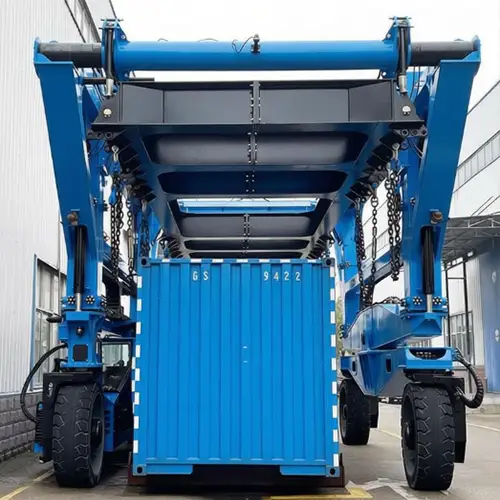
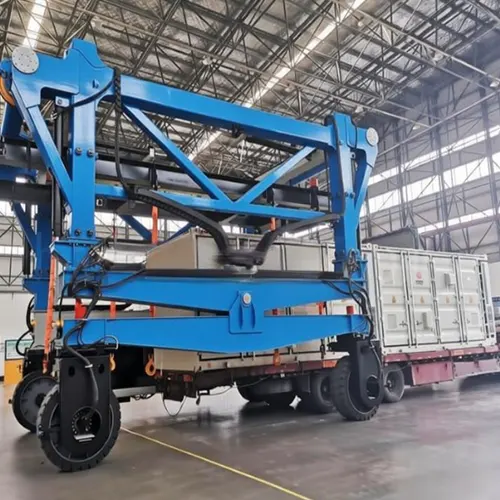
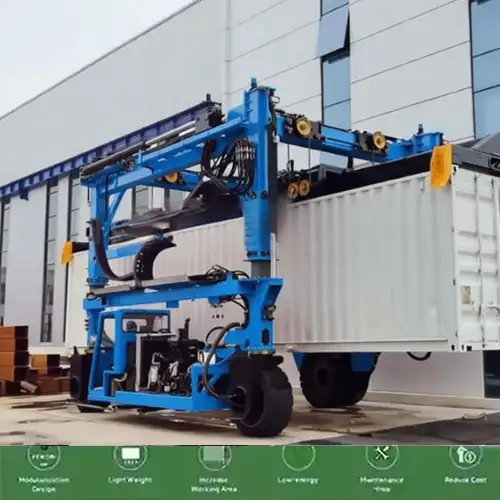

Yuantai Cranes
Overhead Crane Manufacturer with CE, ISO, SGS, CNEX Certificates.
- Main Specifications - Capacity: 0.5–550 tons | Span: up to 40m | Speed: 0.8–12 m/min | Duty: A3–A7 | Power: 380–690V, 50/60Hz | Control: pendant/remote/cabin
- Full engineering: FEA/PLC/VFD + in-house build + global delivery + on-site support, for workshops, factories, EPC contractors, industrial projects, etc.
- Support: design, manufacturing, testing, service – end-to-end, customized lifting solutions worldwide.
How to Get an Accurate Crane Price for Your Application?
Tips: Copy the spec list, fill in your details, and paste it into the form on the right/ down-below for a quick price.
- Crane type:_____ . (e.g., overhead crane, gantry crane, jib crane)
- Max weight to lift:_____ tons. (e.g., 2t, 5t, 10t, 20t, 50t)
- Lifting height:_____ m. (How high does the hook need to reach?
- Workshop width (span):_____ m . (Distance between the two crane rails)
- Travel distance:_____ m . (How long does the crane need to move along the runway?)
- Control type:_____. (Pendant / remote / cabin Control)
- Power supply:_____. (Local voltage & frequency – e.g., 380V, 50Hz, 3-phase)
- What will it be used for?_____ (e.g., steel fabrication, concrete products, mold handling, general manufacturing, etc.)
- Any special requirements?_____ (e.g., extreme temperature, dusty or explosive environment, special paint color, etc.)
Just leave a message via the contact form and our hoist and crane engineer will contact you with in 24working hours.
Get Your Custom Quote–Quick & Easy
Fill in what you know. Skip what you don't – we'll help.Any question will be reply with 24 working hours