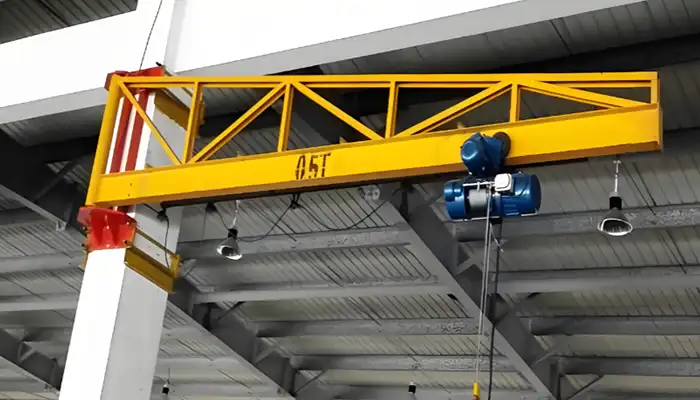
Wall Mounted Jib Crane Structural Requirements Guide
Content Quick Link
Most Important Takeaway
A wall-mounted jib crane does not only lift vertical loads—it introduces significant bending moment and horizontal forces into the building structure, and if the wall or steel column is not properly designed or reinforced, the system becomes unsafe regardless of crane capacity.
- Wall-mounted jib cranes transfer vertical load + horizontal shear + bending moment
- Structural capacity is often limited by jib arm length rather than rated load
- Anchor bolts and bracket design are critical failure points in installation
- Dynamic forces during rotation and lifting increase structural stress beyond static calculations
- Reinforced concrete walls or steel columns must be verified before installation
- If structure is insufficient, an independent steel column support system is required
Questions Solved in This Article
What structural requirements are needed for wall-mounted jib crane installation?
A wall-mounted jib crane depends fully on the building structure, so the wall or steel column must be checked before installation. It must have enough strength to handle vertical load, horizontal shear force, and bending moment together.
Key points in real projects:
- Reinforced concrete wall or steel column must be load-bearing
- No visible cracking or weak structural zones near mounting area
- Proper reinforcement layout must exist behind fixing points
- Structure must handle repeated lifting cycles, not only static load
In workshop practice, engineers always treat the building as part of the crane system, not just a support surface.
Why does jib arm length affect structural safety more than load weight in some cases?
In many cases, the jib arm length has more impact than the rated load itself because of leverage.
- Short jib arm → lower bending moment on wall
- Long jib arm → higher leverage force on mounting point
- Maximum stress always happens at full outreach position
So even a 1 ton crane can create higher structural stress than expected if the arm is long. This is why layout and rotation radius often control the design more than tonnage.
How do anchor bolts influence crane stability and safety?
Anchor bolts are the direct connection between crane and structure. They carry the full transfer of load.
- Bolt grade must match industrial lifting conditions
- Embedment depth controls pull-out resistance
- Correct spacing helps distribute bending moment
- Poor installation can lead to loosening or cracking over time
In real workshop use, most long-term issues come from anchor failure, not the crane body itself.
What happens if a building wall cannot support jib crane bending moments?
If the wall cannot handle bending moment and repeated stress, structural problems will appear over time.
Common outcomes include:
- Wall cracking near bracket zone
- Anchor bolt loosening
- Bracket deformation under repeated use
- Excess deflection during rotation
In this case, continuing wall mounting is not safe. The structure must be reinforced or replaced with an independent system.
When is a steel column support system required instead of wall mounting?
A steel column support system is required when the building structure cannot safely carry crane loads.
Typical situations:
- Old or lightweight workshop structures
- Insufficient reinforcement in concrete walls
- High lifting frequency with long jib radius
- Expansion of production layout beyond wall capacity
The steel column provides a dedicated load path and removes dependency on the building wall.
How do dynamic loads affect jib crane structural design?
Dynamic loads come from real operating conditions, not static calculations.
They include:
- Acceleration and stopping during hoisting
- Load swing during rotation
- Impact during positioning or assembly work
These forces increase actual stress beyond rated load values. That is why safety factors are always applied in design, especially for wall-mounted systems where bending moment is already critical.
Final practical note
In real industrial installation work, the rule is simple:
- Static load tells you what the crane lifts
- Structural design must consider what the building feels during operation
That difference is what decides long-term safety and performance.
Why Bending Moment Defines the Design Limit
In wall-mounted jib crane design, people often focus on rated capacity first (for example, 1 ton or 2 ton). But in actual workshop conditions, this is not the main control factor. The limitation usually comes from bending moment at the wall or steel column connection. The load may stay the same, but once the jib arm gets longer, the force on the structure changes significantly.
How jib arm length changes structural stress
This is simple in field practice. The longer the arm, the more "leverage" the load creates on the wall.
- Short outreach jib arm → lower moment load on wall structure. The load stays closer to the support point. Stress is easier to control. Common in compact maintenance stations or small assembly zones.
- Long outreach jib arm → higher stress at mounting point. The load moves farther away. The wall or column must resist stronger turning force. This is where many design issues start if structure is not checked properly.
Where maximum stress actually happens
In real operation, the worst condition is not when the crane is empty or partially loaded.
- Maximum stress happens when the load is placed at the outermost working radius
- At this position, the leverage effect is highest
- The wall bracket, anchor bolts, and reinforcement plates all carry peak force at the same time
This is why testing and structural checks always focus on full outreach position, not just lifting near the column.
Why workspace layout often controls crane selection
In many industrial projects—automotive assembly lines, machining workshops, steel fabrication areas—the crane is not selected only by tonnage. It is more often driven by how the space is used.
- Narrow workshop layout → shorter jib arm is preferred
- Multi-station production line → controlled rotation radius is important
- Obstructed floor area → engineers try to reduce outreach to limit wall load
- High-frequency lifting zone → structure fatigue becomes a key concern
So in practice, workspace geometry often decides the crane specification before lifting capacity does.
Simple field understanding used in installation
Technicians on site often summarize it in a very direct way:
- Same load, longer arm = more stress on the wall
- Short arm is easier to manage structurally
- Outer position is always the critical point
That is why in wall-mounted jib crane planning, engineers look at radius, rotation angle, and structure strength first, then confirm the tonnage later.
Wall or Steel Column Load Capacity Assessment
Before installing a wall-mounted jib crane, the first step is always the same: check the structure. Not the crane first, but the wall or steel column. Because this is what carries the full load in operation. In many workshops, this step is sometimes rushed. That is where problems start later—cracks, loosened anchors, or deflection after months of use.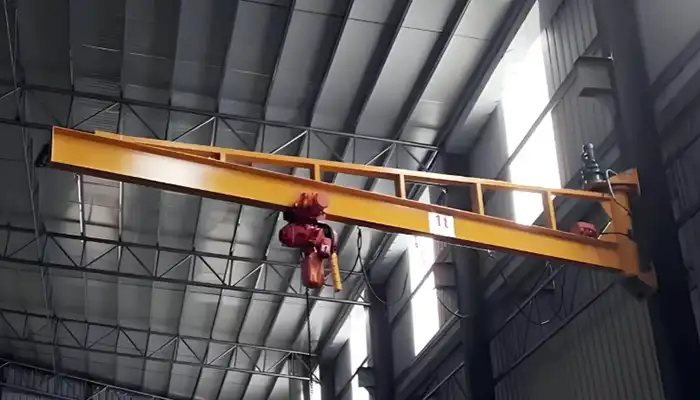
H Beam mounted wall jib crane
Reinforced Concrete Wall Requirements
When the crane is fixed on a concrete wall, the wall must do more than just "exist." It must handle lifting force, side force, and repeated stress from daily use.
- The wall must have enough compressive strength and thickness to carry combined load from lifting and rotation
- It must resist localized cracking, especially around the bracket area where stress is concentrated
- The internal reinforcement layout (rebar position and spacing) must be confirmed before drilling or anchoring
In practice, engineers often review structural drawings or perform on-site scanning before installation. If the reinforcement is weak or too shallow, the wall surface may look solid but still fail under repeated loading cycles.
Steel Column Structure Requirements
In many industrial buildings, a steel column is used instead of a concrete wall. This is common in fabrication shops and assembly plants where crane systems are added after construction.
- The column must resist both shear force and bending moment generated during jib rotation and lifting
- Connection points (brackets, welds, or bolted joints) must handle repeated rotation stress, not just static load
- Column stiffness is important. If the column flexes too much, the crane will feel unstable during operation
In real use, even small deflection at the column top becomes noticeable at the jib arm end. Operators often describe it as "swing" or "soft movement," which is not ideal for precise assembly work.
Practical Field Check Before Installation
In workshop installation work, engineers usually check a few simple but important points:
- Is the wall or column part of the main load-bearing structure?
- Is reinforcement clearly confirmed at the mounting zone?
- Will the structure hold repeated lifting cycles, not just one-time load test?
- Is there any sign of old cracking, rust, or deformation?
If any of these answers are uncertain, the design is usually adjusted before installation starts.
Simple Engineering Reality in Workshop Projects
In industrial projects like automotive lines, machining areas, and steel workshops, one rule is commonly followed:
- Strong structure first, crane second
- Concrete wall or steel column must be verified before tonnage selection
- Stability over time matters more than initial installation strength
This is why structural assessment is not a formality. It directly decides whether the wall-mounted jib crane will run smoothly for years or start showing problems early in operation.
Anchor Bolt Design and Structural Fixing System
Anchor bolts are not a small detail in wall-mounted jib crane installation. In practice, they are the connection between the crane and the building structure. Every force from lifting, rotation, and outreach finally passes through these bolts. If this part is not designed properly, the whole system becomes unsafe, even if the crane itself is correctly selected.
Bolt grade selection for industrial lifting conditions
In industrial workshop environments, anchor bolts must handle repeated load cycles, not just static weight.
- High-strength structural bolts are required for industrial jib crane mounting
- Lower-grade bolts may deform over time under repeated lifting and rotation
- Bolt material must match expected working load and duty frequency
In many cases, engineers select higher-grade bolts than the minimum requirement to allow long-term safety margin, especially in high-frequency production lines.
Embedment depth and pull-out resistance
One of the most important factors is how deep the bolt is fixed into the wall or foundation.
- Deeper embedment improves resistance to pull-out force
- Shallow installation increases risk of loosening under repeated loading
- Concrete quality around the anchor zone directly affects holding strength
In installation work, proper drilling depth and correct chemical anchoring or mechanical anchoring method are essential. This is especially important when the crane has a long jib arm, since leverage increases the force on the anchor point.
Anchor spacing and load distribution
Anchor bolts must not work as single points. They must act as a system.
- Correct spacing helps distribute bending moment across multiple points
- Improper spacing creates stress concentration on one or two bolts
- Even load sharing reduces long-term fatigue risk
In workshop practice, wider bolt spacing is often used for higher moment loads, especially in wall-mounted systems with medium to long outreach.
Fatigue resistance under repeated operation
In industrial use, the crane is not lifted once or twice. It works daily.
- Repeated lifting creates fatigue stress on anchor bolts
- Small movements during rotation can gradually loosen connections
- Over time, micro-slippage may develop if design is weak
This is why inspection schedules often include checking bolt tightness and base condition during maintenance cycles.
Common field issue in jib crane installations
In many projects, structural problems do not come from the crane body itself. They come from anchoring.
Typical issues include:
- Bolt loosening after long-term operation
- Concrete cracking around anchor zones
- Uneven load sharing between bolts
- Deformation at bracket connection points
Most of these issues are linked to under-designed or poorly installed anchor systems.
Simple installation rule used in practice
On site, experienced engineers often follow a simple rule:
- Strong bolt grade alone is not enough
- Embedment depth and spacing matter just as much
- Anchor system must be designed for repeated working cycles, not only static load
In wall-mounted jib crane systems, anchor bolts are the final safety line. If they are not correct, everything above them becomes unreliable in operation.
Bracket Reinforcement and Load Distribution Design
The mounting bracket is a key structural part in a wall-mounted jib crane system. It is the point where all forces come together—lifting load, rotation force, and bending moment—and then transfers everything into the wall or steel column. If the bracket design is weak, even a properly sized crane will not perform safely in long-term use.
Stiffener plates reduce local stress concentration
Stiffener plates are used to strengthen the bracket where force is most concentrated.
- They help spread the load away from a single point
- Reduce high stress zones around bolt holes and welds
- Improve resistance against repeated lifting cycles
In workshop conditions, stiffeners are especially important when the crane is used frequently, such as in assembly lines or maintenance bays.
Base plates improve load distribution
The base plate is the main contact surface between the bracket and the structure.
- A larger base plate spreads the load over a wider wall area
- Helps reduce pressure on concrete or steel surface
- Reduces risk of local crushing or deformation
In practical installation work, engineers often increase base plate size when dealing with longer jib arms or higher working frequency. It is a simple but effective way to control stress.
Gusset reinforcement for rotational forces
Gusset plates are used to strengthen the bracket against twisting and rotation.
- They support the bracket under bending moment conditions
- Improve stability during slewing (rotation of jib arm)
- Reduce vibration and slight movement at the mounting point
In operation, this becomes important when the crane is used for positioning tasks where the load is frequently rotated or stopped at different angles.
Why bracket design decides long-term performance
In workshop environments like fabrication shops, automotive plants, and machining areas, bracket failure is rarely immediate. It develops over time.
Common issues include:
- Gradual deformation at weld joints
- Slight movement at mounting connection
- Uneven load transfer to the wall or column
- Fatigue damage after repeated cycles
Most of these problems come from insufficient reinforcement design, not from the crane itself.
Practical installation understanding
In field work, engineers usually look at bracket design in a simple way:
- Base plate carries the spread load
- Stiffeners handle local stress points
- Gussets control rotation and stability
When these three parts work together properly, the wall-mounted jib crane operates smoothly and stays stable under repeated industrial use.
Dynamic Load Effects in Operating Conditions
In workshop use, a wall-mounted jib crane never works under "clean" static load. The load is always moving, stopping, or being positioned. That means the structure sees extra force beyond the rated lifting weight. Static calculation is only the starting point. Field conditions are different.
Acceleration and deceleration during hoisting
When the hoist starts or stops, force is not smooth.
- Starting the lift creates a short impact load
- Sudden stop increases tension in the lifting point
- Repeated cycles create extra stress on wall bracket and anchors
In daily operation, this happens many times per shift. So the structure is not just holding weight—it is handling repeated motion forces.
Load swing during rotation
During slewing (rotation of the jib arm), the load often swings slightly.
- Swing creates side force on the jib arm
- The force transfers back into the bracket and wall structure
- Longer jib arms amplify the swing effect
In workshops like fabrication shops or assembly lines, operators often rotate the crane while the load is still stabilizing. This adds extra dynamic stress that is not shown in static load charts.
Sudden positioning impact during assembly work
In many industrial applications, cranes are used for positioning parts, not just lifting.
- Load may be lowered quickly into position
- Small impact happens when the load touches a fixture or machine
- Repeated placement cycles create micro-shocks in the structure
This is common in automotive assembly, machining, and maintenance workshops where precision placement is frequent.
Why dynamic load changes the design value
In theory, a crane may be rated for a certain tonnage. But in operation:
- Actual force is higher than static rated load
- Moment load on the wall increases during movement
- Repeated cycles cause fatigue over time
This is why engineers apply safety factors during design, especially for wall-mounted systems where bending moment is already a key stress point.
Practical field understanding
In installation and workshop use, experienced engineers often describe it simply:
- Static load is what the crane "lifts"
- Dynamic load is what the structure "feels" during operation
That difference is what decides long-term performance.
Simple engineering rule in practice
In industrial projects:
- Smooth operation reduces structural stress
- Sudden movement increases fatigue on brackets and anchors
- Dynamic load must always be included in design checks
Without considering these factors, even a correctly sized wall-mounted jib crane can face early wear or structural issues in continuous production environments.
Structural Limitation and the Need for Independent Steel Column Systems
In many wall-mounted jib crane projects, the limiting factor is not the crane itself. It is the building structure. Once the wall or existing steel column cannot safely carry the bending moment and shear force, continuing with wall mounting is no longer practical. At this point, engineers usually shift to an independent steel column solution.
When the building structure reaches its limit
In workshop conditions, structural limits show up in a few clear ways:
- The wall shows cracking near the bracket area
- Anchor bolts cannot be safely upgraded further
- Excess deflection appears during rotation or lifting
- The calculated bending moment exceeds safe wall capacity
When these conditions appear, the structure is no longer suitable for direct crane mounting, even if the crane capacity is small.
What a steel column support system provides
An independent steel column system removes dependence on the building wall. It creates a dedicated load path from crane to foundation.
- Dedicated load-bearing structure
The crane forces go directly into the steel column and foundation, not the building wall. - Higher lifting capacity and larger jib radius
Because the structure is designed specifically for crane loads, it can support higher tonnage and longer outreach. - Improved safety in older workshops
In aging buildings or light steel structures, this avoids risk of structural fatigue or hidden weakness. - Better flexibility for layout changes
The crane position can be planned according to workflow instead of wall location.
Where independent columns are commonly used
In industrial applications, this solution is widely used where load demand and layout flexibility are both important:
- Automotive assembly workshops with multi-station workflow
- Heavy fabrication shops handling steel parts and assemblies
- Maintenance areas with frequent lifting and repositioning tasks
- Production lines where future expansion is expected
In these environments, crane usage is continuous. The structure must be reliable over long cycles, not just initial installation.
Why this system is often the safer long-term option
In practice, engineers prefer independent steel columns when there is uncertainty about the building structure.
- It removes risk from unknown wall conditions
- It avoids dependence on old or unverified reinforcement
- It provides predictable load behavior under bending and rotation
Over time, this reduces maintenance issues and improves operational stability.
Simple field conclusion
In installation work, the decision is usually straightforward:
- If the building is strong and verified → wall-mounted jib crane is acceptable
- If structure is uncertain or heavily loaded → independent steel column is the safer path
This is not about over-design. It is about keeping the crane system stable for daily industrial use without stressing the building structure beyond its capacity.
Conclusion
Wall-mounted jib cranes are highly efficient for localized lifting and workstation material handling, but their safety depends entirely on structural engineering integrity. The critical design challenge is not lifting capacity alone, but the combined effects of bending moment, anchor performance, and dynamic loading.
Proper evaluation of wall or column strength, bracket reinforcement, and jib arm length ensures safe operation. When structural limits are exceeded, transitioning to an independent steel column system is the correct engineering solution to maintain safety and long-term operational reliability.

Article by Bella ,who has been in the hoist and crane field since 2016. Bella provides overhead crane & gantry crane consultation services for clients who need a customized overhead travelling crane solution.Contact her to get free consultation.
Yuantai Cranes
Overhead Crane Manufacturer with CE, ISO, SGS, CNEX Certificates.
- Main Specifications - Capacity: 0.5–550 tons | Span: up to 40m | Speed: 0.8–12 m/min | Duty: A3–A7 | Power: 380–690V, 50/60Hz | Control: pendant/remote/cabin
- Full engineering: FEA/PLC/VFD + in-house build + global delivery + on-site support, for workshops, factories, EPC contractors, industrial projects, etc.
- Support: design, manufacturing, testing, service – end-to-end, customized lifting solutions worldwide.
How to Get an Accurate Crane Price for Your Application?
Tips: Copy the spec list, fill in your details, and paste it into the form on the right/ down-below for a quick price.
- Crane type:_____ . (e.g., overhead crane, gantry crane, jib crane)
- Max weight to lift:_____ tons. (e.g., 2t, 5t, 10t, 20t, 50t)
- Lifting height:_____ m. (How high does the hook need to reach?
- Workshop width (span):_____ m . (Distance between the two crane rails)
- Travel distance:_____ m . (How long does the crane need to move along the runway?)
- Control type:_____. (Pendant / remote / cabin Control)
- Power supply:_____. (Local voltage & frequency – e.g., 380V, 50Hz, 3-phase)
- What will it be used for?_____ (e.g., steel fabrication, concrete products, mold handling, general manufacturing, etc.)
- Any special requirements?_____ (e.g., extreme temperature, dusty or explosive environment, special paint color, etc.)
Just leave a message via the contact form and our hoist and crane engineer will contact you with in 24working hours.
Get Your Custom Quote–Quick & Easy
Fill in what you know. Skip what you don't – we'll help.Any question will be reply with 24 working hours