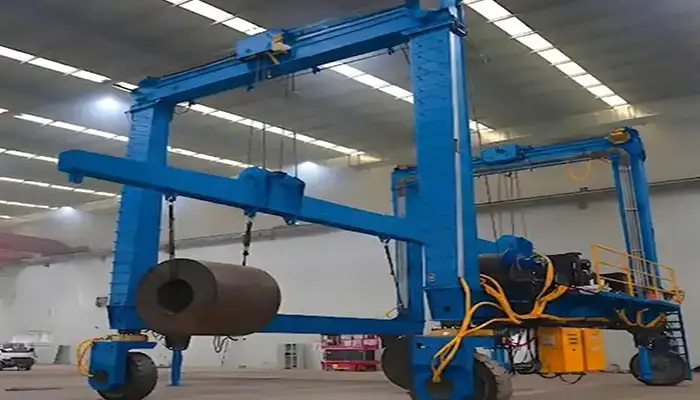
RTG Crane vs Rail Travelling Gantry Crane for Steel Coils
Content Quick Link
Most Important Takeaway
For steel coil handling, the key decision is not only crane type, but mobility system and yard structure.
- RTG crane (rubber tyred wheel gantry crane / wheel travelling cranes) is best for flexible, changing steel coil yards
- Rail travelling gantry crane (standard gantry crane on rails) is best for fixed, structured, high-efficiency steel coil operations
The correct choice depends on whether your steel coil yard requires freedom of movement or fixed rail efficiency.
What This Guide Helps You Decide
This guide is designed to help buyers make practical decisions when selecting between RTG cranes (rubber tyred wheel gantry cranes), wheel travelling cranes, and rail travelling gantry crane systems for steel coil handling projects. The focus is on real working conditions in steel mills, ports, and logistics yards rather than just technical specifications.
Difference between RTG crane and rail travelling gantry crane in steel coil handling
Understanding how each system works helps avoid wrong selection at the planning stage. RTG cranes use rubber tyre movement and flexible yard access, while rail travelling gantry cranes follow fixed paths for structured coil flow and stable operation.
How rubber tyred wheel gantry crane systems improve yard flexibility
In steel coil storage yards with frequently changing layouts, rubber tyred RTG systems allow operators to adjust working zones without rebuilding infrastructure. This makes them suitable for yards where storage patterns and daily operation needs frequently change.
When wheel travelling cranes are more practical than fixed rail systems
Wheel travelling cranes are ideal when steel coil flow is irregular, customer-driven, or seasonal. They adapt to changing coil positions and varying shipment schedules without forcing a fixed yard structure.
Typical capacity range used in steel coil handling applications
RTG and wheel travelling cranes are designed for practical working ranges, while rail travelling gantry cranes are selected for higher and more stable lifting requirements. Capacity depends on coil size, stacking height, and handling frequency rather than a fixed standard.
How steel mills, ports, and logistics yards influence crane selection
Steel mills follow continuous production flow, ports work with high-turnover shipping cycles, and logistics yards handle mixed customers and variable schedules. These differences determine whether a fixed rail system or a mobile wheel-based system is more suitable.
Infrastructure impact such as rails, ground condition, and power supply
Rail travelling gantry cranes require stable foundation, rails, and reliable power supply. RTG systems rely more on ground condition, mobility space, and operational flexibility. These infrastructure factors often dictate the final system choice before capacity is considered.
How coil size, weight, and handling frequency affect crane choice
Heavier coils, frequent lifting cycles, and continuous handling require more stable crane systems. Mixed coil sizes, irregular flow, and variable handling frequency favor wheel travelling cranes for their adaptability.
How to avoid selecting a gantry crane system that does not match real operation flow
The most common mistake is choosing based only on price or lifting capacity without studying actual coil movement. Proper selection must consider how coils are stored, how often yard layout changes, and the full material flow from production or delivery points.
RTG Crane and Rail Travelling Gantry Crane Systems
In steel coil handling projects, the first consideration is often not price, but the crane movement system. Whether the crane moves on tyres or rails affects yard layout, coil stacking, and truck loading efficiency. Once this is clear, selecting the right crane becomes much easier.
RTG Crane (Rubber Tyred Wheel Gantry Crane)
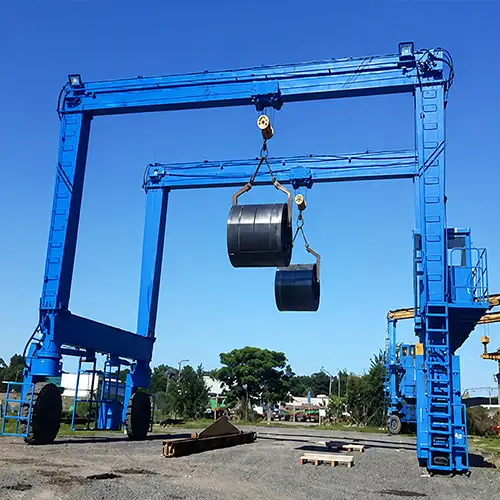
RTG cranes, also called rubber tyred wheel gantry cranes, run on rubber tyres instead of fixed rails. They move freely across yards, ideal for steel coil storage areas where layouts frequently change.
Many steel coil yards reorganize storage weekly based on shipment plans. RTG cranes adapt easily to these changing layouts, unlike fixed rail cranes.
Main characteristics of RTG cranes:
- Rubber tyre travelling system without rail limitation
- Can move in multiple directions across coil zones
- Powered by diesel, hybrid, or electric battery systems
- Suitable for outdoor yards and open logistics areas
- Accommodates yard expansion or layout changes
Operator insight: "We just drive the crane to where the coils are." This simple flexibility is a key reason RTG cranes are chosen.
Typical Capacity Range for Steel Coil Handling
- Standard RTG crane: 20–80 ton
- Heavy-duty RTG crane: 80–150 ton
- Custom steel coil handling RTG: up to ~200 ton (depending on structure and wheel load distribution)
- Common lifting tools: coil hooks, C-hooks, or coil tongs depending on coil diameter and packing type
Most routine operations stay within 30–80 ton; heavier configurations are reserved for special grades or bundled coils.
Rail Travelling Gantry Crane (Standard Gantry Crane on Rails)
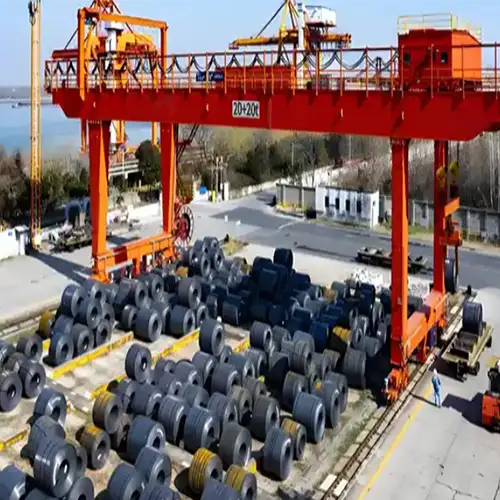
Rail travelling gantry cranes move along steel rails on concrete foundations. Their limited path ensures stable movement and precise positioning.
This system is ideal when yard layouts are pre-planned and unlikely to change. Once installed, coil flow becomes structured, reducing random movement.
Key characteristics:
- Fixed rail system with defined straight or parallel tracks
- Fully electric operation connected to industrial power supply
- Stable, precise movement along controlled path
- Best for planned stacking zones
- Handles continuous loading/unloading efficiently
Operators prefer predictable paths, improving coordination with trucks, forklifts, and storage areas.
Typical Capacity Range for Steel Coil Handling
- Standard rail gantry crane: 30–100 ton
- Heavy-duty industrial gantry crane: 100–300 ton+
- Special steel coil/slab handling systems: up to 500 ton for large plants or port operations
- Designed for continuous, high-frequency coil handling
Daily operations typically fall in 40–120 ton. Higher capacities are used for heavier or bundled coils, slabs, or oversized steel materials.
When Flexibility Matters More (RTG Crane / Wheel Travelling Cranes)
In many steel coil handling projects, the yard layout changes frequently with production output, shipping orders, or seasonal demand. RTG cranes and wheel travelling cranes are more practical in these cases because they do not lock the operation into a fixed structure. Instead of designing everything around rails, the yard stays open, and the crane moves with the work.
Typical Application Scenarios
RTG cranes and wheel travelling gantry systems are chosen when working conditions are unstable or expected to change.
Common use cases include:
- Steel coil storage yards where stacking layout changes based on shipment plans
- Multi-customer logistics and distribution centers handling different coil specifications
- Temporary or expandable steel handling yards that may grow or shift over time
- Outdoor steel coil yards where rail foundation investment is impractical
Coil positions are not always predictable; a flexible travelling system adapts better to weekly changes in yard status and dispatch schedules.
Why Rubber Tyred Wheel Gantry Crane Performs Better
The key advantage of a rubber tyred gantry crane is mobility and removing fixed constraints from yard design.
Benefits in practical operation:
- No rail installation required, reducing civil work cost and planning time
- Can be relocated between coil storage blocks without structural limitations
- Handles irregular steel coil flow with frequently changing lifting points
- Accommodates mixed coil sizes and varying shipment schedules within the same yard
Operators often prefer RTG systems because the crane can "follow the work" instead of waiting for materials in a fixed lane, which improves daily yard efficiency.
Practical Buyer Insight
Steel coil logistics is rarely stable. Coil output varies with rolling schedules, order batches, and delivery timing. Trucks may arrive early, late, or all at once. Storage space shifts depending on dispatch urgency.
In such environments, a wheel travelling or RTG crane provides operational freedom, allowing the yard to adjust without stopping production or rebuilding infrastructure.
Key points buyers notice in real use:
- Coil stacking areas can be reorganized without changing equipment layout
- Crane operation is not limited to one fixed lane, reducing waiting time
- Handling sequence can be adjusted based on daily shipment priority
- Yard expansion does not require immediate rail extension
In short, when steel coil flow is not fixed, the crane should not be fixed either.
When Rail Travelling Gantry Crane Performs Better
Rail travelling gantry cranes are best suited for steel coil handling systems with well-planned, stable layouts. In these yards, mobility is less important than consistent, repeatable operation. The crane follows fixed lanes and stacking positions, making stability the priority.
Typical Application Scenarios
Rail travelling gantry cranes are chosen where material flow is continuous and predictable.
Common scenarios include:
- Steel mills with continuous coil production lines feeding storage and dispatch areas
- Port terminals handling steel coil import and export with fixed loading lanes
- Railway loading/unloading yards using track-based coil transfer systems
- Long-term industrial storage centers with stable customer demand and planned yard layout
In these setups, coil movement is scheduled and predictable, allowing the system to operate the same way for years.
Why Standard Gantry Crane on Rails Is More Efficient
The main advantage of rail travelling gantry cranes is controlled, repeatable movement, which ensures operational efficiency.
Operational benefits:
- Faster cycle times as cranes always travel along defined paths
- Higher stacking density with storage zones planned around rail lanes
- Improved stability during repetitive lifting cycles in continuous production
- Lower long-term operational cost due to reduced energy waste and predictable movement
Operators often notice that once rail systems are optimized, coordination with trucks, forklifts, and schedules becomes simpler.
Practical Buyer Insight
Rail travelling gantry cranes excel when coil flow is steady. The system is built for repetition, not variation.
Key observations from real operations:
- Coil movement paths remain consistent daily
- Yard layout can be optimized for maximum stacking with minimal adjustments
- Cycle time per operation becomes predictable
- Equipment wear is reduced due to controlled travel routes
In short, when steel coil flow is stable, rail travelling gantry cranes help the yard operate efficiently, reducing unnecessary movements and operational variability.
Cost vs Productivity Comparison
Comparing RTG cranes and rail travelling gantry cranes is not just about purchase price. The real difference lies in long-term cost behavior, daily productivity, and suitability for changing or fixed steel coil yard conditions.
RTG Crane (Rubber Tyred Wheel Gantry Crane)
RTG cranes are popular because they avoid rail installation, reducing initial infrastructure work and speeding up project setup. Long-term operating costs and performance depend on yard management and operator handling.
Main cost and performance characteristics:
- Lower initial infrastructure cost (no rail or track foundation required)
- Higher energy or fuel use depending on diesel, hybrid, or battery configuration
- Moderate productivity influenced by yard organization and movement planning
- High flexibility, especially in yards with changing layouts or unstable demand
Best suited for:
- Steel coil logistics yards with changing operational needs
- Projects with phased investment planning
- Facilities where flexibility outweighs maximum throughput
Rail Travelling Gantry Crane (Standard Gantry Crane)
Rail travelling gantry cranes require rail installation, foundation work, and precise alignment. While the initial investment is higher, the system delivers stable, efficient operation once installed.
Main cost and performance characteristics:
- Higher initial investment due to rail foundation and civil works
- Lower operating cost from fully electric operation along fixed paths
- Higher productivity in continuous steel coil handling with repetitive cycles
- Optimized cycle efficiency with minimal unnecessary movement
Best suited for:
- Steel mills with continuous coil production output
- Port and industrial terminals with fixed loading lanes
- Long-term steel coil storage and distribution systems
- Buyers prioritizing stable operation and predictable throughput
Steel Mill vs Logistics Yard Selection Logic
Choosing between RTG cranes and rail travelling gantry cranes depends largely on how steel coils move through the site. Steel mills and logistics yards follow different operational patterns, so crane selection should align with these patterns.
Steel Mill Coil Handling (Production Side)
Steel mills operate in a production-driven rhythm with continuous coil output. The yard layout is usually fixed, and operations are repetitive and structured.
Key characteristics:
- Continuous coil output from rolling or processing lines
- Fixed storage and dispatch zones
- High repetition handling cycles with similar coil sizes and weights
Recommended solution: Rail Travelling Gantry Crane (Standard Gantry Crane)
This choice ensures coil movement is synchronized with production, reducing waiting time and maintaining stable cycle timing.
Logistics and Distribution Yard (Commercial Side)
Steel logistics yards are customer- and market-driven. Coil flow changes based on shipment plans, so yard layouts are adjusted frequently.
Key characteristics:
- Irregular coil flow depending on orders and shipment timing
- Flexible storage layouts that adjust to inventory levels
- Multi-zone operations handling different customers and coil specifications
Recommended solution: RTG Crane / Rubber Tyred Wheel Gantry Crane
This system allows cranes to move between zones and adapt to changing yard conditions, making daily operations practical in dynamic logistics environments.
Hybrid Steel Handling Strategy
Large steel projects often require a mixed approach to cover both production efficiency and logistics flexibility.
Typical hybrid arrangement:
- Rail travelling gantry cranes in high-efficiency core zones near production lines or fixed dispatch points
- Wheel travelling cranes or RTG cranes in flexible storage areas where coil flow changes frequently
This combination balances two goals: stable handling for production-side operations and adaptable flexibility for logistics-side operations.
Real Project Application Examples
RTG cranes and rail travelling gantry cranes are both commonly used in steel coil handling projects. The selection is usually determined by day-to-day yard operation rather than just technical specs.
Port Steel Coil Terminal Case
In port environments, coil handling is part of continuous import/export flow. Yard layout is fixed, with structured lanes for stacking and truck movement.
Typical conditions:
- High-volume export/import with constant turnover
- Stable yard layout with defined stacking lanes
- Fast loading/unloading to match vessel schedules
Result: Rail Travelling Gantry Crane is preferred for cycle stability, stacking efficiency, and predictable high-frequency operation.
Steel Plant Internal Yard Case
Inside steel plants, coil movement is linked to production speed. Yard layout may change daily depending on output, dispatch priorities, and temporary storage needs.
Typical conditions:
- Direct movement from production line to temporary storage
- Yard layout adjusted based on rolling schedule and production volume
- Outdoor/semi-outdoor storage zones flexible per shift
Result: RTG Crane or Wheel Travelling Gantry Crane is preferred for flexible yard operation, adapting to changing coil output and real-time storage demands.
Industrial Logistics Hub Case
Industrial logistics hubs handle mixed steel coil batches from multiple suppliers to different customers. The handling flow is unpredictable, requiring flexible yard organization.
Typical conditions:
- Mixed coil specifications: sizes, weights, packing types
- Multiple customers with independent shipment schedules
- Variable handling flow changing daily
Result: Rubber Tyred Wheel Gantry Crane provides better adaptability, allowing free movement across the yard and adjusting storage zones according to actual workflow.
Final Buyer Decision Framework
This section helps buyers decide between RTG cranes and rail travelling gantry cranes based on yard layout, operation flow, and project priorities.
Q: How do I choose between RTG crane and rail travelling gantry crane for steel coil handling?
A: The right choice depends mainly on whether your steel coil yard is fixed in layout or needs frequent operational changes.
- If your yard design stays the same for years with stable coil movement, rail travelling gantry crane is better for repetitive loading cycles and consistent handling routes.
- If the storage area changes often, or you manage multiple customers, mixed coil sizes, and shifting dispatch schedules, RTG crane works better for adaptable yard operation without rail constraints.
Q: Is RTG crane suitable for steel coil yard with changing storage layout?
A: Yes, RTG crane is more suitable for yards frequently rearranged or expanded.
- Operators often search for "flexible steel coil handling solution without rail installation cost," which RTG systems provide.
- Wheel travelling cranes can move between stacking blocks, supporting temporary storage changes and seasonal workload without structural modifications.
Q: When does rail travelling gantry crane become the better choice?
A: Rail travelling gantry crane is better when coil flow is stable and operation follows fixed routes.
- In steel mills with predictable dispatch schedules, fixed rails reduce unnecessary movement and improve cycle efficiency.
- Ideal for projects seeking "high efficiency steel coil yard crane system for long-term operation" rather than flexible movement.
Q: Which crane is better for steel mill vs logistics yard?
A: Steel mills usually prefer rail travelling gantry cranes, while logistics yards tend to use RTG or wheel travelling gantry cranes.
- Steel mills have structured, repetitive handling cycles, making fixed rails more efficient.
- Logistics yards have changing customer demand, shipment timing, and mixed coil specifications, so RTG cranes provide better adaptability.
Q: Does RTG crane reduce infrastructure cost compared to rail systems?
A: Yes, RTG crane reduces initial civil work because no rail installation is required.
- Many buyers consider RTG systems for "low investment steel coil yard crane solution" or "no rail gantry crane for outdoor steel storage."
- Operating cost and energy/fuel usage vary depending on yard management and usage intensity, despite easier initial setup.
Q: Can both RTG crane and rail travelling gantry crane be used in the same steel coil project?
A: Yes, many large projects combine both systems to balance flexibility and efficiency.
- Rail cranes in high-throughput fixed zones near production lines, RTG cranes in flexible storage and dispatch areas.
- Hybrid setup is ideal for "complete steel coil handling system" integrating production and logistics, especially in large industrial or port-connected operations.
Conclusion
The decision between RTG crane (rubber tyred wheel gantry crane, wheel travelling cranes) and rail travelling gantry crane (standard gantry crane system) depends on steel coil handling strategy, not only equipment type.
RTG cranes provide maximum flexibility for changing steel coil yards and dynamic logistics environments. Rail travelling gantry cranes provide higher efficiency, stability, and long-term performance for fixed steel coil operations.
For steel mills, ports, and logistics yards, the correct choice depends on how steel coils move, how stable the yard structure is, and how the system is expected to perform over its full lifecycle.

Article by Bella ,who has been in the hoist and crane field since 2016. Bella provides overhead crane & gantry crane consultation services for clients who need a customized overhead travelling crane solution.Contact her to get free consultation.
Yuantai Cranes
Overhead Crane Manufacturer with CE, ISO, SGS, CNEX Certificates.
- Main Specifications - Capacity: 0.5–550 tons | Span: up to 40m | Speed: 0.8–12 m/min | Duty: A3–A7 | Power: 380–690V, 50/60Hz | Control: pendant/remote/cabin
- Full engineering: FEA/PLC/VFD + in-house build + global delivery + on-site support, for workshops, factories, EPC contractors, industrial projects, etc.
- Support: design, manufacturing, testing, service – end-to-end, customized lifting solutions worldwide.
How to Get an Accurate Crane Price for Your Application?
Tips: Copy the spec list, fill in your details, and paste it into the form on the right/ down-below for a quick price.
- Crane type:_____ . (e.g., overhead crane, gantry crane, jib crane)
- Max weight to lift:_____ tons. (e.g., 2t, 5t, 10t, 20t, 50t)
- Lifting height:_____ m. (How high does the hook need to reach?
- Workshop width (span):_____ m . (Distance between the two crane rails)
- Travel distance:_____ m . (How long does the crane need to move along the runway?)
- Control type:_____. (Pendant / remote / cabin Control)
- Power supply:_____. (Local voltage & frequency – e.g., 380V, 50Hz, 3-phase)
- What will it be used for?_____ (e.g., steel fabrication, concrete products, mold handling, general manufacturing, etc.)
- Any special requirements?_____ (e.g., extreme temperature, dusty or explosive environment, special paint color, etc.)
Just leave a message via the contact form and our hoist and crane engineer will contact you with in 24working hours.
Get Your Custom Quote–Quick & Easy
Fill in what you know. Skip what you don't – we'll help.Any question will be reply with 24 working hours