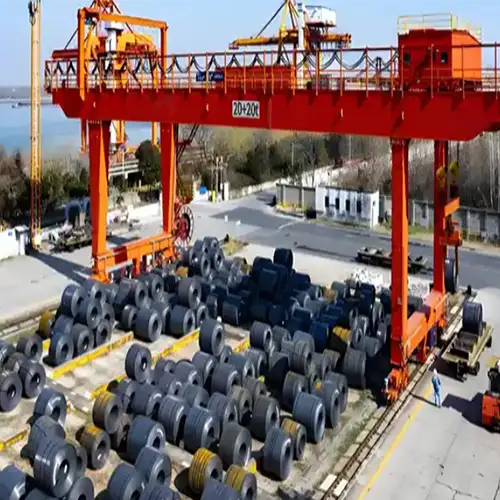
Rail Mounted Gantry Cranes: Load Handling & Industrial Guide
Rail mounted gantry cranes for containers, steel, precast, and bulk materials. Learn design, attachments, and selection for industrial operations.
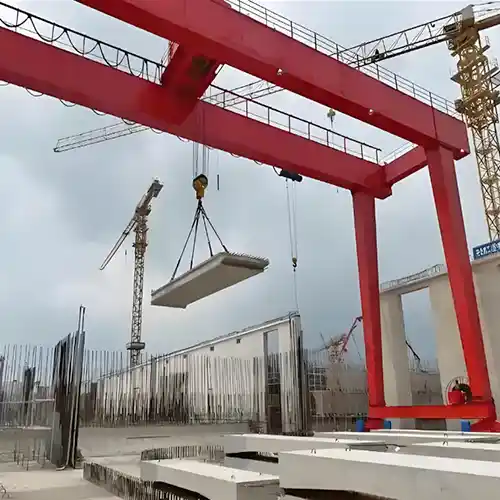
| Crane Type | Rail Mounted Gantry Cranes with ground rail travelling - Rail Mounted Gantry Crane (RMG), double-girder for industrial and heavy-load applications; electric wire rope hoist or open winch; ISO A5–A8 / FEM 2M–5M 380/400/415V, 50Hz, 3Ph; |
| Crane Capacity | 10 ton to 320 ton, for industrial RMG applications; capacity selected according to maximum load, lifting attachment/spreader weight, load distribution, and handling cycle. |
| Span Length | 10–40 m+ span; rail gauge, runway length, and working range customized according to the site layout and load-handling area. |
| Lifting Height | 6–30 m; customized according to storage height, clearance, load dimensions, and operating requirements. |
| Coverage Area Type | Rail-defined rectangular working coverage; storage yards, container yards, steel yards, fabrication areas, production zones, warehouses, loading areas, and designated material-handling lanes. |
| Application | Steel handling, container handling, precast production, shipyard operations, heavy machinery handling, warehouses, fabrication yards, logistics terminals, and industrial material storage. |
| Certifications | CE / ISO / SGS / Other third-party inspection |
| Customization | Customized double-girder gantry structure, electric wire rope hoist or open winch, electric trolley, hook/spreader/grab/magnet configuration, cabin or radio control, VFD, positioning, anti-collision, and automation according to the load and application. |
Crane Manufacturer: Yuantai Cranes – 30+ Years Professional Crane Manufacturer from China
Category: Featured
Tags: rmgcrane
Your Trusted Rail Mounted Gantry Crane Manufacturer & Supplier
Rail Mounted Gantry Crane for Sale
Load Handling & Industrial Guide : Select Based on Your on Load Handling &Application
Most Important Takeaway
Choosing the right rail mounted gantry crane is load-driven; understanding weight, shape, material, and industrial environment ensures safety, efficiency, and ROI.
Key Takeaways
- Load type dictates crane design: hoist, trolley, span, and attachments.
- Weight, shape, size, and material properties determine lifting systems and precision needs.
- Operational frequency, site layout, and environmental conditions influence duty classification.
- Specialized loads (coils, TBM segments, ship blocks, bulk materials) require unique attachments.
- Questions solved: How to select the right crane? What lifting attachments are needed? What spans, hoists, and duty levels suit my operation?
Practical FAQ – Rail Mounted Gantry Cranes & Load Handling
Q: Can one RMG crane handle both steel coils and precast panels safely?
A: Yes, but only if it's designed with flexible lifting attachments and suitable duty classification.
- Multi-purpose cranes require C-hooks or coil grabs for coils and multi-point lifting frames for precast panels.
- Duty class, hoist selection, and anti-sway systems must accommodate the heaviest and most fragile load.
- Single-purpose cranes are cheaper but less flexible for mixed-load yards.
Q: How do I choose the right trolley configuration for my yard?
A: Trolley choice depends on load length, weight distribution, and operational speed requirements.
- Single trolley → short, medium-weight loads like 20–40 ft containers or light coils.
- Dual trolley → long beams, precast panels, heavy shipyard modules, or high-cycle steel coils.
- Dual trolleys reduce bending, sway, and stress for uneven or long loads.
Q: What lifting devices should I use for steel coils?
A: C-hooks or coil grabs are most common, with optional dual-trolley support for large or high-cycle coils.
- Anti-rotation devices prevent coil twisting during acceleration or deceleration.
- Dual-trolley configuration is only recommended for heavy, long, or high-speed operations.
- Proper attachment selection ensures safety, productivity, and minimal material damage.
Q: How do load size and shape influence span and lifting height?
A: Longer or irregular loads require longer spans and precise lifting height adjustments.
- Steel beams or long precast panels → span 25–50 m, lifting height 8–15 m.
- Compact loads → span 20–30 m, lifting height 6–12 m.
- Clearance for high stacking (containers) must consider 10–15 m lifts and anti-sway design.
Q: How frequently can a crane operate without excessive wear?
A: Crane duty class and motor selection should match lifting cycles per hour.
- Light duty → occasional lifts in workshops.
- Medium duty → moderate cycles in fabrication or precast yards.
- Heavy duty → frequent lifts in steel mills or ports.
- Continuous duty → 24/7 container terminals with automation and precision drives.
Q: Do environmental conditions affect RMG crane design?
A: Absolutely, outdoor and extreme environments require reinforced structures and special controls.
- Wind-prone sites need anti-sway systems and robust crane girders.
- Cold or hot climates affect steel and motor performance.
- Dusty, wet, or coastal environments require sealed electrical systems and corrosion protection.
Q: Can a crane handle different load weights efficiently?
A: Yes, if the hoist, trolley, and structural design are rated for the maximum expected load.
- Overloading or underestimating weight can cause structural stress and reduce lifespan.
- Multiple attachments allow handling different shapes without compromising safety.
- Load behavior (rigid, flexible, fragile, or bulk) is as important as weight.
Q: What are the most common mistakes buyers make when ordering RMG cranes?
A: Choosing a crane solely based on weight without considering load type, yard layout, or cycle frequency.
- Leads to overbuilt cranes (wasting cost) or underbuilt cranes (risking safety).
- Ignores material behavior: coils, beams, panels, and bulk materials have different handling requirements.
- Can result in operational inefficiency and high maintenance costs.
Q: How do I decide between a single-girder and double-girder RMG crane?
A: Load weight, length, and application frequency determine the bridge type.
- Single-girder → light-duty, indoor workshops, short cycles, small spans.
- Double-girder → medium-heavy loads, longer spans, higher lifting height, outdoor yards.
- Multi-girder → rarely used; usually multiple gantry cranes are deployed for extremely heavy ship modules or port applications.
Q: What's the best setup for container handling in a yard?
A: Standard double-girder RMG with telescopic spreaders or twin-lift spreaders.
- Single trolley sufficient for 20–40 ft container lifting.
- Dual trolley for high-throughput, twin-lift 20 ft containers.
- Anti-sway and precise travel control ensures stacking accuracy and faster cycle times.
Q: How much does an RMG crane cost, and what drives the price?
A: Cost depends on span, capacity, duty class, automation level, and lifting attachments.
- Larger spans and higher lifting height → more steel and stronger foundations.
- Dual-trolley or synchronized dual-hoist systems → higher mechanical complexity.
- Automation, anti-sway, and remote operation systems → increased cost but higher productivity.
Q: Can the crane adapt to future expansion?
A: Yes, if the initial design accounts for longer travel rails, higher stacking, or heavier loads.
- Modular rail and girder design allows adding travel length or increasing lifting height.
- Consider future load increases, yard expansion, or additional lifting attachments in the original specification.
- Proper planning avoids costly retrofits later.
Introduction: What Are Rail Mounted Gantry Cranes?
What is an RMG crane?
Rail mounted gantry cranes, usually called RMG cranes, are heavy lifting machines that run on fixed rails. They are used to move large, heavy, or long materials in a controlled way, typically in container terminals, steel plants, precast concrete yards, shipyards, and major infrastructure projects.
RMG cranes handle loads that standard forklifts or overhead cranes cannot manage safely, providing stable, repeatable movement along fixed paths.
Why does load type matter most?
The first and most important factor in RMG crane selection is the load itself. Weight, shape, size, and material type directly determine the crane's design and operational behavior.
- Steel coils → C-hooks or coil grabs with anti-rotation devices.
- Precast concrete panels → multi-point lifting beams with synchronized hoists.
- Bulk materials (coal, scrap, ore) → grab buckets or magnetic systems.
Wrong lifting setups can reduce safety, slow cycle times, and increase wear on the crane system.
Who is this guide for?
This guide is intended for crane buyers, project engineers, and operators who need to match equipment to actual site conditions.
It helps you understand:
- Types of materials RMG cranes handle across industries
- How load characteristics influence crane structure, hoisting system, and attachments
- Why environmental and operational conditions matter
- How to select a crane for long-term operational efficiency
What will I gain from this guide?
By reading this guide, you will be able to:
- Evaluate load types more accurately, considering weight, shape, and handling behavior
- Identify the crane configuration that best fits your operation (single or dual trolley)
- Choose proper lifting attachments rather than relying on general-purpose tools
- Avoid selection mistakes based solely on capacity numbers
The key principle: matching the crane to the real load and working conditions ensures stable, predictable, and manageable operations over time.
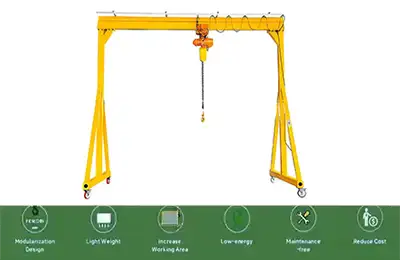
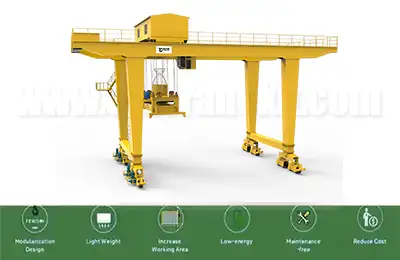
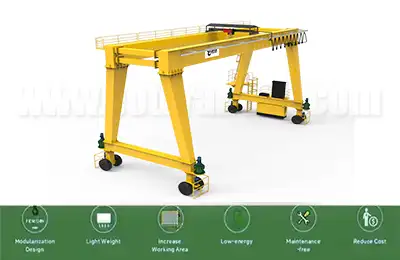
| Application / Industrial Sector | Typical Loads | Typical RMG Crane Capacity | Key Crane Features | Common Lifting Attachments |
|---|---|---|---|---|
| Container and Logistics (Container terminals, rail yards, intermodal hubs) | ISO shipping containers (20–45ft), reefers, tank containers, rail freight containers | 30–100 tons | High-speed travel, single/dual trolley, anti-sway, automated positioning | Container spreaders (fixed/telescopic), twin-lift spreaders, twist-lock systems |
| Heavy Steel & Metal Products (Steel mills, service centers, fabrication plants) | Steel plates, slabs, coils, pipes, structural steel modules | 40–200+ tons | Heavy-duty structure, high-torque hoist, anti-sway, heat/dust resistant | C-hooks (coils), electromagnets (plates/slabs), pipe lifting beams, spreader beams |
| Precast & Concrete Products (Precast yards, highway/bridge construction, tunnels) | Wall panels, slabs, bridge segments, tunnel lining, beams | 20–120+ tons | Dual hoist synchronized system, multi-point lifting, smooth acceleration/braking, high positioning accuracy | Adjustable lifting beams, vacuum lifters, multi-point frames, synchronized systems |
| Heavy Machinery & Industrial Equipment (Power plants, EPC plants, heavy manufacturing) | Industrial machines, turbines, generators, mining/process modules | 50–300+ tons | Dual trolley, precision hoist control, high-capacity wire rope hoist, low-speed control | Heavy-duty hooks, modular lifting frames, dual trolley systems |
| Long & Irregular Materials (Pipe yards, steel distribution, timber depots, wind plants) | Steel pipes, pipe bundles, timber, H/I beams, aluminum extrusions, wind turbine components | 20–150 tons | Long-span structure, anti-sway, adjustable hoist spacing, balance control | Spreader beams, adjustable lifting points, balance lifting systems |
| Shipyard & Offshore Loads (Shipyards, offshore fabrication, marine engineering) | Ship blocks, hull sections, offshore modules, deck structures, marine engines | 80–500+ tons | Heavy-duty structure, dual hoist synchronized, long-span gantry, weather-resistant | Large-span spreader frames, dual hook lifting systems, modular frames |
| Bulk Materials & Scrap Handling (Recycling plants, bulk terminals, mining storage yards) | Coal, ore, sand, aggregates, scrap metal, industrial waste | 20–100+ tons per grab | High-duty continuous operation, dust-resistant, reinforced structure, high-cycle capability | Grab buckets, orange peel grabs, magnetic lifting systems |
| Workshop & Manufacturing Loads (Workshops, warehouses, assembly lines) | Mechanical components, pallets, tools, assembly materials | 1–20 tons | Compact design, fast travel, simple manual/semi-automatic operation | Standard hooks, clamps, vacuum lifting systems |
| Tunnel & Infrastructure Construction (Metro/rail tunnels, hydropower, underground construction) | TBM cutterheads, tunnel segments, excavation equipment, precast modules | 20–150+ tons | Low-headroom design, precision positioning, synchronized lifting, compact structure | Low-headroom hoists, synchronized lifting systems, adjustable segment frames |
Typical Industrial Material Handling Applicaitons of Rail Mounted Gantry Cranes
Rail mounted gantry cranes (RMG cranes) are used across industries to lift heavy and oversized materials safely and efficiently, with capacities from 1 ton to 500+ tons. They are equipped with the right structure, hoists, and lifting attachments for each application:
- Container & logistics: ISO containers, reefers, tank containers in ports and rail yards
- Steel & metal: Plates, slabs, coils, pipes, beams in mills and fabrication plants
- Precast & concrete: Panels, bridge segments, tunnel linings, beams in construction projects
- Heavy machinery: Turbines, generators, mining equipment, plant modules
- Long & irregular materials: Pipes, beams, timber bundles, wind turbine components
- Shipyard & offshore: Ship blocks, hull sections, offshore modules
- Bulk & scrap: Coal, ore, sand, scrap metal using grabs or magnets
- Workshop & manufacturing: Machine parts, tools, assemblies in factories
- Tunnel & infrastructure: TBM components, tunnel segments, precast modules in confined spaces
Container and Logistics Loads (RMG Crane for Port and Rail Yard Operations)
Typical Loads:
Rail mounted gantry cranes used in container terminals are designed for standardized but high-frequency logistics handling. These loads include:
- ISO shipping containers (20ft, 40ft, 45ft)
- Refrigerated containers (reefers)
- Tank containers for liquid cargo
- Rail freight containers and intermodal cargo units
These are standard industrial logistics loads, but the working intensity is high. Continuous loading and unloading is common in container stacking yards.
Industrial Sectors:
- Container terminals in ports
- Railway freight yards
- Intermodal logistics hubs
- Container storage and stacking yards
Typical Rail Mounted Gantry Crane Capacity:
- 30–100 tons, depending on single lift or twin-lift container handling
Key RMG Crane Features:
- High-speed rail mounted gantry crane travel system for fast container transfer
- Single or dual trolley configuration for high-efficiency logistics handling
- Anti-sway system for stable container movement during long travel distances
- Automated positioning for stacking accuracy in container yards
Lifting Attachments:
- Container spreaders (fixed and telescopic types)
- Twin-lift spreaders for double container handling
- Automatic twist-lock systems for secure container engagement
Heavy Steel and Metal Products (Industrial Steel Mill RMG Crane Applications)
Typical Loads:
In steel industry applications, rail mounted gantry cranes handle dense and high-temperature materials:
- Steel plates and steel slabs
- Steel coils (hot rolled and cold rolled)
- Steel pipes and structural beams
- Fabricated steel modules and assemblies
Industrial Sectors:
- Steel mills and rolling mills
- Steel service centers
- Fabrication plants
- Pipe storage and distribution yards
Typical RMG Crane Capacity:
- 40–200+ tons, depending on steel slab or coil handling requirements
Key RMG Crane Features:
- Heavy-duty industrial gantry crane structure for high-load steel handling
- High-torque hoisting system designed for continuous steel production cycles
- Anti-sway control for long and heavy steel products
- Heat-resistant and dust-resistant electrical systems in steel mill environments
Lifting Attachments:
- C-hooks for steel coils
- Electromagnetic lifting systems for steel plates and slabs
- Pipe lifting beams for tubular steel products
- Spreader beams for long structural steel
Precast and Concrete Products (Construction Rail Mounted Gantry Crane Systems)
Typical Loads:
Precast concrete handling requires precise control due to material brittleness:
- Wall panels and precast slabs
- Bridge segments and box girders
- Tunnel lining segments
- Concrete beams and structural components
These loads are large, heavy, and require balanced lifting to avoid cracking.
Industrial Sectors:
- Precast concrete yards
- Highway and bridge construction projects
- Railway infrastructure projects
- Tunnel and metro construction sites
Typical RMG Crane Capacity:
- 20–120+ tons depending on precast element size
Key RMG Crane Features:
- Synchronized dual hoist rail mounted gantry crane system for balanced lifting
- Multi-point lifting control for long precast concrete segments
- Smooth acceleration and braking system to prevent structural damage
- High positioning accuracy for precast installation workflows
Lifting Attachments:
- Adjustable lifting beams
- Vacuum lifters for smooth surface panels
- Multi-point lifting frames
- Synchronized lifting systems for heavy precast segments
Heavy Machinery and Industrial Equipment (Heavy Duty Gantry Crane Applications)
Typical Loads:
These are large industrial assets requiring precise placement:
- Industrial machines and production equipment
- Turbines and generators
- Mining equipment and process modules
- EPC plant modules and assemblies
Industrial Sectors:
- Power plants
- Heavy manufacturing industries
- EPC construction and installation projects
Typical RMG Crane Capacity:
- 50–300+ tons depending on module size and installation requirement
Key RMG Crane Features:
- Dual trolley rail mounted gantry crane systems for long and irregular loads
- Precision synchronized hoist control for accurate positioning
- High-capacity wire rope hoisting system for industrial machinery lifting
- Stable low-speed control for installation accuracy
Lifting Attachments:
- Heavy-duty lifting hooks
- Modular lifting frames
- Dual trolley synchronized systems
Long and Irregular Materials (Structural Steel and Pipe Yard RMG Cranes)
Typical Loads:
These materials require balance control due to length and shape:
- Steel pipes and pipe bundles
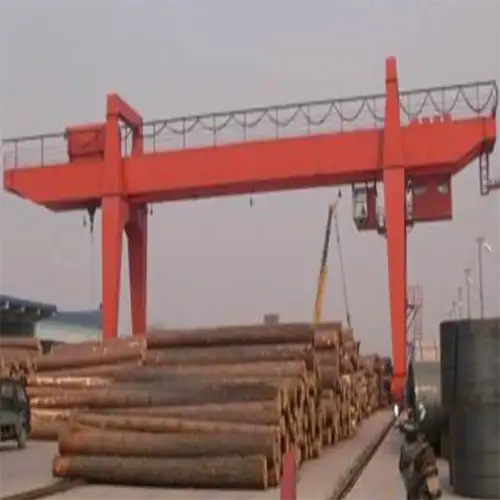
- Timber bundles for construction
- Structural steel beams (H-beams, I-beams)
- Aluminum extrusions
- Wind turbine components
Industrial Sectors:
- Pipe yards and steel distribution centers
- Timber depots and construction supply yards
- Wind energy manufacturing plants
Typical RMG Crane Capacity:
- 20–150 tons depending on material length and load distribution
Key RMG Crane Features:
- Long-span rail mounted gantry crane structure for extended load handling
- Anti-sway system for long materials during crane travel
- Adjustable hoist spacing for uneven load distribution
- Balance control for structural steel and pipe handling
Lifting Attachments:
- Spreader beams for long materials
- Adjustable lifting points
- Balance lifting systems for uneven loads
Shipyard and Offshore Loads (Heavy Duty Industrial Gantry Crane Systems)
Typical Loads:
Shipbuilding and offshore operations involve extremely heavy and irregular structures:
- Ship blocks and hull sections
- Offshore platform modules
- Deck structures
- Marine engines and large components
Industrial Sectors:
- Shipyards
- Offshore fabrication yards
- Marine engineering facilities
Typical RMG Crane Capacity:
- 80–500+ tons for ship block and offshore module handling
Key RMG Crane Features:
- Heavy-duty rail mounted gantry crane structure for shipyard operations
- Dual hoist synchronized lifting system for large asymmetric loads
- Long-span gantry design for wide ship sections
- Weather-resistant design for outdoor marine environments
Lifting Attachments:
- Large-span spreader frames
- Dual hook lifting systems
- Modular lifting frames for ship blocks
Bulk Materials and Scrap Handling (Grab Type Rail Mounted Gantry Cranes)
Typical Loads:
Bulk handling relies on continuous loading cycles:
- Coal, ore, sand, and aggregates
- Scrap metal and industrial waste
Industrial Sectors:
- Recycling plants
- Ports and bulk material terminals
- Mining and raw material storage yards
Typical RMG Crane Capacity:
- 20–100+ tons per grab cycle depending on material density
Key RMG Crane Features:
- High-duty rail mounted gantry crane system for continuous operation
- Dust-resistant industrial crane electrical system
- Reinforced structure for abrasive bulk material handling
- High-cycle operation capability for continuous unloading
Lifting Attachments:
- Grab buckets for bulk materials
- Orange peel grabs for scrap metal
- Magnetic lifting systems for ferrous scrap handling
Workshop and Manufacturing Loads (Light Duty Gantry Crane Systems)
Typical Loads:
Used in internal factory and warehouse logistics:
- Mechanical components and machine parts
- Industrial pallets and tools
- Assembly line materials
Industrial Sectors:
- Manufacturing workshops
- Warehouses and logistics centers
- Assembly lines and production facilities
Typical RMG Crane Capacity:
- 1–20 tons for light to medium industrial crane applications
Key RMG Crane Features:
- Compact rail mounted gantry crane design for indoor use
- Fast travel speed for repetitive handling
- Simple manual or semi-automatic operation
Lifting Attachments:
- Standard industrial hooks
- Clamps for irregular parts
- Vacuum lifting systems for light materials
Tunnel and Infrastructure Construction Loads (Specialized RMG Crane Systems)
Typical Loads:
Tunnel and underground projects require precise lifting in confined spaces:
- TBM cutterheads
- Tunnel lining segments
- Excavation equipment
- Precast tunnel modules
Industrial Sectors:
- Metro and railway tunnel projects
- Hydropower tunnels
- Underground infrastructure construction
Typical RMG Crane Capacity:
- 20–150+ tons depending on tunnel segment or TBM component
Key RMG Crane Features:
- Low-headroom rail mounted gantry crane design for confined spaces
- Precision positioning system for tunnel segment installation
- Synchronized lifting for heavy tunnel components
- Compact structure for underground construction environments
Lifting Attachments:
- Low-headroom hoists
- Synchronized lifting systems
- Adjustable segment lifting frames
Practical Selection Guide for Rail Mounted Gantry Cranes Based on Material Handled
Provide industrial buyers with a practical framework to choose the right rail mounted gantry crane (RMG crane) based on real load conditions, site constraints, and operational requirements.
In industrial operations, crane buyers already know the materials they handle — the weight, size, shape, and lifting frequency. The key is turning that knowledge into a load-driven crane specification.
Weight-Based Capacity Selection
Why Weight Matters:
Load weight is the first factor that determines the crane's lifting capacity, structural design, hoist system, and motor specification. Overloading a crane can cause structural fatigue, downtime, and safety hazards. Underloading a crane may waste budget.
Load Class Overview (1–300+ tons)
| Load Class | Typical Load Weight | Typical Materials / Objects | Typical Rail Mounted Gantry Crane Capacity | Crane Configuration | Hoist Type | Lifting Attachments / Hooks |
|---|---|---|---|---|---|---|
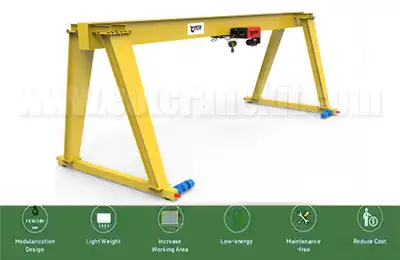
| Light Loads | 1–20 tons | Workshop components Small pallets Machine parts Assembly units | 3t, 5t, 10t, 16t, 20t | Single-girder rail mounted gantry crane Small double-girder possible for wider indoor yards | Standard electric wire rope hoist Single trolley | Standard hooks Small lifting beams Clamps Vacuum lifters |
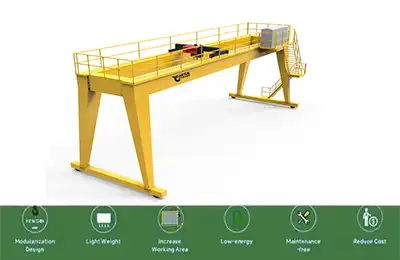
| Medium Loads | 20–80 tons | Precast panels Steel slabs Containers Fabrication yard materials | 32t, 50t, 63t, 70t, 80t | Double-girder rail mounted gantry crane Single or dual trolley | Medium-duty electric hoist Dual hoist optional for long/unstable loads | Adjustable spreader beams Container spreaders Twin-lift spreaders Coil grabs C-hooks |
| Heavy Loads | 80–300+ tons | Large machinery Steel coils Bridge segments Heavy precast modules | 100t, 160t, 200t, 250t, 300t | Reinforced double-girder rail mounted gantry crane Dual trolley Dual hoist synchronized | High-torque electric hoists Dual hoist synchronized | Coil grabs C-hooks Multi-point lifting frames Spreader beams |
| Oversized Loads | 300+ tons | Ship blocks Offshore modules Large bridge segments Mega industrial assemblies | 400t, 600t, 800t+ (custom) | Custom multiple rail mounted gantry crane Dual or tri-hoist coordination | Multi-point synchronized lifting system | Multi-point lifting hooks Large-span spreader frames Synchronized hoist assemblies |
Light Loads (1–20 tons)
Typical use: Workshops, small assembly parts, light pallets, machine components, and internal material handling. These are short, compact loads that need quick, repetitive lifting without heavy structural requirements.
Recommended rail mounted gantry crane type and capacity: Single-girder rail mounted gantry cranes (light-duty or workshop-type gantry cranes) are ideal. In some cases, small double-girder cranes can be used for wider indoor workspaces or where moderate spans are required. Typical lifting capacity ranges from 1 to 20 tons, with common industrial configurations of 3t, 5t, 10t, 16t, and 20t.
Hoist and trolley system: Standard electric wire rope hoist with a single trolley.
Duty: Low to medium cycle operation, suitable for intermittent lifting and short travel distances.
Key features for industrial buyers:
- Compact gantry structure for workshop or factory floors
- Smooth, low-speed operation for precise positioning
- Minimal maintenance and cost-effective installation
Medium Loads (20–80 tons)
Typical use: Precast concrete panels, steel slabs, mid-size containers, and fabrication yard materials. These loads are heavier and may be longer, requiring dual-point lifting or adjustable trolley positioning.
Recommended rail mounted gantry crane type and capacity: Double-girder rail mounted gantry cranes are the standard solution, often configured with single or dual trolley systems depending on load length. Capacity typically ranges from 20 to 80 tons, with common industrial setups of 32t, 50t, 63t, 70t, and 80t.
Hoist and trolley system: Medium-duty electric hoists; dual hoist configurations can be added for longer, unstable, or irregular loads.
Duty: Moderate cycle, occasional high-speed operation for loading, unloading, or stacking in logistics yards, precast plants, or steel service centers.
Key features for industrial buyers:
- Reinforced bridge girder for outdoor yard operation
- Optional anti-sway and load positioning controls
- Adjustable span and travel for different site layouts
- Suitable for medium-duty industrial applications with repetitive lifting
Heavy Loads (80–300+ tons)
Typical use: Large industrial machinery, heavy steel coils, bridge segments, and precast modules. These loads require structural rigidity, precise control, and long-span gantry cranes for safe lifting and transport.
Recommended rail mounted gantry crane type and capacity: Reinforced double-girder rail mounted gantry cranes, often with dual trolley and synchronized dual hoists. Typical capacities range from 80 to 300+ tons, with common configurations of 100t, 160t, 200t, 250t, and 300t.
Hoist and trolley system: High-torque electric motors, dual hoists with synchronized lifting for balance control.
Duty: High-cycle operation, continuous lifting in steel mills, precast concrete yards, or port container handling.
Key features for industrial buyers:
- Strong bridge structure and heavy-duty rails
- Anti-sway and precision travel systems for long loads
- Suitable for outdoor yards or large-scale fabrication plants
- Supports multi-point lifting attachments for slabs, beams, or coils
Oversized Loads (300+ tons)
Typical use: Ship blocks, offshore modules, large bridge segments, massive industrial assemblies. These are project-specific, highly specialized loads that require custom-engineered solutions.
Recommended rail mounted gantry crane type and capacity: Custom rail mounted gantry cranes designed for oversized, heavy-duty lifting. Typical capacities start at 300 tons and can go up to 400t, 600t, 800t, or more depending on project requirements. Usually, the tandem lifting of multiple gantry cranes are required.
Hoist and trolley system: Multi-point synchronized lifting system with computer-controlled load balancing and dual/tri-hoist coordination.
Duty: Project-specific, often slow, highly controlled operation with limited but precise cycles.
Key features for industrial buyers:
- Extremely large spans and reinforced rails for mega loads
- Precision lifting and positioning systems for offshore or shipyard assembly
- High structural redundancy to handle extreme industrial weights
- Designed for long travel distances and heavy-duty infrastructure projects
Practical Takeaways for Industrial Buyers
- Load weight determines crane capacity: Always add 10–20% margin for safety.
- Load size and site layout dictate crane span, lifting height, and travel distance.
- Load nature drives attachments: C-hooks, coil grabs, spreader beams, or multi-point hoists.
- Lifting frequency determines duty classification and motor design: Light, medium, heavy, or continuous duty cranes.
This approach ensures industrial buyers select the right rail mounted gantry crane for efficiency, safety, and long-term operation, tailored to their exact materials, environment, and workflow.
Shape, Size, and Application Space
Why Size Matters
The physical dimensions of your load and the layout of your site are just as important as weight when selecting a rail mounted gantry crane. These factors determine:
- Crane span – how wide the gantry bridge must be to clear your load and fit the workspace.
- Lifting height – the vertical clearance needed for stacking, storage, or transport.
- Travel length – the distance the crane needs to cover along rails to reach all load positions.
Ignoring these details can lead to a crane that is too short, too tall, or unable to safely handle your materials, slowing operations and increasing risk.
Regular and Compact Loads
Regular, compact loads are among the most common handled by rail mounted gantry cranes in logistics and port operations. These include boxes, pallets, and standard ISO containers with predictable dimensions. Because these loads are uniform, the handling process is less about unusual shapes and more about speed, stacking efficiency, and reliability over repeated cycles.
Practical point: Even though containers are standardized, the crane's design must account for yard layout, stacking height, and automation level, not just the weight of the load.
Load Examples – ISO Shipping Containers
ISO container handling represents a high-frequency, standardized application for rail mounted gantry cranes in container terminals, rail yards, and intermodal logistics hubs. Cranes must handle containers safely, quickly, and consistently.
- 20ft standard container (TEU)
- 40ft standard container (FEU)
- 45ft high-cube container (HC)
- Refrigerated containers (Reefers)
- Tank containers (liquid cargo)
- Special cargo containers (flat rack, open-top, heavy machinery containers)
In real operations, containers are often mixed in stacking blocks, so the crane must handle different weights, heights, and stacking combinations continuously.
Typical Container Dimensions and Weight
20ft container (TEU)
- Dimensions: 06 × 2.44 × 2.59 m
- Weight: 20–30 tons
- Note: Stable for fast cycles and dense stacking
40ft container (FEU)
- Dimensions: 12.19 × 2.44 × 2.59 m
- Weight: 25–32 tons
- Note: Requires precise alignment during travel and stacking
45ft high-cube container
- Dimensions: 13.72 × 2.44 × 2.89 m
- Weight: up to 32 tons
- Note: Higher center of gravity increases sway risk
Reefer and Tank Containers
- Same ISO dimensions as 20ft/40ft
- Slightly lower payload due to refrigeration or tank structure
- Note: Sensitive equipment; smooth acceleration and controlled travel required
Recommended Rail Mounted Gantry Crane Type
- Single-girder rail mounted gantry crane – tandem lifting; ideal for light-duty indoor container yards or small logistics terminals
- Light double-girder rail mounted gantry crane – medium container yards with moderate stacking height
- Standard double-girder container RMG crane – used in ports, high-throughput rail freight yards, and intermodal terminals
Typical Crane Capacity and Design Range
- Single container lifting: 30–40 tons
- Twin-lift (two 20ft containers): 60–80 tons
- Reefer/tank containers: same range, with stricter safety margins
Practical insight: Capacity isn't just container weight. Dynamic loads during travel, wind pressure, and stacking height are critical considerations.
Span, Rail Layout, and Travel
Typical span: 20–45 m
- 20–30 m → inland rail yards, compact logistics terminals
- 30–45 m → large port storage yards and stacking blocks
- Rail travel length: 100–800+ m depending on yard size
- Operational note: Longer travel requires inverter-controlled drives for smooth acceleration and braking
Lifting Height and Stacking
Lifting height: 10–15 m
- 3-high → standard rail yards
- 4-high → modern container terminals
- 5-high → high-density port operations (requires reinforced gantry)
Higher stacking increases wind load impact, requiring stronger anti-sway systems and reinforced crane structures.
Trolley Configuration
Single trolley system
- Standard container lifting
- Faster cycles
- Lower mechanical complexity
Dual trolley / Twin-lift system
- Lift two 20ft containers simultaneously
- Used in high-throughput ports
- Requires synchronized control and precise rail alignment
Lifting Attachments
- Telescopic container spreaders – adjustable for 20ft / 40ft / 45ft
- Fixed container spreaders – faster cycle time for single-size yards
- Twin-lift spreaders – high-efficiency dual container handling
- Automatic twist-lock systems – secure container corner locking
- Weighing / positioning systems (optional) – load monitoring and stacking accuracy
Key Practical Tips for Buyers
When selecting a container rail mounted gantry crane, consider more than just capacity:
- Cycle speed (containers/hour)
- Stacking height requirement (3-high to 5-high)
- Yard span and rail length
- Automation level (manual, semi-automatic, fully automated)
- Environmental conditions (wind, outdoor exposure)
A 40-ton crane in a slow rail yard is completely different from a 40-ton crane in a high-speed port terminal, even if the rated capacity is identical.
Rail Mounted Gantry Cranes for Long and Irregular Materials
Long or irregular loads require careful consideration for lifting, travel, and placement. In industrial operations, materials such as steel beams, timber bundles, pipelines, and precast panels are often heavy, long, or unevenly distributed. Handling them safely and efficiently relies on the right rail mounted gantry crane configuration, trolley setup, hoist, and lifting attachments.
Steel Beams Handling
Steel beams are common in fabrication yards, steel service centers, and construction sites. These can include I-beams, H-beams, channel steel, or fabricated structural modules.
Typical Load Dimensions & Weight:
- Length: 12–18 m
- Weight: 5–25 tons per beam
- Shape: Long, rigid, uniform cross-section
Recommended Rail Mounted Gantry Crane Configuration:
- Double-girder gantry crane – standard for long and heavy beams
- Dual hoists – synchronized lifting at multiple points to prevent bending
- Spreader beams or adjustable lifting points – evenly distributes load along beam length
Capacity & Span:
- Light beams: 20–40 tons
- Medium beams: 40–80 tons
- Heavy beams: 80–150+ tons
- Typical span: 25–50 m depending on yard layout
- Lifting height: 8–15 m
Trolley & Hoist:
- Single trolley: moderate-length beams
- Dual trolley: long or uneven beams requiring balanced lifting
- Hoist: medium to high-duty electric wire rope hoist, high-torque motors for continuous operations
Attachments & Handling Notes:
- Beam clamps for lifting individual sections
- Spreader beams for long bundles
- Anti-sway devices to prevent swing
Practical Tip: Even if the beam is light, its length can create significant bending and sway, so multi-point lifting is usually recommended.
Timber Bundles Handling
Timber bundles are found in construction supply yards, prefabricated wood workshops, and lumber depots. These are long, flexible, and sometimes unevenly bundled.
Typical Load Dimensions & Weight:
- Length: 6–15 m
- Weight: 2–20 tons depending on bundle density
- Shape: Flexible and irregular, may have uneven ends
Recommended Rail Mounted Gantry Crane Configuration:
- Double-girder gantry crane – for longer or heavier bundles
- Dual hoist system – prevents sagging and maintains stability
- Adjustable spreader beams or lifting clamps – adapts to bundle size
Capacity & Span:
- Light bundles: 5–15 tons
- Medium bundles: 15–30 tons
- Heavy bundles: 30–50 tons
- Typical span: 20–40 m
- Lifting height: 6–12 m depending on storage racks or stacking
Trolley & Hoist:
- Single trolley: shorter timber bundles
- Dual trolley: long or heavy bundles
- Hoist: standard wire rope hoist or moderate-duty electric hoist
Attachments & Handling Notes:
- Timber clamps for bundles
- Adjustable spreader beams for variable lengths
- Anti-sway devices for stacked loads
Practical Tip: Always consider bundle flexibility, as a long, loosely bound timber bundle can swing significantly if lifted from a single point.
Pipelines Handling
Pipelines are long tubular loads used in oil, gas, water, and industrial construction projects. They are often heavy, cylindrical, and difficult to balance.
Typical Load Dimensions & Weight:
- Length: 6–24 m
- Weight: 3–30 tons depending on diameter and wall thickness
- Shape: Long and cylindrical
Recommended Rail Mounted Gantry Crane Configuration:
- Double-girder gantry crane for long pipelines
- Dual synchronized hoists – lift at two or more points
- Adjustable lifting points – adapts to pipe diameter
Capacity & Span:
- Light pipes: 5–15 tons
- Medium pipes: 15–40 tons
- Heavy pipes: 40–80 tons
- Typical span: 25–45 m
- Lifting height: 8–12 m
Trolley & Hoist:
- Single trolley: short pipes
- Dual trolley: long pipelines or multiple pipe bundles
- Hoist: medium to high-duty electric hoist
Attachments & Handling Notes:
- Pipe hooks or cradles
- Adjustable spreader beams
- Anti-rotation devices for round pipes
Practical Tip: Pipelines often roll or twist under lift, so multiple attachment points and anti-rotation devices are critical.
Precast Panels Handling
Precast concrete panels are common in tunnel projects, bridges, highways, and building construction. They are heavy, flat, and fragile, requiring careful placement.
Typical Load Dimensions & Weight:
- Length: 3–12 m
- Weight: 5–25 tons
- Shape: Flat, rigid but fragile
Recommended Rail Mounted Gantry Crane Configuration:
- Double-girder gantry crane
- Dual hoist or synchronized lifting system
- Multi-point lifting frames – prevents cracking or bending
Capacity & Span:
- Light panels: 5–10 tons
- Medium panels: 10–20 tons
- Heavy panels: 20–30 tons
- Typical span: 20–40 m
- Lifting height: 8–15 m
Trolley & Hoist:
- Dual trolley recommended for panels >6 m
- High-precision hoist with smooth acceleration and deceleration
Attachments & Handling Notes:
- Multi-point lifting frames
- Vacuum lifters for certain smooth-surface panels
- Anti-sway devices to prevent impact during travel
Practical Tip: Fragile panels must never be lifted from a single point, even if weight seems low. Multi-point lifting preserves structural integrity.
| Parameter | Steel Beams | Timber Bundles | Pipelines | Precast Panels |
|---|---|---|---|---|
| Typical Dimensions & Weight | Length: 12–18 m Weight: 5–25 tons Rigid, uniform cross-section | Length: 6–15 m Weight: 2–20 tons Flexible, uneven bundle shape | Length: 6–24 m Weight: 3–30 tons Cylindrical, rolling-prone | Length: 3–12 m Weight: 5–25 tons Flat, rigid but fragile |
| Recommended RMG Crane Configuration | Double-girder rail mounted gantry crane Dual hoist Spreader beam or adjustable lifting points | Double-girder rail mounted gantry crane Dual hoist Adjustable lifting clamps/spreader beams | Double-girder rail mounted gantry crane Dual synchronized hoists Anti-rotation lifting system | Double-girder rail mounted gantry crane Dual hoist or synchronized lifting Multi-point lifting frame |
| Typical Capacity | Light: 20–40 t Medium: 40–80 t Heavy: 80–150+ t | Light: 5–15 t Medium: 15–30 t Heavy: 30–50 t | Light: 5–15 t Medium: 15–40 t Heavy: 40–80 t | Light: 5–10 t Medium: 10–20 t Heavy: 20–30 t |
| Span | 25–50 m | 20–40 m | 25–45 m | 20–40 m |
| Lifting Height | 8–15 m | 6–12 m | 8–12 m | 8–15 m |
| Trolley & Hoist | Single trolley (moderate beams) Dual trolley (long/heavy beams) High-duty wire rope hoist | Single trolley (short bundles) Dual trolley (long/heavy bundles) Standard/medium-duty hoist | Single trolley (short pipes) Dual trolley (long/multiple pipes) Medium-high duty hoist | Dual trolley recommended for >6 m High-precision hoist with smooth control |
| Lifting Attachments / Devices | Beam clamps Spreader beams Anti-sway devices | Timber clamps Adjustable spreader beams Anti-sway devices | Pipe cradles Pipe hooks Adjustable spreader beams Anti-rotation devices | Multi-point lifting frames Vacuum lifters (optional) Anti-sway devices |
| Key Handling Notes | Length causes bending; multi-point lifting recommended | Flexible bundles swing easily; stability control is critical | Rolling and twisting risk high; multiple lifting points required | Fragile panels must never be lifted from a single point |
Material Behavior and Lifting Devices
Not all loads behave the same when lifted. Understanding how your materials react under stress is critical for selecting the correct rail mounted gantry crane attachments and ensuring safe, efficient operations.
Why Material Behavior Matters in Rail Mounted Gantry Crane Selection
In rail mounted gantry crane operations, material behavior is often more critical than weight alone. Two loads with the same tonnage can require completely different crane configurations depending on how the material reacts during lifting, travel, and placement.
The key issue is simple: how the load behaves once it is suspended in the air. That determines safety, stability, and the type of lifting system required.
Rigid or Fragile Materials
Typical examples:
- Glass sheets
- Precast concrete panels
- Wall sections
- Bridge segments
- Tunnel lining segments
These materials are rigid in structure but highly sensitive to stress concentration and impact forces.
Handling Requirements
- Multi-point lifting frames to distribute load evenly
- Synchronized dual hoist systems for balanced lifting
- Anti-sway control systems for stable travel
- Precision positioning controls for accurate placement
Practical Engineering Insight
Even when the load is relatively light, lifting from a single point creates uneven stress distribution. This can lead to:
- Cracking in precast concrete
- Edge damage in panels
- Internal stress failure during lifting or rotation
That is why rail mounted gantry cranes handling precast or fragile materials almost always use multi-point lifting systems instead of simple hook lifting.
Flexible or Rollable Materials
Typical examples:
- Steel coils
- Aluminum coils
- Rolled steel sheets
- Coil bundles in steel service centers
These materials are compact but behave dynamically due to their cylindrical shape and rolling tendency.
Handling Requirements
- C-hooks or coil lifters designed for internal coil support
- Coil grabs for tighter grip and secure handling
- Anti-rotation devices to prevent uncontrolled spinning
- Controlled lowering systems for precise placement
Practical Engineering Insight
The main risk is not just weight—it is rotation and center-of-gravity shift during movement.
Without proper control:
- Coils may swing like a pendulum during travel
- Rotation can occur if the hook is misaligned
- Sudden braking may cause lateral shifting or impact damage
For this reason, steel coil handling in rail mounted gantry crane systems focuses heavily on rotation control and stable lifting geometry, not just lifting capacity.
Bulk or Granular Materials
Typical examples:
- Coal
- Scrap metal
- Iron ore
- Sand and aggregates
- Industrial waste materials
These materials do not have fixed shape or structure, which makes them highly variable during lifting.
Handling Requirements
- Grab buckets for general bulk material handling
- Orange peel grabs for scrap metal and irregular waste
- Magnetic lifting systems for ferrous materials
- Heavy-duty hopper-compatible lifting cycles in port systems
Practical Engineering Insight
Bulk materials continuously change in:
- Volume
- Distribution inside the grab
- Center of gravity during lifting
This creates challenges such as:
- Spillage during hoisting and travel
- Uneven load distribution inside the grab
- Increased wear on hoisting systems due to variable loading
That is why rail mounted gantry cranes handling bulk materials are designed for adaptive lifting, fast cycle operation, and robust structural durability rather than precision positioning.
Key Engineering Insight
In real industrial crane design:
Load behavior defines the lifting system, not just the load weight.
A correct rail mounted gantry crane selection must always consider:
- How the material moves when lifted
- Whether it rotates, bends, or shifts
- Whether it maintains or changes shape under load
Simple Buyer Rule
- Rigid or fragile → focus on balance and precision lifting
- Flexible or rollable → focus on rotation control and secure gripping
- Bulk or granular → focus on adaptive grabbing and continuous handling efficiency
Key Insight for Crane Buyers
The lifting device is not optional. Choosing the wrong attachment can:
- Cause safety risks for operators and nearby personnel
- Damage the load and reduce material quality
- Lower operational efficiency and increase cycle time
For rail mounted gantry cranes, always match the lifting system to both the weight and physical behavior of the material. This ensures precision, safety, and efficiency in daily operations.
If you want, I can next turn this into a quick comparison table (material → crane type → attachment → risk → typical RMG configuration) for your buyer guide section.
Load Handling Frequency & Duty Classification
How often a rail mounted gantry crane lifts loads affects motor size, structural strength, and overall service life. Choosing the wrong duty rating can lead to faster wear, more maintenance, and even unsafe operations.
Duty Classes Overview (Expanded for Rail Mounted Gantry Crane Applications)
Duty classification defines how a rail mounted gantry crane performs over time under real operating cycles. It reflects not only lifting capacity, but also working rhythm, thermal load on motors, structural fatigue, and overall system durability. In practice, selecting the correct duty class is just as important as selecting the crane capacity itself.
Light Duty
Light duty rail mounted gantry cranes are used in environments where lifting is occasional and operations are not continuous. The system is designed for simple handling tasks, low cycle frequency, and straightforward workflow without heavy industrial stress.
Where used:
- Workshops
- Warehouses
- Small assembly areas
- Maintenance stations
Lift frequency:
- Occasional lifts per hour
- Intermittent operation with idle periods
Typical rail mounted gantry crane configuration:
- Single-girder gantry crane system
- Standard electric wire rope hoist
- Manual or semi-manual control
- Basic trolley travel system
Operational characteristics:
- Short working cycles
- Low thermal load on motors
- Limited continuous travel distance
- Simple load handling tasks (pallets, small machinery, components)
Notes:
This class is suitable for non-continuous industrial handling where cost control and simplicity matter more than speed or high throughput.
Medium Duty
Medium duty cranes are the most commonly used in general industrial production environments. They support repetitive lifting cycles throughout the working shift and are designed for stable performance under consistent daily operation.
Where used:
- Precast concrete yards
- Steel fabrication plants
- Manufacturing assembly lines
- Medium-volume logistics yards
Lift frequency:
- Regular lifting cycles throughout the shift
- Repetitive but not continuous operation
Typical rail mounted gantry crane configuration:
- Double-girder gantry crane system
- Medium-duty electric hoist
- Frequency inverter control for smoother motion
- Optional anti-sway system for better positioning
Operational characteristics:
- Balanced mix of speed and stability
- Continuous daily production cycles
- Moderate travel distances across yard or workshop
- Handling of structured industrial loads (steel beams, precast panels, containers)
Notes:
This duty level supports stable industrial output where cranes must operate reliably across repeated production cycles without excessive wear.
Heavy Duty
Heavy duty rail mounted gantry cranes are designed for demanding industrial environments where lifting operations are frequent and often continuous. These cranes are built for high structural strength and long working hours under significant load stress.
Where used:
- Steel mills and rolling mills
- Port terminals
- Shipyards and offshore fabrication yards
- Heavy industrial construction sites
Lift frequency:
- Frequent lifting operations
- Near-continuous use during production periods
- Short idle time between cycles
Typical rail mounted gantry crane configuration:
- Reinforced double-girder gantry crane system
- High-torque motors with strong thermal resistance
- Dual hoist or synchronized lifting systems
- Advanced braking and anti-sway control systems
Operational characteristics:
- High structural fatigue demand
- Long operating shifts under load
- High acceleration and deceleration cycles
- Handling of heavy steel coils, ship sections, large modules
Notes:
This class is designed for intensive industrial production where downtime directly affects output and operational cost.
Continuous Duty
Continuous duty rail mounted gantry cranes are built for nonstop operation in highly automated or high-throughput environments. They are engineered for maximum uptime, precision control, and integration into industrial logistics systems.
Where used:
- Container terminals
- Automated intermodal logistics hubs
- High-throughput rail freight yards
- Smart port operations
Lift frequency:
- 24/7 continuous operation
- Minimal downtime
- Fully integrated workflow systems
Typical rail mounted gantry crane configuration:
- Heavy-duty double or multi-girder gantry crane system
- Fully automated or semi-automated control systems
- High-capacity hoists with redundancy design
- Advanced anti-sway, positioning, and collision avoidance systems
- Integration with terminal operating systems (TOS)
Operational characteristics:
- High-speed container handling cycles
- Continuous stacking and retrieval operations
- Long travel distances along rail systems
- Precision positioning for automated stacking
Notes:
This level of operation requires highly engineered systems designed for reliability, automation readiness, and uninterrupted service.
Practical Buyer Insight
In real procurement decisions for rail mounted gantry cranes, duty class defines long-term performance more than any single specification.
- Light duty focuses on simplicity and cost efficiency
- Medium duty balances productivity and durability
- Heavy duty prioritizes continuous industrial performance
- Continuous duty focuses on automation, speed, and uptime
Final Selection Principle
Matching the correct duty class is essential because it directly influences motor sizing, structural fatigue life, maintenance intervals, and overall operational safety.
A rail mounted gantry crane must be selected not only for how much it lifts, but for how often and how long it must lift under real working conditions.
Integrated Decision Framework for Rail Mounted Gantry Crane Buyers
In real industrial procurement, selecting a rail mounted gantry crane is not based on a single parameter. It is a step-by-step process where load characteristics, handling behavior, and operating conditions all work together to define the final crane design. A practical selection always follows four key decision layers.
Step 1: Start with Load Weight
Load weight is the first and most direct factor. It defines the crane's rated capacity, structural strength, and safety margin.
- Light to medium loads → standard double-girder rail mounted gantry crane
- Heavy loads → reinforced structure with higher torque drives
- Very heavy or oversized loads → multi-girder or custom engineered systems
Important note: Always include a safety margin above the maximum expected load, especially for dynamic lifting conditions.
Step 2: Check Load Shape, Size, and Site Space
At this stage, the focus shifts from weight to geometry and working environment.
- Long or irregular loads → require dual hoists, spreader beams, or multi-point lifting
- Compact loads (containers, coils) → single trolley systems are usually sufficient
Site layout defines span and travel distance:
- Wide yards → long span rail mounted gantry cranes
- Narrow workshops → compact span for fast repetitive lifting
- Confined spaces → low-headroom crane configurations with precise positioning
Step 3: Consider Material Behavior and Handling Method
This step determines the lifting attachment system and load control strategy.
- Steel beams → spreader beams or multi-point lifting to prevent bending
- Timber bundles → clamps or adjustable lifting beams to manage flexibility
- Steel coils → C-hooks or coil grabs with anti-rotation control
- Pipelines → cradle systems with rotation control
- Precast panels → multi-point lifting frames or vacuum systems
Key point: The lifting device is not optional—it must match how the material behaves under load.
Step 4: Assess Lifting Frequency and Duty Class
This step defines the crane's working intensity and mechanical durability level.
- Light duty → occasional lifting (workshops, small warehouses)
- Medium duty → repetitive operations (fabrication and precast yards)
- Heavy duty → continuous industrial use (steel mills, ports)
- Continuous duty → 24/7 operations (container terminals, logistics hubs)
Higher frequency requires stronger motors, better cooling systems, and more robust drive components.
Example Decision Paths
Steel Coil Handling (25 tons)
- Crane type: double-girder rail mounted gantry crane
- Trolley: single trolley (standard solution)
- Lifting system: C-hook with anti-rotation device
- Duty: medium cycle operation
- Note: dual trolley is generally unnecessary unless high-speed or extreme stability is required
Ship Module Handling (150 tons)
- Crane type: heavy-duty multi-girder rail mounted gantry crane
- Trolley: dual trolley system
- Lifting system: synchronized lifting frame
- Duty: heavy to continuous duty
- Operation: slow, controlled precision travel with high stability requirements
Key Takeaways for Industrial Buyers
- Load weight defines crane capacity, but must always include safety margin
- Load size and site layout define span, lifting height, and travel distance
- Material behavior determines lifting attachments and control systems
- Lifting frequency defines duty class, motor strength, and crane durability level
Final Insight
A rail mounted gantry crane is not selected by specification alone. It is selected by how the load behaves in real operation.
When these four factors are properly aligned, the result is a crane system that delivers safe handling, stable performance, and long-term operational efficiency without unnecessary overdesign or hidden limitations.
Engineering Factors Influenced by Load
When selecting a rail mounted gantry crane, the load type and handling requirements directly affect key engineering factors. Each factor ensures the crane can operate safely, efficiently, and reliably under real industrial conditions.
Span Selection
- Wide spans → required for heavy, long, or oversized loads such as ship blocks, steel beams, or precast panels.
- Shorter spans → suitable for workshops, warehouses, and light assembly areas with compact loads.
- Practical tip: Consider both the load length and the yard width; overestimating span increases cost unnecessarily, underestimating limits handling flexibility.
Lifting Height Requirements
- High stacking needs → containers, precast panels, or multi-tiered storage require lifting heights of 10–15 m or more.
- Clearance lifting → for passing over obstacles or working in multi-layer operations.
- Practical tip: Add extra height for safety margin and anti-sway requirements in outdoor operations.
Hoisting System
- Single hoist → adequate for standard loads like medium steel coils, pallets, or single containers.
- Dual hoist → recommended for very long or heavy materials, such as large steel beams, long pipelines, or multiple bundled loads.
- Practical tip: Dual hoists improve load stability, reduce swing, and allow synchronized lifting of unbalanced or flexible items.
Trolley Configuration
- Single trolley → suitable for medium-length loads and standard operations.
- Dual trolley → needed for oversized, heavy, or long loads to distribute weight and control bending or rotation.
- Example: Steel coils under 25–30 tons can use a single trolley; coils over 40 tons or long bundles may benefit from dual trolley setups.
Motor & Drive Systems
- High-torque motors → required for heavy loads or continuous operations.
- Smooth acceleration & deceleration → prevents load swing and reduces stress on attachments.
- Frequency inverter drives → improve precision positioning for sensitive loads like precast panels, fragile materials, or container stacking.
Duty Classification
- Light duty → occasional lifts in workshops or warehouses.
- Medium duty → moderate lifting cycles in precast yards or fabrication plants.
- Heavy duty → continuous operations in steel mills, ports, or shipyards.
- Continuous duty → 24/7 container terminals or high-speed logistics hubs.
- Practical tip: Always match crane duty classification to your expected load cycles to avoid premature wear or unexpected downtime.
Summary
Load characteristics define almost every engineering decision for a rail mounted gantry crane—from span, height, and hoisting configuration to motors and duty rating. Correctly aligning these factors ensures safe, stable, and efficient operations in your industrial environment.
Practical Buyer Considerations for Rail Mounted Gantry Crane Selection
In real procurement work, selecting a rail mounted gantry crane is rarely based on capacity alone. Buyers usually make decisions by matching the crane to how the load behaves, how often it is moved, and what the site can physically support. These practical factors often matter more than the nameplate tonnage.
Load Characteristics: Weight, Size, and Uniformity
- Maximum lifting weight → sets the baseline crane capacity
- Load dimensions → long beams, wide precast panels, or standard containers directly influence crane span and lifting stability
- Load uniformity → consistent loads (like ISO containers) are easier to automate, while mixed loads require flexible lifting systems
Practical note: A 30-ton compact load behaves very differently from a 30-ton long beam or eccentric steel coil. Stability is often more critical than weight alone.
Working Environment and Operation Mode
- Indoor operation → workshop or fabrication yard, usually lower wind influence, more controlled environment
- Outdoor operation → container yards, ports, steel storage yards; wind load and weather protection become important
- Lifting frequency → occasional use vs continuous high-cycle operation directly affects duty classification
- Automation level → manual, semi-automatic, or fully automated systems depending on throughput requirements
Practical note: High-frequency container or steel coil handling often justifies automation and advanced control systems to reduce operator load and improve cycle consistency.
Site Conditions: Rail Layout and Structural Constraints
- Rail layout length → determines travel efficiency and operational coverage
- Span constraints → based on yard width and storage arrangement
- Wind conditions → critical for outdoor stacking, especially containers and precast panels
- Ground bearing capacity → affects rail foundation design and long-term stability
- Future expansion → extra rail length or modular crane design may reduce future upgrade costs
Practical note: Many buyers underestimate future expansion needs, which later increases modification cost and downtime.
Lifting Attachments and Handling Systems
- Hooks → general-purpose lifting for machinery, pallets, or components
- Spreader beams → used for long loads like beams, pipes, or precast panels
- Grab buckets / orange peel grabs → bulk materials such as scrap, coal, or ore
- Vacuum lifters → smooth surface panels, glass, or delicate precast elements
- Anti-rotation devices → essential for steel coils and cylindrical loads
Practical note: The same crane capacity can perform completely different tasks depending on the lifting attachment system.
Key Buyer Insight
- Load weight and geometry
- Operating environment and frequency
- Site layout and rail constraints
- Future expansion planning
- Matching lifting attachments to material behavior
Final Takeaway
A rail mounted gantry crane is not selected as a fixed product—it is configured around the load, site, and operating rhythm. When these factors are aligned properly, the system runs with fewer interruptions, safer handling, and more predictable long-term performance.
Conclusion
Rail mounted gantry crane (RMG crane) design is fundamentally load-driven and application-specific. In real industrial projects, the crane is not selected first—the load is.
Load Type Determines the Entire Crane Concept
- Heavy loads → require rigid structures, reinforced girders, and synchronized lifting systems to maintain safety under high stress conditions
- Long or irregular materials → depend on balanced lifting, spreader beams, and multi-point support to prevent bending, swing, or deformation
- Fragile or precision-sensitive loads → need anti-sway control, smooth acceleration, and accurate positioning systems to avoid impact damage
- Bulk materials → rely on grab buckets or magnetic systems to maintain continuous, high-efficiency material flow
Practical Engineering Reality
In actual port terminals, steel yards, precast plants, and infrastructure projects, the same rail mounted gantry crane platform can behave very differently depending on the lifting system installed.
That is why attachments and control systems are not optional add-ons—they define how the crane performs in real operation.
Final Takeaway for Industrial Buyers
To select the right rail mounted gantry crane system, buyers should always follow a clear decision order:
- Start with load type (weight, shape, and material behavior)
- Then evaluate operating environment and lifting frequency
- Then define site constraints and rail layout
- Finally match attachments, hoisting system, and duty classification
Performance Outcomes
When these factors are correctly aligned, the result is a rail mounted gantry crane system that delivers:
- Safe and stable lifting operations
- Efficient material flow
- Reduced maintenance pressure
- Better long-term return on investment (ROI)
Final Statement
In short: the load defines the crane, not the other way around.

Yuantai Cranes
Overhead Crane Manufacturer with CE, ISO, SGS, CNEX Certificates.
- Main Specifications - Capacity: 0.5–550 tons | Span: up to 40m | Speed: 0.8–12 m/min | Duty: A3–A7 | Power: 380–690V, 50/60Hz | Control: pendant/remote/cabin
- Full engineering: FEA/PLC/VFD + in-house build + global delivery + on-site support, for workshops, factories, EPC contractors, industrial projects, etc.
- Support: design, manufacturing, testing, service – end-to-end, customized lifting solutions worldwide.
How to Get an Accurate Crane Price for Your Application?
Tips: Copy the spec list, fill in your details, and paste it into the form on the right/ down-below for a quick price.
- Crane type:_____ . (e.g., overhead crane, gantry crane, jib crane)
- Max weight to lift:_____ tons. (e.g., 2t, 5t, 10t, 20t, 50t)
- Lifting height:_____ m. (How high does the hook need to reach?
- Workshop width (span):_____ m . (Distance between the two crane rails)
- Travel distance:_____ m . (How long does the crane need to move along the runway?)
- Control type:_____. (Pendant / remote / cabin Control)
- Power supply:_____. (Local voltage & frequency – e.g., 380V, 50Hz, 3-phase)
- What will it be used for?_____ (e.g., steel fabrication, concrete products, mold handling, general manufacturing, etc.)
- Any special requirements?_____ (e.g., extreme temperature, dusty or explosive environment, special paint color, etc.)
Just leave a message via the contact form and our hoist and crane engineer will contact you with in 24working hours.
Get Your Custom Quote–Quick & Easy
Fill in what you know. Skip what you don't – we'll help.Any question will be reply with 24 working hours