
EOT Cranes Africa | Chinese Overhead & Gantry Crane Manufacturer
Check EOT cranes, overhead bridge cranes and gantry cranes for Africa. Compare Chinese crane technology, technical specs, export markets, kits and parts.
Category: Africa
Your Trusted EOT Crane Manufacturer & Supplier
1 Ton to 320 Ton EOT Cranes and Overhead Cranes for Sale Africa
Full Package Crane Systems and Economical Crane Kit Solutions
Chinese Overhead & Gantry Crane Manufacturer
China-Africa EOT Crane Market Overview
African industries need cranes for moving heavy equipment, production materials, steel products, machinery and maintenance parts. The requirements vary from one industry to another. A mining workshop may need a heavy-duty double girder EOT crane for gearbox and crusher maintenance. A manufacturing plant may need a 5 ton or 10 ton single girder overhead crane for routine material handling.
China is one of the main manufacturing sources for these lifting systems. Chinese crane manufacturers supply complete overhead bridge cranes, gantry cranes, electric wire rope hoists, crane components and crane kits to overseas markets.
For African buyers, the main question is usually not just the crane capacity. The project also needs the right span, lifting height, duty class, power supply, control system and operating environment.


Growing Demand for Industrial Material Handling
Industrial development across Africa creates demand for lifting equipment in several sectors. The crane selected for each site depends on the loads, production process and maintenance work.
Mining and Mineral Processing
Mining operations use overhead cranes in workshops, processing plants and maintenance areas. Common lifting jobs include:
- Crusher and mill maintenance
- Motor and gearbox replacement
- Pumps and heavy mechanical parts
- Mining equipment repair
- Workshop material handling
- Maintenance of conveyors and processing equipment
For frequent heavy lifting, a double girder EOT crane is often considered. The required crane duty class should be calculated from the actual lifting frequency and load spectrum. Typical selections for mining workshops fall under FEM 3m to 5m or ISO M5 to M7 duty classes, depending on the number of operating cycles per hour and the average load factor. A mine maintenance crane may see only 2–5 lifts per hour but at high loads, whereas a production crane might handle 10–20 lifts per hour with lighter average loads. This distinction directly affects the hoist group rating, motor duty, brake sizing and wheel design.
When specifying a crane for an African mine, it is also worth considering the electrical room location. Many mines operate with power distribution rooms placed some distance from the workshop. Voltage drop across long cable runs can affect motor performance. The electrical system should be checked for actual voltage at the crane connection point, not just the nominal supply voltage.
Steel and Metal Industries
Steel plants and fabrication workshops handle steel coils, plates, billets, structural sections and heavy machinery. Typical crane applications include:
- Steel plate handling
- Coil handling
- Billet handling
- Production equipment maintenance
- Furnace and mill maintenance
- Steel fabrication
- Loading and unloading of heavy components
Where the crane works many hours per day, the buyer needs to specify the working class, lifting frequency and expected service life before selecting the hoist and bridge structure. Steel plants often require FEM 4m to 6m or ISO M6 to M8 duty classifications, with high-speed hoisting and travel motions to maintain production throughput.
A key technical consideration in steel plants is heat. Cranes operating near furnaces or over hot steel products may be exposed to ambient temperatures above 50°C. In these conditions, standard motors may overheat. Yuantai typically recommends H-class insulation for motors used in hot environments, along with forced ventilation or separate cooling circuits for the electrical enclosure. Lifting magnets are also common in steel plants and require the crane to be fitted with a separate power supply circuit and control system for magnet operation.
Cement Plants
Cement plants use cranes mainly for equipment installation and maintenance. Typical lifting work includes:
- Crusher maintenance
- Kiln equipment maintenance
- Mill maintenance
- Gearbox replacement
- Motor handling
- Pump maintenance
- Workshop lifting
Dust is an important site condition. Electrical enclosures, motors and other components should be selected according to the actual dust level and operating environment. Yuantai commonly supplies IP54 or IP55 enclosure ratings for cement plant cranes, with additional protection for the hoist limit switches, festoon systems and control panels. Where dust is particularly fine, such as in cement packing areas, IP65 enclosures may be necessary.
Another practical concern in cement plants is the maintenance schedule. Many cement plants operate 24/7 during peak seasons, with only short shutdown windows for maintenance. A crane that fails during a shutdown can delay the restart and cost hundreds of thousands of dollars in lost production. For this reason, many cement plant buyers prefer cranes with dual-speed or VFD-controlled hoisting for precision positioning during maintenance, and redundant limit switches for safety.
Manufacturing
Factories use EOT cranes for production, assembly and maintenance. Typical applications include:
- Machinery assembly
- Die and mold handling
- Engine and motor handling
- Production-line maintenance
- Steel fabrication
- Equipment installation
- General workshop lifting
For these applications, a single girder EOT crane may be suitable where the capacity and duty requirements are moderate. A typical single girder configuration uses an electric wire rope hoist mounted on a single bridge beam, with the hoist travelling along the bottom flange of the girder. This design is cost-effective for capacities up to about 20 tons and spans up to 30 meters. Higher loads or heavier working cycles may require a double girder design.
In assembly workshops, positioning accuracy matters. A crane with VFD control on all motions offers smooth acceleration and deceleration, reducing load swing and allowing the operator to place heavy components within a few millimeters of their target. The additional cost of VFDs is usually justified by the productivity gain and reduced risk of damage to expensive dies and molds.
Power Plants
Power plants require cranes for installation and maintenance of large mechanical and electrical equipment. Applications can include:
- Generator maintenance
- Turbine maintenance
- Transformer handling
- Pump replacement
- Motor handling
- Heavy equipment installation
Crane capacity and lifting height need to be checked against the largest component that must be removed or installed. In power plants, the auxiliary hoist is often a useful feature. A main hoist of 100 tons might be paired with an auxiliary hoist of 20 tons. The smaller hoist is faster and more economical for routine lighter lifts, while the main hoist is available for the rare occasion when a heavy generator rotor or transformer needs to be handled.
The lifting height in power plants can exceed 20 meters, especially in turbine halls where the crane may be installed close to the roof. Long lift heights require careful attention to the rope reeving and drum capacity of the hoist. A multi-fall reeving arrangement reduces the rope load per line but requires more rope on the drum, which may increase the drum size and hoist trolley dimensions.
Ports and Logistics
Ports and related workshops use cranes for heavy equipment maintenance and material handling. Applications include:
- Port machinery maintenance
- Heavy component handling
- Workshop lifting
- Equipment assembly
- Maintenance of cargo-handling machinery
Outdoor cranes require additional consideration for rain, wind, corrosion and local temperature conditions. Yuantai typically recommends hot-dip galvanized or heavy-duty painted finishes with a corrosion-resistant primer for outdoor installations in coastal areas. The electrical system should be protected with weatherproof enclosures and the crane should be designed to withstand the specified wind load as per local building codes.
In ports, the crane may be required to handle shipping containers, steel coils or heavy machinery. The span of the crane can be large — sometimes exceeding 40 meters — to cover multiple work bays or rail tracks. Large spans require deeper girders to maintain the necessary stiffness and limit deflection under load. The deflection limit for overhead cranes is typically L/700 to L/1000 of the span, with tighter limits required for precision handling.
Heavy Engineering Workshops
Heavy engineering companies often handle large fabricated structures and machinery. Typical lifting work includes:
- Steel structure assembly
- Welding and fabrication
- Machinery repair
- Engine and gearbox handling
- Heavy component positioning
- Equipment installation
The crane may need a long span, high lifting height or auxiliary hoist depending on the workshop layout. In heavy engineering workshops, the crane often serves as a primary production tool rather than just a maintenance aid. The workshop layout may include multiple workstations along the length of the bay, and the crane is expected to serve all of them. This requires adequate long travel speed and good operator visibility from the cabin or radio remote.
For very long workshop bays, more than one crane may be installed on the same runway. In these cases, the anti-collision system becomes important. Yuantai supplies laser or radar-based collision detection systems that prevent two cranes from coming into contact, even when operated independently.
China-Africa Crane Trade Data
Trade statistics can help show the scale of international crane movement between China and African markets. For crane-related trade research, HS 842611 is an important customs classification covering gantry and overhead travelling cranes on fixed supports.
The data can be used to examine:
- China's crane exports to African countries
- African imports of cranes from China
- Import value
- Reported quantity
- China's share of a country's imports
- Main supplying countries
- Changes in import demand over time
Countries such as South Africa, Nigeria, Egypt, Kenya, Morocco, Ghana, Angola, Tanzania and Zambia can be reviewed separately when preparing country-specific market pages.
How to Read Crane Import Data
Trade data should be treated as a market reference, not as a direct count of EOT cranes.
An HS code may cover more than one crane configuration. A reported quantity may also represent customs units rather than a simple count of complete cranes. One large industrial crane can have a very different value from a small workshop crane.
For this reason, a reliable market analysis should compare:
- HS code
- Export or import value
- Reported quantity
- Country of origin
- Destination country
- Year
- Crane type
- Project capacity
- Actual equipment specifications
China-to-Africa Crane Trade
China's crane exports to Africa include complete overhead cranes, gantry cranes and related lifting equipment. African import data can also show where Chinese suppliers compete with manufacturers from Europe, India, Turkey and other crane-producing countries.
For buyers, the trade data provides useful market context. The actual crane specification still needs to be confirmed through a technical RFQ.
A proper EOT crane inquiry should normally include:
- Crane type: Single girder, double girder, gantry, semi-gantry
- Rated capacity: In tons, with any auxiliary hoist capacity
- Span: Distance between runway rails, center to center
- Lifting height: From hook at highest position to lowest position
- Duty class: FEM or ISO classification based on load spectrum and cycles
- Hoisting speed: Main and auxiliary speeds, single/dual speed or VFD
- Travel speeds: Trolley and bridge travel speeds
- Power supply: Voltage, frequency, phase, and type of power feed (cable festoon or conductor bar)
- Control method: Pendant, radio remote, cabin, or combination
- Indoor or outdoor operation: Affects enclosure ratings and corrosion protection
- Ambient conditions: Temperature range, humidity, dust level, corrosive atmosphere
- Existing runway information: Rail size, gauge, length, elevation, and condition
- Required delivery scope: Complete crane, crane kit, or selected components
This information allows a manufacturer such as Yuantai Crane to match the crane structure, hoist, drive system and electrical equipment to the actual working conditions rather than quoting a crane from capacity alone.
Your Trusted EOT Crane Manufacturer & Supplier
1 Ton to 320 Ton EOT Cranes and Overhead Cranes for Sale African
EOT & Overhead Bridge Cranes for African Industries
Yuantai supplies EOT and overhead bridge cranes for factories, workshops, steel plants, mines, cement plants, power stations and other industrial facilities in Africa. Crane selection is based on the lifting capacity, span, lifting height, duty class, operating frequency and site conditions.
The main configurations are single girder EOT cranes for light and medium-duty lifting, double girder EOT cranes for heavier loads, and heavy-duty overhead cranes for frequent industrial operation.
Single Girder EOT Crane for African Industries
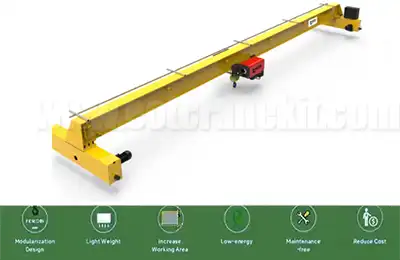
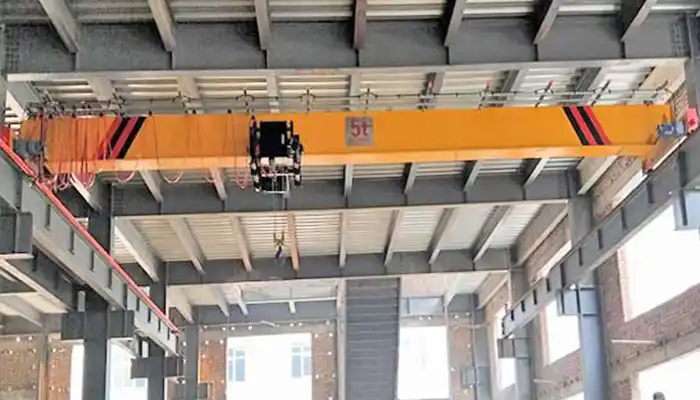
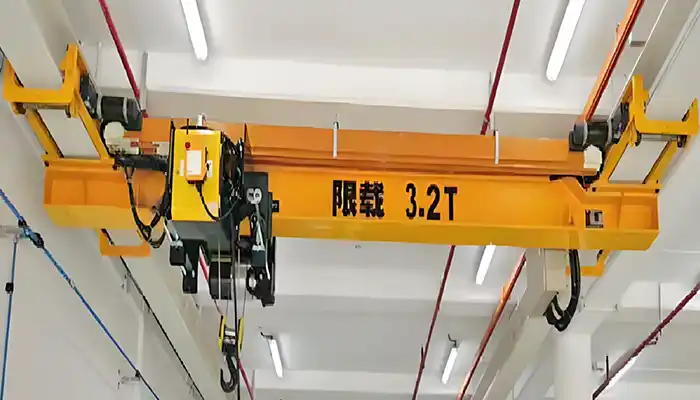
A single girder EOT crane has one main bridge girder. The electric wire rope hoist normally runs below the girder. It is widely used across African factories, workshops and warehouses where the lifting load and working duty do not require a double girder structure.
Typical African Applications
Single girder EOT cranes are found in a wide range of industrial and commercial settings across Africa where the lifting demands are moderate but reliability and cost-effectiveness are important. These cranes are particularly popular in emerging markets where workshops and factories need dependable lifting equipment without over-investing in heavy-duty infrastructure.
Key sectors using single girder cranes in Africa:
- Manufacturing workshops — Assembly lines, component handling, and production support in factories across Nigeria, Kenya and South Africa
- Machinery factories — Moving machine parts, engine blocks and fabricated components in industrial zones
- Warehouses and storage facilities — Loading and unloading of palletized goods, steel sections and construction materials
- Equipment maintenance bays — Lifting motors, gearboxes, pumps and other components for repair work
- Steel fabrication shops — Handling steel plates, beams, pipes and welded assemblies before shipment
- Automotive assembly plants — Moving vehicle bodies, engines and sub-assemblies along production lines
- Repair workshops — General maintenance lifting in industrial service centers
- General material handling areas — Moving raw materials, semi-finished goods and finished products
Typical lifting jobs include motors, pumps, molds, machine components, steel sections and maintenance equipment. The single girder design is particularly well-suited to African workshops where the crane is used for occasional lifting throughout the day rather than continuous heavy production work. It offers a practical balance between cost and capability.
A common use case across Africa is a fabrication workshop where steel beams, plates and fabricated assemblies need to be moved between workstations. The crane provides coverage across the entire workshop bay and allows the operator to position heavy items precisely for welding, drilling or assembly work.
Local conditions to consider in African installations:
- Power supply stability: Many African sites experience voltage fluctuations. Yuantai can supply cranes with under-voltage protection and phase-failure relays to protect the electrical system from unstable grid conditions.
- Spare parts availability: Single girder cranes use standard, commonly available motors and controls, making it easier to source replacement parts locally or through regional distributors in hubs like Johannesburg, Nairobi and Lagos.
- Transport logistics: Single girder cranes are easier to ship as they are lighter and can be containerized. This reduces freight costs and simplifies delivery to African ports such as Durban, Mombasa, Tema, Lagos and Dar es Salaam.
Typical Yuantai Technical Range
The tables below show the typical technical range for Yuantai single girder EOT cranes suitable for African industrial applications. All figures are project-specific and should be confirmed against actual site conditions.
| Parameter | Typical Specification |
|---|---|
| Lifting capacity | 1–20 ton (5–10 ton most common for African workshops) |
| Crane span | Approx. 7.5–28 m (custom spans available) |
| Lifting height | 6–30 m, project-specific (often 6–12 m in typical workshops) |
| Hoist type | Electric wire rope hoist with helical/spiral grooved drum |
| Hoisting speed | Approx. 0.8–8 m/min (dual speed or VFD for precision) |
| Cross-travel (trolley) speed | Approx. 10–20 m/min (VFD optional for smooth positioning) |
| Long-travel (bridge) speed | Approx. 20–30 m/min (VFD optional for smooth positioning) |
| Duty class | ISO A3–A5 / FEM 1Am–2m (select based on actual lifting cycles) |
| Control method | Pendant push-button / radio remote (cabin optional) |
| Power supply | 380V / 400V / 415V / 440V, 50/60Hz, 3Ph |
| Motor control | Contactor (standard) or VFD (recommended for unstable power) |
| Enclosure protection | IP54 standard / IP55 recommended for dusty environments / IP65 for extreme |
| Working temperature | -10°C to +45°C standard; high-temperature options available |
| Power feed | Cable festoon system (standard) / Conductor bar (for high-frequency) |
The actual range depends on the crane model and project conditions. For example, a 5 ton workshop crane with an 18 m span and a 9 m lifting height has very different structural and duty requirements from a 20 ton crane working 20 hours per day in a steel service center.
One point that is often overlooked in African projects is the crane wheel load. The total load transmitted to the runway beam includes not only the lifted load but also the dead weight of the bridge and trolley. For a single girder crane, the wheel loads are lower than for a comparable double girder crane, which can be an advantage when the existing runway structure has limited load capacity. This is particularly relevant in older African workshops where the building structure may not have been designed with heavy crane loads in mind. Yuantai provides wheel load data as part of the technical proposal so that the buyer can verify the building structure can support the crane.
Power supply considerations for Africa:
- Most African countries use 50Hz frequency, which is compatible with Yuantai's standard motor range.
- Common voltages: Nigeria (415V), South Africa (380/400V), Kenya (415V), Ghana (400V), Egypt (380V), Morocco (380V).
- Yuantai can accommodate voltage variations of ±10% through appropriate motor and control selection.
Single Girder Crane Selection for African Projects
To ensure the crane matches your African site requirements, provide the following key data at the inquiry stage. Complete information helps avoid delays and ensures the proposed crane is suitable for local conditions.
- Maximum lifting load: The heaviest single item to be lifted, including any lifting attachments (slings, magnets, spreader bars).
- Span between runway rails: The center-to-center distance between the two runway rails. This determines the bridge length and the structural design of the girder.
- Required lifting height: The vertical distance from the hook at its highest position to the lowest position where the hook must reach.
- Maximum headroom available: The available vertical space from the runway rail to the roof or overhead obstructions. This limits the overall crane height and affects the hoist selection.
- Daily operating hours: The number of hours the crane is expected to be in use each day. This influences the motor duty rating and the hoist group selection.
- Lifting cycles per hour: The number of lifts performed per hour. Combined with the load percentage, this defines the duty class.
- Maximum load percentage: The proportion of lifts that are at or near the rated capacity. A crane that lifts 10 tons 80% of the time requires a higher duty class than one that lifts 10 tons only 10% of the time.
- Power supply: Voltage, frequency, phase and the type of power feed available at the site (cable festoon or conductor bar).
- Control method: Pendant, radio remote or cabin. For single girder cranes, pendant and radio remote are the most common in Africa.
- Indoor or outdoor installation: Outdoor cranes require additional weather protection, corrosion-resistant finishes and wind load calculations.
- Site environmental conditions: Dust levels, humidity, temperature range and any corrosive atmosphere.
For a general African manufacturing workshop, a 5 ton or 10 ton single girder EOT crane is often the first choice. These capacities cover the majority of routine material handling needs in factories and workshops across the continent. Where the load, span or working frequency increases, a double girder design may be more suitable.
Single Girder vs. Double Girder: A Selection Guide for Africa
The choice between a single girder and a double girder crane is not always obvious. Here are some practical guidelines for African buyers:
- Choose single girder when: Capacity is 20 tons or less, span is moderate (up to 28 m), headroom is limited (single girder has lower overall height), and the crane is used for general workshop lifting rather than continuous heavy production. This is suitable for most small and medium-sized African factories and workshops.
- Choose double girder when: Capacity exceeds 20 tons, span is very large, lifting height is high, duty class is heavy (ISO M6+), or the crane needs to handle loads close to capacity on a frequent basis. This is common in mining workshops, steel plants and heavy engineering facilities.
- Cost consideration: A single girder crane typically costs 20–30% less than a comparable double girder crane for the same capacity and span, making it the preferred choice when the duty conditions allow. For African buyers working with limited capital budgets, this is a significant factor.
- Logistics advantage: Single girder cranes are lighter and can be shipped in standard containers, reducing shipping costs and simplifying port clearance in African countries where infrastructure is still developing.
Common Mistakes When Specifying a Single Girder Crane in Africa
Buyers sometimes specify a single girder crane for an application that really needs a double girder design. This can lead to premature wear, frequent breakdowns and safety risks. The most common mistake is specifying the crane based on capacity alone, without considering the duty class. A 10 ton crane used 8 hours per day at near-full load requires a much more robust design than a 10 ton crane used 2 hours per day at half load.
Another common error in African projects is failing to account for the actual lifting height including the hook block and slings. The lifting height specified should be the hook height at the top position, not the clearance to the roof. Yuantai recommends adding at least 500 mm of clearance between the hook block at its highest position and the roof or overhead beams to allow for safe operation and future maintenance.
Finally, many African buyers overlook the power feed arrangement. Single girder cranes typically use a cable festoon system for the trolley power supply. The festoon cable runs along the bridge girder and feeds power to the hoist trolley as it travels. This is cost-effective for most applications but requires proper cable support and tensioning. For high-speed or high-frequency applications, a conductor bar system on the bridge girder may be more reliable.
After-sales support for Africa:
- Yuantai provides technical documentation in English and French to support local installation and maintenance teams.
- Spare parts: Critical wear parts (brake shoes, contactors, limit switches, ropes) can be stocked locally or shipped quickly from Yuantai's warehouse.
- Remote support: For sites with internet connectivity, Yuantai can provide remote technical assistance via video calls and diagnostic support.
| Feature | Specification |
|---|---|
| Crane type | Single Girder EOT Crane — YUAN-SG Series |
| Working Class | ISO A3–A5 / FEM 1Am–2m (project-specific) |
| Tonnage | 1–20 T |
| Span | 7.5–28 m |
| Lifting Height | 6–30 m |
| Control | Pendant / Radio Remote (cabin optional) |
| Voltage | 380/400/415/440V, 50/60Hz, 3Ph |
| Use | Indoor (standard) / Outdoor (with weather protection) |
| Crane Rail | P18–P50 according to wheel load |
| Quality | ISO 9001, CE, GB/T |
| Key Components | Bridge girder: Welded steel box or I-beam construction with camber for deflection compensation. Designed to L/700–L/1000 deflection limit. Steel Q345B. Hoist: Electric wire rope hoist with helical grooved drum, rope guide, and limit switches. Hoist speeds 0.8–8 m/min. End carriages: Fabricated steel construction with anti-derailment brackets, bumpers and maintenance platforms. Travel wheels: Forged steel wheels with hardened treads. Wheel diameter selected based on wheel load and travel speed. Motors: Squirrel cage induction motors with Class F insulation, IP55 enclosure. Voltage tolerance ±10%. Gearboxes: Helical or planetary gearboxes with oil bath lubrication, designed for continuous duty. Control panel: Main contactor, overload protection, phase failure relay, under-voltage protection, emergency stop circuit. Safety devices: Upper/lower limit switches, overload limiter, emergency stop, end stops, bumpers, audible/visual warning devices. Power feed: Cable festoon system with galvanized steel trolleys and copper conductors. Optional conductor bar for high-frequency applications. Finish: Sandblasted to Sa 2.5, primer coating, two topcoats. Colour: RAL 1007 (standard) or as specified. Documentation: General arrangement drawings, electrical schematics, operation and maintenance manual, spare parts list, CE declaration. |
Double Girder EOT Crane for African Industries
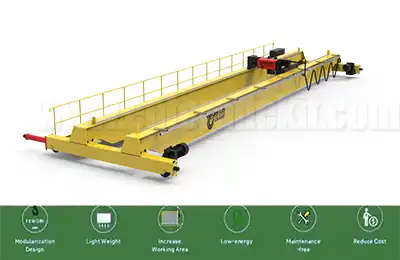
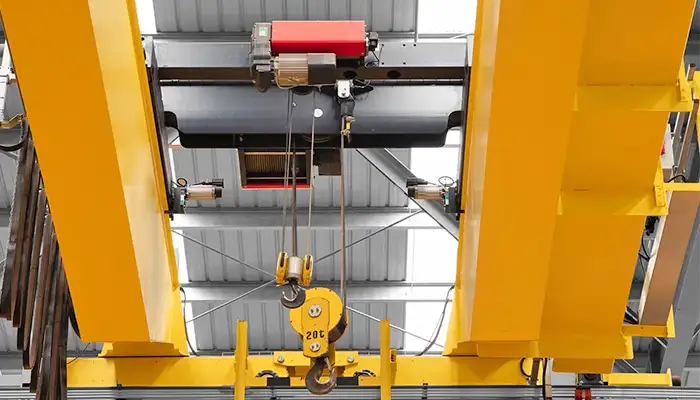
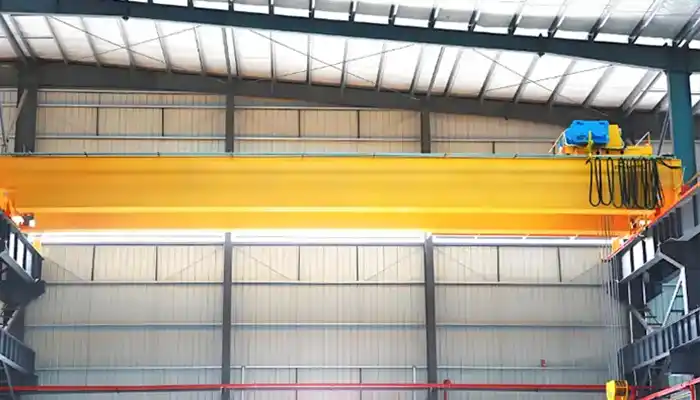
A double girder EOT crane uses two main bridge girders. The hoisting trolley is supported by the bridge structure, providing greater capacity and better lifting performance for demanding applications across African industries.
It is commonly selected for heavy loads, long spans, high lifting heights and higher-duty operation in sectors such as mining, steel production, cement manufacturing and power generation.
Typical African Applications
Double girder EOT cranes are found in heavy industrial sectors across Africa where the lifting demands are high and reliability is critical. These cranes are essential for operations that involve frequent heavy lifts, large components and demanding duty cycles.
Key sectors using double girder cranes in Africa:
- Steel mills — Handling steel coils, plates, billets and furnace maintenance
- Mining plants — Crusher maintenance, mill repairs and heavy equipment handling
- Mining maintenance workshops — Gearbox, motor and pump replacement
- Cement plants — Kiln maintenance, crusher repairs and heavy component handling
- Heavy engineering factories — Large fabricated structures and machinery assembly
- Foundries — Ladle handling, mold positioning and heavy casting movement
- Power plants — Generator, turbine and transformer maintenance
- Heavy machinery manufacturing — Large equipment assembly and testing
- Large fabrication workshops — Heavy plate and structural steel handling
- Industrial equipment maintenance — Overhaul and repair of large machinery
Typical lifting work includes crushers, mills, gearboxes, motors, transformers, steel products, production equipment and large fabricated structures. The double girder design provides the strength and stability required for these demanding applications.
Industry-specific considerations for African projects:
- Mining (South Africa, Zambia, DRC, Ghana): Heavy-duty double girder cranes with FEM 4m–5m duty class are commonly specified. Dust protection and corrosion resistance are important, particularly in copper and cobalt mining regions.
- Steel (Egypt, South Africa, Nigeria): Cranes may require high ambient temperature ratings, H-class motor insulation, and lifting magnets for scrap and billet handling. Duty class often FEM 4m–6m for production areas.
- Cement (Nigeria, Kenya, Tanzania, Ethiopia): Fine dust requires IP55 or IP65 enclosures for all electrical components. Cranes in clinker storage areas may need heat-resistant paint and special wheel materials.
- Power (South Africa, Morocco, Egypt): Lifting heights can exceed 20 meters in turbine halls. Auxiliary hoists are frequently specified for routine lighter maintenance tasks.
Typical Yuantai Technical Range
The tables below show the typical technical range for Yuantai double girder EOT cranes suitable for African heavy industrial applications. All figures are project-specific and should be confirmed against actual site conditions.
| Parameter | Typical Specification |
|---|---|
| Lifting capacity | 20–550 ton (common: 20T, 32T, 50T, 75T, 100T, 160T) |
| Crane span | Project-specific; commonly 10–35 m in African workshops |
| Lifting height | Project-specific; commonly 8–30 m depending on application |
| Hoisting arrangement | Trolley hoist (up to ~100T) / Open winch trolley (100T+) |
| Main hoist capacity | Project-specific, matched to max maintenance or production load |
| Auxiliary hoist capacity | Available; typically 10–20% of main hoist capacity |
| Main hoisting speed | Approx. 0.8–12 m/min (VFD-controlled for precision) |
| Auxiliary hoisting speed | Approx. 4–15 m/min (faster for lighter loads) |
| Cross-travel speed | Approx. 10–40 m/min (VFD-controlled) |
| Long-travel speed | Approx. 20–40 m/min (VFD-controlled) |
| Duty class | ISO A3–A8 / FEM 1Am–5m, project-specific |
| Control method | Cabin (standard) / Pendant / Radio remote |
| Motor control | VFD available for all motions |
| Power supply | 380/400/415/440V, 50/60Hz, 3Ph |
| Enclosure protection | IP54 standard / IP55 or IP65 for harsh environments |
| Motor insulation | Class F standard / Class H for high-temperature |
| Working temperature | -10°C to +45°C standard; extreme options available |
| Power feed | Conductor bar system (standard) / Cable festoon |
For higher-capacity cranes above 100 tons, an open winch trolley is typically used instead of a standard electric wire rope hoist. This arrangement allows the lifting mechanism to be engineered specifically for higher loads, longer lifting heights and heavier duty cycles. The open winch design uses a separate rope drum and motor, with wire rope reeving arranged for the required load capacity and lifting speed.
One important consideration for African double girder crane projects is the wheel load distribution. Double girder cranes have higher wheel loads than single girder cranes, which means the runway beams and columns must be designed to support these loads. For existing workshops, Yuantai provides detailed wheel load calculations and runway beam reaction data so that the buyer can verify the structural capacity of the building.
Main and Auxiliary Hoists
A double girder crane can be fitted with multiple hoisting arrangements to suit different operational requirements. This flexibility is one of the key advantages of the double girder design.
Typical configurations:
- Main hoist only: A single hook for the full rated capacity. Suitable for applications where all lifts are heavy.
- Main hoist plus auxiliary hoist: A heavy main hook and a lighter auxiliary hook on the same trolley. The auxiliary hoist is faster and more economical for routine lighter lifts.
- Two independent main hoists: Two heavy hooks for handling long or unbalanced loads, such as steel beams or transformer tanks.
- Main and auxiliary hooks with independent lifting mechanisms: Each hoist has its own motor, gearbox and control, allowing simultaneous or independent operation.
Typical capacity combinations for African projects:
- 50T main + 10T auxiliary: Common in mining maintenance workshops
- 100T main + 20T auxiliary: Typical for steel mills and heavy fabrication shops
- 160T main + 32T auxiliary: Used in power plants for turbine and generator maintenance
- 250T main + 50T auxiliary: Found in large mining plants and heavy engineering facilities
For example, a crane may use a 50 ton main hoist plus a 10 ton auxiliary hoist. The main hook handles heavy equipment such as gearboxes, crushers and motors, while the auxiliary hook handles smaller components during maintenance, reducing energy consumption and improving speed for lighter lifts.
Benefits of auxiliary hoist in African operations:
- Energy savings: The smaller auxiliary hoist consumes less power for routine lighter lifts.
- Faster operation: Auxiliary hoist speeds are typically higher than main hoist speeds, improving productivity for small lifts.
- Reduced wear: The main hoist is used only for heavy lifts, extending its service life.
- Operational flexibility: Two hooks allow handling of unbalanced or multiple loads simultaneously.
Double Girder Crane Design Considerations for Africa
For African mining, steel, cement and power projects, the design should carefully consider the following factors to ensure the crane meets operational requirements and has a long service life.
Key Technical Parameters
- Maximum wheel load: Must be checked against runway beam capacity.
- Crane span: Center-to-center distance between runway rails.
- Runway beam capacity: Existing or proposed beams must support wheel loads.
- Building column spacing: Affects runway beam length and support.
- Available headroom: Distance from rail to roof limits crane height.
- Hook approach distance: Minimum distance from hook to wall.
- Lifting height: Vertical hook travel from top to bottom position.
- Load spectrum: Distribution of loads lifted over time.
- Daily operating hours: Affects motor duty and thermal ratings.
- Start/stop frequency: Affects contactor and VFD selection.
- Outdoor wind conditions: For outdoor installations, design for specified wind loads.
Environmental Factors in African Installations
- Temperature: High-temperature options with Class H insulation for 45°C+ conditions.
- Dust and grit: IP55 or IP65 enclosures recommended for mining, cement and steel.
- Corrosion: Hot-dip galvanized components and epoxy paint for coastal installations.
- Altitude: Motor derating required for altitudes above 1000 m.
Power Supply Considerations
- Voltage fluctuations of ±10% or more — Yuantai specifies motors with wide tolerance.
- Harmonic distortion — VFD systems include line reactors and filters.
- Standby power compatibility for critical applications.
- Conductor bar systems preferred for high-duty applications.
Safety and Compliance
- Overload limiter: Standard on every Yuantai double girder crane.
- Load-moment protection: For large-span cranes to prevent overturning.
- Anti-collision systems: Radar or laser-based for multiple cranes on same runway.
- Documentation: Operation manuals, drawings, schematics and CE certification.
| Feature | Specification |
|---|---|
| Crane type | Double Girder EOT Crane — YUAN-DG Series |
| Working Class | ISO A3–A8 / FEM 1Am–5m (project-specific) |
| Tonnage | 20–550 T |
| Span | 10–35 m+ |
| Lifting Height | 8–30 m+ |
| Control | Cabin / Pendant / Radio Remote |
| Voltage | 380/400/415/440V, 50/60Hz, 3Ph |
| Use | Indoor (standard) / Outdoor (with weather protection) |
| Crane Rail | P38–P65 according to wheel load |
| Quality | ISO 9001, CE, GB/T |
| Key Components | Main girders: Welded box girders with stiffeners and camber. L/700–L/1000 deflection. Steel Q345B. Trolley frame: Welded steel supporting main and auxiliary hoists. Main hoist: Open winch with grooved drum, multi-fall reeving. Speeds 0.8–12 m/min. Auxiliary hoist: Smaller winch or hoist for lighter loads. Speeds 4–15 m/min. End carriages: Fabricated steel with anti-derailment brackets and bumpers. Wheels: Forged steel, hardened treads, sealed bearings, double-flanged with rail sweeps. Motors: Squirrel cage induction, Class F/H insulation, ±10% voltage tolerance. Gearboxes: Helical or planetary, oil bath lubrication, forced cooling optional. Brakes: Electromagnetic disc or hydraulic, wear monitoring. Control: PLC-based with VFD, emergency stop, safety interlocks. Safety: Overload limiter, limit switches, load-moment limiter, anti-collision, warning devices. Power feed: Conductor bar system (standard), cable festoon for trolley. Finish: Sandblasted Sa 2.5, zinc primer, epoxy mid-coat, polyurethane topcoat. Documentation: GA drawings, electrical schematics, O&M manual, spare parts list, CE cert. |
Your Trusted EOT Crane Manufacturer & Supplier
1 Ton to 320 Ton EOT Cranes and Overhead Cranes for Sale Africa
Tailored EOT Crane Solutions for Industrial Projects in Africa
EOT Crane Electrical Specifications for African Projects
Electrical details should be confirmed before a Chinese EOT crane enters production. Yuantai cranes can be configured for common African industrial power supplies, with the motor, control panel and protection devices selected to match the site conditions.
Common Electrical Configurations
Typical African project supplies include 380V/50Hz/3Ph, 400V/50Hz/3Ph and 415V/50Hz/3Ph. Projects using 440V or 460V at 60Hz can also be engineered according to the site power supply.
The final motor voltage, control voltage, frequency and electrical components should be confirmed from the customer's actual plant supply before manufacturing begins.
| Item | Typical Yuantai Configuration |
|---|---|
| Power supply | 380V / 400V / 415V / 440V / 460V |
| Frequency | 50Hz or 60Hz |
| Phase | 3-phase |
| Motor insulation | Class F (standard) / Class H (high-temperature environments) |
| Motor protection (IP rating) | IP54 standard / IP55–IP65 for dusty, wet or harsh environments |
| Control voltage | Commonly 24V / 48V, project-specific (low-voltage for operator safety) |
| Control method | Pendant push-button / radio remote / cabin |
| Speed control | Contactor control (standard) or VFD (recommended for precision and heavy-duty) |
| Hoisting drive | Single-speed / dual-speed / VFD-controlled |
| Travel drive (bridge & trolley) | Single-speed / dual-speed / VFD-controlled |
| Protection devices | Circuit breakers, overload protection, emergency stop, limit switches |
| Voltage tolerance | ±10% (standard) — critical for African sites with unstable supply |
Common African power supply voltages by country:
South Africa: 380V / 400V, 50Hz, 3Ph | Nigeria: 415V, 50Hz, 3Ph | Kenya: 415V, 50Hz, 3Ph | Ghana: 400V, 50Hz, 3Ph | Egypt: 380V, 50Hz, 3Ph | Morocco: 380V, 50Hz, 3Ph | Zambia: 400V, 50Hz, 3Ph | Tanzania: 400V / 415V, 50Hz, 3Ph | Angola: 380V / 400V, 50Hz, 3Ph
Yuantai can accommodate all these voltages with appropriate motor and control component selection. The actual site power supply should be measured and confirmed before manufacturing.
Main Electrical Components
A Yuantai EOT crane electrical package can include the following components, all selected to match the site power supply and duty requirements.
| Component | Details |
|---|---|
| Hoisting motor | Squirrel cage induction motor, Class F or H insulation, IP55 enclosure, voltage matched to site |
| Cross-travel motor | Squirrel cage induction motor, matched to trolley travel speed and load |
| Long-travel motors | One or two motors on bridge, depending on span and wheel load |
| Main isolator | Lockable main switch for safe isolation during maintenance |
| Circuit breakers | Moulded-case circuit breakers with thermal-magnetic protection for each motor circuit |
| Contactors | AC3 rated contactors for motor starting and stopping |
| Thermal overload protection | Overload relays with adjustable trip settings for each motor |
| Control transformer | Steps down main voltage to 24V or 48V for control circuits |
| VFDs (Variable Frequency Drives) | Available for hoist, trolley and bridge for smooth control and precision |
| Control panel | IP54/IP55 enclosure housing all control components, located on bridge or in cabin |
| Upper/lower limit switches | Mechanical or proximity limit switches to prevent over-travel |
| Travel limit switches | End-of-travel limits for trolley and bridge travel |
| Overload limiter | Electronic overload limiter with display, prevents lifting beyond rated capacity |
| Emergency stop | Red mushroom-head push buttons on pendant, remote, and panel |
| Pendant station | Suspended push-button station with emergency stop, up to 12 buttons |
| Radio remote control | Industrial-grade wireless control with dual-receiver for safety |
For example, a 20 ton double girder EOT crane may use separate motors for hoisting, trolley travel and bridge travel, with VFDs applied where precise movement is required. The exact motor power and speed are calculated from the load, lifting height, duty class and required cycle time.
Africa-specific electrical considerations:
- Phase failure protection: Yuantai includes phase-failure relays that shut down the crane if a phase is lost, preventing motor burnout.
- Under-voltage protection: Circuit breakers with under-voltage trip to protect motors during brownouts.
- Surge protection: Available for regions with lightning risk, protecting VFDs and sensitive electronics.
- Harmonic filtering: Line reactors and filters for VFD systems where power quality is poor.
VFD Control for Heavy Loads
VFD (Variable Frequency Drive) control is particularly useful for cranes handling heavy machinery, steel products and mining equipment across African industries. It offers significant operational and maintenance advantages over traditional contactor control.
Key benefits of VFD control for African crane applications:
- Adjustable hoisting speed: Operator can select slow speeds for precision positioning and faster speeds for routine lifts, improving productivity.
- Controlled acceleration: Smooth start-up reduces mechanical shock on the gearbox, wire rope and crane structure, extending component life.
- Controlled braking: Regenerative or dynamic braking reduces wear on mechanical brakes, lowering maintenance costs.
- Reduced mechanical shock: Eliminates the "jerk" associated with contactor switching, protecting both the crane and the load.
- Smoother crane travel: Improved ride quality and less load swing during bridge and trolley travel.
- Better load positioning: Precise speed control allows accurate placement of heavy components during installation and maintenance.
- Reduced load swing: Smooth acceleration and deceleration minimize pendulum effect, improving safety.
- Energy savings: VFDs optimize motor efficiency, reducing power consumption compared to fixed-speed contactor control.
Typical applications in Africa where VFD is recommended:
- Mining maintenance cranes: Slow-speed operation helps the operator align a gearbox, motor or pump with its foundation during installation.
- Steel mills: Precision positioning of coils, slabs and billets during production and handling.
- Power plants: Accurate placement of turbine components and generators during maintenance.
- Cement plants: Controlled lifting of kiln sections, crusher components and heavy machinery.
VFD considerations for African installations:
- Harmonic distortion: VFDs can generate harmonics that affect other equipment on the same supply. Yuantai includes line reactors and EMC filters to mitigate harmonic effects.
- Power quality: For sites with unstable power, VFDs with under-voltage ride-through and auto-restart functions are recommended.
- Ambient temperature: VFDs are rated for specific ambient temperatures. For high-temperature African environments, Yuantai supplies VFDs with derated capacity or forced ventilation.
- Enclosure protection: VFD enclosures should match the site conditions — IP55 or IP65 for dusty or wet environments.
| Feature | Contactor Control | VFD Control |
|---|---|---|
| Speed range | Fixed (single or dual speed) | Variable, 0 to rated speed |
| Acceleration | Step change (mechanical shock) | Ramp-controlled (smooth) |
| Braking | Mechanical brake only | Dynamic/regenerative + mechanical |
| Load swing | More swing during start/stop | Reduced swing, smoother travel |
| Positioning accuracy | Moderate | High — precise load placement |
| Energy efficiency | Fixed, less efficient at part-load | Optimized for load, energy savings |
| Mechanical wear | Higher shock loads, more wear | Reduced wear, longer component life |
| Initial cost | Lower | Higher (but offset by maintenance savings) |
| Recommended use | Light-duty, infrequent lifts | Heavy-duty, frequent lifts, precision work |
For a mining maintenance crane, for example, slow-speed operation can help the operator align a gearbox or motor with its foundation during installation. For a steel mill crane, VFD control allows smooth acceleration and deceleration when handling coils, reducing the risk of load swing and improving safety.
Your Trusted EOT Crane Manufacturer & Supplier
1 Ton to 320 Ton EOT Cranes and Overhead Cranes for Sale Africa
Tailored EOT Crane Solutions for Your Operating Conditions in Africa
EOT Crane Protection for African Operating Conditions
African projects can expose cranes to dust, heat, rain, humidity, salt and wind. These conditions should be included in the crane specification to ensure reliable operation and long service life.
Mining & Cement Plants
For dusty environments found in mining and cement plants across Africa, the electrical and mechanical equipment may be specified with enhanced protection to prevent premature failure and reduce maintenance downtime.
Recommended protection measures for dusty environments:
- IP54/IP55 or higher protection where required for all electrical components
- Enclosed control panels with sealed cable entries
- Protected motors with sealed terminal boxes
- Sealed electrical components and connectors
- Protected limit switches with rubber boots or proximity types
- Suitable cable protection — metal conduits or armored cables
- Accessible maintenance points for regular cleaning and inspection
The required IP rating should be specified for each component according to its location. A control cabinet located inside a protected electrical room has different requirements from a motor installed directly in a dusty production area. Yuantai can supply components with different protection ratings within the same crane.
Typical dust levels by industry:
- Cement plants: Fine cement dust — IP55 or IP65 recommended for all electrical components
- Mining (dry processing): Rock dust and grit — IP54 minimum, IP55 recommended
- Mining (wet processing): Dust and moisture — IP55 minimum
- Steel mills: Metallic dust and grit — IP54 minimum, sealed components recommended
High-Temperature Areas
For steel mills, foundries and cement plants in hot African climates, the specification should state the actual ambient temperature at the crane location. Many African regions experience ambient temperatures above 40°C, and cranes near furnaces or hot products can be exposed to even higher temperatures.
Typical checks for high-temperature applications:
- Motor temperature rise: Motors should be rated for the actual ambient temperature, with appropriate temperature rise limits
- Class F insulation: Standard for motors in hot environments; Class H recommended for extreme conditions above 45°C
- VFD temperature limits: VFDs must be derated for high ambient temperatures; forced ventilation or air conditioning may be required
- Brake temperature rating: Brake coils and friction materials must be rated for the operating temperature
- Control-panel ventilation: Control panels in hot areas require adequate ventilation or cooling to prevent component overheating
- Electrical component derating: All electrical components should be derated according to the actual ambient temperature
If the crane works close to hot production equipment, the actual temperature at the crane location should be provided rather than using the general outdoor temperature. A crane installed 10 meters above a furnace may experience very different temperatures from one installed 5 meters away.
Temperature ranges for African regions:
- Coastal West Africa (Nigeria, Ghana): 25–40°C with high humidity
- East Africa (Kenya, Tanzania): 15–35°C at moderate altitudes
- Southern Africa (South Africa, Zambia): 5–40°C depending on season
- North Africa (Egypt, Morocco): 10–45°C, extreme in desert areas
- Sahel region (Mali, Niger, Sudan): 20–50°C with high dust levels
Outdoor EOT & Gantry Cranes
Outdoor cranes in African ports, mining sites, steel yards and construction areas require additional consideration for weather conditions. These factors affect both the structural design and the electrical equipment.
Key considerations for outdoor cranes:
- Working wind speed: The maximum wind speed at which the crane can operate safely (typically 20–30 m/s)
- Non-working wind speed: The maximum wind speed the crane must survive when parked (typically 50–60 m/s)
- Rain: Weatherproof enclosures for electrical equipment, sealed cable glands, and drainage provisions
- Solar exposure: Control panels and electrical components may need sunshields or forced ventilation
- Corrosion: Appropriate paint system and corrosion-resistant materials
- Rail conditions: Rails may be exposed to weather; rail sweeps and debris clearance required
- Storm parking: Designated parking position and anchoring points
- Rail clamps: Mechanical or hydraulic rail clamps to secure the crane during high winds
- Wheel and brake protection: Enclosures to protect wheels and brakes from rain and debris
Large outdoor gantry cranes should be checked for wind loads, wheel loads and anchoring requirements during structural design. Yuantai performs wind load calculations according to international standards and provides anchoring specifications for each project.
Outdoor crane types commonly used in Africa:
- Gantry cranes: Used in ports, steel yards, and construction sites — require full weather protection
- Semi-gantry cranes: One rail on wall, one on ground — used in open-sided workshops
- Outdoor overhead cranes: Often found in steel plants and mining facilities with open bays
Coastal & Port Projects
For South African, Egyptian, Nigerian and other coastal industrial sites, salt and humidity can accelerate corrosion significantly. Ports and coastal facilities require special attention to material selection and surface protection.
Protection measures for coastal installations:
- Anti-corrosion paint system: Marine-grade coating with appropriate primer, intermediate and topcoat layers
- Surface preparation: Sandblasting to Sa 2.5 minimum to ensure paint adhesion
- Protected electrical cabinets: IP55 or IP65 enclosures with sealed entries and gaskets
- Sealed cable glands: Compression-type glands to prevent moisture ingress
- Corrosion-resistant components: Stainless steel or galvanized hardware, fasteners and small components
- Regular inspection points: Accessible areas for corrosion inspection and touch-up painting
The coating system should be selected according to the site's atmospheric corrosion conditions rather than using the same paint specification for every project. Yuantai uses the ISO 12944 classification system for coating selection:
- C2 (low corrosivity): Indoor, low humidity — standard industrial coating
- C3 (medium corrosivity): Indoor with occasional condensation or outdoor in temperate climates — enhanced coating
- C4 (high corrosivity): Outdoor in industrial areas or coastal areas with low salinity — heavy-duty coating system
- C5 (very high corrosivity): Coastal areas with high salinity or industrial areas with high pollution — marine-grade coating system
Key African coastal locations requiring corrosion protection:
- South Africa: Durban, Cape Town, Port Elizabeth
- Nigeria: Lagos, Port Harcourt, Onne
- Egypt: Alexandria, Port Said, Suez
- Kenya: Mombasa
- Tanzania: Dar es Salaam
- Ghana: Tema, Takoradi
- Morocco: Casablanca, Tangier
Electrical Data Buyers Should Provide
For a reliable quotation, African buyers should send the Chinese crane manufacturer the following information. Complete data helps Yuantai engineers select the motors, VFDs, control panel, protection devices and electrical enclosures correctly before manufacturing.
| Data Required | Example / Notes |
|---|---|
| Voltage | e.g. 400V — confirm from site measurement |
| Frequency | e.g. 50Hz — most African countries use 50Hz |
| Phase | 3Ph (standard for industrial cranes) |
| Capacity | e.g. 20 ton (main hoist), 5 ton (auxiliary) |
| Lifting height | e.g. 10 m — hook height at top position |
| Duty class | ISO / FEM classification — e.g. ISO M5 or FEM 3m |
| Hoisting speed | Required or project-specific — e.g. 5/0.8 m/min (VFD) |
| Travel speeds | Trolley and bridge speeds — e.g. 20 m/min, 30 m/min |
| Control method | Pendant / radio remote / cabin (specify type) |
| Ambient temperature | Max and min at crane location — critical for motor and VFD selection |
| Dust/humidity conditions | Describe dust levels and humidity — affects IP rating selection |
| Indoor or outdoor operation | Outdoor requires wind load, rain protection, UV protection |
| Coastal exposure | Distance from coast — affects corrosion protection requirements |
| Altitude | Above 1000m requires motor derating for reduced cooling |
| Power quality | Voltage fluctuations, harmonics — affects VFD and protection selection |
This information gives Yuantai engineers enough data to select the motors, VFDs, control panel, protection devices and electrical enclosures correctly before manufacturing. Providing complete data at the RFQ stage avoids delays and ensures the crane is suitable for the actual site conditions.
Additional data for existing workshop installations:
- Runway rail size and condition
- Building column spacing and clearance
- Existing power feed location and type
- Photos of the installation area
- Structural drawings or building layout
Key Technical Parameters of Chinese EOT Cranes for African Projects
Chinese EOT crane manufacturers supply overhead bridge cranes for African mining, steel, cement, manufacturing, power and engineering projects. The crane is normally engineered to match the customer's load, building structure, power supply and working conditions.
For African buyers, the quotation should include the following technical data to ensure the crane is properly specified for the intended application.
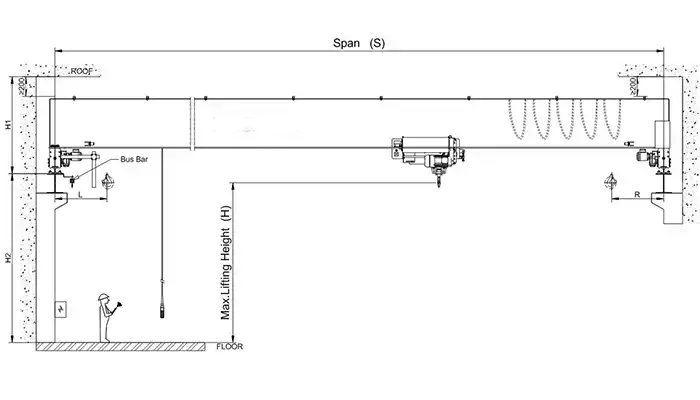
Single girder eot crane parameters that needs to be confirmed for a quotation
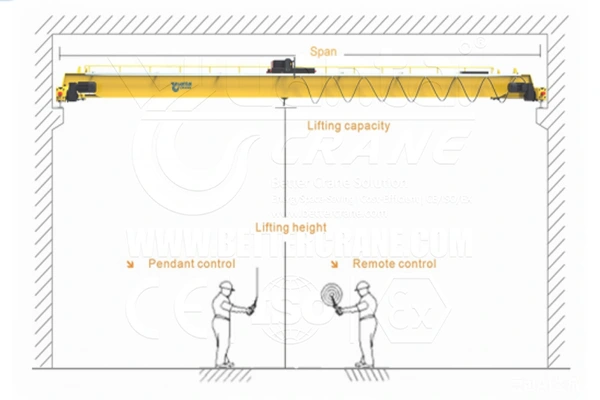
Double girder eot crane specification drawing
Key Technical Parameters
The table below outlines the key technical parameters for Chinese EOT cranes supplied to African projects. All figures are project-specific and should be confirmed against actual site conditions.
| Parameter | Typical Chinese EOT Crane Specification for Africa |
|---|---|
| Lifting capacity | 1–550 ton+ (common: 5T, 10T, 20T, 32T, 50T, 75T, 100T, 160T) |
| Crane type | Single girder / double girder EOT crane |
| Crane span | Project-specific, commonly 7.5–28 m for single girder; up to 35 m+ for double girder |
| Lifting height | Project-specific, based on building height and required hook position (typically 6–30 m) |
| Duty class | ISO A3–A8 / FEM 1Am–5m, selected according to load spectrum and working frequency |
| Hoist type | Electric wire rope hoist / trolley-mounted hoist / open winch (for capacities above 100T) |
| Main & auxiliary hoist | Available for heavy-duty and process applications; auxiliary typically 10–20% of main capacity |
| Hoisting speed | Project-specific; single/dual speed (0.8–12 m/min), VFD available for precision control |
| Cross-travel (trolley) speed | Project-specific (typically 10–40 m/min), VFD available for smooth positioning |
| Long-travel (bridge) speed | Project-specific (typically 20–40 m/min), VFD available for smooth positioning |
| Power supply | 380V / 400V / 415V / 440V / 460V, 50/60Hz, 3-phase (matched to site supply) |
| Control method | Pendant push-button / radio remote / operator cabin |
| Motor protection (IP rating) | Typically IP54–IP55, IP65 available for extreme dust/moisture environments |
| Electrical enclosure | IP rating selected according to site conditions (IP54 standard, IP55–IP65 for harsh) |
| Operating environment | Indoor / outdoor / dusty / humid / corrosive / high-temperature — specify at RFQ |
| Safety equipment | Overload limiter, limit switches, emergency stop, end stops, bumpers, audible/visual alarms |
| Crane runway | Building-supported runway rails — rail size P18–P65 based on wheel load |
| Standards compliance | Chinese GB / ISO / FEM / project-specific international requirements |
| Quality certification | ISO 9001, CE, GB/T, and other certifications as required by the project |
Important notes for African buyers:
- Capacity: Specify the maximum load including lifting attachments (slings, spreader bars, magnets). Do not base capacity on the equipment weight alone.
- Span: Measure the center-to-center distance between runway rails — not the building width.
- Lifting height: Specify the hook height at the top position, not the clearance to the roof. Allow at least 500 mm clearance above the hook block.
- Duty class: Provide actual operating hours and lifting cycles per day, not just the capacity. A 10T crane used 8 hours/day requires a higher duty class than one used 2 hours/day.
- Power supply: Confirm voltage at the crane connection point, not just the nominal supply voltage. Voltage drop over long cable runs can affect motor performance.
Your Trusted EOT Crane Manufacturer & Supplier
1 Ton to 320 Ton EOT Cranes and Overhead Cranes for Sale Africa
African Country Markets
African crane requirements vary by industry, lifting conditions and local engineering capacity. South Africa is one of the more established industrial markets in the region, with demand from mining, steel, manufacturing, power and heavy engineering.
For a Chinese EOT crane manufacturer, South Africa is also a useful market to examine through actual import data rather than relying only on general market descriptions.
EOT Crane Market in South Africa
South Africa has a broad industrial base, with strong demand for overhead bridge cranes, EOT cranes, gantry cranes, electric wire rope hoists and replacement crane components.
Mining and mineral processing require cranes for equipment maintenance. Steel and engineering companies use overhead cranes for fabrication and machinery handling. Power and manufacturing plants require cranes for installation, production and maintenance work.
Main Industries & Typical Crane Applications
Key industries using cranes in South Africa:
- Mining and mineral processing
- Steel and metal processing
- Manufacturing
- Heavy engineering
- Power generation
- Industrial logistics
- Equipment maintenance
Typical crane applications across South African industry:
- Crusher, mill and conveyor maintenance
- Mining equipment handling
- Motor and gearbox replacement
- Steel fabrication and coil handling
- Heavy machinery assembly
- Power plant equipment maintenance
- Workshop material handling
- Outdoor equipment handling
South Africa-specific considerations:
- Mining: South Africa's deep-level mines require cranes with high reliability and dust protection. Many mines operate 24/7, so duty class selection is critical.
- Steel: The steel industry in Gauteng and Mpumalanga requires heavy-duty cranes with heat-resistant components and lifting magnets.
- Power: Eskom power stations use large-capacity cranes for turbine and generator maintenance.
- Ports: Durban, Cape Town and Richards Bay handle heavy equipment and require corrosion-resistant cranes.
Chinese Crane Imports into South Africa
South African customs data provides a useful reference for the Chinese crane supply market. Under HS 842611, which covers gantry and overhead travelling cranes on fixed supports, South Africa imported about US$4.22 million of equipment in 2024, with 1,471 reported items. China supplied about US$1.30 million, with 544 reported items.
This means China accounted for roughly 31% of the reported import value and 37% of the reported quantity under this HS code in South Africa in 2024. The figures show that Chinese suppliers already have a measurable position in the South African overhead and gantry crane market.
At the same time, the customs quantity should be read carefully. HS 842611 is a trade classification, not a technical classification for a specific EOT crane model. A reported "item" does not tell us whether the equipment was a 5 ton workshop crane, a 50 ton double girder crane or another configuration.
China's overall exports under HS 842611 were about US$406.17 million and 9,513 reported items in 2024. South Africa was one of the destinations for Chinese crane exports, with the country receiving about US$1.30 million under this category.
Trade data insights for buyers:
- Chinese suppliers are well-established in the South African market.
- Competition includes suppliers from Europe, India and Turkey.
- Trade data should be used as a market indicator, not a direct equipment count.
- For accurate pricing, technical RFQs are more reliable than customs averages.
Typical Chinese EOT Crane Specifications for South Africa
Chinese manufacturers can configure EOT cranes according to the requirements of South African industrial sites. The table below shows typical specifications for the South African market.
| Parameter | Typical Specification |
|---|---|
| Crane type | Single girder / double girder EOT |
| Capacity | 1–550 ton+ |
| Span | Project-specific |
| Lifting height | Project-specific |
| Duty class | ISO / FEM, based on working cycle |
| Hoist type | Electric wire rope hoist / trolley / open winch |
| Main & auxiliary hoist | Available |
| Power supply | 380V / 400V / 415V, 50Hz, 3Ph or project-specific |
| Control | Pendant / radio remote / cabin |
| Travel control | Contactor or VFD |
| Hoisting control | Single speed / dual speed / VFD |
| Motor protection | Typically IP54–IP55, project-specific |
| Safety | Overload limiter, limit switches, emergency stop, buffers |
| Environment | Indoor / outdoor / dusty / humid / corrosive |
| Crane structure | Single girder / double girder |
South Africa-specific power supply:
- Common voltages: 380V or 400V, 50Hz, 3-phase
- Some industrial sites use 415V — confirm site supply before ordering
- Yuantai can accommodate voltage variations of ±10%
EOT Crane Requirements for South African Industry
South African crane projects cover mining, steel production, engineering workshops and equipment maintenance. The crane specification should match the load, duty cycle, runway and site environment rather than capacity alone.
Mining & Mineral Processing Cranes
Mining maintenance cranes may handle:
- Crusher components
- Mill components
- Gearboxes and motors
- Pumps
- Conveyor drives
- Screens
- Heavy maintenance parts
For these applications, Yuantai engineers should calculate the duty from:
- Daily operating hours
- Lifting cycles
- Average and maximum load
- Load spectrum
- Required service life
Typical Mining Crane Configuration
| Parameter | Typical Specification |
|---|---|
| Crane type | Double girder EOT |
| Capacity | 20–100 ton+, project-specific |
| Hoist type | Wire rope hoist / open winch |
| Duty | ISO / FEM, based on load spectrum |
| Control | Pendant / radio remote / cabin |
| Speed control | Single / dual speed / VFD |
| Motor protection | Typically IP54–IP55, project-specific |
| Safety | Overload limiter, limits, emergency stop |
For heavier maintenance work, main and auxiliary hoists, open winch trolleys and VFD control can be specified.
Mining sites should also consider dust protection for motors, control panels, limit switches and electrical connections. The required IP rating should be selected according to the actual installation area.
Steel & Heavy Engineering Plants
Steel fabrication and heavy engineering plants may use EOT cranes for both production and maintenance.
Typical configurations include:
- 5–20 ton single girder EOT cranes for workshop lifting
- 20–100 ton double girder EOT cranes for heavy machinery
- Higher-capacity cranes for large production equipment
- VFD control for precise movement
- Radio remote or cabin control
- Main and auxiliary hoists where required
- Higher ISO/FEM duty classes for frequent operation
For steel coils, fabricated structures and machinery, the RFQ should specify hook height, span, maximum load, lifting cycle and required positioning accuracy.
EOT Crane Kits & Replacement Hoists
EOT Crane Kits for Local Fabrication
Where a local contractor has suitable steel fabrication and installation capability, Yuantai can supply an EOT crane kit.
A typical kit may include:
- Electric wire rope hoist or open winch trolley
- End carriages with wheels
- Travel motors and gearboxes
- Control panel with VFDs
- Festoon system and power feed components
- Limit switches and overload limiter
- Radio remote control or pendant
- Technical drawings and assembly instructions
The local fabricator can manufacture the main girder, platforms and selected structural parts according to the approved drawings.
Important dimensions such as wheelbase, runway gauge, girder connection and hoist mounting position should be controlled by the crane design to ensure the locally fabricated structure matches the imported components.
Replacement Hoists & Crane Components
South African plants with existing overhead cranes may not need a complete replacement crane. A new hoist or travelling mechanism can often be supplied if the existing structure remains suitable.
For a replacement hoist, provide:
- Existing capacity and lifting height
- Hoist dimensions and trolley wheelbase
- Power supply details
- Crane nameplate data and photographs
- Existing bridge and runway condition
For mining projects, add the load spectrum, lifting frequency, maximum component weight and shutdown maintenance cycle.
For Chinese crane suppliers, this information turns an RFQ from a simple "20 ton crane price" request into an engineering specification. It allows the main girder, hoist, motors, wheels, electrical system and safety equipment to be selected for the actual South African site.
Note on trade data: HS 842611 is useful for tracking international trade in gantry and overhead travelling cranes on fixed supports. It should not be treated as a direct count of EOT cranes. Customs records can cover different crane configurations and reporting methods, so trade figures are best used as market indicators rather than individual crane model data.
EOT Crane Market in Nigeria
Nigeria has demand for industrial lifting equipment in cement, steel, ports, construction equipment manufacturing and general manufacturing. Many projects involve plant maintenance, heavy machinery assembly and equipment installation.
Chinese crane suppliers can provide complete EOT crane systems, heavy-duty overhead cranes, gantry cranes, electric wire rope hoists and crane kits for Nigerian projects.
Main Industries & Typical Crane Applications
Key industries using cranes in Nigeria:
- Cement production
- Steel and metal fabrication
- Ports and logistics
- Construction equipment manufacturing
- General manufacturing
- Heavy engineering
- Industrial maintenance
Typical crane applications across Nigerian industry:
- Crusher and kiln maintenance
- Cement mill maintenance
- Gearbox and motor replacement
- Steel structure fabrication
- Heavy machinery assembly
- Port equipment maintenance
- Equipment installation
- Workshop material handling
A cement plant may need an overhead crane for crushers, mills, motors and gearboxes. A steel fabrication plant may use an EOT crane to move steel plates, beams and fabricated structures.
Nigeria-specific considerations:
- Cement: Major producers like Dangote, Lafarge and BUA operate large plants requiring heavy-duty maintenance cranes. Dust protection is critical.
- Steel: The steel industry in Lagos, Ogun and other states requires reliable cranes for fabrication and handling.
- Ports: Lagos (Apapa, Tin Can), Port Harcourt and Onne handle heavy equipment and require corrosion-resistant cranes.
- Power supply: Voltage fluctuations are common — Yuantai supplies cranes with under-voltage protection and wide voltage tolerance.
Chinese EOT Crane Supply to Nigeria
China is an established supplier of industrial cranes and material handling equipment to the Nigerian market.
For trade analysis, HS 842611 is commonly used for gantry and overhead travelling cranes on fixed supports. It provides a useful indication of crane trade between China and Nigeria.
Trade data highlights (2024):
- Nigeria imported approximately US$11.18 million of products under HS 842611
- China supplied approximately US$1.77 million of this import value
- Chinese exports to Nigeria under the same HS code were approximately US$1.47 million, covering about 101 reported items
The data shows an existing supply flow of Chinese overhead and gantry cranes into Nigeria. For buyers, the more useful question is the technical specification of the crane required for the project.
Trade data insights for buyers:
- Nigerian import values show significant demand for lifting equipment.
- Chinese suppliers are well-established but face competition from European, Indian and Turkish suppliers.
- Technical RFQs are essential for accurate pricing — customs data alone does not specify crane configuration.
- Port clearance and logistics should be considered when planning delivery to Nigeria.
Typical Chinese EOT Crane Specifications for Nigeria
Chinese manufacturers can configure EOT cranes according to the Nigerian plant, workshop or industrial yard. The table below shows typical specifications for the Nigerian market.
| Parameter | Typical Specification |
|---|---|
| Crane type | Single girder / double girder EOT |
| Capacity | 1–550 ton+ |
| Span | Project-specific |
| Lifting height | Project-specific |
| Duty class | ISO / FEM |
| Hoist type | Electric wire rope hoist / trolley / open winch |
| Main & auxiliary hoist | Available |
| Hoisting speed | Project-specific |
| Cross-travel speed | Project-specific |
| Long-travel speed | Project-specific |
| Power supply | 380V / 400V / 415V / 440V, 50/60Hz, 3-phase |
| Control | Pendant / radio remote / cabin |
| Motor control | Contactor / VFD |
| Motor protection | Typically IP54–IP55, project-specific |
| Operating environment | Indoor / outdoor / dusty / humid |
| Safety equipment | Overload limiter, limit switches, emergency stop, buffers |
These are typical engineering ranges. The final crane specification should be calculated from the actual load, building and operating conditions.
Nigeria-specific power supply:
- Common voltage: 415V, 50Hz, 3-phase
- Some sites use 380V or 400V — confirm site supply before ordering
- Voltage fluctuations are common — Yuantai supplies motors with ±10% tolerance
- Under-voltage and phase-failure protection are recommended
EOT Cranes for Nigerian Cement Plants
Nigerian cement plants often use overhead cranes for planned maintenance and heavy equipment replacement. Crushers, mills, kilns, gearboxes and motors can require regular lifting during shutdowns. The crane should be selected from the actual load and maintenance cycle.
Typical lifting work in cement plants:
- Crusher maintenance
- Kiln maintenance
- Cement mill maintenance
- Gearbox replacement
- Motor replacement
- Pump maintenance
- Conveyor maintenance
- Heavy component installation
Typical Technical Data for Cement Plant Cranes
| Parameter | Typical Range / Option |
|---|---|
| Crane type | Single or double girder EOT |
| Capacity | 5–100 ton+, project-specific |
| Span | Approx. 7.5–30 m, project-specific |
| Lifting height | 6–30 m+, project-specific |
| Hoist type | Electric wire rope hoist / open winch |
| Duty class | ISO / FEM, based on load spectrum |
| Control | Pendant / radio remote / cabin |
| Travel control | Single speed / dual speed / VFD |
| Hoisting control | Single speed / dual speed / VFD |
| Motor protection | Typically IP54–IP55, project-specific |
| Power supply | 380/400/415V, 50Hz, 3Ph or project-specific |
A double girder EOT crane is generally considered for heavier maintenance loads, larger spans, higher duty cycles or applications requiring greater structural capacity.
Dust Protection for Cement Plants
Cement dust can affect motors, control panels and electrical equipment. The specification should consider:
- Motor IP rating — IP55 or higher recommended
- Control-panel enclosure — IP55 with sealed cable entries
- VFD cabinet protection — filtered ventilation or sealed
- Cable and festoon protection — sealed connectors and dust boots
- Limit-switch protection — proximity switches with sealed housings
- Sealed electrical connections throughout
- Maintenance access for regular cleaning
The final protection level should be selected according to the actual plant location.
EOT Cranes for Steel, Gantry Cranes & Power Supply
EOT Cranes for Nigerian Steel & Machinery Plants
Steel fabricators and construction-equipment manufacturers use overhead cranes for fabrication, assembly, maintenance and material handling.
Typical loads include:
- Steel plates
- Structural beams
- Fabricated steel structures
- Excavator components
- Construction machinery
- Motors and gearboxes
- Hydraulic equipment
A 5–20 ton single girder EOT crane can suit many general workshops. Heavier production and machinery-handling areas may require 20–100 ton or higher double girder EOT cranes.
Where loads are handled mainly in outdoor yards, a gantry crane can avoid the need for a building-supported runway.
Gantry Cranes for Nigerian Industrial Yards
Gantry cranes are useful for outdoor handling where there is no suitable overhead runway.
Typical applications include:
- Steel storage yards
- Construction equipment yards
- Machinery assembly
- Precast concrete handling
- Port maintenance
- Heavy equipment storage
Typical configurations include:
- Single girder gantry crane
- Double girder gantry crane
- Electric wire rope hoist or open winch trolley
- Radio remote control or operator cabin
- Rail-mounted travel
Typical capacities can range from 5–50 ton for general yard handling, while heavier industrial gantry cranes can be engineered for 100 ton, 200 ton or higher loads.
Outdoor cranes should be checked for wind load, rain, humidity, corrosion, rail alignment and foundation conditions.
Power Supply for Nigerian EOT Cranes
The site power supply should be confirmed before crane production. Common configurations include 380V/50Hz/3Ph, 400V/50Hz/3Ph and 415V/50Hz/3Ph, with other project-specific options available.
The selected voltage and frequency affect the hoist motors, travel motors, control transformer, VFDs, control panel, circuit breakers and protection devices. For replacement cranes or hoists, the existing motor nameplate and actual site voltage should be checked to avoid electrical mismatch during installation.
Crane Kits & Replacement Components
EOT Crane Kits for Local Assembly in Nigeria
A crane kit can suit Nigerian engineering companies with steel fabrication, welding, installation and maintenance capabilities.
The Chinese supplier can provide:
- Electric wire rope hoist or open winch trolley
- End carriages with crane wheels
- Travel motors and gearboxes
- Control panel with VFDs
- Festoon system and power feed components
- Limit switches and overload limiter
- Radio remote control or pendant
- Technical drawings and assembly instructions
The local fabricator can manufacture the bridge girder according to the approved structural design.
Before fabrication, the Chinese supplier and Nigerian fabricator should confirm:
- Steel grade and material specifications
- Girder dimensions and structural calculations
- Welding requirements and quality standards
- Wheel loads and allowable deflection
- Assembly tolerances and connection details
- Electrical installation details
- Responsibilities for testing and commissioning
For the imported components to fit correctly, dimensions such as wheelbase, runway gauge, girder connection and hoist mounting position should be controlled by the approved drawings.
Replacement Hoists & Crane Components in Nigeria
Many Nigerian factories already operate overhead cranes. A complete crane replacement may not be necessary when the existing bridge and runway remain suitable.
Chinese suppliers can provide:
- Electric wire rope hoists
- Hoist and travel motors
- Gearboxes and crane wheels
- Brakes and end carriages
- VFDs and control panels
- Limit switches and festoon systems
- Radio remote controls and overload limiters
For a replacement hoist, provide:
- Crane capacity and lifting height
- Hoist dimensions and trolley wheelbase
- Motor data (power, speed, voltage)
- Voltage and frequency at site
- Duty class and operating conditions
- Existing nameplate and photos
- Available crane drawings
For larger replacements, the existing bridge girder, runway and wheel loads should also be checked before selecting the new hoist.
Documentation for larger projects:
- General arrangement drawings
- Load calculations and wheel loads
- Motor specifications and electrical diagrams
- Spare parts list
- Operation and maintenance manuals
This information allows the Chinese manufacturer to design the EOT crane around the actual Nigerian site rather than supplying a standard crane based only on lifting capacity.
EOT Crane Market in Egypt
Egypt has a broad industrial base covering cement, steel, metal processing, ports, construction equipment and machinery manufacturing. EOT cranes are used for production, equipment assembly, plant maintenance and heavy material handling.
For Chinese crane suppliers, Egypt is a market for both complete overhead crane systems and individual lifting equipment, including electric wire rope hoists, crane kits and replacement components.
Main Industries & Crane Applications
Egypt's demand for industrial lifting equipment is closely linked to cement, steel, metal processing, machinery manufacturing, construction equipment, ports and heavy engineering. Crane specifications should be based on the maximum load, lifting height, duty cycle and whether the crane operates inside a plant or in an outdoor yard.
Main industries using cranes in Egypt:
- Cement production: Crushers, cement mills, kiln equipment, gearboxes, motors and conveyor systems
- Steel and metal processing: Steel plates, beams, coils, fabricated structures and production machinery
- Machinery manufacturing: Motors, gearboxes, hydraulic systems and assembled machinery
- Construction equipment: Excavators, loaders, pumps, engines and heavy equipment components
- Ports and logistics: Heavy machinery, steel products, maintenance equipment and cargo handling
- Heavy engineering: Large fabricated structures, industrial machinery and plant equipment
- Industrial maintenance: Motors, pumps, reducers, compressors and replacement components
Typical crane applications across Egyptian industry:
- Cement plant equipment maintenance
- Crusher and mill maintenance
- Steel fabrication and handling
- Machinery assembly
- Motor and gearbox handling
- Port equipment maintenance
- Heavy equipment installation
- Factory material handling
Egypt-specific considerations:
- Temperature: High temperatures in summer (40–45°C+) affect motor ratings and VFD performance. Class H insulation recommended for outdoor or poorly ventilated areas.
- Dust: Cement and steel plants require enhanced dust protection. IP55 or IP65 enclosures recommended.
- Power supply: Common voltage is 380V, 50Hz, 3-phase. Some industrial sites use 400V or 415V — confirm site supply before ordering.
- Ports: Alexandria, Port Said and Suez handle heavy equipment and require corrosion-resistant cranes for coastal installations.
For outdoor Egyptian industrial yards and port areas, 10–100 ton gantry cranes can be considered where there is no suitable building runway. Outdoor designs should account for wind, dust, heat, rain, corrosion and foundation conditions.
For Egyptian projects, the RFQ should specify capacity, span, lifting height, ISO/FEM duty class, hoisting speed, travel speed, power supply, control method and operating environment.
Chinese EOT Crane Supply to Egypt
For trade analysis, HS 842611 is commonly used for gantry and overhead travelling cranes on fixed supports.
Trade data highlights (2024):
- Egypt imported approximately US$6.45 million of products under HS 842611
- China supplied approximately US$1.08 million of this import value
- China's reported exports to Egypt under the same HS code were approximately US$1.04 million, covering about 56 reported items
The import and export figures can differ because of customs reporting practices, shipment dates, valuation methods and differences between exporter and importer declarations.
The HS code should therefore be used as a market and trade indicator. It does not identify whether an individual shipment contains a single girder EOT crane, double girder EOT crane, gantry crane or another type of overhead travelling equipment.
For buyers, the technical specification remains more important than the trade classification.
Trade data insights for buyers:
- Egyptian import values show consistent demand for lifting equipment.
- Chinese suppliers have a measurable share of the market.
- Competition includes European, Indian and Turkish suppliers.
- Technical RFQs are essential for accurate pricing — customs data alone does not specify crane configuration.
Typical Chinese EOT Crane Specifications for Egypt
Chinese manufacturers can configure overhead bridge cranes for Egyptian factories according to the load, building structure and operating environment. The table below shows typical specifications for the Egyptian market.
| Parameter | Typical Specification |
|---|---|
| Crane type | Single girder / double girder EOT |
| Capacity | 1–550 ton+ |
| Span | Project-specific |
| Lifting height | Project-specific |
| Duty class | ISO / FEM |
| Hoist type | Electric wire rope hoist / trolley / open winch |
| Main & auxiliary hoist | Available |
| Hoisting speed | Project-specific |
| Cross-travel speed | Project-specific |
| Long-travel speed | Project-specific |
| Power supply | 380V / 400V / 415V / 440V, 50/60Hz, 3-phase |
| Control | Pendant / radio remote / cabin |
| Motor control | Contactor / VFD |
| Motor protection | Typically IP54–IP55, project-specific |
| Operating environment | Indoor / outdoor / dusty / high-temperature |
| Safety equipment | Overload limiter, limit switches, emergency stop, buffers |
The final specification should be based on the actual Egyptian project rather than selecting equipment from capacity alone.
EOT Cranes for Egyptian Cement Plants
Egyptian cement plants use cranes for production equipment handling and scheduled maintenance. Typical lifting work includes crusher maintenance, kiln equipment maintenance, cement mill maintenance, gearbox replacement, motor handling, pump replacement, conveyor maintenance and heavy component installation.
For heavy maintenance loads, a double girder EOT crane can be configured with an electric wire rope hoist or open winch trolley. Main and auxiliary hoists may be used where large equipment must be lifted and positioned during plant shutdowns.
Typical cement plant crane configuration:
- Capacity: 10–100 ton+, project-specific
- Crane type: Double girder EOT for heavy maintenance
- Duty class: ISO M5–M7 / FEM 3m–5m based on shutdown cycle
- Hoist: Open winch trolley with main and auxiliary hoists
- Control: Radio remote or cabin for precision positioning
- Speed control: VFD on hoist and travel motions
- Motor protection: IP55 minimum for dust protection
Dust protection for cement plants:
Cement dust can affect motors and electrical equipment. The crane specification should consider:
- Hoist motors and travel motors — IP55 or higher
- Control panels — IP55 with sealed cable entries
- VFD cabinets — filtered ventilation or sealed with heat exchangers
- Electrical enclosures — fully sealed
- Limit switches — sealed proximity switches
- Cable systems — sealed connectors and dust boots
The required IP rating should be selected according to the actual installation location.
EOT Cranes for Egyptian Steel & Metal Processing
Steel plants and metal-processing facilities use overhead cranes for production, fabrication, coil handling and maintenance.
Typical loads include:
- Steel plates and structural steel
- Fabricated components
- Steel coils
- Motors and gearboxes
- Production machinery
- Maintenance equipment
For general workshops, a 5–20 ton single girder EOT crane can be suitable. Heavier production and maintenance areas may use 20–100 ton or higher double girder EOT cranes with trolley-mounted wire rope hoists or open winch trolleys.
Where accurate load positioning is required, VFDs can be applied to the hoisting, cross-travel and long-travel mechanisms.
Heat considerations for steel plants:
- Motors may require Class H insulation for high ambient temperatures
- Control panels may need forced ventilation or air conditioning
- VFDs should be derated for temperatures above 40°C
- Brakes and friction materials should be rated for the operating temperature
Gantry Cranes & Technical Requirements
Gantry Cranes for Egyptian Outdoor Yards
Gantry cranes are useful where heavy loads must be handled outdoors and there is no suitable building-supported runway.
Typical applications include:
- Steel storage yards
- Construction equipment yards
- Machinery assembly
- Precast concrete handling
- Port maintenance
- Heavy equipment handling
Typical configurations include:
- Single girder or double girder gantry crane
- Electric wire rope hoist or open winch trolley
- Radio remote control or operator cabin
- Rail-mounted travel
Typical capacities can range from 5–50 ton for general yard handling, while larger industrial gantry cranes can be engineered for 100 ton, 200 ton or higher loads.
Outdoor crane checks:
- Wind load — working and non-working wind speeds
- Dust and sand protection — sealed components
- Temperature — motor and VFD derating for high temperatures
- Rain — weatherproof enclosures and drainage
- Corrosion — appropriate paint system and materials
- Rail alignment and foundation conditions
Temperature and Dust Requirements in Egypt
Egyptian industrial sites can experience high temperatures, especially in outdoor yards and poorly ventilated production areas. The crane specification should confirm:
- Design ambient temperature
- Motor insulation class (Class F standard, Class H for high-temperature)
- Motor IP rating (IP55 recommended for dusty environments)
- Electrical enclosure protection
- Control-panel ventilation
- VFD temperature limits and derating
- Brake operating conditions
For cement plants, dust protection should be matched to the actual plant area. A crane installed inside a protected electrical room will have different requirements from one operating directly beside a crusher or cement mill.
Power Supply for Egyptian EOT Cranes
The electrical configuration should be confirmed before manufacturing. Common options include:
- 380V/50Hz/3Ph (most common in Egypt)
- 400V/50Hz/3Ph (some industrial sites)
- 415V/50Hz/3Ph (project-specific)
- 440V/60Hz/3Ph or other project-specific supplies available where required
The selected power supply affects the hoist motor, crane travel motors, control transformer, VFDs, control panel and electrical protection devices. For replacement equipment, the existing crane nameplate and actual site voltage should be checked before selecting the new motor and control system to avoid voltage, frequency or control-system mismatches.
Data to Provide for Egyptian Crane Projects
For Egyptian crane projects, buyers should provide:
- Maximum load (including lifting attachments)
- Span between runway rails
- Required lifting height
- ISO/FEM duty class
- Daily operating hours and lifting cycles
- Power supply voltage and frequency
- Indoor or outdoor operation
- Ambient temperature range
- Dust conditions (cement, sand, etc.)
- Coastal exposure (if applicable)
This gives the manufacturer enough information to select the hoist, motors, electrical protection and structural configuration correctly.
Other African EOT Crane Markets
Beyond South Africa, Nigeria and Egypt, Chinese EOT crane suppliers serve industrial projects across East, West and North Africa. Crane selection usually depends on the maximum load, span, lifting height, duty cycle and whether the crane works inside a factory or in an outdoor yard.
East African Markets
Kenya
Kenya has demand from manufacturing, steel fabrication, cement, logistics and infrastructure.
Typical applications include workshop lifting, steel fabrication, cement plant maintenance and machinery assembly.
Typical crane data:
- Single girder EOT: 1–20 ton
- Double girder EOT: 20–50 ton+
- Typical span: 7.5–28 m, project-specific
- Lifting height: 6–20 m, project-specific
- Outdoor yards: 5–50 ton gantry cranes
- Hoist: Electric wire rope hoist
- Control: Pendant / radio remote
- Duty: ISO / FEM, project-specific
Tanzania
Tanzania has crane demand from mining, cement, manufacturing, construction and infrastructure.
Typical lifting loads include motors, pumps, gearboxes, crusher components and construction equipment.
Typical crane data:
- Single girder EOT: 1–20 ton
- Double girder EOT: 20–100 ton+
- Gantry crane: 10–100 ton
- Span: 7.5–30 m+, project-specific
- Lifting height: 6–30 m+
- Hoist: Wire rope hoist / open winch
- Control: Pendant / radio remote / cabin
- Duty: ISO / FEM
Ethiopia
Ethiopian crane demand is linked to manufacturing, cement, steel fabrication, construction equipment and infrastructure.
- For general factories: 1–20 ton single girder EOT cranes
- Larger cement and heavy-engineering facilities: 20–80 ton+ double girder cranes
- Gantry cranes for outdoor machinery and construction equipment yards
North & West African Markets
Morocco
Morocco's automotive, steel, machinery and port industries require cranes for production and maintenance.
Typical loads include steel components, fabricated structures, motors, gearboxes and production machinery.
Typical crane data:
- Workshop EOT: 3–20 ton
- Double girder EOT: 20–80 ton+
- Span: 8–30 m, project-specific
- Hoisting height: 6–20 m+
- VFD available for hoisting and travel
- Control: Radio remote / pendant / cabin
- Gantry crane: 10–100 ton, depending on yard requirements
Algeria
Algeria has industrial demand from oil and gas, steel, cement, manufacturing and heavy engineering.
Typical requirements include:
- Heavy-duty EOT: 20–100 ton+
- Double girder EOT
- Gantry cranes: 10–100 ton+
- Open winch trolley
- Main and auxiliary hoists
- VFD travel control
- ISO/FEM higher-duty classifications
For large plant maintenance, the crane capacity should be based on the heaviest component that must be removed, transported and installed.
Ghana
Ghana's mining, cement, steel and port industries create demand for heavy maintenance cranes.
Typical work includes crusher maintenance, mining equipment handling, machinery assembly and port equipment maintenance.
For larger mining facilities, typical configurations include 20–100 ton+ double girder EOT cranes, with wire rope hoists or open winch trolleys. Main and auxiliary hoists can be used where large equipment must be lifted and positioned during maintenance.
Côte d'Ivoire and Senegal
Cement, ports, construction, manufacturing and logistics are common application areas.
- For general workshops: 1–20 ton EOT cranes
- Larger industrial facilities: 20–80 ton+ double girder EOT cranes
- Outdoor yards: 10–50 ton gantry cranes
Southern & Central African Markets
Zambia
Mining is a major application for industrial lifting equipment in Zambia. Cranes may handle gearboxes, motors, crusher components, conveyor equipment and other maintenance loads.
- Large mining facilities: 20–100 ton+ double girder EOT cranes
- Open winch trolleys, auxiliary hoists and VFD travel control for heavier maintenance work
- Crane kits suitable where local engineering companies can fabricate the bridge structure and complete installation
Angola
Angola's oil and gas support, ports, mining, construction and heavy equipment sectors require both workshop and yard cranes.
Typical configurations include:
- Workshop EOT: 5–30 ton
- Heavy-duty double girder: 20–100 ton+
- Outdoor gantry: 10–100 ton+
- Wire rope hoist / open winch
- Radio remote or cabin control
Outdoor designs should consider wind, rain, humidity, corrosion and foundation conditions.
Mozambique
Mozambique has potential demand from mining, ports, energy, construction and manufacturing.
Typical crane configurations include:
- Workshop EOT: 5–30 ton
- Double girder EOT: 20–100 ton+
- Rail-mounted gantry: 10–100 ton+
- Electric wire rope hoist
- Heavy-duty crane kits
Outdoor projects should account for wind, rain, humidity, coastal corrosion and ground-rail conditions.
Technical Data & Crane Selection Guide
Across these markets, buyers should provide the following basic crane data. All figures are typical engineering ranges, not fixed country standards.
| Parameter | Typical Range / Configuration |
|---|---|
| Capacity | 1–550 ton+, project-specific |
| Single girder EOT | 1–20 ton |
| Double girder EOT | 20–550 ton+ |
| Gantry crane | 5–550 ton+ |
| Span | Approx. 7.5–35 m+, project-specific |
| Lifting height | 6–30 m+, project-specific |
| Hoist type | Wire rope hoist / open winch |
| Duty class | ISO / FEM |
| Control | Pendant / radio remote / cabin |
| Speed control | Single / dual speed / VFD |
| Power supply | 380/400/415V, 50Hz, 3Ph or project-specific |
| Protection | Typically IP54–IP55, project-specific |
| Environment | Indoor / outdoor / dusty / coastal |
The final crane should be designed from the actual load, span, lifting height, duty cycle, site power supply and environmental conditions.
Crane Selection by Application
Rather than selecting the same crane package for every country, the equipment can be matched to the application.
| Application | Typical Crane Choice | Common Capacity Range |
|---|---|---|
| Manufacturing workshop | Single girder EOT | 1–20 ton |
| Steel fabrication | Single / double girder EOT | 5–50 ton+ |
| Mining maintenance | Double girder EOT | 20–100 ton+ |
| Cement plant maintenance | Double girder EOT | 10–100 ton+ |
| Machinery assembly | EOT / double girder EOT | 5–100 ton+ |
| Outdoor equipment yard | Gantry crane | 5–100 ton+ |
| Heavy equipment assembly | Double girder gantry | 20–550 ton+ |
| Port equipment maintenance | EOT / gantry crane | Project-specific |
| Local crane fabrication | Crane kit | Project-specific |
| Existing crane replacement | Wire rope hoist / components | Existing crane specification |
The capacity ranges are reference values rather than fixed country standards. The final crane should be selected from the maximum load, lifting height, span, duty class, working cycle, power supply and site conditions.
African Market Selection for Yuantai Crane
African crane projects vary by industry, plant size and lifting requirements. A mining company may need a high-duty double girder EOT crane, while a manufacturing workshop may only need a 5 ton or 10 ton single girder crane. Outdoor equipment yards may be better served by a gantry crane.
For Yuantai Crane, the market can be organized by industrial application and crane requirement rather than presenting the same product list for every country. This makes it easier for buyers to identify the equipment that fits their project.
| Market Group | Main Demand | Typical Crane Focus |
|---|---|---|
| South Africa | Mining, steel, power, heavy engineering | Heavy-duty EOT, double girder, crane kits |
| Nigeria | Cement, steel, ports, manufacturing | EOT cranes, gantry cranes, crane kits |
| Egypt | Cement, steel, ports, machinery | EOT cranes, gantry cranes, hoists |
| Kenya | Manufacturing, cement, infrastructure | Workshop EOT, gantry cranes |
| Morocco | Automotive, steel, ports | Production EOT, workshop cranes |
| Ghana | Mining, cement, ports | EOT and heavy-duty cranes |
| Tanzania | Mining, cement, construction | Double girder EOT, gantry cranes |
| Zambia | Mining and maintenance | Heavy-duty EOT, crane kits |
| Angola | Ports, mining, construction | EOT and outdoor gantry cranes |
| Ethiopia | Manufacturing, cement, infrastructure | EOT and gantry cranes |
| Algeria | Oil & gas, steel, cement | Heavy-duty EOT and gantry cranes |
| Mozambique | Mining, ports, energy | EOT and outdoor gantry cranes |
| Côte d'Ivoire / Senegal | Cement, ports, infrastructure | Medium-duty EOT and gantry cranes |
The table provides a starting point for matching the crane type to each market. The actual selection still depends on the lifting capacity, span, lifting height, duty class, operating cycle and site conditions.
For example, mining projects in South Africa and Zambia may require higher-duty double girder EOT cranes for motors, gearboxes, crushers and other heavy equipment. Cement plants in Nigeria and Egypt may require overhead cranes for kiln, mill and crusher maintenance. Manufacturing projects in Kenya, Morocco and Ethiopia may have more demand for single girder EOT cranes and workshop lifting systems.
Yuantai can also supply different levels of equipment according to the customer's project model. A complete crane can be supplied for a turnkey installation, while crane kits, electric wire rope hoists and replacement components can be supplied to engineering companies that carry out local fabrication or maintenance.
Each country section can then link to the relevant EOT crane, single girder crane, double girder crane, gantry crane, crane kit or electric wire rope hoist page. This avoids repeating technical specifications while giving buyers a direct route to the crane information relevant to their application.
Your Trusted EOT Crane Manufacturer & Supplier
1 Ton to 320 Ton EOT Cranes and Overhead Cranes for Sale Africa
China–Africa Crane Trade: Why Buy Electric Travelling Cranes from China
China–Africa Crane Trade: Import & Export Data
China is a major manufacturing source for EOT cranes, overhead bridge cranes, gantry cranes, electric wire rope hoists and crane components. Import data helps show where Chinese lifting equipment already has a presence in Africa and which markets may offer further opportunities.
HS 842611: Tracking EOT & Overhead Crane Trade
HS 842611 covers gantry and overhead travelling cranes on fixed supports. It is a useful reference for studying international trade in EOT and overhead travelling cranes.
The data can be used to compare:
- China's crane exports
- African crane imports
- Import value and reported quantity
- China's share of individual markets
- Changes between years
Important note: HS 842611 is a trade classification, not a technical product classification. It does not identify the crane capacity, span, duty class, hoist type or control system. A reported "item" could be a 5 ton workshop crane, a 50 ton double girder crane, or a different configuration entirely.
Key limitations of trade data:
- Customs quantities may not represent a simple count of complete cranes
- Import and export figures may differ due to reporting practices
- The HS code covers multiple crane types
- Data does not include technical specifications
For buyers, trade data is best used as a market indicator rather than a direct equipment count.
Where China Supplies Overhead Cranes in Africa
China's crane exports can be compared across major African markets. The table below shows the main industrial demand and typical Chinese crane supply for each market.
| African Market | Main Industrial Demand | Typical Chinese Crane Supply |
|---|---|---|
| South Africa | Mining, steel, power | Heavy-duty EOT, double girder, crane kits |
| Nigeria | Cement, steel, ports | EOT, gantry, hoists |
| Egypt | Cement, steel, machinery | EOT, gantry, hoists |
| Kenya | Manufacturing, infrastructure | Workshop EOT, gantry |
| Morocco | Automotive, steel, ports | Production EOT, workshop cranes |
| Ghana | Mining, cement, ports | Heavy-duty EOT, gantry |
| Tanzania | Mining, cement, construction | Double girder EOT, gantry |
| Zambia | Mining, maintenance | Heavy-duty EOT, crane kits |
| Angola | Ports, mining, construction | EOT, outdoor gantry |
| Algeria | Oil & gas, steel, cement | Heavy-duty EOT, gantry |
The data can also be extended to Mozambique, Ethiopia, Côte d'Ivoire, Senegal, Uganda, Zimbabwe and Namibia when evaluating specific projects.
Key insights from the data:
- Chinese suppliers have a measurable presence in all major African industrial markets
- South Africa, Nigeria and Egypt represent the largest import volumes
- East African markets (Kenya, Tanzania, Ethiopia) show growing demand
- West African markets (Ghana, Côte d'Ivoire, Senegal) are developing
- Southern African markets (Zambia, Angola, Mozambique) are driven by mining and port activity
What China–Africa Trade Data Means for Buyers
The trade flow shows that Chinese lifting equipment is already entering a range of African industrial markets. This supports several supply models for African buyers.
Available supply models from China:
- Complete EOT crane systems for new factories and plant expansions
- Double girder cranes for heavy industrial applications (mining, steel, cement)
- Gantry cranes for outdoor yards and port areas
- Crane kits for local fabrication and assembly by African engineering companies
- Electric wire rope hoists for new or existing cranes
- Replacement components for crane maintenance, modernization and upgrades
How to use trade data effectively:
- Use import figures to identify which countries are actively buying cranes
- Use year-on-year changes to track market trends
- Use China's market share to understand supplier competition
- Do not rely on trade data for technical specifications or pricing
For buyers, import statistics are best used to understand supplier availability and market activity. Final crane selection still depends on the project specification: capacity, span, lifting height, duty class, operating cycle, power supply and site conditions.
Country-Specific Trade Data Summary
The table below summarizes the 2024 trade data for key African markets under HS 842611.
| Country | Total Imports (US$) | China Imports (US$) | China Market Share |
|---|---|---|---|
| Nigeria | US$11.18M | US$1.77M | ~16% |
| Egypt | US$6.45M | US$1.08M | ~17% |
| South Africa | US$4.22M | US$1.30M | ~31% |
| Morocco | Data available on request | Data available on request | — |
| Kenya | Data available on request | Data available on request | — |
| Other Markets | Ghana, Tanzania, Zambia, Angola, Algeria, Mozambique, Ethiopia | Data available on request | — |
Note on data interpretation:
- Import and export figures may differ due to customs reporting practices, shipment dates and valuation methods.
- HS 842611 covers multiple crane types — market share percentages are indicative, not exact.
- For accurate project planning, always use technical RFQs rather than trade averages.
- Yuantai can provide updated trade data and market analysis for specific countries on request.
Technical Requirements for African EOT Crane Projects
African EOT cranes should be specified according to the load, working cycle, power supply and site environment. These details should be confirmed before production to ensure the crane is properly engineered for the actual conditions.
Capacity, Span & Lifting Height
The basic crane dimensions define the physical size and load capacity of the crane. These parameters must be matched to the building layout and the loads to be handled.
Key dimensional data to provide:
- Capacity: 1–550 ton+ (including lifting attachments such as slings, spreader bars or magnets)
- Span: Distance between runway rails, typically about 7.5–35 m+ (center-to-center)
- Lifting height: Required hook height, commonly 6–30 m+ (from hook at top position to lowest reach)
- Headroom: Available space above the crane (from rail to roof or overhead obstructions)
- Runway: Gauge, elevation and total length of the runway beams
- Hook coverage: Required working area — how close the hook must reach to walls or columns
For existing workshops:
- Provide runway drawings or site measurements
- Allow Yuantai engineers to check wheel loads, headroom and runway compatibility
- Verify rail size and condition
- Check building column spacing and clearance
Important notes:
- Span is measured center-to-center between rails, not the building width
- Lifting height should include 500 mm clearance above the hook block at its highest position
- Capacity should include the weight of lifting attachments, not just the load itself
- Wheel loads must be checked against the existing runway structure
Duty Classification
Duty class should match the actual lifting cycle. A crane used 8 hours per day at near-full load requires a much higher duty class than one used 2 hours per day at half load. Provide the following data to allow correct selection.
Data required for duty class selection:
- ISO / FEM classification — e.g., ISO M5 or FEM 3m
- Daily operating hours — hours per day the crane is in use
- Lifting cycles — number of lifts performed per hour
- Average and maximum load — typical load versus rated capacity
- Load spectrum — distribution of loads lifted over time
- Required service life — design life in years or operating hours
Typical duty class applications:
- Light-duty (ISO A3 / FEM 1Am): General workshops, infrequent use, light loads
- Medium-duty (ISO A4–A5 / FEM 2m): Manufacturing, assembly, routine material handling
- Heavy-duty (ISO A6–A7 / FEM 3m–4m): Mining maintenance, steel plants, cement plants
- Very heavy-duty (ISO A8 / FEM 5m): Continuous production, high-frequency lifting, process cranes
Application-specific guidance:
- Mining, steel, cement and power plants may require higher-duty cranes than general workshops
- Maintenance cranes may have fewer cycles but higher average loads
- Production cranes may have more cycles but lower average loads
- The duty class affects: Hoist group rating, motor duty, brake sizing, wheel design and gearbox selection
Electrical Configuration
The site power supply should be confirmed before manufacturing to avoid voltage, frequency or control-system mismatches.
Key electrical data to provide:
- Voltage: 380V / 400V / 415V / 440V / 460V (confirm at the crane connection point)
- Frequency: 50Hz or 60Hz
- Phase: 3-phase
- Voltage tolerance: Many African sites have ±10% variation — Yuantai can accommodate
- Hoist and travel motor data: Power, speed, duty rating
- VFD requirements: Required for precision, smooth travel, or heavy-duty operation
- Control panel: Location and enclosure rating
- Control method: Pendant push-button / radio remote / cabin
Common African power supply configurations:
- South Africa: 380V / 400V, 50Hz, 3Ph
- Nigeria, Kenya: 415V, 50Hz, 3Ph
- Egypt, Morocco, Algeria: 380V, 50Hz, 3Ph
- Ghana, Zambia, Angola: 400V, 50Hz, 3Ph
Electrical protection for African conditions:
- Phase failure protection: Shuts down the crane if a phase is lost
- Under-voltage protection: Protects motors during brownouts
- Surge protection: Recommended for regions with lightning risk
- Harmonic filtering: Line reactors and filters for VFD systems
African Operating Conditions
The site environment has a significant impact on crane reliability and service life. African projects can expose cranes to a wide range of conditions that should be included in the specification.
Environmental factors to specify:
- Mining or cement dust: Requires IP55 or IP65 enclosures, sealed components
- High ambient temperature: Requires motor derating, Class H insulation, VFD cooling
- Rain and humidity: Requires weatherproof enclosures, corrosion-resistant materials
- Outdoor exposure: Requires wind load calculations, UV protection, rain shelters
- Coastal salt corrosion: Requires marine-grade paint, galvanized components, stainless steel fasteners
- Chemical exposure: Requires special coatings and materials
How environmental factors affect crane design:
- Motor protection: IP rating selected according to dust and moisture levels
- Electrical enclosure: IP rating, ventilation, sealing
- Cable systems: Sealed connectors, dust boots, armored cables
- Paint/coating: Corrosion protection level (ISO 12944 classification)
- VFD selection: Derated for high temperatures, forced ventilation
Temperature ranges for African regions:
- Coastal West Africa: 25–40°C with high humidity
- East Africa: 15–35°C at moderate altitudes
- Southern Africa: 5–40°C depending on season
- North Africa: 10–45°C, extreme in desert areas
- Sahel region: 20–50°C with high dust levels
Yuantai offers high-temperature options with Class H insulation, forced ventilation and derated VFDs for extreme conditions.
Safety Systems
Typical EOT crane safety equipment should be specified to protect both personnel and equipment. The following safety devices are standard on Yuantai cranes.
Standard safety equipment:
- Overload limiter: Prevents lifting beyond the rated capacity — electronic with display
- Upper/lower hoist limit switches: Prevents over-travel of the hook block
- Cross- and long-travel limits: End-of-travel limits for trolley and bridge
- Emergency stop: Red mushroom-head push buttons on pendant, remote, and panel
- End buffers: Rubber or hydraulic bumpers at the ends of the runway
- Audible/visual warning: Horn, alarm, or flashing light during crane movement
Optional safety equipment:
- Anti-collision system: Radar or laser-based for multiple cranes on the same runway
- Load-moment limiter: For large-span cranes to prevent overturning
- Wind speed indicator: For outdoor cranes — alarms at high wind speeds
- Rail clamps: For outdoor cranes — mechanical locking during storms
- Two-level limit switches: Redundant hoist limits for critical applications
Safety standards compliance:
- Yuantai cranes are designed to meet Chinese GB standards
- ISO standards can be applied where required
- FEM standards for duty class and design
- CE marking available for applicable projects
- Local safety regulations should be checked for each African country
RFQ Checklist: Data to Provide
For a complete quotation and accurate crane design, include these parameters in the RFQ and technical specification. This gives the crane manufacturer the information needed to select the correct girder, hoist, motors, electrical system and safety equipment.
| Data Category | Information to Provide |
|---|---|
| Capacity & Dimensions | Rated capacity (including attachments), span, lifting height, headroom, runway gauge |
| Duty Class | ISO/FEM classification, daily operating hours, lifting cycles, load spectrum, service life |
| Power Supply | Voltage, frequency, phase, voltage tolerance, VFD requirements |
| Environment | Indoor/outdoor, ambient temperature range, dust levels, humidity, coastal/corrosion exposure |
| Control | Pendant / radio remote / cabin, speed control type, motor control (contactor/VFD) |
| Safety Equipment | Overload limiter, limit switches, emergency stop, anti-collision, wind protection (outdoor) |
| Runway Details | Rail size, gauge, length, elevation, building column spacing, condition of existing runway |
| For Replacement Projects | Existing crane nameplate, hoist dimensions, motor data, photos, drawings (if available) |
Additional documentation for larger projects:
- General arrangement drawings of the building or workshop
- Runway beam drawings or structural details
- Photos of the installation area
- Any existing crane specifications or nameplate data
Crane Standards & Engineering for African Projects
A Chinese EOT crane should be designed around the actual load, duty cycle, runway and site conditions. For example, a 20 ton crane in a South African mining workshop may require a higher duty class, dust protection and VFD control, while a 20 ton crane in a general factory may have a lighter working cycle.
Structural Engineering
The bridge structure should be checked for rated load, self-weight, wheel loads, deflection, fatigue and runway conditions. Proper structural design ensures the crane is safe, durable and compatible with the building.
Typical engineering data for structural design:
- Capacity: 1–550 ton+
- Span: Approximately 7.5–35 m+, project-specific
- Deflection: Calculated according to the selected design standard and loading condition (typically L/700–L/1000)
- Wheel loads: Calculated from crane weight, lifted load and trolley position — critical for runway beam design
- Duty: ISO/FEM classification — affects fatigue design and service life
- Outdoor design: Working and non-working wind loads must be specified
Important structural considerations:
- When replacing an existing crane, the supplier should check the new crane's maximum wheel load against the existing runway beam. A higher-capacity replacement should not be installed simply because the building span is suitable.
- For outdoor gantry cranes, provide working wind speed, storm wind speed, rail gauge, foundation data and anchoring requirements.
- The hook approach distance affects how close the crane can lift to the wall — important for maximizing usable floor area.
- Fatigue design should be based on the load spectrum and expected number of cycles over the crane's service life.
Design standards:
- Yuantai cranes are typically designed to Chinese GB standards
- ISO 8686 for crane load calculations
- ISO 4301 for crane classification
- FEM 9.511 for duty class and design
- Project-specific standards can be applied where required
Mechanical Engineering
Typical mechanical equipment includes wire rope hoist or open winch, drum, lifting motor, gearbox, brake, crane wheels, travel motors, couplings and hook block. The mechanical design must be matched to the load, duty cycle and operating speed requirements.
Typical configurations by capacity:
- 5–20 ton: Electric wire rope hoist, single girder EOT — standard for workshops
- 20–100 ton: Double girder EOT with trolley-mounted hoist — heavy-duty applications
- 100 ton+: Open winch trolley, often with main and auxiliary hoists — large industrial applications
- Heavy maintenance: VFD hoisting and travel for precise positioning
- Precision handling: Dual-speed or VFD control for accurate load placement
Key mechanical components and their selection criteria:
- Hoist/open winch: Capacity, lifting height, speed, duty class
- Rope drum: Diameter, grooving, rope capacity, number of falls
- Lifting motor: Power, speed, insulation class, IP rating, duty rating
- Gearbox: Ratio, torque capacity, cooling requirements
- Brake: Torque rating, temperature rating, wear monitoring
- Crane wheels: Diameter, material, tread hardness, bearing type
- Travel motors: Power, speed, duty rating, IP rating
- Hook block: Capacity, number of sheaves, hook type (C-hook, eye hook, etc.)
Example configurations:
- 50 ton mining maintenance crane: Main 50 ton hook with a smaller auxiliary hoist (10 ton) for tools, pumps or positioning work
- 100 ton steel mill crane: Open winch trolley with main and auxiliary hoists, VFD control, Class H insulation
- 10 ton workshop crane: Electric wire rope hoist, single girder, dual-speed control
Electrical Engineering
Common African project supplies include 380V/50Hz/3Ph, 400V/50Hz/3Ph and 415V/50Hz/3Ph. Other voltage and frequency combinations can be engineered according to the site.
Typical electrical equipment:
- Hoist and travel motors — squirrel cage induction, Class F/H insulation
- Control panel — IP54/IP55 enclosure, main contactor, protection devices
- VFDs — for smooth acceleration, precision positioning, energy savings
- Circuit breakers — moulded-case, thermal-magnetic protection
- Contactors — AC3 rated for motor starting
- Control transformer — steps down main voltage to 24V/48V for control circuits
- Limit switches — mechanical or proximity, hoist and travel limits
- Overload limiter — electronic with display, prevents lifting beyond capacity
- Emergency stop — mushroom-head buttons on pendant, remote, and panel
- Festoon/conductor-bar system — power feed to bridge and trolley
- Radio remote — industrial-grade wireless control, dual-receiver for safety
Electrical engineering considerations:
- For a heavy-duty crane, VFD control can provide controlled acceleration and braking, which is useful when positioning a large motor, gearbox or steel component.
- Voltage tolerance: Motors and VFDs should be rated for ±10% variation to accommodate African grid conditions.
- Harmonic mitigation: Line reactors and EMC filters for VFD systems where power quality is poor.
- Phase failure and under-voltage protection: Essential for sites with unstable power supply.
Power feed options:
- Cable festoon system: Cost-effective, suitable for light to medium-duty applications
- Conductor bar system: More reliable for heavy-duty, high-frequency applications
- Choice depends on: Duty class, operating hours, speed, environmental conditions
Protection for African Conditions
Protection should match the actual location and environmental conditions. African projects vary widely, from dry desert areas to humid coastal regions and dusty industrial sites.
Mining and cement plants:
- Motors and electrical enclosures may require IP55 or higher where specified
- Protected cable systems — sealed connectors, metal conduits or armored cables
- Sealed electrical components — switches, sensors, and junction boxes
- Dust-resistant brakes and limit switches
- Accessible maintenance points for regular cleaning
High-temperature areas:
- Check the specified ambient temperature at the crane location
- Motor insulation — Class F standard, Class H for temperatures above 45°C
- Brake temperature rating — coils and friction materials for high temperatures
- VFD operating limits — derating required above 40°C
- Control-panel ventilation — forced ventilation or air conditioning where needed
Coastal areas:
- Paint and corrosion protection selected for the actual atmospheric conditions
- Port cranes may require a more robust coating system than cranes installed inland
- ISO 12944 classification: C4 or C5 for coastal environments
- Galvanized components, stainless steel fasteners, sealed cable glands
- Regular inspection points for corrosion monitoring
Outdoor yards:
- Specify wind loads — working wind speed (20–30 m/s) and non-working (50–60 m/s)
- Rain protection — weatherproof enclosures and drainage
- Storm parking — designated parking position and anchoring
- Rail clamps — mechanical or hydraulic for high wind protection
- Outdoor-rated electrical equipment — sealed, UV-resistant
Quality Control & Factory Testing
Before shipment from China, typical inspection and testing is carried out to ensure the crane meets the design specifications and quality standards. Buyers may witness testing at the factory or request inspection reports.
Typical inspection and testing activities:
- Steel and welding inspection: Visual inspection, NDT (non-destructive testing) where specified
- Girder dimensional checks: Span, camber, straightness, connection points
- Wheel and end-carriage inspection: Dimensions, alignment, bearing fit
- Motor and gearbox checks: Speed, noise, temperature rise, oil levels
- Brake testing: Torque, response time, temperature rating
- Electrical testing: Insulation resistance, continuity, function of controls
- No-load running test: Hoisting, cross-travel, long-travel operation without load
- Load testing: Typically 100% of rated capacity, 110% or 125% as specified
- Limit-switch testing: Upper/lower limits, travel limits, emergency stops
- Overload protection testing: Verify limiter trips at the correct load
- Radio remote testing: Range, function, emergency stop, interference
Example testing scenario:
- A completed 30 ton double girder EOT crane is checked for hoisting, cross-travel and long-travel operation before shipment
- Test records are included in the project documentation package
- Buyer or third-party inspector may witness the tests
Documentation package:
- GA drawings: General arrangement showing dimensions and layout
- Structural drawings: Detail drawings of girders, end carriages, connections
- Electrical diagrams: Schematics, wiring diagrams, control panel layout
- Component datasheets: Motors, gearboxes, VFDs, brakes, hoist, etc.
- Inspection records: Steel, welding, dimensional checks
- Load-test records: Certification of load testing
- Operation and maintenance manuals: Detailed instructions for installation, operation and maintenance
- Recommended spare-parts list: For maintenance planning and future ordering
EOT Crane Kits for African Local Assembly
For some African projects, a crane kit from China can reduce the amount of steel structure that needs to be shipped. The customer can fabricate the bridge girder locally while importing the hoist, end carriages, wheels, motors and electrical equipment from Yuantai.
This model can suit mining workshops, cement plants, steel fabricators, manufacturing plants and local crane contractors with suitable welding, machining and installation capability.
What a Chinese EOT Crane Kit Includes
The kit can be matched to the customer's local fabrication scope. Yuantai supplies the critical imported components while the local contractor fabricates the main steel structure.
Mechanical components included in the kit:
- End carriages with crane wheels
- Travel motors and gearboxes
- Electric wire rope hoist or open winch trolley
- Couplings and brakes
- Hook block and wire rope
- Bumpers and end stops
Electrical and control equipment included:
- Control panel with main contactor and protection devices
- VFDs for hoist and travel motions
- Contactors, circuit breakers and control transformer
- Festoon or conductor-bar power feed system
- Pendant push-button station or radio remote control
- Limit switches (hoist and travel)
- Overload limiter with display
- Emergency stop devices and warning systems
Typical crane data for kits:
- Capacity: 5–50 ton for many workshop projects; larger 50–200 ton+ kits for heavy industrial applications
- Span: Project-specific
- Lifting height: Project-specific
- Power supply: Common configurations include 380/400/415V, 50Hz, 3Ph
Engineering Documents for Local Fabrication
A crane kit should include the engineering information needed to fabricate and assemble the crane correctly. The wheel loads, girder dimensions, connection details and assembly tolerances are especially important when the main bridge girder is manufactured locally.
Documents provided with a crane kit:
- General arrangement drawing: Overall crane dimensions and layout
- Main girder fabrication drawing: Steel grade, plate thickness, dimensions, connection points
- End-carriage drawing: Wheelbase, connection details, tolerances
- Wheel-load data: Maximum and minimum wheel loads for runway design
- Structural calculations: Where required for the local fabricator
- Electrical schematic: Wiring diagram and control logic
- Component datasheets: Motors, gearboxes, VFDs, hoist, brakes
- Installation instructions: Step-by-step assembly guide
- Testing procedure: Load testing, limit checks, functional testing
- Spare-parts list: Recommended spare parts for maintenance
- Operation and maintenance manual: For ongoing crane operation
Critical coordination points before fabrication:
- The Chinese supplier and African fabricator should agree on the steel grade before cutting steel
- Welding procedure and quality standards should be defined
- Dimensional tolerances must be clearly specified — especially wheelbase and girder connection points
- Wheel alignment is critical for smooth crane travel
- Electrical installation responsibilities and testing responsibilities should be assigned
Typical Technical Data & Local Fabrication Scope
The kit can be engineered for a wide range of industrial applications. The final values should be calculated from the actual crane duty, load spectrum, building structure and operating environment.
| Parameter | Typical Range / Option |
|---|---|
| Crane capacity | 1–550 ton+ |
| Crane type | Single girder / double girder |
| Span | Project-specific |
| Lifting height | Project-specific |
| Duty class | ISO / FEM |
| Hoist type | Electric wire rope hoist / open winch |
| Hoisting speed | Project-specific |
| Travel speed | Single speed / dual speed / VFD |
| Power supply | 380V / 400V / 415V, 50Hz, 3Ph or project-specific |
| Control | Pendant / radio remote / cabin |
| Motor protection | Project-specific, commonly IP54–IP55 |
| Safety | Overload limiter, limits, emergency stop, buffers |
| Structure | Locally fabricated or supplied from China |
Which Parts Can Be Fabricated Locally?
For an EOT crane kit, the African contractor can often fabricate the following locally:
- Main girder: Single or double girder bridge structure
- Platforms and walkways: For maintenance access
- Ladders and handrails: Safety access equipment
- Gantry legs: For gantry crane kits
- Structural supports: Bracing, stiffeners, connection brackets
Before cutting steel, confirm:
- Steel grade (e.g., Q345B or equivalent)
- Plate thickness and girder dimensions
- Overall length and wheelbase
- Connection dimensions — must match imported end carriages
- Welding requirements and quality standards
- Deflection limits (typically L/700–L/1000)
- Paint system and corrosion protection
The locally fabricated girder must match the imported end carriages, hoist and trolley precisely.
Why Crane Kits Work Well in Africa
A crane kit reduces the amount of structural steel shipped from China. This can be particularly useful for projects far from major ports or where shipping costs are high.
Main advantages of the crane kit model:
- Lower shipping volume: The steel girder is the largest and heaviest component — fabricating it locally reduces container requirements
- Local steel and labor: Uses locally available materials and creates local employment
- Easier transport to inland sites: Fabricating the girder near the site avoids transporting long steel sections from the port
- Local installation and maintenance: Local teams can install and maintain the crane more easily
- Easier future structural repairs or modifications: Local expertise can extend the crane's service life
- Reduced import duties: Import duties may be lower on mechanical/electrical components than on complete steel structures
Important Checks Before Assembly
The imported mechanical parts and locally fabricated structure must match precisely. Check the following before assembly:
- Wheel gauge: Distance between rails on the bridge — must match runway gauge
- End-carriage wheelbase: Distance between front and rear wheels on each end carriage
- Girder connections: Bolting or welding details must match
- Wheel loads: Verify against runway beam capacity
- Deflection: Check calculated deflection against the design limit
- Trolley rails: Alignment and connection for the trolley travel
- Hoist mounting: Position and connection details must match
- Cable routing: Festoon or conductor bar alignment
- Buffers and limit-switch positions: Must be correctly positioned for safe operation
The Chinese crane supplier should approve the fabrication drawings before local steel production. This helps prevent wheel-alignment, assembly and crane-travel problems.
Crane Kits for Mining & Cement Projects
For African mining and cement plants, a typical kit may include heavy-duty components suitable for demanding conditions.
Typical mining/cement crane kit:
- Capacity: 20–100 ton+ double girder bridge mechanism
- Hoist: Electric wire rope hoist or open winch trolley
- End carriages: Heavy-duty with forged wheels and sealed bearings
- Travel drives: Motors and gearboxes matched to the duty class
- VFDs: For controlled hoisting and travel
- Overload limiter: Electronic with display
- Radio remote: For safe operation
- Control panel: IP55 enclosure with sealed cable entries
Additional protection for cement and mining sites:
- Dust protection: IP55 or IP65 electrical components, sealed enclosures
- High-temperature considerations: Class H insulation, derated VFDs
- Easier maintenance access: Platforms, walkways and service points
- Corrosion protection: Suitable paint system for the site conditions
Crane Kit vs Complete EOT Crane
The choice between a complete crane and a crane kit depends on the buyer's local capabilities, project location and supply chain preferences.
| Factor | Complete EOT Crane | Crane Kit |
|---|---|---|
| Main steel fabrication | China | Local |
| Hoist | China | China |
| End carriages | China | China |
| Electrical system | China | China |
| Local fabrication | Limited | Required |
| Shipping volume | Higher | Lower |
| Local labor | Lower | Higher |
| Installation flexibility | Standard | Higher |
| Local engineering capability | Less important | Important |
| Best suited for | Complete supply | Local assembly projects |
A complete crane is usually simpler for customers that want one supplier to handle the whole system — from design and fabrication to factory testing and shipment.
A crane kit is more suitable when the African buyer or EPC contractor has qualified local fabricators, installation equipment and crane engineering experience.
Define the Supply Boundary Before Ordering
Before ordering an EOT crane kit, clearly define what Yuantai supplies and what the local contractor fabricates or installs. A clear division of work helps the Chinese supplier and African contractor coordinate fabrication, installation and testing.
Key responsibilities to assign:
- Steel fabrication: Who fabricates the main girder, platforms and supports?
- Mechanical assembly: Who assembles the crane on site?
- Electrical installation: Who installs the control panel, cables and power feed?
- Runway work: Who provides the runway rails, beams and foundation?
- Welding inspection: Who inspects and certifies the welding?
- Painting: Who applies the paint and corrosion protection?
- Load testing: Who carries out load testing and commissioning?
- Local certification: Who obtains local safety and regulatory certification?
- Spare parts: Who supplies and stocks spare parts?
- Warranty service: Who provides warranty support?
Data the buyer should provide:
- Capacity: 1–550 ton+, as required
- Span: Runway rail center distance
- Lifting height: Required hook height
- Duty class: ISO / FEM classification
- Runway gauge: Rail-to-rail distance
- Building dimensions: Span, headroom and runway elevation
- Power supply: Voltage / frequency / 3Ph
- Operating hours and lifting cycles: For duty class verification
- Indoor or outdoor operation: Affects protection requirements
- Temperature, dust, humidity and corrosion conditions: For component selection
Critical technical data for the kit:
- Wheel loads: Maximum and minimum loads for runway design
- Girder connection dimensions: Where the girder connects to end carriages
- Hoist mounting details: Position and attachment points
- Electrical interface points: Power feed, control cable routing
Defining these details clearly helps keep critical components such as the hoist, drives, wheels, brakes and control system matched to the crane design while allowing the local contractor to fabricate the steel structure efficiently.
Your Trusted EOT Crane Manufacturer & Supplier
1 Ton to 320 Ton EOT Cranes and Overhead Cranes for Sale Africa
Yuantai Crane Solutions: Full Package Crane Systems and Economical Crane Kit Solutions
Yuantai Crane Supply & Engineering for Africa
African crane projects may require more than equipment supply. Yuantai can provide complete EOT and gantry cranes, crane kits, replacement parts and engineering support, depending on the customer's local fabrication and installation capability.
Complete EOT & Gantry Crane Supply
A complete package can cover design, manufacturing, factory testing, export packing, shipping coordination, installation guidance and commissioning support.
Typical supply includes single girder EOT cranes, double girder EOT cranes, heavy-duty overhead cranes and gantry cranes, with the final configuration based on capacity, span, lifting height, duty class, power supply and site conditions.
Customized Crane Engineering
Yuantai can configure the crane around the actual African site. Key data includes:
- Capacity: 1–550 ton+
- Span: Project-specific
- Lifting height: Project-specific
- Duty: ISO / FEM
- Hoisting/travel speed: Single speed, dual speed or VFD
- Power: Commonly 380/400/415V, 50Hz, 3Ph
- Control: Pendant / radio remote / cabin
- Environment: Indoor / outdoor, dust, heat, humidity and corrosion
For existing workshops, the design can be checked against runway gauge, headroom, rail elevation and allowable wheel loads.
EOT Crane Kit Supply
Where local contractors have steel fabrication and installation capability, Yuantai can supply the critical crane components while the main girder and selected steelwork are fabricated locally.
A typical kit may include end carriages, wheels, travel motors and gearboxes, electric wire rope hoist, hoist trolley, control panel, VFDs, festoon system, pendant/radio remote, safety devices and technical drawings.
For example, a 10–50 ton workshop EOT crane can use locally fabricated bridge steel with imported mechanical and electrical components, provided the girder dimensions, wheelbase, wheel loads and connection details match the approved design.
Spare Parts & Crane Modernization
For existing cranes, Yuantai can supply wire rope hoists, motors, gearboxes, wheels, end carriages, brakes, control panels, VFDs, festoon systems, limit switches, radio remotes and overload limiters.
Modernization can include hoist replacement, VFD installation, control-panel upgrades, radio-control conversion and safety-system upgrades.
Replacement parts should be matched to the existing capacity, duty class, dimensions, voltage, speed and mechanical interfaces.
Engineering Data for an African Crane RFQ
For a faster and more accurate quotation, provide:
- Capacity, span, lifting height, duty class
- Runway gauge and length
- Power supply
- Operating hours and lifting cycles
- Indoor/outdoor conditions and temperature
- Control preference
- Site drawings or photos
For replacement projects, also provide the existing crane nameplate, hoist dimensions, motor data and component photos.
With these details, Yuantai can define the crane configuration, technical scope, supply boundary and required components before manufacturing.
Frequently Asked Questions About EOT Cranes for Africa
Find answers to the most common questions about EOT cranes, gantry cranes, customization, spare parts, and project planning for African industries.
1. What is an EOT crane?
An EOT (Electric Overhead Travelling) crane is a bridge crane that runs on elevated runway rails. It normally consists of a bridge girder, end carriages, hoist, trolley, motors and control system. It is widely used in factories, workshops, steel plants, mining facilities and power plants.
2. What is the difference between an EOT crane and a gantry crane?
An EOT crane travels on runway beams attached to a building structure. A gantry crane travels on ground rails using legs that support the bridge.
EOT cranes are commonly used inside workshops and factories. Gantry cranes are useful for outdoor yards, construction sites, steel yards and equipment storage areas.
3. What EOT crane is suitable for mining in South Africa?
Mining maintenance usually requires a heavy-duty double girder EOT crane when large equipment such as motors, gearboxes, crushers and pumps must be lifted.
The final selection depends on the maximum maintenance load, duty class, lifting height, span and operating frequency. Dust protection and suitable electrical enclosures should also be considered.
4. What EOT crane is suitable for cement plants in Nigeria?
For cement plants, the crane should be selected according to the maintenance load and working cycle. Single girder EOT cranes can handle general workshop work, while double girder or heavy-duty EOT cranes are more suitable for heavier equipment such as motors, gearboxes, crushers and plant components.
Dust protection, temperature and maintenance access should be included in the specification.
5. What overhead crane is suitable for steel factories in Egypt?
Steel factories may require single girder, double girder or heavy-duty overhead cranes, depending on the load.
Double girder cranes are commonly considered for heavier steel handling, machinery maintenance and production areas. The design should also consider lifting frequency, steel temperature, working environment and required positioning accuracy.
6. Can Chinese EOT cranes be customized for African power supplies?
Yes. The crane electrical system can be configured according to the project power supply.
Typical specifications may include:
- 380V / 50Hz / 3Ph
- 400V / 50Hz / 3Ph
- 415V / 50Hz / 3Ph
- Project-specific voltage and frequency
The actual site power supply should be confirmed before manufacturing.
7. Can Yuantai supply complete EOT cranes to Africa?
Yes. A complete supply can include crane design, structural fabrication, hoist, travelling mechanisms, electrical controls, safety devices, factory testing, export packing and technical support for installation and commissioning.
8. Can Yuantai supply EOT crane kits for local assembly?
Yes. A crane kit can include the hoist, end carriages, wheels, motors, gearboxes, control panel, electrical system, safety devices and technical drawings.
Local contractors can fabricate selected steel structures, such as the main girders, according to the approved drawings.
9. Can Yuantai supply replacement parts for existing cranes?
Yes. Replacement equipment can include:
- Electric wire rope hoists
- Motors
- Gearboxes
- Crane wheels
- End carriages
- Brakes
- Control panels
- VFDs
- Limit switches
- Radio remote controls
- Overload limiters
Existing crane dimensions and technical data should be checked before selecting replacement components.
10. What information is required for an EOT crane quotation?
The basic quotation data should include:
- Lifting capacity
- Span
- Lifting height
- Duty class
- Runway length
- Power supply
- Hoisting and travel speeds
- Control method
- Indoor or outdoor operation
- Ambient temperature
- Dust, humidity or corrosion conditions
- Building or runway drawings, if available
For replacement projects, provide the existing crane nameplate, photos, drawings and component dimensions where possible.
11. How do I choose between a single girder and double girder EOT crane?
A single girder EOT crane is generally suitable for light and medium-duty applications, workshops and general material handling. A typical range is around 1–20 ton, subject to project design.
A double girder EOT crane is better suited to heavier loads, higher duty cycles and applications requiring greater lifting height or more robust hoist arrangements. Yuantai's referenced range can extend from about 20 to 550 ton, depending on the project.
The decision should be based on capacity, span, duty class, lifting height, headroom, operating frequency and total crane cost, rather than capacity alone.


Related Products


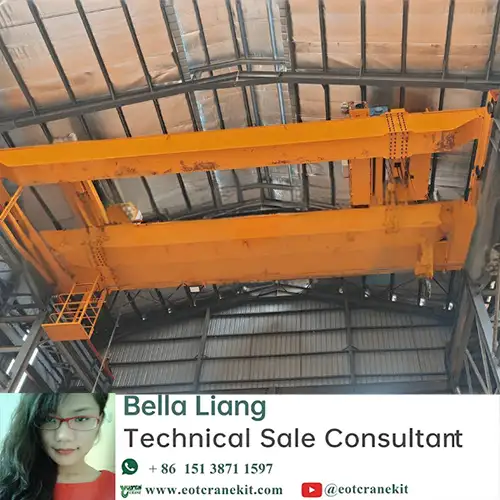


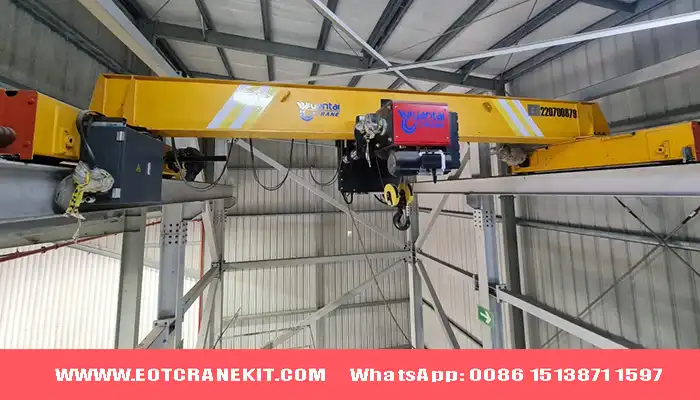
Latest project
Qatar Single Girder Overhead Crane Case 5T–12T System
Qatar case study: single girder overhead crane system with 5 ton & 12 ton low headroom crane, European VFD overhead crane hoist solution.
Yuantai Cranes
Overhead Crane Manufacturer with CE, ISO, SGS, CNEX Certificates.
- Main Specifications - Capacity: 0.5–550 tons | Span: up to 40m | Speed: 0.8–12 m/min | Duty: A3–A7 | Power: 380–690V, 50/60Hz | Control: pendant/remote/cabin
- Full engineering: FEA/PLC/VFD + in-house build + global delivery + on-site support, for workshops, factories, EPC contractors, industrial projects, etc.
- Support: design, manufacturing, testing, service – end-to-end, customized lifting solutions worldwide.
How to Get an Accurate Crane Price for Your Application?
Tips: Copy the spec list, fill in your details, and paste it into the form on the right/ down-below for a quick price.
- Crane type:_____ . (e.g., overhead crane, gantry crane, jib crane)
- Max weight to lift:_____ tons. (e.g., 2t, 5t, 10t, 20t, 50t)
- Lifting height:_____ m. (How high does the hook need to reach?
- Workshop width (span):_____ m . (Distance between the two crane rails)
- Travel distance:_____ m . (How long does the crane need to move along the runway?)
- Control type:_____. (Pendant / remote / cabin Control)
- Power supply:_____. (Local voltage & frequency – e.g., 380V, 50Hz, 3-phase)
- What will it be used for?_____ (e.g., steel fabrication, concrete products, mold handling, general manufacturing, etc.)
- Any special requirements?_____ (e.g., extreme temperature, dusty or explosive environment, special paint color, etc.)
Just leave a message via the contact form and our hoist and crane engineer will contact you with in 24working hours.
Get Your Custom Quote–Quick & Easy
Fill in what you know. Skip what you don't – we'll help.Any question will be reply with 24 working hours