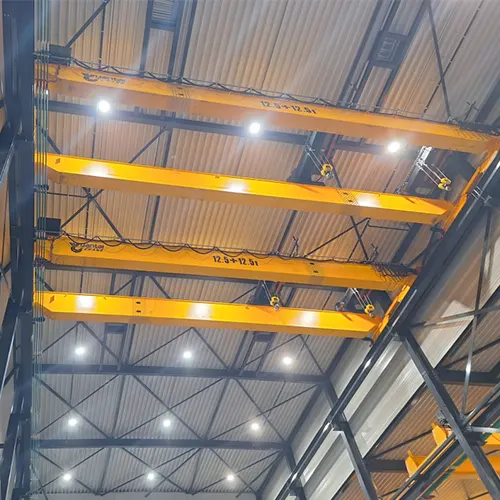
1–550 Ton EOT Cranes for Southeast Asia | Factory Direct & Custom Built
Buy Chinese cranes for sale in Southeast Asia. Factory-direct 1–550 ton EOT overhead cranes for steel fabrication, workshops & yards in Indonesia, Vietnam, Thailand, Malaysia & Philippines. Competitive price, fast delivery, free quote.
| Crane Type | EOT (Electric Overhead Traveling) Crane / Overhead Crane, Single Girder & Double Girder |
| Crane Capacity | 1–550 Ton; Common: 1T, 2T, 3T, 5T, 10T, 16T, 20T, 32T, 50T, 100T, 200T, 550T |
| Span Length | 5–40 m (customizable); Common: 10m, 15m, 20m, 25m, 30m |
| Lifting Height | 6–30 m (customizable); Common: 6m, 9m, 12m, 18m, 24m |
| Coverage Area Type | Rectangular / Linear overhead working area along the runway; the crane travels longitudinally on rails while the trolley moves transversely, covering the full bay width and length. |
| Application | Material handling, lifting, positioning, assembly, maintenance, loading/unloading, Steel fabrication, workshops, warehouses, yards, ports, power plants, cement plants |
| Certifications | CE / ISO / SGS / Other third-party inspection |
| Customization | Customized material handling cranes solutions available for indoor, outdoor, hazardous, corrosive, c |
Crane Manufacturer: Yuantai Cranes – 30+ Years Professional Crane Manufacturer from China
Category: Southeast Asia
Tags: southeastasia,philippines,Indonesia,Malaysia,thailand,vietnam
Your Trusted Overhead Crane Manufacturer & Supplier
EOT Cranes for Southeast Asia | 1–550 Ton Factory Direct
Single & Double Girder EOT Crane Tailored Lifting Solutions for Workshops and Yards
EOT cranes for Southeast Asia — factory-direct from Yuantai. 1–250 ton single & double girder, VFD & low-headroom. Fast delivery to Singapore, Malaysia, Indonesia & Thailand.
Southeast Asia EOT Crane Market Overview
Southeast Asia has a broad manufacturing base covering electronics, automotive, steel, shipbuilding, palm oil, logistics, machinery manufacturing and industrial maintenance. China is already a significant supplier of fixed-support overhead/gantry cranes to the region. In 2024, China exported US$406.17 million of HS 842611 products, totaling 9,513 reported items worldwide. Indonesia, Vietnam and Thailand were among China's largest destination markets.
China-to-Southeast Asia Trade Data – HS 842611
| Country | 2024 China Supply | Reported Quantity | Market Observation |
|---|---|---|---|
| Indonesia (ID) | US$42.45M | – | Largest Southeast Asian destination by importer-reported value |
| Vietnam (VN) | US$29.13M | 552 | Major China supply market |
| Thailand (TH) | US$16.88M | – | Strong industrial crane market |
| Philippines (PH) | US$4.17M | 399 | China is a major supplier |
| Cambodia (KH) | US$2.29M | 340 | Strong number of reported items |
| Singapore (SG) | US$2.15M | 2,725 | High reported item count |
| Laos (LA) | US$1.32M* | 98 | China was the dominant reported exporter |
| Malaysia (MY) | US$0.51M | 12 | Importer-reported figure is relatively small |
| Myanmar (MM) | US$0.22M | 4 | Small but China-dominated market |
| Brunei (BN) | US$0.10M* | 1 | Small market |
For Laos and Brunei, the available WITS/Comtrade result is exporter-reported China-to-country trade rather than a destination-country import record in the retrieved data.
Important data note: Trade statistics can differ between the exporting country's and importing country's records because of valuation basis, shipment timing, re-exports, customs classification and reporting practices. For example, China-reported exports to Malaysia were US$7.17M / 70 items, while Malaysia's importer-reported data shows US$0.51M / 12 items. This is worth explaining in the article rather than presenting conflicting numbers without context.
EOT Crane Technical Data for Southeast Asia
Before entering individual countries, this technical reference section provides a baseline for typical EOT crane configurations in the region.
Typical EOT Crane Technical Range
| Parameter | Typical Range / Configuration |
|---|---|
| Crane Type | Single Girder / Double Girder EOT |
| Capacity | 1–250 t |
| Single Girder Capacity | Approx. 1–20 t |
| Double Girder Capacity | Approx. 20–250 t |
| Span | Approx. 7.5–35 m+ |
| Lifting Height | 6–30 m+ |
| Working Class | ISO A3–A8 / FEM 1Am–8m depending on application |
| Hoisting Speed | Approx. 0.8–12 m/min |
| Crane Traveling Speed | Approx. 20–40 m/min |
| Trolley Speed | Approx. 20–40 m/min |
| Power Supply | 380/400/415 V, 50 Hz, 3 Ph commonly |
| Alternative Supply | 440/460 V, 60 Hz where required |
| Control | Pendant / Radio Remote / Cabin / PLC |
| Hoist | Wire Rope Hoist / Open Winch |
| Motor Control | Direct-on-line / Soft Starter / VFD |
| Protection | IP54–IP65 depending on equipment |
| Ambient Temperature | Project-specific; commonly around -20°C to +40°C |
| Indoor / Outdoor | Both available |
| Structure | Welded box girder / optimized girder |
| Crane Duty | General manufacturing to heavy-duty process applications |
The exact specification should be selected from capacity, span, lifting height, duty class, lifting cycles, load spectrum and operating environment, rather than presenting the table as a universal standard.
Example Configurations by Country
Indonesia (ID) – Mining Maintenance
| Parameter | Example Specification |
|---|---|
| Capacity | 60 t |
| Span | 28 m |
| Lift Height | 18 m |
| Duty | ISO A7 |
| Crane Type | Heavy double girder, open winch |
| Control | Radio remote + cabin |
| Travel | VFD |
| Coating | Heavy-duty industrial system |
| Power | 380 V / 50 Hz / 3 Ph |
Thailand (TH) – Automotive Production
| Parameter | Example Specification |
|---|---|
| Capacity | 15 t |
| Span | 20 m |
| Lift Height | 10 m |
| Duty | ISO A5–A6 |
| Crane Type | Double girder, VFD control |
| Control | Radio remote + pendant |
| Hoisting | VFD with creep speed |
| Power | 400 V / 50 Hz / 3 Ph |
Singapore (SG) – Precision Manufacturing
| Parameter | Example Specification |
|---|---|
| Capacity | 5 t |
| Span | 12 m |
| Lift Height | 7 m |
| Duty | ISO A5 |
| Crane Type | Compact low-headroom single girder |
| Control | Radio remote |
| Travel | VFD on all motions |
| Key Focus | Positioning accuracy, compact design |
Malaysia (MY) – Palm Oil Processing
| Parameter | Example Specification |
|---|---|
| Capacity | 10 t |
| Span | 16 m |
| Lift Height | 9 m |
| Duty | ISO A5 |
| Crane Type | Single girder, corrosion-resistant |
| Electrical | IP55 protected enclosures |
| Coating | Anti-corrosion system for humid environment |
| Power | 415 V / 50 Hz / 3 Ph |
Philippines (PH) – Power Plant Maintenance
| Parameter | Example Specification |
|---|---|
| Capacity | 80 t |
| Span | 26 m |
| Lift Height | 20 m |
| Duty | ISO A5–A6 |
| Crane Type | Double girder, open winch |
| Control | Radio remote + cabin |
| Power | 440 V / 60 Hz / 3 Ph (confirm site supply) |
General Electric EOT Crane Technical Range for Southeast Asia
Electric EOT cranes used in Southeast Asia cover a wide range of applications, from small workshop maintenance and electronics production to automotive manufacturing, steel fabrication, mining, shipyards and power plants. The required crane configuration depends on the load, span, lifting height, operating frequency and available building space.
For Southeast Asian projects, electrical and environmental conditions should also be confirmed at the project stage. Voltage and frequency, indoor or outdoor installation, humidity, dust, coastal exposure and corrosion conditions can all affect the selection of motors, control panels, VFDs and protective coatings.
Typical Electric EOT Crane Technical Range
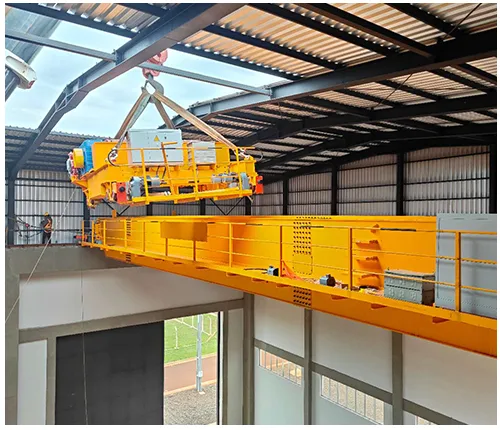
- Crane Type: Single Girder / Double Girder EOT
- Capacity: 1–250 t
- Single Girder Capacity: 1–20 t
- Double Girder Capacity: 20–250 t
- Span: 7.5–35 m+
- Lifting Height: 6–30 m+
- Duty Class: ISO A3–A8
- FEM Classification: FEM 1Am–8m, project dependent
- Hoist: Electric Wire Rope Hoist / Open Winch
- Hoisting Speed: Approx. 3–12 m/min
- Trolley Speed: Approx. 20–40 m/min
- Crane Travel Speed: Approx. 20–40 m/min
- Control: Pendant / Radio Remote / Cabin
- Hoisting Control: DOL / Two-Speed / VFD
- Travel Control: DOL / Two-Speed / VFD
- Power Supply: 380/400/415 V, 50 Hz, 3 Ph
- Control Voltage: Typically 24 V / 48 V / project-specific
- Motor Protection: Typically IP54–IP65
- Electrical Panel: IP54–IP65, project dependent
- Working Temperature: Typically -20°C to +40°C
- Surface Treatment: Industrial anti-corrosion coating
- Installation: Indoor / Outdoor
How to Read These Specifications
For example, a 5–10 t manufacturing crane may use a single-girder EOT with an electric wire rope hoist, pendant or radio control and two-speed or VFD travel.
A 20–50 t steel fabrication or heavy-maintenance crane would typically move toward a double-girder configuration, with a higher duty class and potentially an open-winch hoisting system.
For mining, power plants and heavy industrial applications, higher duty classes, higher lifting heights, VFD control, stronger brakes and enhanced environmental protection may be required.
For Singapore, Malaysia and other humid or coastal locations, corrosion protection and electrical enclosure protection should be selected according to the actual site environment rather than using one standard configuration for every project.
These are typical engineering ranges, not fixed specifications. The final EOT crane should be calculated and configured according to the customer's actual load spectrum, lifting cycles, building structure, runway conditions, electrical supply and operating environment. This allows Yuantai to select the appropriate girder structure, hoist, motors, brakes, wheels, controls and protection system for the specific Southeast Asian project.
Single Girder Electric EOT Crane
Single girder electric EOT cranes are widely used across Southeast Asia for general manufacturing, warehouses, machinery workshops, maintenance, electronics production and automotive plants. They are particularly suitable where the load is moderate and the building benefits from a relatively lightweight crane structure.
For retrofit projects, single girder EOT cranes can also be designed around existing runway conditions and limited headroom. A low-headroom hoist arrangement can help increase the available hook height without major building modifications.
Typical Technical Data
Standard technical specifications for single girder electric EOT cranes used in Southeast Asian industrial applications.
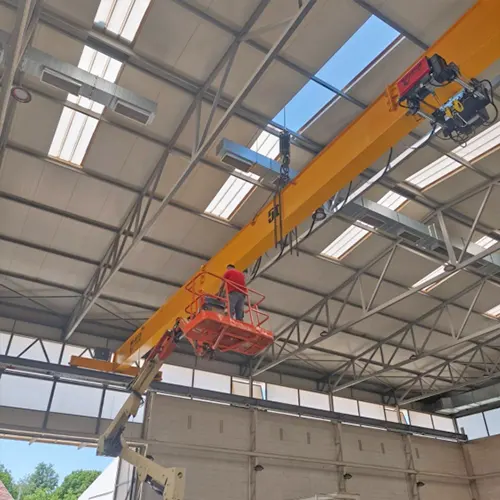
- Capacity: 1–20 t
- Span: 7.5–28 m
- Lifting Height: 6–30 m
- Duty Class: ISO A3–A6
- FEM: FEM 1Am–5m
- Girder: Welded box girder / rolled section, project dependent
- Hoist: Electric wire rope hoist
- Hoist Type: Top-running / low-headroom
- Hoisting Speed: Approx. 3–8 m/min
- Trolley Speed: Approx. 20–30 m/min
- Crane Speed: Approx. 20–30 m/min
- Control: Pendant / Radio Remote
- Travel Motor: Brake motor
- Hoist Motor: Brake motor
- Travel Control: Two-Speed / VFD
- Hoisting Control: Single-Speed / Two-Speed / VFD
- Power Supply: 380/400/415 V, 50 Hz, 3 Ph
- Motor Protection: IP54–IP65
- Application: General industrial
Actual site voltage and frequency should be confirmed for each project.
Why Choose a Single Girder EOT Crane?
The single-girder configuration offers:
- Lower structural self-weight
- Lower runway loads
- Economical solution for many 1–20 t applications
- Compact hoist arrangement
- Good workshop clearance
- Easier maintenance
- Suitable for new buildings
- Suitable for retrofit projects
- Optional VFD for smoother positioning
For Singapore and Malaysia, it can be suitable for compact manufacturing and maintenance areas. In Thailand, it is widely applicable to automotive and machinery production. In Indonesia and the Philippines, it can be used for general manufacturing, warehouses and industrial maintenance.
The final single-girder design should still be checked against span, wheel loads, lifting height, duty class and existing runway capacity.
Double Girder Electric EOT Crane
Double girder electric EOT cranes are better suited to heavy manufacturing, steel fabrication, power plants, mining, shipyards and large industrial workshops across Southeast Asia.
Compared with a typical single-girder crane, the double-girder arrangement provides greater structural capacity and allows the lifting mechanism to be configured for higher loads, longer spans and higher duty requirements.
Typical Technical Data
Standard technical specifications for double girder electric EOT cranes used in heavy industrial applications across Southeast Asia.

- Capacity: 20–250 t
- Common Project Range: 20–100+ t
- Span: 15–35 m+
- Lifting Height: 8–30 m+
- Duty Class: ISO A5–A8
- FEM: FEM 2m–8m
- Girder: Welded box girder
- Hoist: Open Winch / Trolley
- Hoisting Speed: Project-specific
- Trolley Speed: Approx. 20–40 m/min
- Crane Speed: Approx. 20–40 m/min
- Control: Radio Remote / Cabin
- Hoisting Control: Two-Speed / VFD
- Travel Control: VFD
- Power Supply: 380/400/415 V, 50 Hz, 3 Ph*
- Motor Protection: IP54–IP65
- Application: Heavy Industrial
Actual electrical supply should be confirmed from the project specification.
Typical Southeast Asian Applications
- Steel fabrication: 20–100+ t for steel plates, structures and heavy machinery.
- Mining: 20–100+ t for crushers, motors, gearboxes and maintenance equipment.
- Power plants: 10–100+ t for generators, motors, pumps and maintenance components.
- Shipyards: 20–100+ t for ship components, marine machinery and steel fabrication.
- Heavy manufacturing: 20–250 t for large machinery and industrial equipment.
Single vs. Double Girder at a Glance
| Requirement | Single Girder | Double Girder |
|---|---|---|
| Typical Capacity | 1–20 t | 20–250 t |
| Typical Duty | A3–A6 | A5–A8 |
| General Workshop | ✓ | ✓ |
| Warehouse | ✓ | – |
| Automotive | ✓ | ✓ |
| Steel Fabrication | Limited | ✓ |
| Mining | Limited | ✓ |
| Power Plant | Limited | ✓ |
| Heavy Maintenance | Limited | ✓ |
| Low Headroom | ✓ | Project-specific |
| Open Winch | – | ✓ |
| Heavy-Duty Operation | Limited | ✓ |
Selection principle: choose the crane based on load + span + lift + duty + load spectrum + building conditions, rather than capacity alone.
Electric Wire Rope Hoist
Electric wire rope hoists are the main lifting mechanism for many single-girder EOT cranes and are also widely used as independent lifting equipment in workshops and maintenance areas. They are particularly useful for smaller Southeast Asian markets where customers may purchase a hoist or EOT crane kit and complete part of the installation locally.
Typical applications include manufacturing, machinery maintenance, warehouses, automotive plants, steel workshops and palm-oil processing facilities.
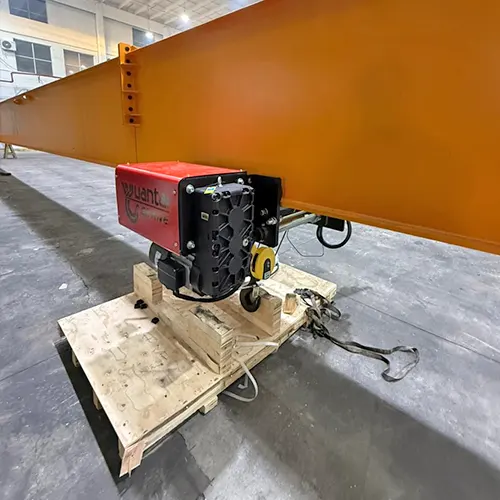
Typical Electric Wire Rope Hoist Data
Standard technical specifications for electric wire rope hoists used in single girder EOT cranes and independent lifting applications across Southeast Asia.
- Capacity: 0.5–32 t
- Higher Capacity: Up to 50 t+ for selected configurations
- Lifting Height: 6–30 m
- Hoisting Speed: Approx. 3–8 m/min
- Double Speed: Available
- Hoist Motor: Brake motor
- Protection: Typically IP54–IP65
- Control: Contactor / VFD
- Trolley: Electric geared trolley
- Control Mode: Pendant / Radio Remote
- Duty: FEM/ISO, project dependent
Drum diameter, wire-rope reeving, motor power and brake capacity should be checked against the actual lifting height and duty class.
For higher lifting heights, the hoist should not be selected from lifting capacity alone. Drum diameter, wire-rope reeving, motor power, brake capacity, lifting speed and duty class should all be checked against the actual application.
For Southeast Asian projects, the hoist electrical specification should also match the customer's actual voltage, frequency and environmental conditions.
Low-Headroom Electric EOT Crane
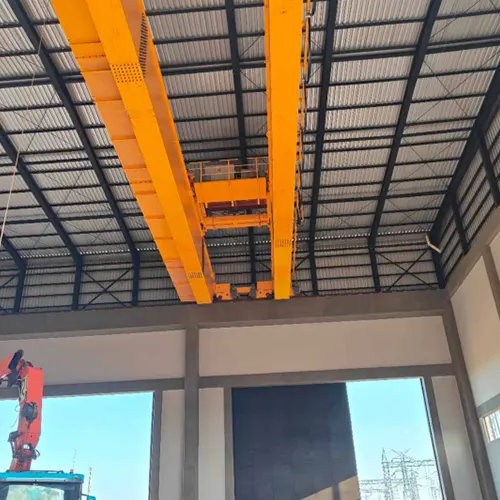
Low-headroom EOT cranes are particularly useful for existing factories and retrofit projects in Southeast Asia, where the building already exists but the customer needs more usable lifting height.
Typical Technical Data
Standard technical specifications for low-headroom electric EOT cranes designed for existing factories and retrofit projects in Southeast Asia.
- Capacity: 1–20 t
- Span: 7.5–25 m
- Lifting Height: 5–25 m
- Duty Class: ISO A3–A6
- Hoist: Low-Headroom Wire Rope Hoist
- Control: Pendant / Radio Remote
- Travel: Two-Speed / VFD
- Power Supply: Project-specific
- Installation: Mainly indoor / retrofit
*Final design should be based on actual roof height, runway elevation, rail position, required hook height and existing structural conditions.
Common Applications
Low-headroom EOT cranes are particularly useful for existing factories and retrofit projects in Southeast Asia, where the building already exists but the customer needs more usable lifting height.
This is common in:
- Manufacturing workshops
- Automotive plants
- Electronics factories
- Machinery workshops
- Maintenance buildings
- Existing warehouses
Instead of modifying the entire building structure, the crane and hoist can be engineered to use the available vertical space more efficiently.
Low-Headroom Design Focus
- Reduced overall crane height
- Optimized hoist position
- Increased hook approach
- Reduced clearance above the hook
- Compact end carriage
- Improved usable lifting height
- Compatibility with existing runway
Why Choose Low-Headroom EOT?
The main objective is not simply to make the crane smaller. It is to maximize the available hook height within the existing building clearance.
For example:Existing roof height → crane clearance → hoist position → hook approach → usable lifting height
This makes low-headroom EOT cranes a practical solution when building modification is expensive or impossible. The final design should be based on the customer's actual roof height, runway elevation, rail position, required hook height and existing structural conditions.
VFD Electric EOT Crane
VFD-controlled EOT cranes are particularly useful for automotive production, machinery manufacturing, electronics, precision handling and repetitive maintenance operations across Southeast Asia.
Unlike a basic DOL or two-speed crane, a VFD system allows the operator to control acceleration, deceleration and low-speed movement. This can reduce load swing and improve positioning when handling machinery, dies, molds or production equipment.
Typical Technical Range
Standard technical specifications for VFD-controlled electric EOT cranes used in production, precision handling and repetitive maintenance applications across Southeast Asia.
- Capacity: 1–80 t+
- Span: 7.5–30 m+
- Lift: 6–30 m+
- Duty: ISO A4–A7
- Hoist: Electric Wire Rope Hoist
- Hoisting Control: VFD
- Trolley Control: VFD
- Crane Travel: VFD
- Control: Pendant / Radio Remote
- Power Supply: 380/400/415 V, 50 Hz, 3 Ph*
Other voltage and frequency configurations can be engineered according to the project.
VFD Control for the Three Crane Motions
Hoisting
VFD hoisting provides:
- Smooth starting and stopping
- Adjustable lifting speed
- Low-speed positioning
- Reduced mechanical shock
- Better control of sensitive loads
Trolley Travel
VFD trolley control provides:
- Variable horizontal speed
- Controlled acceleration
- Controlled deceleration
- More accurate load positioning
- Reduced sudden movement
Crane Travel
VFD crane travel provides:
- Adjustable travel speed
- Smooth starts and stops
- Reduced wheel and rail impact
- Better positioning at workstations
- Improved operator control
Typical VFD EOT Configuration
| Crane Function | Standard Configuration | Precision Handling |
|---|---|---|
| Hoisting | DOL / Two-Speed | VFD |
| Trolley | DOL / Two-Speed | VFD |
| Crane Travel | DOL / Two-Speed | VFD |
| Control | Pendant | Radio Remote |
| Positioning | Operator controlled | Low-speed / VFD |
| Typical Application | General workshop | Production / Maintenance |
*Other voltage and frequency configurations can be engineered according to the project.
For Southeast Asian production facilities, VFD control is especially valuable when the crane is used for frequent lifting, machinery installation, die handling, equipment maintenance or accurate positioning. The VFD capacity and motor selection should be matched to the actual load spectrum, starting frequency, motor power and duty class rather than simply adding VFDs to a standard crane.
Electric EOT Crane Solutions for Industrial Applications in Southeast Asia
EOT crane requirements differ across Southeast Asia because each market has its own industrial base. Thailand (TH) is strong in automotive and electronics, Malaysia (MY) in electronics and palm-oil processing, Indonesia (ID) in mining and heavy industry, Singapore (SG) in marine and precision manufacturing, and the Philippines (PH) in power, shipbuilding and industrial maintenance. The following application-based configurations provide a practical starting point for selecting an electric EOT crane.
Electric EOT Crane for General Manufacturing
General manufacturing is one of the most common EOT crane applications in Southeast Asia. Cranes are used for machine assembly, component handling, equipment installation, material transfer and factory maintenance.
Recommended Configuration
1–20 t Single Girder EOT Crane
| Parameter | Typical Specification |
|---|---|
| Capacity | 1–20 t |
| Span | 7.5–28 m |
| Lifting Height | 6–30 m |
| Duty | ISO A3–A5 |
| Hoist | Electric Wire Rope Hoist |
| Control | Pendant / Radio Remote |
| Travel Speed | 20–30 m/min |
| Hoisting Speed | 3–8 m/min |
| Power | 380/400/415 V, 50 Hz, 3 Ph* |
Typical Applications
- Machine assembly
- Component handling
- Equipment installation
- Factory maintenance
- Material transfer
- Workshop handling
Typical Southeast Asian markets: 🇹🇭 TH (Thailand) – automotive and machinery; 🇲🇾 MY (Malaysia) – electronics and manufacturing; 🇮🇩 ID (Indonesia) – machinery and industrial production; 🇵🇭 PH (Philippines) – manufacturing and maintenance; 🇸🇬 SG (Singapore) – precision manufacturing.
Electric EOT Crane for Oil & Gas
Oil & gas facilities require additional attention to electrical safety, corrosion protection and hazardous-area requirements. EOT cranes may be used for pumps, motors, compressors and process equipment.
Typical Applications
- Pump maintenance
- Motor handling
- Compressor maintenance
- Valve handling
- Equipment installation
- Workshop maintenance
- Process equipment handling
Typical Crane Range
| Parameter | Typical Range |
|---|---|
| Capacity | 3–50+ t |
| Span | 8–30 m |
| Lifting Height | 6–20 m |
| Duty Class | ISO A4–A6 |
| Crane Type | Single / Double Girder |
| Hoist | Wire Rope / Open Winch |
| Control | Pendant / Radio Remote |
| Travel | VFD Optional |
| Electrical Protection | Project-specific |
| Coating | Corrosion-resistant |
Hazardous-Area Requirements
If the crane is installed in a classified hazardous area, the project may require:
- Hazardous-area classification
- Explosion-protected motors
- Explosion-protected electrical components
- Appropriate control equipment
- Grounding and bonding
- Special cable systems
- ATEX / IECEx or applicable local certification
The hazardous-area classification should be confirmed before electrical equipment is selected.
Typical Southeast Asian markets: 🇮🇩 ID (Indonesia) – oil & gas and energy; 🇲🇾 MY (Malaysia) – offshore and oil & gas; 🇧🇳 BN (Brunei) – oil & gas; 🇸🇬 SG (Singapore) – marine, petrochemical and energy facilities.
Electric EOT Crane for Power Plants
Power plants use EOT cranes for scheduled maintenance, major equipment replacement and installation. Capacity should normally be determined from the heaviest component that needs to be handled.
Typical Applications
- Generator maintenance
- Turbine maintenance
- Pump maintenance
- Motor replacement
- Valve handling
- Heavy equipment installation
Typical Technical Configuration
| Parameter | Typical Range |
|---|---|
| Capacity | 10–100+ t |
| Span | 12–35 m+ |
| Lifting Height | 8–30 m+ |
| Duty Class | ISO A5–A7 |
| Crane Type | Double Girder |
| Hoist | Open Winch / Wire Rope |
| Control | Pendant / Radio / Cabin |
| Travel | VFD |
| Hoisting | VFD / Two-Speed |
| Brake | Electromagnetic / Hydraulic, project dependent |
Typical Southeast Asian markets: 🇵🇭 PH (Philippines) – power generation and maintenance; 🇮🇩 ID (Indonesia) – thermal and renewable power projects; 🇲🇾 MY (Malaysia) – power generation; 🇹🇭 TH (Thailand) – industrial power plants; 🇻🇳 VN (Vietnam) – power and industrial projects.
Electric EOT Crane for Steel Fabrication
Steel fabrication workshops require cranes for steel plates, beams, fabricated structures, welding assemblies and heavy machinery.
Typical Technical Data
| Parameter | General Steel Workshop | Heavy Steel Workshop |
|---|---|---|
| Capacity | 5–50 t | 20–100+ t |
| Span | 10–28 m | 15–35 m+ |
| Lift | 6–20 m | 8–30 m+ |
| Crane | Single Girder | Double Girder |
| Duty | ISO A4–A6 | ISO A6–A8 |
| Hoist | Wire Rope | Open Winch |
| Control | Pendant / Radio | Radio / Cabin |
| Travel | Two-Speed / VFD | VFD |
| Hoisting | Two-Speed | VFD / Multi-Speed |
For heavy steel workshops, the design should consider load spectrum, lifting frequency, wheel loads, structural stress and fatigue.
Typical Southeast Asian markets: 🇹🇭 TH (Thailand) – automotive and industrial steel fabrication; 🇲🇾 MY (Malaysia) – structural and machinery fabrication; 🇮🇩 ID (Indonesia) – heavy industry and steel; 🇸🇬 SG (Singapore) – marine and precision steel fabrication; 🇵🇭 PH (Philippines) – construction and shipyard fabrication.
Electric EOT Crane for Maintenance Workshops
Maintenance cranes are normally selected according to the largest piece of equipment that needs to be removed or installed, rather than the average workshop load.
Typical Loads
- Electric motors
- Pumps
- Gearboxes
- Compressors
- Generators
- Machine tools
- Conveyor components
Typical Configuration
| Requirement | Light / General Maintenance | Heavy Maintenance |
|---|---|---|
| Capacity | 2–10 t | 10–50+ t |
| Crane | Single Girder | Double Girder |
| Duty | ISO A3–A5 | ISO A5–A7 |
| Hoist | Wire Rope | Open Winch |
| Travel | Two-Speed / VFD | VFD |
| Control | Pendant / Radio | Radio / Cabin |
Typical Southeast Asian markets: 🇸🇬 SG (Singapore) – marine and industrial maintenance; 🇲🇾 MY (Malaysia) – manufacturing and palm-oil plants; 🇮🇩 ID (Indonesia) – mining and heavy equipment maintenance; 🇵🇭 PH (Philippines) – power and industrial maintenance; 🇰🇭 KH (Cambodia) and 🇱🇦 LA (Laos) – general industrial maintenance.
Electric EOT Crane for Logistics
EOT cranes can support industrial warehouses, production logistics, material transfer and equipment storage.
Typical Technical Data
| Parameter | Typical Range |
|---|---|
| Capacity | 1–20 t |
| Span | 8–25 m |
| Lifting Height | 6–12 m |
| Duty | ISO A3–A5 |
| Crane | Single Girder |
| Hoist | Electric Wire Rope |
| Travel Speed | 20–30 m/min |
| Control | Pendant / Radio Remote |
| VFD | Optional |
For frequent daily operation, the duty classification should be reviewed according to actual lifting cycles and load spectrum.
Typical Southeast Asian markets: SG (Singapore) – logistics and distributio 🇲🇾 MY (Malaysia) – manufacturing listics; 🇹🇭 TH (Thailand) – auarehouses; ID (Indonesia) – industrial logistics; 🇵🇭 PH (Philippines) – warehouses and manufacturing; 🇻🇳 VN (Vietnam) – industrial and export manufacturing.
Outdoor Electric EOT Crane
Outdoor EOT cranes are used in steel yards, power plants, mining sites, shipyards, oil & gas facilities and industrial construction projects. Tropical rainfall, humidity, coastal exposure and strong winds can make environmental protection an important part of the crane design.
Typical Applications
- Power plants
- Steel yards
- Oil & gas facilities
- Mining
- Industrial construction
- Shipyards
- Equipment storage
Recommended Features
- Weather-resistant control panel
- IP-rated motors
- Outdoor cable/festoon system
- Corrosion-resistant coating
- Anti-condensation heaters where required
- Rain protection
- Radio remote control
- Wind/storm protection where required
Typical Technical Data
| Parameter | Typical Range |
|---|---|
| Capacity | 5–100+ t |
| Span | 10–35 m+ |
| Lifting Height | 6–30 m+ |
| Duty | ISO A5–A8 |
| Control | Radio / Cabin |
| Travel | VFD |
| Protection | IP55/IP65, project dependent |
| Coating | Industrial anti-corrosion system |
| Installation | Outdoor |
For outdoor cranes, engineering should consider wind load, storm conditions, parking position, rail clamps/anchoring, corrosion and electrical protection.
Typical Southeast Asian markets: 🇮🇩 ID (Indonesia) – mining, steel and power; 🇲🇾 MY (Malaysia) – oil & gas and industrial yards; 🇵🇭 PH (Philippines) – power plants and shipyards; 🇸🇬 SG (Singapore) – marine/shipyard applications; 🇰🇭 KH (Cambodia) – industrial construction; 🇱🇦 LA (Laos) – hydropower and industrial projects; 🇲🇲 MM (Myanmar) – power and industrial projects; 🇧🇳 BN (Brunei) – oil & gas and energy facilities.
Southeast Asia Application-to-Country Overview
| Application | Main Southeast Asian Markets |
|---|---|
| General Manufacturing | TH (Thailand), MY (Malaysia), ID (Indonesia), PH (Philippines), SG (Singapore) |
| Automotive | TH (Thailand), MY (Malaysia), ID (Indonesia) |
| Electronics | SG (Singapore), MY (Malaysia), TH (Thailand), PH (Philippines), VN (Vietnam) |
| Oil & Gas | ID (Indonesia), MY (Malaysia), BN (Brunei), SG (Singapore) |
| Power Plants | ID (Indonesia), PH (Philippines), MY (Malaysia), TH (Thailand), LA (Laos) |
| Steel Fabrication | TH (Thailand), ID (Indonesia), MY (Malaysia), PH (Philippines), SG (Singapore) |
| Mining | ID (Indonesia), PH (Philippines) |
| Palm Oil Processing | MY (Malaysia), ID (Indonesia) |
| Shipyards / Marine | SG (Singapore), ID (Indonesia), MY (Malaysia), PH (Philippines) |
| Logistics | SG (Singapore), MY (Malaysia), TH (Thailand), ID (Indonesia), VN (Vietnam) |
| Heavy Maintenance | ID (Indonesia), MY (Malaysia), SG (Singapore), PH (Philippines) |
| Outdoor Industrial | ID (Indonesia), MY (Malaysia), PH (Philippines), KH (Cambodia), LA (Laos), MM (Myanmar), BN (Brunei) |
This country/application mapping helps position Yuantai as a Southeast Asia EOT crane engineering supplier, rather than presenting the same generic crane specification for every market.
Country-Specific EOT Crane Focus in Southeast Asia
Each Southeast Asian market has its own industrial base and crane priorities. Singapore needs compact precision cranes, Indonesia demands heavy-duty mining and steel systems, Thailand focuses on automotive production lines, and the Philippines centers on power plant maintenance. The table below maps the main industries and typical EOT crane focus for each market in the region.
Market Overview Table
| Market | Main Industries | Typical EOT Crane Focus |
|---|---|---|
| Singapore (SG) | Marine engineering, shipyards, electronics, precision manufacturing, logistics | 1–10 t compact / low-headroom EOT; 20–100+ t heavy-duty double girder |
| Malaysia (MY) | Electronics, automotive, palm oil processing, steel fabrication, machinery manufacturing | 1–20 t single girder; 20–100+ t double girder |
| Indonesia (ID) | Mining, steel, palm oil, power generation, shipbuilding, heavy manufacturing | 3–50 t maintenance EOT; 20–100+ t heavy-duty double girder |
| Thailand (TH) | Automotive, electronics, machinery, steel fabrication, food processing, warehousing | 1–20 t single girder; 20–100+ t double girder |
| Philippines (PH) | Power generation, shipyards, steel fabrication, manufacturing, mining, industrial maintenance | 1–20 t single girder; 20–100+ t double girder |
| Cambodia (KH) | Manufacturing, industrial construction, logistics, steel fabrication, maintenance | 1–20 t single girder; 5–50+ t double girder |
| Laos (LA) | Hydropower, mining, industrial construction, maintenance, general manufacturing | 5–50 t maintenance EOT; 20–100+ t heavy-duty double girder |
| Myanmar (MM) | Oil & gas, power generation, steel fabrication, manufacturing, logistics, maintenance | 3–50+ t EOT; 20–100+ t double girder |
| Brunei (BN) | Oil & gas, power generation, industrial maintenance, logistics, industrial construction | 1–20 t maintenance EOT; 10–100+ t project-specific heavy-duty cranes |
Technical Positioning by Market
Singapore (SG): Focus on compact, low-headroom and precision EOT cranes, with VFD control for marine, electronics and precision manufacturing.
Malaysia (MY): Focus on single-girder EOT cranes for manufacturing and double-girder cranes for steel, automotive and heavy maintenance.
Indonesia (ID): Emphasize heavy-duty EOT cranes for mining, steel, power and palm-oil plants, including open-winches and higher-duty configurations.
Thailand (TH): Focus on production-line EOT cranes, particularly VFD-controlled systems for automotive, electronics and machinery manufacturing.
Philippines (PH): Position EOT cranes around power plants, shipyards, steel fabrication and mining, with heavier double-girder systems for maintenance.
Cambodia (KH): Focus on cost-effective single-girder cranes for manufacturing and logistics, with double-girder systems for steel fabrication.
Laos (LA): Emphasize hydropower and mining cranes, particularly 20–100+ t double-girder cranes with high lifting heights and VFD travel.
Myanmar (MM): Focus on oil & gas, power and steel applications, including project-specific electrical protection and heavy-duty double-girder cranes.
Brunei (BN): Position Yuantai around specialized oil & gas and power applications, with corrosion protection and project-specific electrical configurations.
Example Configurations by Country
Singapore (SG) – Precision Manufacturing Example
| Parameter | Specification |
|---|---|
| Application | CNC machine loading, mold handling |
| Capacity | 5 t |
| Span | 12 m |
| Lift Height | 7 m |
| Duty | ISO A5 |
| Crane Type | Compact low-headroom single girder |
| Control | Radio remote |
| Travel | VFD on all motions |
| Key Focus | Positioning accuracy, compact design |
Indonesia (ID) – Mining Maintenance Example
| Parameter | Specification |
|---|---|
| Application | Heavy equipment maintenance |
| Capacity | 60 t |
| Span | 28 m |
| Lift Height | 18 m |
| Duty | ISO A7 |
| Crane Type | Heavy double girder, open winch |
| Control | Radio remote + cabin |
| Travel | VFD |
| Coating | Heavy-duty industrial system |
Thailand (TH) – Automotive Production Example
| Parameter | Specification |
|---|---|
| Application | Die and mold handling |
| Capacity | 15 t |
| Span | 20 m |
| Lift Height | 10 m |
| Duty | ISO A5–A6 |
| Crane Type | Double girder, VFD control |
| Control | Radio remote + pendant |
| Hoisting | VFD with creep speed |
Malaysia (MY) – Palm Oil Processing Example
| Parameter | Specification |
|---|---|
| Application | Motor and gearbox maintenance |
| Capacity | 10 t |
| Span | 16 m |
| Lift Height | 9 m |
| Duty | ISO A5 |
| Crane Type | Single girder, corrosion-resistant |
| Electrical | IP55 protected enclosures |
| Coating | Anti-corrosion system for humid environment |
Philippines (PH) – Power Plant Maintenance Example
| Parameter | Specification |
|---|---|
| Application | Generator and turbine maintenance |
| Capacity | 80 t |
| Span | 26 m |
| Lift Height | 20 m |
| Duty | ISO A5–A6 |
| Crane Type | Double girder, open winch |
| Control | Radio remote + cabin |
| Power | 440 V / 60 Hz / 3 Ph (confirm site supply) |
Electric EOT Crane Specification Checklist
For inquiries from Cambodia (KH), Laos (LA), Myanmar (MM) or Brunei (BN), Yuantai should collect the following technical information before preparing a quotation. Getting these details right upfront avoids miscommunication and ensures the crane actually fits the building, the power supply, and the working conditions on site.
Lifting Requirements
- Rated capacity (e.g., 10 t, 20 t, 50 t)
- Maximum load to be lifted
- Load type (e.g., steel plate, machine tool, motor, mold, pump)
- Load dimensions (length × width × height)
- Lifting attachments (hook, sling, spreader beam, magnet, grab)
- Required lifting height
- Hook height from floor or rail level
Example: "10 t capacity, lifting a 8 t gearbox measuring 1.5 m × 1.2 m × 1.0 m, using a standard hook, lift height 10 m."
| Parameter | Example Input |
|---|---|
| Rated Capacity | 10 t |
| Maximum Load | 8.5 t |
| Load Type | Gearbox / machine component |
| Load Dimensions | 1.5 m × 1.2 m × 1.0 m |
| Lifting Height | 10 m |
| Hook Height | 10.5 m from floor |
Crane Dimensions
- Span (center-to-center of runway rails)
- Runway length
- End approach (minimum distance from hook to wall/column)
- Building height
- Top-of-rail elevation
- Available headroom (rail to roof/ceiling)
- Column spacing
Example: "Span 18 m, runway length 60 m, end approach 1.2 m, building height 14 m, top-of-rail elevation 10 m, available headroom 3.5 m, column spacing 6 m."
| Parameter | Example Input |
|---|---|
| Span | 18 m |
| Runway Length | 60 m |
| End Approach | 1.2 m |
| Building Height | 14 m |
| Top-of-Rail Elevation | 10 m |
| Available Headroom | 3.5 m |
| Column Spacing | 6 m |
Operating Conditions
- Working hours per day
- Lifting cycles per hour
- Average load
- Maximum load
- Indoor or outdoor installation
- Ambient temperature range
- Humidity level
- Dust exposure
- Corrosion risk (coastal, chemical, oil)
- Hazardous area classification (if applicable)
Example: "8 hours/day, 15 lifts/hour, average load 6 t, maximum load 8.5 t, indoor, 25–35°C, high humidity, light dust, no hazardous area."
| Parameter | Example Input |
|---|---|
| Working Hours/Day | 8 hours |
| Lifting Cycles/Hour | 15 cycles |
| Average Load | 6 t |
| Maximum Load | 8.5 t |
| Installation | Indoor |
| Temperature | 25–35°C |
| Humidity | High (tropical) |
| Dust | Light |
| Hazardous Area | None |
Electrical Data
- Voltage (e.g., 380 V, 400 V, 415 V)
- Frequency (50 Hz or 60 Hz)
- Phase (3-phase standard)
- Control voltage (e.g., 48 V, 110 V, 220 V)
- Required hoisting speed
- Required crane travel speed
- Required trolley speed
- VFD requirement (hoist, trolley, travel)
- Radio remote requirement
Example: "415 V / 50 Hz / 3 Ph, control voltage 48 V, hoisting speed 5 m/min with VFD, crane speed 30 m/min with VFD, trolley speed 20 m/min with VFD, radio remote required."
| Parameter | Example Input |
|---|---|
| Voltage | 415 V |
| Frequency | 50 Hz |
| Phase | 3 Ph |
| Control Voltage | 48 V |
| Hoisting Speed | 5 m/min (VFD) |
| Crane Speed | 30 m/min (VFD) |
| Trolley Speed | 20 m/min (VFD) |
| Control Method | Radio remote + pendant backup |
Duty Classification
The crane should be selected according to:
- Daily operating time
- Number of starts per hour
- Load spectrum (light, medium, heavy, very heavy)
- Average load
- Maximum load
- Required service life
Typical ranges:
- ISO A3–A4 → light/general workshop applications
- ISO A5–A6 → general industrial production and maintenance
- ISO A7–A8 → heavy-duty/high-frequency applications
The exact classification should be calculated rather than selected solely from the lifting capacity.
Example Duty Classification Scenarios
| Application | Operating Pattern | Load Spectrum | Typical ISO Duty |
|---|---|---|---|
| Light maintenance workshop | 2–4 hours/day, occasional lifts | Light (mostly small loads) | ISO A3–A4 |
| General factory production | 8 hours/day, 10–20 lifts/hour | Medium (mix of light and rated loads) | ISO A5–A6 |
| Steel fabrication / heavy workshop | 16–24 hours/day, frequent heavy lifts | Heavy (many loads near rated capacity) | ISO A6–A7 |
| Mining / heavy maintenance | Continuous operation, high cycles | Very heavy (frequent rated loads) | ISO A7–A8 |
Example: "General factory, 8 hours/day, 15 lifts/hour, average load 6 t (60% of rated 10 t), service life 15 years → ISO A5 duty is appropriate."
EOT Crane Kit for Southeast Asian Markets
For customers with local installation capability, an electric EOT crane kit can be a practical alternative to a completely assembled crane. This approach works well for Southeast Asian EPC contractors, plant maintenance teams, and industrial customers who already have structural fabrication, electrical installation, and commissioning skills on site. The kit supplies the major crane mechanisms and components, while the customer handles the local girder fabrication and assembly work.
Typical EOT Crane Kit Components
The standard kit includes the major mechanical and electrical components needed to build a functional crane:
- Electric wire rope hoist
- Trolley
- End carriages
- Crane wheels
- Crane motors
- Electrical panel
- Festoon system
- Pendant
- Radio remote
- Limit switches
- Buffers
- Control components
Each component is selected according to the crane's rated capacity, span, duty class, and operating environment.
Typical Technical Range
| Parameter | Typical Range |
|---|---|
| Capacity | 1–20 t |
| Span | 7.5–30 m+ |
| Lift Height | 6–30 m+ |
| Duty | ISO A3–A6 |
| Hoist | Electric wire rope |
| Control | Pendant / Radio |
| Power | 380/400/415 V, 50 Hz, 3 Ph |
The kit approach can be particularly useful where the customer already has local structural fabrication, electrical installation and crane commissioning capability.
Example Kit Configurations for Southeast Asia
Example 1: Light Workshop Kit (Cambodia / Laos)
Application: General workshop maintenance
Configuration: 5 t single girder EOT crane kit
| Component | Specification |
|---|---|
| Capacity | 5 t |
| Span | 12 m |
| Lift Height | 8 m |
| Duty | ISO A4 |
| Hoist | 5 t electric wire rope hoist |
| Hoisting Speed | 4 m/min (two-speed) |
| Crane Speed | 20 m/min (two-speed) |
| Trolley Speed | 20 m/min (two-speed) |
| Control | Pendant + radio remote |
| Power | 400 V / 50 Hz / 3 Ph |
| Included | End carriages, wheels, motors, panel, festoon, limit switches, buffers |
Example 2: Medium Production Kit (Myanmar / Brunei)
Application: Production workshop with moderate lifting frequency
Configuration: 20 t double girder EOT crane kit
| Component | Specification |
|---|---|
| Capacity | 20 t |
| Span | 22 m |
| Lift Height | 12 m |
| Duty | ISO A5 |
| Hoist | 20 t open winch trolley |
| Hoisting Speed | 5 m/min (VFD) |
| Crane Speed | 30 m/min (VFD) |
| Trolley Speed | 25 m/min (VFD) |
| Control | Radio remote + pendant backup |
| Power | 415 V / 50 Hz / 3 Ph |
| Included | End carriages, wheels, motors, VFD panel, festoon, limit switches, buffers, couplings |
Example 3: Heavy-Duty Kit (Indonesia / Philippines)
Application: Heavy machinery maintenance workshop
Configuration: 50 t double girder EOT crane kit
| Component | Specification |
|---|---|
| Capacity | 50 t |
| Span | 28 m |
| Lift Height | 15 m |
| Duty | ISO A6 |
| Hoist | 50 t open winch trolley |
| Hoisting Speed | 4 m/min (VFD / multi-speed) |
| Crane Speed | 30 m/min (VFD) |
| Trolley Speed | 25 m/min (VFD) |
| Control | Radio remote + cabin option |
| Power | 380 V / 50 Hz / 3 Ph |
| Included | Heavy-duty end carriages, wheels, motors, PLC panel, festoon, limit switches, buffers, couplings |
Information Required for Kit Projects
For kit projects, the customer should provide accurate information about:
- Crane span
- Runway rail type and size
- Runway gauge
- Building column spacing
- Maximum allowable wheel load
- Required lifting height
- Power supply (voltage, frequency, phase)
- Hoisting duty and lifting frequency
- Installation conditions (indoor/outdoor, environment)
This allows Yuantai to verify component compatibility before manufacturing.
Example Information Checklist
| Parameter | Example Input |
|---|---|
| Crane Span | 22 m |
| Runway Rail Type | P43 / QU70 rail |
| Runway Gauge | 22.5 m (center-to-center) |
| Column Spacing | 6 m |
| Max Wheel Load | 120 kN per wheel |
| Lifting Height | 12 m |
| Power Supply | 415 V / 50 Hz / 3 Ph |
| Duty | ISO A5 |
| Installation | Indoor, humid |
Yuantai Cranes - EOT Crane Supplier for Southeast Asia
Southeast Asia has a wide range of EOT crane applications, from electronics and automotive factories to palm-oil processing, steel fabrication, shipyards, mining and power plants. Crane requirements also vary because of differences in building structures, operating duty, climate, coastal exposure and electrical supply. Yuantai supplies complete electric EOT cranes, crane kits, hoists, trolleys and customized lifting systems from China, with the technical design adapted to the application and local project conditions.
China EOT Crane Manufacturer for Southeast Asia
Yuantai EOT Crane Product Range
Complete electric EOT crane solutions from a Chinese manufacturer — single girder, double girder, low-headroom, heavy-duty, crane kits, hoists and customized lifting systems for Southeast Asian projects.
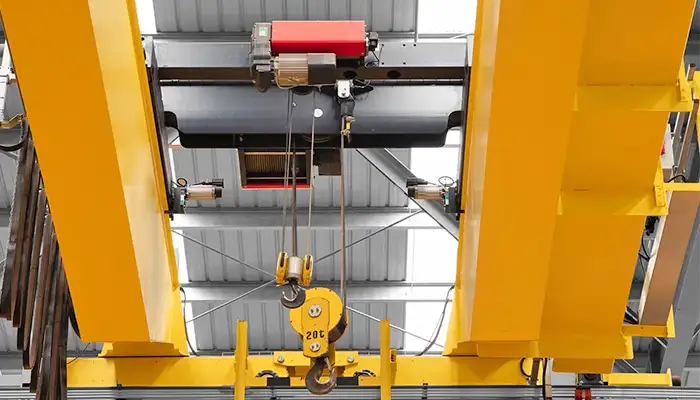
Yuantai can supply:
- Single Girder EOT Cranes
- Double Girder EOT Cranes
- Low-Headroom EOT Cranes
- Heavy-Duty EOT Cranes
- EOT Crane Kits
- Electric Wire Rope Hoists
- Open Winch Trolleys
- Crane End Carriages
- Crane Electrical Systems
- Customized Lifting Equipment
Typical EOT Crane Technical Range
| Parameter | Typical Range |
|---|---|
| Capacity | 1–250 t |
| Single Girder | 1–20 t |
| Double Girder | 20–250 t |
| Span | 7.5–35 m+ |
| Lifting Height | 6–30 m+ |
| Duty Class | ISO A3–A8 |
| FEM Class | FEM 1Am–8m |
| Power | 380/400/415 V, 50 Hz, 3 Ph* |
| Control | Pendant / Radio / Cabin |
| Travel | Two-Speed / VFD |
| Hoisting | Single-Speed / Two-Speed / VFD |
Actual voltage and frequency should be confirmed from the project electrical specification.
Example Configurations by Southeast Asian Market
Example 1: Singapore (SG) – Precision Manufacturing
Application: CNC machine loading and mold handling
Configuration: 5 t compact low-headroom EOT crane with VFD
| Parameter | Specification |
|---|---|
| Capacity | 5 t |
| Span | 15 m |
| Lift Height | 8 m |
| Duty | ISO A5 |
| Hoist | Low-headroom electric wire rope hoist |
| Hoisting | VFD, creep speed for positioning |
| Travel | VFD on crane and trolley |
| Control | Radio remote |
| Power | 400 V / 50 Hz / 3 Ph |
| Key Focus | Positioning accuracy, smooth acceleration, compact design |
Example 2: Malaysia (MY) – Palm Oil Processing
Application: Motor and gearbox maintenance in palm oil mill
Configuration: 10 t single girder EOT crane with corrosion protection
| Parameter | Specification |
|---|---|
| Capacity | 10 t |
| Span | 18 m |
| Lift Height | 10 m |
| Duty | ISO A5 |
| Hoist | Electric wire rope hoist |
| Hoisting | Two-speed |
| Travel | Two-speed / VFD optional |
| Control | Pendant + radio remote |
| Power | 415 V / 50 Hz / 3 Ph |
| Coating | Anti-corrosion system for humid environment |
| Electrical | IP55 protected enclosures |
Example 3: Indonesia (ID) – Mining Maintenance
Application: Heavy equipment maintenance in mining workshop
Configuration: 50 t double girder EOT crane with open winch
| Parameter | Specification |
|---|---|
| Capacity | 50 t |
| Span | 25 m |
| Lift Height | 15 m |
| Duty | ISO A6–A7 |
| Hoist | Open winch trolley |
| Hoisting | VFD / multi-speed |
| Travel | VFD on crane and trolley |
| Control | Radio remote + cabin option |
| Power | 380 V / 50 Hz / 3 Ph |
| Coating | Heavy-duty industrial coating |
| Key Focus | High duty, heavy loads, reliable operation |
Example 4: Thailand (TH) – Automotive Production
Application: Die and mold handling in automotive plant
Configuration: 20 t double girder EOT crane with VFD
| Parameter | Specification |
|---|---|
| Capacity | 20 t |
| Span | 22 m |
| Lift Height | 10 m |
| Duty | ISO A5–A6 |
| Hoist | Electric wire rope hoist / open winch |
| Hoisting | VFD with creep speed |
| Travel | VFD on crane and trolley |
| Control | Radio remote + pendant backup |
| Power | 400 V / 50 Hz / 3 Ph |
| Key Focus | Positioning accuracy, smooth movement, repetitive operation |
Example 5: Philippines (PH) – Power Plant Maintenance
Application: Generator and turbine maintenance
Configuration: 80 t double girder EOT crane with open winch
| Parameter | Specification |
|---|---|
| Capacity | 80 t |
| Span | 28 m |
| Lift Height | 20 m |
| Duty | ISO A5–A6 |
| Hoist | Open winch trolley |
| Hoisting | VFD / multi-speed |
| Travel | VFD on crane and trolley |
| Control | Radio remote + cabin |
| Power | 440 V / 60 Hz / 3 Ph (confirm site supply) |
| Key Focus | Heavy equipment handling, high lift, reliable braking |
Southeast Asia Power Supply Reference
Common power supply configurations in Southeast Asian markets:
| Country | Common Voltage | Frequency | Phase |
|---|---|---|---|
| 🇸🇬 SG (Singapore) | 400 V | 50 Hz | 3 Ph |
| 🇲🇾 MY (Malaysia) | 415 V | 50 Hz | 3 Ph |
| 🇮🇩 ID (Indonesia) | 380 V | 50 Hz | 3 Ph |
| 🇹🇭 TH (Thailand) | 400 V | 50 Hz | 3 Ph |
| 🇵🇭 PH (Philippines) | 440 V / 460 V | 60 Hz | 3 Ph |
| 🇻🇳 VN (Vietnam) | 380 V / 400 V | 50 Hz | 3 Ph |
| 🇰🇭 KH (Cambodia) | 400 V | 50 Hz | 3 Ph |
| 🇱🇦 LA (Laos) | 400 V | 50 Hz | 3 Ph |
| 🇲🇲 MM (Myanmar) | 400 V | 50 Hz | 3 Ph |
| 🇧🇳 BN (Brunei) | 415 V | 50 Hz | 3 Ph |
Important: These are common utility voltages. The actual site supply should always be confirmed before the crane electrical system is manufactured.
Yuantai Technical Engineering for Southeast Asian Projects
A crane should be selected from the actual lifting application, not capacity alone. Yuantai evaluates the full picture—rated capacity, span, lifting height, hook approach, duty class, load spectrum, lifting cycles, and operating hours—before recommending a configuration. This matters because a 20 t crane used for occasional maintenance needs a different build than a 20 t production crane running continuously every day.
Crane Design & Structural Engineering
Crane Design Inputs
Yuantai evaluates:
- Rated capacity
- Span
- Lifting height
- Hook approach
- Duty class
- Load spectrum
- Lifting cycles
- Operating hours
Example: A 20 t crane used for occasional maintenance may require a different design from a 20 t production crane operating continuously every day.
Structural Engineering
Main design checks include:
- Main girder
- End carriage
- Wheel loads
- Deflection
- Fatigue
- Runway interface
Typical Customer Data Required
| Parameter | Example Input |
|---|---|
| Crane Span | 20 m |
| Runway Length | 80 m |
| Rail Size | P43 / 43 kg/m |
| Runway Elevation | 10 m |
| Building Clearance | 3.5 m above rail |
| Column Spacing | 6 m |
| Max Allowable Wheel Load | 100 kN per wheel |
This is especially important for existing factories and retrofit projects.
Mechanical Engineering
Key components are selected according to capacity and duty.
| Component | Main Selection Factor |
|---|---|
| Hoist | Capacity, lift, duty |
| Wire Rope | Load, rope length, reeving |
| Drum | Rope diameter, lifting height |
| Brake | Load, speed, stopping |
| Gearbox | Torque, speed, service factor |
| Wheels | Wheel load, rail, travel speed |
| Coupling | Torque and alignment |
For heavy-duty cranes, load spectrum and operating cycles are important for mechanical sizing.
Example Mechanical Selection
Application: 30 t steel fabrication crane, ISO A6 duty
| Component | Selection |
|---|---|
| Hoist | 30 t open winch trolley |
| Wire Rope | 18 mm diameter, 6-strand, steel core |
| Brake | Electromagnetic, dual brake system |
| Gearbox | Heavy-duty helical, service factor ≥1.6 |
| Wheels | Forged steel, 400 mm diameter |
| Coupling | Flexible gear coupling |
Electrical Engineering
Typical electrical specifications for Southeast Asian projects include:
- 380/400/415 V
- 50 Hz
- 3 Phase
- Control voltage according to project requirements
The actual site supply should always be confirmed before production.
Electrical Package
- Control panel
- Hoisting motor
- Travel motors
- VFD
- Pendant
- Radio remote
- Limit switches
- Emergency stop
- Festoon system
- Cable system
VFD Application
| Motion | Main Benefit |
|---|---|
| Hoisting | Smooth lifting and positioning |
| Trolley | Reduced load swing |
| Crane Travel | Smooth acceleration/deceleration |
VFD control is particularly useful for automotive, electronics, machinery and precision manufacturing.
Southeast Asian Environmental Requirements
The region's tropical and coastal conditions may require additional protection.
Typical Considerations
- High humidity
- Heavy rainfall
- Dust
- High temperature
- Coastal salt
- Corrosive atmosphere
Possible Solutions
- IP54/IP55/IP65 electrical protection
- C4/C5 coating system
- Outdoor electrical cabinets
- Anti-condensation heaters
- Protected cables
- Corrosion-resistant components
The final protection level should be selected according to the actual site environment.
Example Environmental Specifications
| Environment | Typical Protection | Coating System |
|---|---|---|
| Indoor workshop | IP54 | Standard industrial primer + topcoat |
| Indoor humid (palm oil) | IP55 | Anti-corrosion primer + epoxy intermediate |
| Outdoor tropical | IP65 | C4 coating system |
| Coastal / marine | IP65 | C5 coating system |
| Mining / heavy dust | IP55–IP65 | Heavy-duty industrial coating |
Complete EOT Crane vs EOT Crane Kit
| Item | Complete Crane | Crane Kit |
|---|---|---|
| Main Girder | Yuantai | Local fabrication |
| End Carriages | ✓ | ✓ |
| Hoist | ✓ | ✓ |
| Motors | ✓ | ✓ |
| Electrical Panel | ✓ | ✓ |
| Structural Design | Yuantai | Shared |
| Local Installation | Optional | Normally required |
| Best For | Complete projects | Local engineering teams |
An EOT crane kit can be attractive for Southeast Asian customers that already have local steel fabrication and installation capabilities.
Yuantai EOT Crane Engineering Workflow
Application → Load Analysis → Crane Design → Structural Calculation → Mechanical Selection → Electrical Design → Manufacturing → Inspection → FAT/Load Test → Export → Installation Support
This allows Yuantai to provide more than a standard crane. The crane can be engineered around the customer's:
- Load
- Building
- Duty
- Electrical supply
- Operating environment
- Local installation capability
Southeast Asia EOT Crane Technical Selection Table
| Application | Recommended Crane | Typical Capacity | Typical Duty |
|---|---|---|---|
| Small workshop | Compact Single Girder | 1–5 t | A3–A4 |
| Manufacturing | Single Girder | 5–20 t | A4–A5 |
| Automotive | Single/Double Girder | 10–50 t | A5–A6 |
| Electronics | Compact / Low-Headroom | 1–10 t | A3–A5 |
| Machinery | Single/Double Girder | 5–50 t | A4–A6 |
| Palm Oil | Single Girder | 3–20 t | A4–A6 |
| Steel Fabrication | Double Girder | 20–100 t | A5–A7 |
| Shipyard | Double Girder | 20–200+ t | A5–A8 |
| Power Plant | Double Girder | 10–200+ t | A5–A7 |
| Mining | Heavy Double Girder | 20–200+ t | A6–A8 |
| Heavy Industry | Open-Winch Double Girder | 50–200+ t | A6–A8 |
| Retrofit | Low-Headroom EOT | 1–50+ t | Project-specific |
| High-frequency lifting | VFD EOT | 1–50+ t | A5–A7 |
| Local fabrication | EOT Crane Kit | 1–20 t | A3–A6 |
| Outdoor lifting | Protected EOT | 5–200+ t | A5–A8 |
EOT Crane Selection by Capacity
| Capacity | Typical Configuration | Common Application |
|---|---|---|
| 1–5 t | Single Girder | Workshop / maintenance |
| 5–10 t | Single Girder | Manufacturing / warehouse |
| 10–20 t | Single/Double Girder | Automotive / machinery |
| 20–50 t | Double Girder | Steel / heavy manufacturing |
| 50–100 t | Double Girder / Open Winch | Heavy industry |
| 100–200 t | Heavy Double Girder | Mining / power / steel |
| 200–250 t | Heavy Double Girder | Major industrial projects |
Note: Capacity is only one selection factor. Span, lifting height, duty class, load spectrum, operating frequency and building conditions can change the recommended crane configuration.
Southeast Asia Technical Support & Project Capability
For Southeast Asian projects, Yuantai can structure support around the complete project cycle—from initial engineering through manufacturing, testing, export, installation guidance, and long-term spare parts supply. This model is suitable for customers in Singapore (SG), Malaysia (MY), Indonesia (ID), Thailand (TH), the Philippines (PH), Cambodia (KH), Laos (LA), Myanmar (MM) and Brunei (BN), as well as other international markets.
Southeast Asia Technical Support Workflow
The support model follows the complete project cycle:
Engineering → Manufacturing → Inspection & FAT → Export Packing → Shipping → Installation Guidance → Commissioning Support → Operation & Maintenance Documentation → Spare Parts
This model is suitable for customers in Singapore, Malaysia, Indonesia, Thailand, the Philippines, Cambodia, Laos, Myanmar and Brunei, as well as other international markets.
Example Support Timeline
| Project Stage | Yuantai Deliverable | Customer Involvement |
|---|---|---|
| Engineering | Crane design, calculations, drawings | Provide site data, confirm specifications |
| Manufacturing | Fabrication, assembly, wiring | Progress updates, optional inspection |
| Inspection & FAT | Factory testing, documentation | Witness testing, approval |
| Export Packing | Container/breakbulk packing, markings | Confirm shipping requirements |
| Shipping | Export documentation, loading | Freight arrangement, customs clearance |
| Installation Guidance | Drawings, manuals, remote support | Local installation team |
| Commissioning Support | Remote guidance, checklists | Local commissioning team |
| Operation & Maintenance | Manuals, maintenance schedules | Operator training, routine service |
| Spare Parts | Recommended spare parts list, supply | Stocking, replacement planning |
Why Engineering Capability Matters to Global EOT Crane Buyers
A global EOT crane project can fail even when the rated capacity is correct. Common technical issues can come from:
- Incorrect voltage/frequency
- Insufficient lifting height
- Incorrect duty classification
- Excessive wheel loads
- Poor hook approach
- Runway mismatch
- Inadequate corrosion protection
- Incorrect motor selection
- Inadequate brake capacity
- Poor installation dimensions
Yuantai's engineering approach therefore starts with the application and project conditions, then develops the crane configuration.
Engineering Logic
Application → Capacity → Span/Lift → Duty → Structure → Mechanical System → Electrical System → Testing → Export
This is the core difference between an EOT crane manufacturer with engineering capability and a supplier that simply offers standard crane products.
Example: How Engineering Prevents Problems
| Common Issue | Engineering Solution |
|---|---|
| Wrong voltage | Confirm site supply before electrical design |
| Insufficient lift height | Low-headroom design, optimized hoist position |
| Wrong duty class | Calculate from actual load spectrum and cycles |
| Excessive wheel loads | Structural optimization, wheel arrangement check |
| Poor hook approach | Trolley/hoist positioning design |
| Runway mismatch | Verify rail size, gauge, wheel compatibility |
| Corrosion failure | Coating system matched to environment |
| Brake failure | Brake sizing for load and speed |
Global EOT Crane Project Capability
| Project Stage | Yuantai Capability |
|---|---|
| Application analysis | ✓ |
| Capacity selection | ✓ |
| Structural calculation | ✓ |
| Wheel-load calculation | ✓ |
| Mechanical design | ✓ |
| Electrical design | ✓ |
| Steel fabrication | ✓ |
| Welding inspection | ✓ |
| Mechanical assembly | ✓ |
| Electrical testing | ✓ |
| FAT | ✓ |
| Load testing | ✓ |
| Export packing | ✓ |
| Export documentation | ✓ |
| Installation guidance | ✓ |
| Commissioning support | ✓ |
| Spare-parts support | ✓ |
Recommended Positioning Statement
Yuantai Cranes provides more than EOT cranes from China. We provide an integrated engineering, manufacturing, testing and export solution for global lifting projects. From capacity and duty-class selection to structural calculation, mechanical and electrical design, FAT, export packing and commissioning support, each EOT crane can be developed around the customer's application, building and operating environment.
Key Questions Before Buying an EOT Crane in Southeast Asia
EOT crane requirements vary across Southeast Asia because Singapore electronics factories, Malaysian palm-oil plants, Indonesian mines, Thai automotive factories and Philippine shipyards have very different lifting conditions. Before buying an EOT crane from China, buyers should answer these six questions. Getting these details right upfront saves time, avoids miscommunication, and ensures the crane actually fits the building and the job.
What will the EOT crane be used for?
Direct answer: Start with the industry, material and lifting task. This determines the crane type and duty.
| Southeast Asian Application | Typical EOT Solution |
|---|---|
| Electronics / precision manufacturing | 1–10 t Compact / Low-Headroom EOT |
| Automotive | 3–50 t Single/Double Girder EOT |
| Palm-oil processing | 3–20 t Single Girder EOT |
| Steel fabrication | 20–100+ t Double Girder EOT |
| Mining | 20–200+ t Heavy Double Girder |
| Shipyard | 20–200+ t Double Girder |
| Power plant | 10–200+ t Double Girder |
| Warehouse | 1–20 t Single Girder |
What to tell the supplier:
"The crane will be used for [application] to lift [load] in a [factory/yard/plant]."
What capacity, span and lifting height do you need?
Direct answer: Give the supplier the maximum load, crane span and required hook height.
Typical starting ranges:
- Capacity: 1–250 t
- Single Girder: 1–20 t
- Double Girder: 20–250 t
- Span: 7.5–35 m+
- Lifting height: 6–30 m+
Also provide:
- Runway length
- Hook approach
- Top clearance
- Existing rail size
- Building height
Example:
10 t capacity + 18 m span + 10 m lift + 80 m runway.
This information allows the manufacturer to determine whether you need a standard, compact, low-headroom, single-girder or double-girder EOT crane.
How frequently will the crane operate?
Direct answer: Tell the supplier how many hours and lifting cycles the crane performs, not just its capacity.
For example:
8 hours/day, 20 lifts/hour, average load 6 t, maximum load 10 t.
Typical starting points:
| Application | Typical Duty |
|---|---|
| Occasional maintenance | ISO A3–A4 |
| General factory | ISO A4–A5 |
| Production / automotive | ISO A5–A6 |
| Steel fabrication | ISO A5–A7 |
| Mining / heavy maintenance | ISO A6–A8 |
Why it matters: A 20 t maintenance crane and a 20 t production crane may require very different hoists, motors, brakes, structures and duty classifications.
What electrical supply is available at your Southeast Asian site?
Direct answer: Confirm the actual factory power supply before the crane is manufactured.
Provide:
- Voltage
- Frequency
- 3-phase power
- Control voltage
- Required hoisting speed
- Trolley speed
- Crane travel speed
Common export configurations include:
- 380 V / 50 Hz / 3 Ph
- 400 V / 50 Hz / 3 Ph
- 415 V / 50 Hz / 3 Ph
- 440 V / 60 Hz / 3 Ph
- 460 V / 60 Hz / 3 Ph
Important: Do not select the electrical system only according to the country. Confirm the actual site supply.
For production and precision applications, also consider:
- Hoisting VFD
- Trolley VFD
- Crane travel VFD
- PLC
- Radio remote
What Southeast Asian environment will the crane operate in?
Direct answer: Identify whether the crane is indoor, outdoor, coastal, humid, dusty, corrosive or hazardous.
For example:
Singapore shipyard: marine/coastal environment → corrosion protection + protected electrical system.
Indonesia mining plant: dust/heavy-duty environment → robust mechanical system + protected electrical equipment.
Malaysia palm-oil plant: humid/process environment → corrosion protection + suitable electrical enclosure.
Brunei oil & gas project: potentially hazardous area → hazardous-area classification must be confirmed before selecting electrical equipment.
Possible technical requirements include:
- IP55/IP65 protection
- C4/C5 coating
- Outdoor control panels
- Anti-condensation heaters
- Protected cables
- Corrosion-resistant components
- Explosion-protected equipment where required
Should you buy a complete EOT crane or an EOT crane kit from China?
Direct answer: Choose according to your local engineering and installation capability.
Choose a Complete EOT Crane if:
You want the China supplier to provide most of the system:
- Main girders
- End carriages
- Hoist/trolley
- Motors
- Electrical panel
- VFD
- Festoon system
- Pendant/radio control
- Limit switches
Best for: Customers requiring a complete engineered crane package.
Choose an EOT Crane Kit if:
You have local capabilities for:
- Girder fabrication
- Crane assembly
- Electrical installation
- Site installation
- Commissioning
The supplier can provide:
- Hoist/trolley
- End carriages
- Wheels
- Motors
- Electrical system
- Controls
- Engineering drawings
Best for: Southeast Asian EPC contractors and industrial customers with local fabrication and installation teams.
Quick EOT Crane Buying Checklist for Southeast Asia
Before requesting a quotation, prepare these 8 items:
| Information | Example |
|---|---|
| Application | Automotive production |
| Capacity | 10 t |
| Span | 20 m |
| Lifting height | 10 m |
| Runway length | 100 m |
| Duty | ISO A5 |
| Electrical | 400 V / 50 Hz / 3 Ph |
| Environment | Indoor, humid |
Then the supplier can determine the appropriate:
Crane Type → Hoist → Structure → Duty → Motors → VFD → Electrical Protection → Price
This makes the buying process much more efficient and helps Southeast Asian buyers avoid selecting an EOT crane based on capacity and price alone.


Yuantai Cranes
Overhead Crane Manufacturer with CE, ISO, SGS, CNEX Certificates.
- Main Specifications - Capacity: 0.5–550 tons | Span: up to 40m | Speed: 0.8–12 m/min | Duty: A3–A7 | Power: 380–690V, 50/60Hz | Control: pendant/remote/cabin
- Full engineering: FEA/PLC/VFD + in-house build + global delivery + on-site support, for workshops, factories, EPC contractors, industrial projects, etc.
- Support: design, manufacturing, testing, service – end-to-end, customized lifting solutions worldwide.
How to Get an Accurate Crane Price for Your Application?
Tips: Copy the spec list, fill in your details, and paste it into the form on the right/ down-below for a quick price.
- Crane type:_____ . (e.g., overhead crane, gantry crane, jib crane)
- Max weight to lift:_____ tons. (e.g., 2t, 5t, 10t, 20t, 50t)
- Lifting height:_____ m. (How high does the hook need to reach?
- Workshop width (span):_____ m . (Distance between the two crane rails)
- Travel distance:_____ m . (How long does the crane need to move along the runway?)
- Control type:_____. (Pendant / remote / cabin Control)
- Power supply:_____. (Local voltage & frequency – e.g., 380V, 50Hz, 3-phase)
- What will it be used for?_____ (e.g., steel fabrication, concrete products, mold handling, general manufacturing, etc.)
- Any special requirements?_____ (e.g., extreme temperature, dusty or explosive environment, special paint color, etc.)
Just leave a message via the contact form and our hoist and crane engineer will contact you with in 24working hours.
Get Your Custom Quote–Quick & Easy
Fill in what you know. Skip what you don't – we'll help.Any question will be reply with 24 working hours