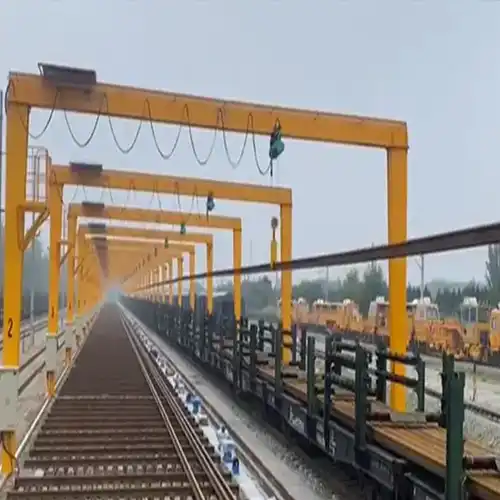
Wireless Remote Controlled Cranes: Selection & Operation
Guide on selecting, operating wireless crane controls, and managing tandem lifting for safe, efficient multi-crane operations.
| Crane Type | Top-running overhead crane, gantry crane, low-headroom crane, explosion-proof crane, 1–20 ton single girder / 20–550+ ton double girder · ISO A3–A8 / FEM 1Am–5m · Span: 7.5–35 m+ · Lift: 6–30 m+ · 380/400/415 V, 3 Ph, 50 Hz |
| Crane Capacity | 1–20 ton: commonly single girder; 20–550+ ton: double girder configuration for heavy-duty lifting |
| Span Length | Typically 7.5–35 m+; longer spans available with project-specific engineering |
| Lifting Height | Typically 6–30 m+, customized according to building height, working level and lifting requirements |
| Coverage Area Type | Indoor or outdoor lifting areas; runway length and working area are customized to the facility |
| Application | Manufacturing, workshops, warehouses, steel fabrication, machinery plants, maintenance bays, logistics, ports and heavy industry |
| Certifications | CE / ISO / SGS / Other third-party inspection |
| Customization | Single girder /double girder · Hoist: wire rope / low-headroom / European / open winch · Control: pendant / radio remote / cabin · indoor / outdoor / high-temperature / explosion-proof · Attachments: hook / lifting beam / spreader / C-hook / grab / magne |
Crane Manufacturer: Yuantai Cranes – 30+ Years Professional Crane Manufacturer from China
Category: Featured
Tags:
Your Trusted Overhead Crane Manufacturer & Supplier
Wireless Remote Controlled Cranes – Selection, Operation, and Tandem Lifting
Wireless Remote Controlled Cranes
Overview of Wireless Remote Control Systems for Cranes
Wireless remote control systems for cranes allow operators to control the movement of cranes without being physically attached to the machine. These systems use radio frequencies (RF) or other wireless technologies to transmit signals from the operator's remote control to the crane. This provides greater flexibility and convenience, as the operator can work from a safe distance, improving both efficiency and safety.
The systems are designed to control various crane functions, including lifting, lowering, trolley movement, and crane rotation. The remote control typically consists of a transmitter, held by the operator, and a receiver installed on the crane. These systems can vary in terms of range, complexity, and the number of functions available, with some offering advanced features like multi-crane control and real-time feedback on load status.
Advantages of Wireless Control in Overhead Cranes and Gantry Cranes
Wireless control systems provide a range of benefits in overhead and gantry crane operations:
- Improved Safety: One of the biggest advantages is the increased safety for crane operators. By using a remote control, operators can stay away from potential hazards such as moving loads, high temperatures, or toxic environments, reducing the risk of injury.
- Enhanced Efficiency: Wireless controls allow the operator to move freely around the site, offering better visibility and better control over the crane. This leads to smoother operations, faster lifting, and less time spent positioning the load.
- Flexibility and Mobility: Unlike traditional wired control systems, wireless controls let the operator move around the crane or job site. This means they can be positioned in a place that offers the best vantage point, which is especially useful for large or complex lifts.
- Simplified Crane Management: Wireless systems can allow for the operation of multiple cranes from one location. This can streamline operations in environments like warehouses or construction sites, where several cranes may need to work in sync.
- Reduced Wear and Tear: Since the operator isn't directly connected to the crane via cables, there is less chance for the physical wear and tear that can occur with traditional wired systems. Additionally, wireless controls are often designed to be robust and durable for harsh environments.
Types of Cranes Suitable for Wireless Control
Wireless remote control systems can be used on various types of cranes, each designed to meet specific operational needs:
- Overhead Bridge Cranes: Overhead cranes, which include single and double girder systems, are commonly used in industrial environments like warehouses, manufacturing plants, and factories. Wireless control enhances the operator's ability to handle heavy and bulky loads with precision, often in restricted spaces. These cranes are ideal for tasks such as lifting and moving materials along a defined track system.
- Gantry Cranes: Gantry cranes, which move on tracks either on the floor or on a raised platform, are particularly well-suited for outdoor environments, like construction sites or ports. Wireless remote control allows operators to manage the crane from a distance, improving their ability to maneuver large loads over longer distances with ease.
- Jib Cranes: Smaller than overhead cranes, jib cranes are often used in workshops or areas with limited space. While they can be operated manually, adding a wireless control system can improve the ergonomics and flexibility of operation, especially for lifting loads that are challenging to handle manually.
- Portable Cranes: Wireless control is also increasingly used in portable cranes, which are often smaller, lightweight machines that are moved around a work site. The convenience of wireless control makes these cranes easier to maneuver and operate without needing to be tethered to a fixed control station.
Each of these types of remote controled overhead cranes benefits from wireless control by offering greater flexibility, safety, and efficiency, ensuring that operators can complete their tasks with fewer complications and better precision.
Types of Wireless Remote Control Systems for Cranes
Wireless remote control systems for various types of remote operated cranes come in different types, each suited to specific operational needs and crane functions. These systems provide operators with flexibility, convenience, and safety, allowing for improved crane control in various industrial settings. Below is an overview of the three primary types of wireless remote control systems used for cranes: Button-Type Wireless Remote Controls, Joystick-Type Wireless Remote Controls, and Custom Remote Control Systems.
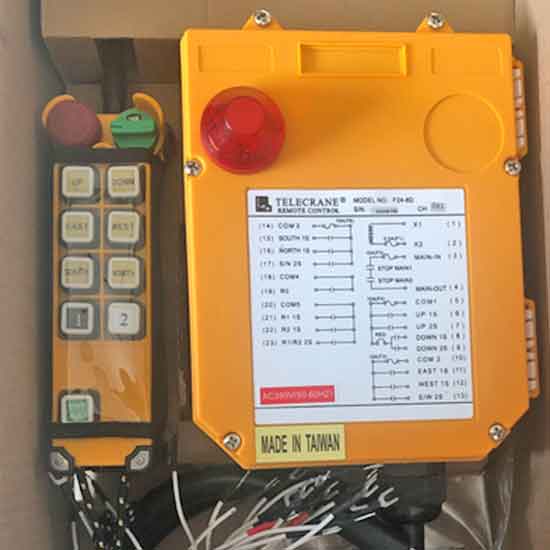
Button-Type Wireless Remote Controls
Button-type remotes are the most basic and commonly used wireless control systems for cranes. These devices are equipped with a set of buttons that control essential crane functions like lifting, lowering, and moving along tracks.
Key Characteristics:
- Basic Operations: Operators can use the buttons to control simple crane movements, such as vertical lifting, lowering, and horizontal travel. Each button is typically dedicated to a specific function.
- Ideal for Smaller Cranes: This system is best suited for smaller cranes where operations are less complex, such as in warehouses or light-duty industrial settings.
- Cost-Effective: Due to their simplicity, button-type wireless controls are budget-friendly and easy to maintain.
Best Suited For:
- Overhead Cranes in warehouses, light-duty industrial environments, and basic lifting tasks.
- Gantry Cranes with less complex needs or smaller lifting capacities.

Joystick-Type Wireless Remote Controls
Joystick-type wireless remotes offer more advanced control, enabling the operator to handle multiple crane functions simultaneously. These systems are ideal for larger, more complex cranes requiring precision control.
Key Characteristics:
- Complex Operations: Joystick remotes allow for the simultaneous control of various crane movements, such as lifting, lowering, traveling, and rotating, providing greater flexibility and control.
- Precise Movement: Operators can fine-tune the crane's motions, enabling more intricate tasks like lifting and traveling at the same time.
- Ideal for Larger Systems: These remotes are most effective with large overhead cranes and gantry cranes that operate in more demanding environments where multiple movements need to be coordinated.
Best Suited For:
- Large Overhead Cranes and Gantry Cranes used in industrial environments where high precision and multi-functionality are required.
- Cranes that need to operate over large areas or in complex layouts.
Custom Remote Control Systems
Custom wireless remote control systems are tailored to meet specific operational needs, especially in challenging or hazardous environments. These systems offer specialized features for cranes that operate in extreme conditions or require added safety measures.
Key Characteristics:
- Tailored for Special Environments: These systems are designed for industries with unique requirements, such as explosive or corrosive environments. For instance, explosion-proof systems are crucial for oil refineries or chemical plants.
- Enhanced Durability: Custom systems are built to withstand harsh conditions, including extreme temperatures, moisture, chemicals, and other environmental factors.
- Advanced Communication and Safety Features: Custom systems may include advanced technologies like long-range wireless communication and real-time monitoring of load and crane status.
Best Suited For:
- Explosion-Proof Systems in oil and gas industries, chemical plants, and mining operations.
- Harsh Industrial Settings where the crane is exposed to extreme weather, chemicals, or other corrosive elements.
Summary of Wireless Remote Control Systems for Cranes
Button-Type Wireless Remote Controls
- Use Case: Basic operations in smaller cranes.
- Ideal for: Overhead and light-duty gantry cranes with simple lifting needs.
- Advantages: Cost-effective, easy to use, and easy to maintain.
Joystick-Type Wireless Remote Controls
- Use Case: Complex operations requiring simultaneous movement control.
- Ideal for: Large-scale overhead cranes and gantry cranes in demanding industrial applications.
- Advantages: Provides fine control over crane functions and flexibility for large systems.
Custom Wireless Remote Control Systems
- Use Case: Special environments like hazardous or corrosive settings.
- Ideal for: Cranes operating in extreme conditions such as oil refineries, chemical plants, or marine environments.
- Advantages: Tailored features for safety, durability, and advanced communication.
Each type of wireless remote control system offers distinct advantages based on the crane's application and the operational environment. Choosing the right system can significantly improve crane efficiency, operator safety, and overall productivity in the workplace.
Here's a table summarizing the types of wireless remote control systems for cranes:
| Wireless Remote Control System | Key Characteristics | Best Suited For | Advantages |
|---|---|---|---|
| Button-Type Wireless Remote Controls | - Simple controls for lifting, lowering, and traveling. - Basic operation with dedicated buttons. | - Small overhead cranes. - Light-duty gantry cranes in warehouses or smaller industrial settings. | - Cost-effective. - Easy to use and maintain. - Ideal for simpler operations. |
| Joystick-Type Wireless Remote Controls | - Allows simultaneous control of multiple crane functions. - Provides precise movement for intricate tasks. | - Large overhead cranes. - Complex gantry cranes. - Applications requiring high precision. | - Flexibility in controlling various crane movements. - Suitable for large, multi-functional cranes. - High precision and coordination. |
| Custom Wireless Remote Control Systems | - Tailored for specific environments (explosion-proof, harsh conditions). - Built for durability and safety. | - Explosion-prone environments (oil refineries, chemical plants). - Extreme temperature or corrosive settings. | - Custom solutions for specialized environments. - Enhanced safety features. - Advanced communication and monitoring capabilities. |
This table presents a clear comparison of the types of wireless remote control systems, their characteristics, suitable crane applications, and their advantages.
Selecting the Right Wireless Remote Control
When choosing the appropriate wireless remote control for a crane, there are several factors to consider. Below are the key aspects that should guide your decision:
Crane Type and Specifications
The type and specifications of your crane will play a significant role in determining the best wireless remote control system. Different crane types (overhead, gantry, jib, etc.) and their operational requirements (such as lifting capacity, span, and working radius) influence the selection process.
- Overhead Cranes: Typically require simpler controls for basic lifting and movement. For small to medium-sized overhead cranes, button-type controls may be sufficient.
- Gantry Cranes: Often require more complex remote control systems, especially if they are used for heavy-duty lifting and multi-directional movement.
- Jib Cranes: Usually operate in confined spaces, so a compact and easy-to-operate wireless control system, like a button-type system, is ideal.
Always match the remote control system to the crane's lifting capacity and its specific operational needs to ensure seamless functionality.
Control Functions
A wireless remote control system needs to support the functions required by your crane's operations. Common control functions include:
- Lifting and Lowering: Basic control for moving loads up and down.
- Trolley Movement: Allows for left and right trolley movement, a key feature for gantry cranes.
- Crane Rotation: If the crane requires rotating loads, a joystick or custom remote system may be necessary.
- Multiple Crane Control: If operations involve multiple cranes, it's important to choose a remote that allows simultaneous control of several units.
For cranes with more complex operations, a joystick-type remote or custom solutions would be more appropriate due to their ability to control multiple movements at the same time.
Effective Working Distance
The effective range of the remote control's signal is an essential factor, especially for outdoor or large-scale operations. Wireless remote systems typically offer a range from 100 meters up to 300 meters.
- Indoor Operations: Shorter ranges, such as 100 meters, are often sufficient for warehouses or factory floors.
- Outdoor Operations: For large cranes in open areas or expansive work sites, choosing a remote control with a range of 200-300 meters may be necessary.
Make sure the transmitter range meets the operational needs of your facility to avoid communication issues.
Signal Transmission Types
Wireless remote controls can be broadly classified into crystal-type and card-type controls. Understanding the differences will help you select the most suitable option:
Crystal-Type: These use analog signal transmission and are known for their superior resistance to interference. They are stable and provide a consistent connection but may require more effort for pairing.
- Advantages: Highly stable and reliable signal transmission.
- Best For: Environments with high interference or where precise control is critical.
Card-Type: These use digital signal transmission and often allow users to switch frequencies by changing the plug-in card. These are easier to pair and more flexible.
- Advantages: Easy to pair and can be used in various devices with different frequencies.
- Best For: Facilities with multiple cranes operating simultaneously, where flexibility is required.
Choosing between crystal-type and card-type depends on the specific needs of your operation, including signal stability and flexibility.
Environmental Considerations
For cranes operating in challenging environments, such as chemical plants, ports, or metalworking shops, environmental factors like dust, corrosion, and explosive atmospheres must be considered.
- Explosion-Proof Systems: For locations like oil refineries or chemical plants, explosion-proof remote controls are essential. These systems are designed to minimize the risk of sparks and fires, using anti-static and flame-resistant materials.
- Anti-Corrosion Features: In coastal areas or facilities exposed to moisture, anti-corrosion remote controls made from stainless steel and other resistant materials are crucial to ensure long-lasting performance.
Choosing the right environmental features not only improves the longevity of the wireless remote control but also ensures the safety and efficiency of crane operations in demanding conditions.
By considering these factors, you can select the most suitable wireless remote control system for your crane, ensuring that it meets both operational and environmental requirements.
Operating Wireless Remote Controlled Cranes
Operating wireless remote-controlled cranes offers several advantages in terms of mobility, convenience, and safety. However, to maximize the effectiveness of these systems, it's crucial to understand the key procedures, safety measures, and maintenance practices involved. Below are the key aspects of operating wireless remote-controlled cranes.
Basic Operation Procedures
Operating a crane with a wireless remote control is relatively straightforward, but knowing the key functions and features is essential for smooth operation. The basic functions of wireless remote control systems typically include:
- Up/Down Movements: These basic controls allow the operator to lift and lower loads safely.
- Left/Right Movements: For cranes with trolleys, remote controls provide easy left and right directional movements.
- Forward/Backward Movements: Especially relevant for gantry cranes, this function controls the movement of the crane along its track.
For ease of use, wireless remotes often have intuitive layouts with buttons or joysticks designed to control these movements.
Key Features for Ease of Use and Safety:
- Ergonomic Design: Remotes should be comfortable to hold and use, with buttons or joysticks positioned for efficient control.
- Clear Feedback: Visual or auditory feedback (e.g., indicator lights, beeps) can provide operators with immediate information about crane position or status.
- Responsive Controls: Smooth, precise control is essential, especially for delicate or heavy loads.
For safety, operators should ensure the crane is in a safe operational range and have a clear line of sight to avoid accidents.
Multi-Crane Control
Advanced wireless remote control systems enable the simultaneous operation of multiple cranes, which is particularly useful in large warehouses, ports, or construction sites.
Practical Use Cases:
- Warehouse Operations: In large storage facilities where several cranes may be used to move different loads at once, multi-crane control ensures that operators can efficiently manage multiple tasks.
- Heavy-Duty Lifting: In situations where tandem lifts are required, such as lifting large machinery or long beams, operators can use the same remote control system to coordinate multiple cranes.
Multi-crane control systems are typically designed to minimize interference and allow for precise coordination between cranes, improving efficiency and safety during operations.
Safety Features
The safety of operators and equipment is a priority when using wireless remote-controlled cranes. Key safety features include:
- Emergency Stop Buttons: These are vital for halting crane operation immediately in the event of an emergency, preventing accidents and minimizing damage to equipment.
- Overload Protection: Many remote systems include built-in overload protection that automatically stops crane operations if the load exceeds safe limits, protecting both the load and the crane itself.
- Safety Cutoffs: These features automatically disengage certain functions (such as the lifting mechanism) when they detect an unsafe condition, like low battery or signal interference.
Regular Training and Safety Protocols:
- Operator Training: All crane operators should be thoroughly trained to understand the remote control system, crane functions, and emergency protocols.
- Safety Protocols: Operators should follow strict safety protocols, including pre-operational checks, ensuring the workspace is clear, and adhering to weight limits.
Regular training and awareness of the safety features can help prevent accidents and ensure smooth, efficient crane operations.
Remote Control Maintenance
To maintain the reliability and safety of the wireless remote control system, regular maintenance is essential. Here are some best practices:
- Signal Strength Checks: Ensure that the remote has a strong, uninterrupted signal. Interference or weak signal strength can lead to operational delays or accidents.
- Battery Life: Check the battery level regularly and replace it as needed to prevent sudden loss of power during operations.
- Physical Wear and Tear: Over time, the remote control may experience physical wear. Inspect buttons, joysticks, and housing for signs of damage or malfunction.
- Cleaning and Storage: Keep the remote clean and store it in a dry, safe location to avoid exposure to dirt, moisture, or corrosive substances that could affect its functionality.
Following these maintenance practices ensures that the remote control system remains in good condition, reducing the risk of malfunctions and enhancing its longevity.
By understanding the operational procedures, safety features, and maintenance requirements, operators can fully benefit from wireless remote-controlled crane systems, ensuring efficient, safe, and reliable operations.
Tandem Lifting with Wireless Remote Controlled Cranes
Tandem lifting is a crucial technique used in crane operations when handling large, heavy, or awkwardly shaped loads. This method requires the coordinated operation of multiple cranes to lift and move a single load safely. The use of wireless remote-controlled cranes has greatly enhanced the efficiency and safety of tandem lifting operations, allowing operators to manage complex lifts with precision.
What is Tandem Lifting? Tandem lifting involves the use of two or more cranes working together to lift a single load. This technique is often used when the load is too large, heavy, or unbalanced for a single crane to lift on its own. By distributing the load across multiple cranes, tandem lifting helps prevent damage to the load or the crane, ensuring a safer and more efficient lift.
Why Tandem Lifting is Used Tandem lifting is essential in several industries, especially when dealing with:
- Large Components: Heavy machinery, large beams, or oversized equipment that exceeds the lifting capacity of a single crane.
- Heavy Machinery: Complex or heavy machines that require precise lifting to avoid strain or damage.
- Unbalanced Loads: Loads with uneven weight distribution that could be dangerous to lift with a single crane.
This technique allows for a safer, more controlled lifting process while also reducing the risk of accidents and equipment damage.
Setting Up for Tandem Lifting
How to Configure Multiple Cranes for Tandem Lifting Operations Setting up a tandem lift requires careful planning and coordination between crane operators. To configure multiple cranes for tandem lifting:
- Determine Load Specifications: Assess the size, weight, and center of gravity of the load to determine the number and capacity of cranes needed.
- Positioning Cranes: Position the cranes symmetrically around the load to ensure an even distribution of weight and balanced lifting.
- Attach Lifting Slings: Use appropriate lifting slings or rigging to secure the load to the cranes. The rigging should be designed for tandem lifts and checked for weight tolerance.
Wireless Remote Control Features that Support Tandem Lifting Wireless remote-controlled cranes facilitate tandem lifting by offering:
- Synchronized Lifting: Modern remote systems enable multiple cranes to lift the load in perfect synchronization, ensuring the load is raised evenly.
- Independent Controls for Each Crane: Wireless remotes allow each crane operator to control their respective crane independently while still working in tandem. This flexibility ensures precise control over each crane's movement.
These features are especially important in complex lifting scenarios, as they help avoid accidents caused by uneven lifting or loss of control.
Operational Considerations for Tandem Lifting
Coordination Between Crane Operators
Effective communication between crane operators is key to successful tandem lifting. Operators must work in sync to ensure that the load is lifted smoothly and evenly. Communication involves:
- Real-Time Updates: Operators need to communicate regularly during the lift to ensure they are maintaining the correct speed and positioning.
- Load Movement Adjustments: If the load shifts or becomes unstable, operators must be able to adjust their movements in real time to correct the issue.
Communication Protocols and Safety Measures
Clear communication protocols should be established before the lift begins, such as using radios or hand signals, to ensure all operators are on the same page.
Key safety measures for tandem lifting include:
- Load Stability: Constant monitoring of the load to ensure it remains stable throughout the lift.
- Speed Matching: Operators must ensure that each crane lifts at the same speed, preventing the load from tilting or becoming unbalanced.
- Avoiding Interference: The remote control systems should be configured to avoid signal interference, which could cause a delay or miscommunication during the lift.
Types of Wireless Controls Best Suited for Tandem Lifting
When selecting wireless remote controls for tandem lifting, the following features are beneficial:
- Multiple Buttons or Joysticks: Wireless remotes with several buttons or joysticks allow operators to control the different functions of each crane independently while maintaining coordination. These controls help manage movements such as lifting, lowering, and traveling.
- Customizable Settings: Some remote systems allow operators to customize control settings for tandem lifts, ensuring the cranes work in sync for the specific load type and lifting environment.
Tandem Lifting Safety
Key Safety Procedures for Tandem Lifting To ensure the safety of both operators and the load, the following procedures should be followed during tandem lifting:
- Load Balancing: Before initiating the lift, ensure the load is perfectly balanced to avoid tipping or uneven lifting. This can be achieved by using precise rigging techniques and ensuring both cranes are positioned correctly.
- Equal Lifting Speeds: Both cranes should lift at the same speed. Wireless remote systems that allow for synchronized movements are essential to ensure the load remains level during the entire lift.
- Real-Time Coordination: Continuous coordination between operators during the lift is crucial. Any slight miscommunication or delay could result in load instability.
Regular Crane Inspection To maintain synchronization and ensure safe load handling, regular inspection of the cranes is vital. This includes checking:
- Mechanical Components: Ensure that the lifting mechanisms, hooks, and rigging are in good condition and free of damage.
- Remote Control Systems: Check that the wireless remotes are functioning correctly and are free from any interference or signal issues.
- Safety Features: Verify that all safety features, such as overload protection and emergency stop buttons, are working as intended.
Regular inspection of both cranes and remote systems ensures that the lifting operation proceeds smoothly and safely.
By following these operational considerations and safety protocols, tandem lifting can be executed efficiently and securely, allowing for the safe handling of large, heavy, or unbalanced loads with wireless remote-controlled cranes.
Best Practices for Wireless Remote Control Systems in Cranes
To ensure maximum performance, safety, and longevity of wireless remote control systems for cranes, it's crucial to follow best practices. This section explores essential considerations for selecting and maintaining wireless control systems, including ergonomics, durability, customization, and cost-effectiveness.
Ergonomics and Ease of Use
Choosing Wireless Remotes with Comfortable Design When selecting wireless remote control systems for cranes, ergonomics is a key factor in improving the operator's experience and ensuring safe, efficient operation. Comfortable, user-friendly designs help reduce operator fatigue, which is especially important during long lifting sessions.
- Compact and Lightweight Design: Wireless remotes should be compact and lightweight to ensure ease of handling. This is particularly important for operators who need to carry or maneuver the remote for extended periods.
- User-Friendly Interface: A clear, intuitive interface allows operators to control the crane with minimal effort and confusion. Well-labeled buttons and responsive controls are essential for smooth operations.
- Ergonomic Grips and Button Layout: Remotes should have ergonomic grips and strategically placed buttons for easy access, reducing the need for awkward hand positions or excessive hand movements. This enhances comfort and reduces strain during operations.
A well-designed remote control system improves operational efficiency and minimizes the risk of errors or accidents.
Durability and Customization
Selecting Durable, Weatherproof, and Anti-Corrosive Materials In demanding industrial environments, remote controls are subjected to harsh conditions such as extreme temperatures, moisture, and exposure to chemicals. Selecting a remote system built to withstand these elements is essential for long-term performance and reliability.
- Weatherproof and Water-Resistant: For cranes used in outdoor or exposed environments, such as construction sites or marine operations, remotes should be weatherproof and resistant to water, dust, and dirt. This ensures that the controls remain operational under various conditions.
- Anti-Corrosive Materials: In coastal or industrial settings, where cranes are exposed to chemicals, saltwater, or high humidity, remotes should be made from corrosion-resistant materials. This helps protect the system from damage and ensures its longevity.
- Rugged Construction: Cranes often operate in environments with high levels of vibration and impact. The remote control should be durable enough to endure drops, impacts, and frequent handling without losing functionality.
Customizing Control Features Based on Operator Preference Customization of remote controls can significantly enhance operator comfort and crane performance. Some features to consider customizing include:
- Control Layout: Operators can select the button or joystick layout that suits their needs. For example, adding more buttons for complex crane movements or using larger buttons for ease of use.
- Programmable Settings: Some remotes allow operators to program certain functions, such as preset lifting speeds or lifting heights, for quick access during repetitive tasks.
- Feedback Options: Integrating visual or tactile feedback (like vibration) into the remote can help operators gauge crane movements, especially in noisy environments.
By customizing the remote system, the crane can be optimized for specific applications and operational requirements, improving overall productivity.
Cost-Effective Solutions
Balancing Functionality with Cost for Specific Crane Operations While it's tempting to choose the most advanced or feature-rich remote control system, it's important to balance functionality with the budget and needs of the operation.
- Assessing Needs: Evaluate the crane's operations and the environment in which it will be used. For simpler tasks, a basic button-type remote may suffice. However, for complex or tandem lifting operations, a joystick-type remote or customized solution may be necessary.
- Long-Term Value: Consider the durability and maintenance costs over time. A slightly higher initial investment in a more durable or customizable system may save money in the long run by reducing repairs or replacements.
- Budget-Friendly Options: If budget constraints are a concern, crystal-type remote systems may offer a more cost-effective solution, as they are generally less expensive than card-type systems. However, it's important to ensure that the system meets the operational needs, as well as safety and communication requirements.
Comparing Crystal-Type and Card-Type Remote Control Systems There are different types of signal transmission systems used in wireless remotes: crystal-type and card-type systems. The choice between these systems depends on the specific requirements of the crane operation:
- Crystal-Type Remote Control Systems: These systems use analog signals and are typically less expensive. They are suitable for basic crane operations that don't require advanced features or long-range communication. However, they may be more prone to interference in environments with high levels of electromagnetic noise.
- Card-Type Remote Control Systems: These systems use digital signals, which offer better resistance to interference and provide clearer communication over longer distances. While card-type systems tend to be more expensive, they are ideal for complex crane operations and environments where reliability and signal strength are critical.
For budget-conscious operations, crystal-type systems can provide a cost-effective solution, but for more complex operations or high-demand environments, investing in a card-type system may be more cost-efficient in the long term due to its reliability and durability.
Selecting the right wireless remote control system requires balancing ergonomics, durability, customization options, and cost. By focusing on user-friendly designs, durable materials, and functional features tailored to specific crane operations, operators can improve safety, efficiency, and long-term reliability. Carefully considering the best wireless control options based on operational needs ensures that cranes are operated efficiently, reducing downtime and enhancing performance.
Conclusion
Wireless remote controls play a crucial role in enhancing the flexibility, safety, and efficiency of overhead and gantry crane operations. When selecting a wireless remote control system, it's important to consider the type of crane, operational requirements, and the environment in which the crane will be used. The key factors to evaluate include:
- Control Type: Whether a button-type or joystick-type remote is appropriate, depending on the complexity of the crane movements and the specific application.
- Functionality: The remote should be capable of controlling essential crane functions such as lifting, lowering, and movement, with additional features for advanced tasks like tandem lifting.
- Durability: Remotes should be designed for rugged environments, with weatherproof, anti-corrosive, and impact-resistant features, especially in challenging industrial conditions.
- Customization: The ability to customize the remote for operator comfort and specific crane operations can significantly enhance performance and reduce operator fatigue.
Final Tips on Tandem Lifting and Ensuring Safety in Multi-Crane Operations
Tandem lifting, where multiple cranes work in unison to lift heavy or large loads, requires careful coordination and precise control. To ensure safety and efficiency:
- Synchronization: It's essential that cranes are synchronized to lift and lower loads at the same speed, balancing the load evenly between the cranes. This helps avoid accidents, equipment damage, or operator injury.
- Communication: Clear communication protocols between crane operators are vital for tandem lifting operations. Wireless remote control systems that support multi-crane operation allow for seamless control and minimize the risk of miscommunication.
- Safety Measures: Always incorporate safety features like emergency stop buttons, overload protection, and real-time monitoring to avoid accidents. Conduct regular checks to ensure that all safety systems are functioning properly.
The Importance of Ongoing Training and Maintenance
Regular training for crane operators is essential to ensure they are well-versed in operating wireless remote controls safely and effectively. Ongoing education helps reduce the risk of human error, improves operator confidence, and promotes best practices in crane operation.
Equally important is the regular maintenance of both the cranes and their remote control systems. This includes:
- Signal Checks: Regularly inspecting signal strength, transmission quality, and battery life to ensure reliable performance during crane operations.
- Physical Inspection: Routine checks for wear and tear on remote controls, cranes, and related systems to identify potential issues before they lead to failure or accidents.
By adhering to these best practices in training and maintenance, crane operators can optimize the performance and safety of wireless remote control systems, ensuring that overhead and gantry cranes function at their highest capacity. Contact us to get your customized wireless remote controlled cranes.




Yuantai Cranes
Overhead Crane Manufacturer with CE, ISO, SGS, CNEX Certificates.
- Main Specifications - Capacity: 0.5–550 tons | Span: up to 40m | Speed: 0.8–12 m/min | Duty: A3–A7 | Power: 380–690V, 50/60Hz | Control: pendant/remote/cabin
- Full engineering: FEA/PLC/VFD + in-house build + global delivery + on-site support, for workshops, factories, EPC contractors, industrial projects, etc.
- Support: design, manufacturing, testing, service – end-to-end, customized lifting solutions worldwide.
How to Get an Accurate Crane Price for Your Application?
Tips: Copy the spec list, fill in your details, and paste it into the form on the right/ down-below for a quick price.
- Crane type:_____ . (e.g., overhead crane, gantry crane, jib crane)
- Max weight to lift:_____ tons. (e.g., 2t, 5t, 10t, 20t, 50t)
- Lifting height:_____ m. (How high does the hook need to reach?
- Workshop width (span):_____ m . (Distance between the two crane rails)
- Travel distance:_____ m . (How long does the crane need to move along the runway?)
- Control type:_____. (Pendant / remote / cabin Control)
- Power supply:_____. (Local voltage & frequency – e.g., 380V, 50Hz, 3-phase)
- What will it be used for?_____ (e.g., steel fabrication, concrete products, mold handling, general manufacturing, etc.)
- Any special requirements?_____ (e.g., extreme temperature, dusty or explosive environment, special paint color, etc.)
Just leave a message via the contact form and our hoist and crane engineer will contact you with in 24working hours.
Get Your Custom Quote–Quick & Easy
Fill in what you know. Skip what you don't – we'll help.Any question will be reply with 24 working hours