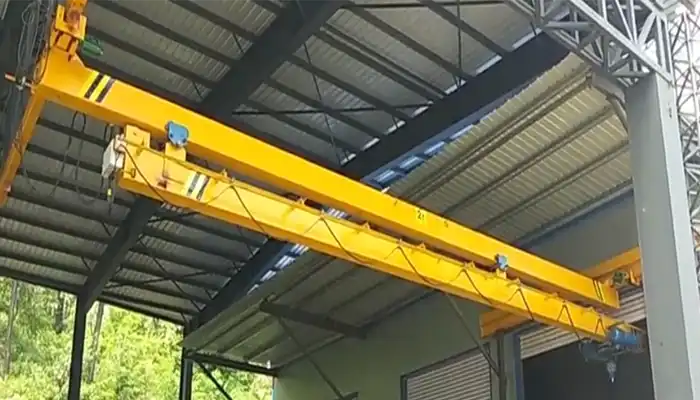
Underhung Telescopic Bridge Crane for Indoor Outdoor Transfer
menu_open
Content Quick Link
Underhung Single Girder Telescopic Bridge Crane
Seamless Indoor–Outdoor Material Handling System
Most Important Takeaway
The underhung single girder telescopic bridge crane is designed to solve cross-boundary material handling challenges by enabling continuous lifting and transfer between indoor workshops and outdoor storage or loading areas without relying on forklifts, multiple cranes, or repeated material rehandling.
- Enables seamless indoor-to-outdoor material transfer within a single crane system
- Combines underhung bridge crane structure with a telescopic bridge girder mechanism
- Provides flexible outreach for loading and unloading beyond building boundaries
- Optimized for facilities with limited overhead space and complex workshop layouts
- Reduces material handling time and improves workflow continuity
- Eliminates the need for separate indoor crane and outdoor lifting equipment
Key Questions This Underhung Single Girder Telescopic Bridge Crane System Solves
In real industrial workshops, the main challenge is not only lifting capacity, but how efficiently materials move between indoor production areas and outdoor logistics zones. The underhung single girder telescopic bridge crane is designed to solve these practical handling problems with a single integrated system.
Q: How can one crane handle both indoor and outdoor lifting easily?
A: One underhung single girder telescopic bridge crane can handle indoor and outdoor lifting by moving inside the workshop and extending its bridge girder outside when needed.
This is commonly used in "workshop to yard material handling" or "indoor outdoor crane system" setups. The crane lifts materials inside the workshop, then extends outward to place them in a yard or loading area without using another machine.
- One crane covers both indoor and outdoor areas
- No need to move materials between different equipment
- Faster and simpler material transfer process
Q: What crane is best for workshop to yard transfer without stopping work?
A: A telescopic bridge crane is suitable because it can extend from inside the workshop to the outside yard in one smooth operation.
In many factories looking for "seamless indoor outdoor transfer crane," the problem is stopping work to move materials outside. The telescopic design removes this step and keeps material flow continuous.
- Moves materials directly from workshop to yard
- No interruption between production and loading
- Improves daily working speed
Q: How can factories reduce forklift use between indoor and outdoor areas?
A: Factories can reduce forklift use by using a telescopic overhead crane to lift and move materials directly between indoor and outdoor zones.
Instead of forklifts carrying loads back and forth, the crane does the transfer in the air. This is safer and reduces traffic in busy workshop areas.
- Less forklift movement in workshop
- Safer working environment
- Fewer handling steps for materials
Q: What crane can reach from inside workshop to outdoor loading dock?
A: A telescopic bridge crane can extend its working reach from inside the workshop to the outdoor loading dock.
In many "loading dock crane system" or "flexible reach overhead crane" needs, the distance between indoor and outdoor areas is different. The telescopic bridge adjusts its reach to match the loading position.
- Adjustable reach for different dock positions
- Works with changing yard layouts
- One crane fits multiple loading points
Q: How can small workshops move materials easily between different areas?
A: Small workshops can use an underhung telescopic bridge crane because it saves floor space and extends only when needed.
For "space saving workshop crane" or "low headroom indoor outdoor crane" setups, space is limited. The underhung design keeps the floor open, while the telescopic part gives extra reach when required.
- Saves floor space in workshop
- Works well in compact factory layouts
- Helps move materials smoothly between zones
Underhung Single Girder Telescopic Bridge Crane Concept Overview for Indoor Outdoor Material Handling
The underhung single girder telescopic bridge crane is designed for practical indoor outdoor material handling between a workshop and an external yard, loading bay, or storage area. In many industrial facilities, the main challenge is not lifting inside the workshop, but moving materials across building boundaries in a continuous workflow without relying on multiple handling systems. In real factory operation, materials are often processed inside the workshop and then transferred directly to outdoor zones for storage, dispatch, or loading. This underhung telescopic bridge crane supports that workflow by reducing handling interruptions and keeping material movement consistent from production to logistics areas.
Practical Purpose in Real Industrial Layouts
The underhung single girder telescopic bridge crane is designed for practical indoor outdoor material handling between a workshop and an external yard, loading bay, or storage area. In many industrial facilities, the main challenge is not lifting inside the workshop, but moving materials across building boundaries in a continuous workflow without relying on multiple handling systems.
In real factory operation, materials are often processed inside the workshop and then transferred directly to outdoor zones for storage, dispatch, or loading. This system supports that workflow by reducing handling interruptions and keeping material movement consistent from production to logistics areas.
- Used for workshop to yard material transfer in industrial plants
- Suitable for warehouse loading and unloading crane applications
- Designed for continuous indoor outdoor material flow in compact factory layouts
Underhung Single Girder Crane Structure for Space Saving Design
The underhung single girder crane structure operates beneath the runway beams fixed to the building, forming an under running overhead crane system. This design is widely used in facilities with limited headroom or constrained workshop layouts where floor space must remain fully available for production equipment and logistics movement.
Compared with heavier double girder systems, the single girder underhung crane reduces structural load on the building while still providing stable lifting performance for medium duty industrial applications.
- Under running crane system improves usable workshop floor space
- Suitable for low headroom industrial overhead crane installations
- Lighter crane structure reduces building support requirements
Telescopic Bridge Girder Crane for Flexible Indoor Outdoor Reach
The key feature of the underhung single girder telescopic bridge crane is the laterally extendable bridge girder. This telescopic mechanism allows the crane to adjust its working reach beyond the indoor runway limit and extend into outdoor loading or storage areas.
In practical use, this means one crane system can handle cross zone lifting without installing separate indoor and outdoor cranes. The telescopic bridge crane provides flexible reach for loading docks, yard transfer points, and building exit openings.
- Telescopic bridge girder crane enables adjustable outreach
- Supports indoor outdoor cross boundary lifting operations
- Eliminates need for multiple crane systems in separate zones
- Ideal for warehouse and workshop loading dock handling systems
Continuous Material Transfer Between Workshop and Outdoor Yard
The underhung single girder telescopic bridge crane is commonly used in production environments where material flow does not stop at the workshop wall. The crane travels along the indoor runway, lifts materials inside the workshop, and then extends outward when transfer to outdoor areas is required.
This working process reduces intermediate handling steps and improves coordination between production and logistics operations. It is widely used in steel fabrication workshops, machinery assembly plants, warehouse facilities, and industrial storage yards.
- Continuous indoor outdoor material transfer without workflow interruption
- Reduces reliance on forklifts and secondary lifting equipment
- Improves efficiency in workshop to yard handling operations
- Suitable for fabrication, logistics, and warehouse crane applications
Practical Industrial Application Focus
The underhung single girder telescopic bridge crane is designed for real industrial conditions where space is limited and material movement must remain efficient. It provides a practical solution for factories that require a reliable indoor outdoor material handling system without complex automation or multiple crane installations.
It is best suited for facilities that prioritize stable operation, space efficiency, and continuous material flow between production areas and external logistics zones.
Operation Video of Underhung Single Girder Telescopic Bridge Crane
Structural Configuration and Design Features of Underhung Single Girder Telescopic Bridge Crane
The underhung single girder telescopic bridge crane is built for compact industrial workshops where space, headroom, and workflow continuity are critical. Its structural design focuses on suspended travel along runway beams and a telescopic bridge mechanism that supports indoor outdoor material transfer in a single system.
Underhung Single Girder Crane Structure for Low Headroom Industrial Workshops
The underhung single girder crane structure is designed as an under running overhead crane system where the bridge travels along the bottom flange of runway beams fixed to the building structure. This suspended configuration is widely used in low headroom workshops, compact industrial facilities, and production areas where every meter of floor space needs to remain available for machining, assembly, and material movement.
In practical industrial installations, this underhung bridge crane setup allows smooth travel across the workshop without occupying ground space or interfering with production equipment layout. It is often selected in factories where space constraint and workflow density are key design considerations.
- Under running overhead crane system for space saving workshop layout
- Suitable for low headroom industrial crane applications
- Supports continuous material handling without floor obstruction
- Common in fabrication workshops and compact manufacturing plants
Single Girder Lightweight Bridge Crane Design for Practical Load Handling
The single girder bridge crane design uses a simplified main beam structure that reduces overall dead weight and minimizes load impact on the building support system. This makes it suitable for light to medium duty industrial material handling where stable performance and cost efficiency are more important than heavy lifting capacity.
In real-world applications such as warehouse logistics, machinery assembly, and general fabrication workshops, this lightweight crane structure provides reliable operation while keeping installation and maintenance requirements manageable.
- Lightweight single girder overhead crane structure for reduced building load
- Suitable for light and medium duty material handling operations
- Easy installation and maintenance in industrial workshop environments
- Commonly used in logistics warehouse crane systems and assembly lines
Telescopic Bridge Girder Mechanism for Indoor Outdoor Material Transfer
The telescopic bridge girder mechanism is the key functional feature of the underhung single girder telescopic bridge crane. It allows the bridge section to extend laterally, creating a variable span crane system that can adjust its working reach based on operational needs.
This telescopic extension capability enables indoor outdoor crane operation, where the lifting point can move beyond the workshop boundary into external loading or storage areas. In practical use, it reduces the need for forklifts or secondary cranes at building exits and improves direct material transfer efficiency between production and logistics zones.
- Telescopic bridge crane system with adjustable span design
- Supports indoor outdoor cross boundary material handling operations
- Enables direct transfer from workshop to loading yard or dock area
- Reduces handling steps in warehouse and fabrication workflows
- Improves flexibility in compact industrial plant layouts
Working Principle of Underhung Single Girder Telescopic Bridge Crane System
The working principle of the underhung single girder telescopic bridge crane is based on a combination of indoor runway travel and a laterally extendable bridge girder. This allows the system to handle internal workshop lifting and external yard transfer within one continuous operating cycle.
Indoor Runway Travel for Stable Workshop Material Handling
The underhung single girder telescopic bridge crane operates on an indoor runway system installed along the building structure. The crane bridge travels beneath the runway beams, allowing smooth and controlled movement across the workshop without occupying floor space. In practical industrial use, this setup is commonly applied in under running overhead crane systems where production lines, machining stations, and assembly areas require uninterrupted ground access.
During normal operation, the crane moves materials inside the workshop like a standard single girder overhead crane, ensuring stable lifting performance and precise load positioning. This makes it suitable for continuous material handling in manufacturing plants, fabrication workshops, and warehouse environments.
- Under running crane travel along indoor runway beams
- Stable overhead material handling inside workshop areas
- Suitable for production lines and industrial assembly zones
- Maintains clear floor space for equipment and workflow
Telescopic Bridge Girder Extension for Cross Zone Material Transfer
When materials need to be moved from the indoor workshop to an outdoor yard, loading dock, or storage area, the telescopic bridge girder extends laterally through a designated wall opening or transfer point. This telescopic movement allows the crane to reach beyond the indoor runway limit without repositioning the entire system.
In real industrial applications, this function is widely used for indoor outdoor material transfer where production output must be directly loaded to trucks, storage areas, or external handling zones. The design reduces handling steps and supports direct cross boundary lifting operations.
- Lateral extension of telescopic bridge girder for outdoor reach
- Supports workshop to yard material transfer operations
- Suitable for loading dock crane systems and transfer stations
- Eliminates need for secondary lifting equipment at building exits
Continuous Material Flow Between Production and Logistics Areas
The working principle of the underhung telescopic bridge crane is based on continuous material flow between indoor production and outdoor logistics zones. The crane completes lifting operations inside the workshop, then extends outward when transfer is required, and finally retracts back into the indoor working area after completing the task.
This operating cycle helps maintain steady workflow in industrial environments where production does not stop at the workshop boundary. It is commonly used in steel fabrication plants, machinery manufacturing workshops, warehouse logistics centers, and similar industrial facilities requiring consistent indoor outdoor handling.
- Continuous indoor outdoor crane operation without workflow interruption
- Reduces material rehandling and intermediate transfer steps
- Improves coordination between production and logistics processes
- Suitable for fabrication, warehouse, and industrial handling systems
Stable Load Control During Telescopic Extension and Retraction
During telescopic movement, the crane system maintains controlled load stability to ensure safe operation across different working zones. The extension and retraction of the bridge girder are designed to operate in a balanced and guided manner, reducing swing and maintaining accurate load positioning.
In practical industrial conditions, this stability is important when handling steel components, machinery parts, or palletized materials across building openings or loading areas. The system ensures consistent performance even during repeated indoor outdoor transfer cycles.
- Controlled telescopic movement for stable load handling
- Reduced load swing during extension and retraction
- Safe operation across workshop and yard transition zones
- Reliable performance in repetitive industrial lifting cycles
Functional Advantages of Underhung Single Girder Telescopic Bridge Crane in Industrial Material Handling
The underhung single girder telescopic bridge crane is designed for industrial environments where material movement must remain continuous between indoor production areas and outdoor logistics zones. Its main value is improving handling efficiency while reducing intermediate steps in real workshop and warehouse operations.
Improved Efficiency in Indoor Outdoor Material Handling Operations
The underhung single girder telescopic bridge crane is widely used in industrial material handling systems where smooth connectivity between indoor workshop areas and outdoor yard or loading zones is required. In real factory operations, this type of indoor outdoor bridge crane helps maintain a continuous material flow without unnecessary stops or repeated lifting steps.
By allowing direct transfer from production areas to external logistics points, the system reduces waiting time between processes and supports a more stable workflow in manufacturing plants, fabrication workshops, and warehouse facilities.
- Supports continuous workshop to yard material transfer
- Improves operational efficiency in industrial handling systems
- Suitable for production line and logistics coordination areas
- Reduces interruptions between indoor and outdoor operations
Reduced Material Handling Time and Fewer Transfer Steps
One of the main advantages of the telescopic bridge crane system is the reduction of total handling time. Instead of moving materials through multiple equipment stages, such as forklifts, manual repositioning, or secondary lifting devices, the crane completes the lifting and transfer process in a single controlled cycle.
In practical industrial use, this helps shorten production-to-dispatch time, especially in environments where materials must move quickly from machining or assembly areas to storage or loading zones.
- Reduces multi-step material handling processes
- Eliminates repeated lifting and repositioning operations
- Improves workflow speed in warehouse and workshop systems
- Supports direct loading from production to transport area
Elimination of Forklift Dependency in Cross Zone Transfer
In many industrial facilities, forklifts are commonly used for moving materials between indoor and outdoor areas. However, in compact or high-frequency operations, forklift use can create congestion, safety risks, and inefficiencies.
The underhung telescopic bridge crane reduces or eliminates the need for forklifts in cross-zone material transfer by handling both indoor lifting and outdoor reach within a single system. This improves operational control and reduces traffic movement inside the workshop.
- Reduces forklift usage in workshop to yard operations
- Improves safety in high traffic industrial environments
- Minimizes material congestion at building exits and loading points
- Provides direct crane-based transfer between zones
Space Optimization for Compact Industrial Factory Layouts
The underhung single girder crane structure is particularly suitable for factories where floor space is limited. Since the crane travels beneath the runway beams, the entire workshop floor remains open for production equipment, assembly lines, or storage operations.
Combined with the telescopic bridge girder, the system allows flexible reach without requiring additional crane installations, making it suitable for compact industrial layouts and facilities with constrained building dimensions.
- Maximizes usable workshop floor space
- Suitable for low headroom industrial crane applications
- Reduces need for multiple crane systems in separate zones
- Ideal for compact factory and warehouse environments
Improved Production Line Continuity and Workflow Stability
In industrial environments where production and logistics are closely linked, interruptions between material processing and transfer can slow down overall output. The telescopic bridge crane helps maintain continuous workflow by allowing direct movement of materials from production areas to external handling zones.
This improves coordination between manufacturing stages and logistics operations, especially in steel fabrication, machinery assembly, and warehouse distribution systems.
- Maintains continuous material flow between production and logistics
- Reduces downtime between processing and dispatch stages
- Supports stable workflow in industrial manufacturing systems
- Common in fabrication workshops and warehouse operations
Application Functions, Uses and Benefits of Telescopic Cantilever in Underhung Single Girder Telescopic Bridge Crane Systems
The telescopic cantilever in an underhung single girder telescopic bridge crane is designed to extend working reach beyond the indoor runway area, allowing direct material transfer between workshop production zones and outdoor logistics or storage areas. In practical industrial use, it reduces handling steps and improves continuity between different working spaces.
Telescopic Cantilever Function in Workshop to Yard Material Transfer
In industrial indoor outdoor material handling systems, the telescopic cantilever of the underhung single girder telescopic bridge crane is mainly used to extend the working reach beyond the indoor runway area. This function allows the crane to move loads from inside the workshop directly into outdoor zones such as loading yards, truck bays, or temporary storage areas without relocating the crane itself.
In practical operation, the telescopic extension acts like a controlled outreach arm. It bridges the gap between building interior and external working space, making cross-boundary lifting more direct and reducing dependence on forklifts or secondary lifting equipment.
- Extends crane working radius beyond indoor runway limits
- Enables direct workshop to yard material transfer
- Reduces intermediate handling steps in loading operations
- Improves continuity of indoor outdoor material flow
Steel Fabrication Workshops – Benefit of Telescopic Outreach for Long and Heavy Materials
In steel fabrication environments, the telescopic cantilever is used to extend lifting reach toward outdoor storage yards where steel beams, structural sections, and fabricated components are stored or loaded. This avoids the need to carry materials manually or by forklift across workshop exits.
The main benefit is controlled handling of long and heavy steel components with a single crane movement from production area to external yard, reducing handling risks and improving workflow stability.
- Supports direct transfer of steel beams and structural components
- Reduces forklift movement at workshop exits
- Improves handling safety for long and heavy loads
- Maintains continuous fabrication to storage workflow
Machinery Manufacturing Plants – Benefit of Flexible Transfer from Assembly to Dispatch Area
In machinery production and assembly facilities, the telescopic cantilever allows finished equipment or components to be lifted inside the workshop and extended outward for inspection, packaging, or dispatch preparation. This reduces the need for multiple handling points between assembly lines and logistics zones.
The benefit is smoother production flow, where assembled machines can be moved directly to outdoor loading areas without intermediate storage steps inside the workshop.
- Enables direct movement from assembly line to dispatch zone
- Reduces internal storage congestion in workshops
- Improves production line continuity and output flow
- Simplifies loading preparation for finished equipment
Warehouse and Logistics Centers – Benefit of Fast Dock Loading and Unloading
In warehouse loading dock systems, the telescopic cantilever provides flexible reach from indoor storage racks to outdoor truck loading areas. This is especially useful in compact warehouses where dock space is limited and fast turnover is required.
The key benefit is faster loading and unloading cycles, as goods can be lifted directly from storage zones and extended outward for truck loading without repositioning or manual transfer.
- Improves loading dock efficiency in warehouse operations
- Reduces time spent on cargo repositioning
- Supports direct indoor to truck transfer operations
- Enhances throughput in logistics distribution centers
Precast Concrete Production – Benefit of Heavy Load Reach Extension
In precast concrete plants, large panels, molds, and structural elements often require movement between indoor casting zones and outdoor curing or storage areas. The telescopic cantilever provides the necessary reach extension to handle these oversized components safely.
The benefit lies in controlled heavy load transfer across different production zones without the need for additional gantry cranes or outdoor lifting systems.
- Supports transfer of large precast concrete panels
- Reduces need for separate outdoor lifting equipment
- Improves handling efficiency in casting and curing workflow
- Ensures stable movement of heavy structural components
Industrial Maintenance Workshops – Benefit of Flexible Equipment Handling Zones
In maintenance and repair facilities, the telescopic cantilever allows machinery parts and equipment assemblies to be moved between indoor repair bays and outdoor staging or testing areas. This flexibility is important when working with oversized or irregular components.
The benefit is improved service workflow, where equipment can be lifted, extended, and repositioned without manual dragging or multiple lifting operations.
- Enables flexible movement of machinery parts between service zones
- Reduces manual handling in repair operations
- Supports staging and testing outside workshop space
- Improves efficiency in maintenance workflow cycles
Overall Functional Value of Telescopic Cantilever System
Across all industrial sectors, the telescopic cantilever function of the underhung single girder telescopic bridge crane provides one consistent advantage: extending controlled lifting reach beyond the workshop boundary to create a continuous indoor outdoor material handling path.
This reduces handling complexity, improves workflow continuity, and allows a single crane system to perform tasks that would normally require multiple lifting equipment setups.
- Extends crane reach beyond fixed runway span
- Connects indoor production directly with outdoor logistics
- Reduces reliance on forklifts and secondary handling systems
- Improves overall industrial material flow efficiency
System Integration and Operational Control Options for Underhung Single Girder Telescopic Bridge Crane
The underhung single girder telescopic bridge crane is designed with multiple integrated control systems that work together to ensure smooth motion, stable load handling, and safe indoor outdoor operation. These systems are commonly applied in industrial workshops, warehouses, and fabrication plants where continuous material transfer is required.
Variable Frequency Drive (VFD) Control for Smooth Crane Travel and Load Stability
In modern industrial applications, the underhung single girder telescopic bridge crane is commonly equipped with variable frequency drive (VFD) control systems to manage bridge travel, trolley movement, and hoisting operations. The main function of VFD control is to provide smooth acceleration and deceleration during crane operation, especially when the telescopic bridge girder is extending or retracting under load.
This controlled motion reduces mechanical impact on the gearbox, wheel assemblies, and runway beams. In real workshop conditions, it also helps maintain load stability when moving materials between indoor production areas and outdoor yard zones.
- Smooth start and stop for crane travel and trolley movement
- Reduced mechanical shock on drive wheels and gear systems
- Improved load stability during telescopic extension operations
- Suitable for frequent indoor outdoor material handling cycles
Wireless Remote Control for Flexible Industrial Operation
Wireless remote control systems are widely used in telescopic overhead crane operation because they allow operators to control lifting, travel, and telescopic extension from a safe distance. This is especially useful in indoor outdoor transfer zones where visibility and positioning accuracy are important.
In practical use, the operator can manage the crane from ground level, follow the load movement, and adjust positioning without being fixed to a pendant station. This improves flexibility in workshop to yard material handling operations.
- Remote operation from safe working distance
- Improved visibility during cross-zone lifting tasks
- Flexible control in warehouse and fabrication environments
- Reduced operator limitation compared to fixed pendant control
Electric Hoist Compatibility for Different Lifting Requirements
The underhung single girder telescopic bridge crane is compatible with different types of electric hoists, including electric wire rope hoists and electric chain hoists. This allows the system to adapt to different lifting capacities, material sizes, and industrial application requirements.
In real industrial setups, this flexibility is important because the same crane system may be used for steel components, machinery parts, or packaged goods, depending on the facility type.
- Compatible with wire rope and chain hoist systems
- Supports different lifting capacities for industrial use
- Suitable for multi-purpose material handling applications
- Allows customization based on workshop requirements
Load Monitoring and Overload Protection Systems
To ensure safe operation in indoor outdoor crane environments, load monitoring systems and overload protection devices are often integrated into the telescopic bridge crane. These systems help prevent unsafe lifting conditions by monitoring real-time load weight and stopping operation when limits are exceeded.
This is particularly important during telescopic extension, where load distribution changes as the bridge reaches beyond the runway span.
- Real-time load weight monitoring during lifting operations
- Automatic overload protection for safety compliance
- Prevents unsafe lifting during telescopic extension
- Improves operational safety in industrial environments
Safety Interlocks for Building Boundary and Transfer Zone Operation
Because the telescopic bridge crane operates across indoor and outdoor boundaries, safety interlock systems are often installed at transfer zones such as wall openings, loading docks, or structural exits. These interlocks ensure that crane movement is controlled and restricted when necessary to prevent collision or misalignment during operation.
In practical use, this improves safety when handling materials near building edges or tight transfer spaces.
- Safety control at indoor outdoor transition points
- Prevents collision at building openings and loading zones
- Ensures controlled telescopic extension and retraction
- Improves operational safety in confined industrial layouts
Integrated Control System for Coordinated Crane Operation
When combined, these control systems create a coordinated operation environment for the underhung single girder telescopic bridge crane. The integration of VFD control, wireless operation, hoist compatibility, load monitoring, and safety interlocks allows stable and predictable performance in industrial material handling tasks.
This integrated approach is commonly used in workshops, warehouses, and manufacturing plants where continuous indoor outdoor material flow is required without compromising operational safety.
- Coordinated control of lifting, travel, and telescopic movement
- Stable operation in indoor outdoor industrial environments
- Improved efficiency in workshop to yard material transfer
- Enhanced safety and reliability in daily crane operation
7. Safety Systems and Operational Reliability of Underhung Single Girder Telescopic Bridge Crane
Safety is a key requirement in underhung telescopic bridge crane systems because the crane operates with dynamic movement during bridge extension and retraction between indoor workshop areas and outdoor yard or loading zones. The system is designed to maintain stable and controlled performance in continuous industrial material handling applications.
- Telescopic travel limit switches control extension and retraction range to prevent over-travel beyond safe working span
- Overload protection devices monitor lifting weight and stop operation when rated capacity is exceeded
- Anti-sway load control system reduces load swinging during bridge travel and telescopic movement, improving positioning accuracy
- Emergency stop system provides immediate shutdown of crane movement in abnormal or unsafe conditions
- Structural stability design ensures balanced load handling during full telescopic extension in underhung single girder configuration
- Electrical protection systems safeguard against phase loss, voltage fluctuation, and power instability during operation
- Integrated safety features support reliable performance in continuous indoor outdoor material handling environments
Custom Engineering and Configuration Options for Underhung Single Girder Telescopic Bridge Crane
The underhung single girder telescopic bridge crane is engineered as a flexible, project-based system designed according to real workshop conditions. In industrial practice, layout constraints, indoor outdoor transfer distance, and structural limitations all influence the final crane configuration, making customization a standard requirement rather than an optional feature.
Project-Based Design for Real Industrial Requirements
The underhung single girder telescopic bridge crane is designed as a fully customizable system, adjusted according to actual workshop layout, indoor outdoor material handling distance, and building structural limitations. In practical industrial projects, no two facilities are exactly the same, so the crane configuration is usually defined based on site conditions rather than a fixed standard model.
This makes it suitable for both new production facilities and retrofit overhead crane installations in existing workshops.
- Designed based on workshop layout and building structure conditions
- Suitable for both new installation and retrofit crane projects
- Adaptable to indoor outdoor material transfer requirements
- Used in factory upgrading from forklift or fixed crane systems
Adjustable Structural Parameters for Flexible Application
The main structural parameters of the telescopic bridge crane can be configured according to specific operational needs. This includes the indoor runway span, telescopic outreach distance, lifting capacity, and overall working range required for workshop to yard material handling.
These adjustments allow the crane to match different production scales, from small fabrication workshops to larger logistics or manufacturing facilities.
- Indoor runway span customized to workshop width
- Telescopic outreach adjusted for outdoor loading or yard access
- Lifting capacity configured for light to medium industrial loads
- Flexible working range for cross-zone material handling operations
Control System and Power Supply Configuration Options
The crane control system can be selected based on operational preference and site conditions. Common configurations include pendant control systems for basic operation or wireless remote control systems for more flexible movement during indoor outdoor transfer tasks.
Power supply systems can also be adapted to match local industrial electrical standards, ensuring stable performance in different factory environments.
- Pendant control or wireless remote control options available
- Suitable for operator-based or flexible ground control operation
- Power supply configured to local industrial voltage and frequency standards
- Stable operation in continuous industrial use conditions
Adaptation for Different Industrial Environments
The underhung telescopic bridge crane can be engineered for different working environments, depending on the nature of the industrial application. In real-world conditions, workshops may involve dust, humidity, temperature variation, or partial outdoor exposure, so the crane structure and components can be adjusted accordingly.
This ensures reliable performance in a wide range of industrial material handling scenarios.
- Suitable for dusty environments such as fabrication and machining workshops
- Adaptable for high humidity industrial areas and coastal facilities
- Can operate in semi-outdoor or exposed loading zones
- Optional surface treatment for corrosion resistance and durability
Integration with Existing Production and Logistics Systems
In many factories, the telescopic bridge crane is installed as part of an existing workflow rather than a standalone system. It can be integrated with production lines, warehouse storage systems, and loading dock operations to improve material flow efficiency between indoor and outdoor zones.
This allows smooth transition from older handling methods such as forklifts or fixed-span cranes to a more flexible indoor outdoor telescopic crane system without major structural modification.
- Compatible with existing production line and warehouse systems
- Supports integration with loading dock and logistics operations
- Suitable for upgrading from forklift-based material handling systems
- Improves overall workflow efficiency in industrial environments
Engineering Considerations for Underhung Single Girder Telescopic Bridge Crane Design
The engineering design of an underhung single girder telescopic bridge crane must account for changing load behavior, structural stress variations, and dynamic operating conditions. Unlike fixed-span cranes, this system works across both indoor and outdoor zones, so stability, alignment, and deflection control become critical design factors.
Load Distribution During Telescopic Extension
In underhung single girder telescopic bridge crane design, load distribution changes continuously as the bridge girder extends from the indoor runway toward the outdoor working zone. This creates different stress conditions compared to a fixed-span overhead crane, especially when handling materials across building openings or loading dock areas.
Proper engineering requires checking how the load shifts along the girder during full extension, ensuring that the crane maintains balance and safe lifting performance in both retracted and extended positions.
- Load distribution changes during indoor outdoor extension
- Requires stable balance in both retracted and full outreach positions
- Critical for workshop to yard material handling operations
- Important for safe cross-zone lifting performance
Structural Deflection Control of Telescopic Girder
Deflection control is a key factor in telescopic bridge crane systems because the extended girder behaves differently under load compared to a fixed beam. When the telescopic section reaches outward into the yard or loading zone, additional bending stress can occur.
Engineering design must ensure controlled deflection levels to maintain smooth operation, accurate load positioning, and reduced mechanical stress on the single girder structure.
- Controls bending and deflection during telescopic outreach
- Ensures stable performance under variable span conditions
- Maintains accurate load positioning in indoor outdoor transfer
- Reduces structural stress on single girder bridge system
Dynamic Stability During Crane Travel and Lifting
The underhung telescopic bridge crane operates under dynamic conditions, especially during simultaneous travel, lifting, and telescopic extension. These movements can create load swing and vibration if not properly controlled.
Engineering design must focus on stability during acceleration, deceleration, and directional changes to ensure smooth material handling between workshop and yard areas.
- Stability control during crane movement and lifting operations
- Reduces load swing during dynamic travel conditions
- Ensures safe operation during telescopic extension and retraction
- Important for repetitive industrial handling cycles
Runway Beam Alignment and Installation Accuracy
Accurate alignment of runway beams is essential for underhung crane performance. Since the crane travels on the bottom flange of the runway structure, even small installation deviations can affect travel smoothness and long-term wear.
Proper alignment ensures consistent movement of the bridge crane across the workshop and supports reliable indoor outdoor material transfer operations.
- Requires precise runway beam installation and alignment
- Ensures smooth travel of under running crane system
- Reduces uneven wheel wear and mechanical stress
- Improves long-term operational stability
Guide Roller Wear and Mechanical Durability
The telescopic mechanism relies on guide rollers and sliding components to support lateral extension. These components are subject to continuous wear due to repeated movement and load variation during industrial use.
Engineering design must consider material selection, wear resistance, and maintenance access to ensure long service life in continuous operation environments.
- Guide rollers support smooth telescopic movement
- Wear resistance critical for long-term operation
- Requires durable components for repeated industrial cycles
- Maintenance accessibility improves service life
Building Structure Load Capacity for Suspended Crane System
Since the underhung single girder telescopic bridge crane is a suspended system, the building structure must be capable of supporting both static and dynamic loads. This includes crane weight, lifted materials, and additional forces generated during telescopic extension.
Structural assessment of the building frame is essential before installation to ensure safe long-term operation in industrial environments.
- Building must support suspended crane load and dynamic forces
- Includes crane weight and lifted material load conditions
- Important for safe installation in workshop structures
- Essential for long-term operational reliability
The underhung single girder telescopic bridge crane is a specialized overhead crane solution designed for efficient indoor outdoor material handling, enabling seamless transfer between workshop production areas and external storage or loading zones. By combining a space saving underhung crane structure with a flexible telescopic bridge girder system, it provides a highly adaptable solution for modern industrial facilities requiring continuous workflow, reduced handling complexity, and optimized space utilization.

Article by Bella ,who has been in the hoist and crane field since 2016. Bella provides overhead crane & gantry crane consultation services for clients who need a customized overhead travelling crane solution.Contact her to get free consultation.