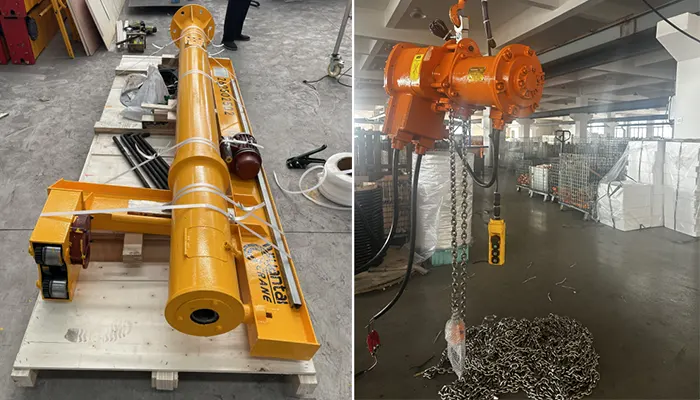
Dust Explosion Jib Crane, 2.15m + 60.45m Lift | Saudi Arabia
Content Quick Link
Project Overview of Dust Explosion-Proof Pillar Jib Crane with an Extended Lifting Height for Saudi Arabia
A customer in Saudi Arabia needed a freestanding pillar jib crane with an explosion-proof electric chain hoist for a dust-hazardous material-handling station. Two details set this order apart from a standard low-capacity jib crane:
- Dust explosion protection. The crane and hoist had to suit the site's classified dust-hazardous area, not just a "dusty" room.
- An unusual lifting-height figure. The specification records 2.15 m + 60.45 m. That figure had to be interpreted against the approved drawing and the actual operating arrangement before any hoist or mast could be selected.
One crane was supplied. Delivery was CIF, shipped LCL.
Project snapshot
| Parameter | Detail |
|---|---|
| Destination | Saudi Arabia |
| Crane type | Freestanding pillar jib crane |
| Hoist type | Dust explosion-proof electric chain hoist |
| Rated capacity | 0.2 ton |
| Lifting-height specification | 2.15 m + 60.45 m |
| Power supply | 480V / 60Hz / 3-phase |
| Quantity | 1 set |
| Delivery term | CIF |
| Shipping | LCL |
Application
A Dust-Hazardous Workplace
Where combustible dust is handled, airborne particles or settled deposits can form an explosive atmosphere under the right conditions. Whether that applies here depends on the site's own hazardous-area classification, not on the mere presence of dust. The crane package therefore had to be matched to that classification.
Before selecting equipment, four things had to be pinned down:
- The dust itself. What kind of dust, how fine, how readily it ignites, and whether layers build up on surfaces.
- The classified zone. Which parts of the crane — hoist, controls, cabling, push-button station — actually sit inside the hazardous area.
- Duty and frequency. How often the crane lifts, and whether the hoist runs continuously or intermittently.
- Power and access. The site supply (480V/60Hz/3-phase) plus how the crane would be installed and serviced.
The lifting-height figure: 2.15 m + 60.45 m
This is the part of the project that most needs explaining, and the part a generic product page would gloss over. A figure written as two dimensions is not automatically a total lifting height. It could describe:
Before selecting equipment, four things had to be pinned down:
- two separate elevations (for example, a lower and an upper load position),
- a hook travel plus a mounting or headroom dimension,
- or two reference points on the drawing with different meanings.
Treating 2.15 m + 60.45 m as a single 62.6 m lift would be an assumption, not a fact. Before the hoist or mast could be sized, the following had to be confirmed against the approved drawing:
- What each dimension references (floor, hook, beam, building level).
- The actual hook travel required.
- The highest and lowest load positions.
- Headroom above the crane and obstructions around it.
- Any intermediate operating levels.
Why a Freestanding Pillar Jib Crane
Three reasons made this crane type a fit for the job:
- It stands on its own. The pillar carries the jib and the load down to a foundation, so the crane does not depend on the building structure for support. That matters where roof or wall steel cannot take a jib bracket.
- It serves one spot well. A jib covers a defined working radius around a single workstation or process point — appropriate here, where lifting is localized rather than plant-wide.
- It separates lifting from positioning. The hoist does the vertical work; the jib arm and slew bearing do the horizontal positioning. Each part can be specified for its own job, including the explosion-proof rating on the hoist.
This is not a claim that a pillar jib suits every application. Its fit depends on the confirmed working radius, the lifting-height arrangement, the load path, and the foundation and installation constraints.
The Supplied Solution
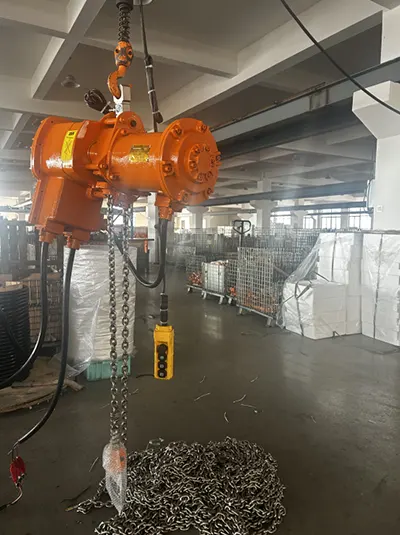
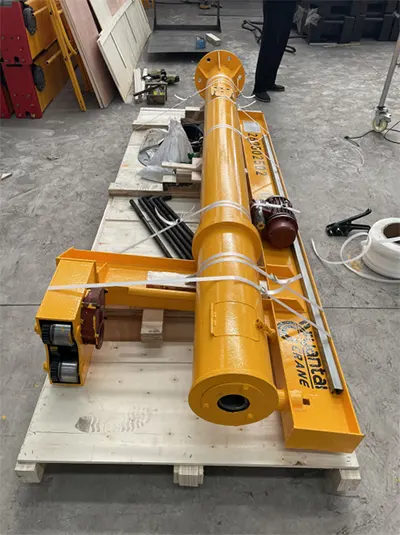
The crane was supplied as one integrated lifting arrangement: freestanding pillar + jib arm + slewing mechanism + explosion-proof electric chain hoist.
- Pillar — carries structural and operating loads into the foundation.
- Jib arm — supports the hoist and sets the working radius.
- Slewing mechanism — lets the operator position the load within the designed sector.
- Electric chain hoist — provides vertical lifting, built to the specified explosion-protection configuration.
Engineering Focus: Dust Explosion Protection
Dusty is not the same as explosive
A room full of dust is not automatically a classified hazardous area. The equipment protection level follows from the site's area classification and the dust's properties. Getting this backwards — buying "explosion-proof" gear for an unclassified area, or standard gear for a classified one — is the most common and most expensive mistake in this category.
What gets assessed
Depending on the approved design, the review covers:
- the hoist motor and its electrical assembly,
- the control station and electrical enclosure,
- cables and connections,
- any other component sitting inside the hazardous area.
Certification and temperature
The applicable hazardous-area classification, dust group, equipment protection level, maximum surface temperature, and required certification all had to be confirmed for this project. No specific Ex marking or certificate is stated here unless the project documents support it — and buyers should insist on the same discipline from any supplier.
Engineering Focus: The 2.15 m + 60.45 m Specification
Establish what each dimension means
Document the meaning of both figures before describing the crane as "high-lift" or quoting a total height. The approved drawing is the authority here, not the quotation table.
Verify hook travel and clearances
The engineering review should establish:
- required vertical hook travel,
- upper and lower hook positions,
- headroom and surrounding obstructions,
- load pickup and placement elevations,
- any intermediate operating levels.
Select the hoist and crane arrangement
Capacity, lifting height, duty, mounting arrangement, and available space have to be chosen together — changing one changes the others.
If 60.45 m turns out to be a genuinely long vertical lift, the case study should describe the hoisting arrangement used and the engineering it demands (chain length and stretch, guide arrangements, hook approach, reeving). If it is another elevation or an installation dimension, the article should say so plainly instead. Either way, the number gets explained, not repeated.
Electrical Configuration for Saudi Arabia
The specified supply is 480V / 60Hz / 3-phase. That single line drives several decisions, and they interact with the hazardous-area requirement:
- hoist motor and electrical ratings matched to 480V/60Hz,
- control-system requirements,
- explosion-proof electrical components on the classified side,
- protection and grounding,
- compatibility with the site's actual power.
Voltage and frequency are easy to state and easy to get wrong at the motor. The explosion-proof rating and the supply rating have to be satisfied by the same components, not traded off against each other.
Final Technical Specifications
| Parameter | Specification |
|---|---|
| Country | Saudi Arabia |
| Application | Dust-hazardous material handling |
| Crane type | Freestanding pillar jib crane |
| Hoist type | Explosion-proof electric chain hoist |
| Rated capacity | 0.2 ton |
| Lifting-height specification | 2.15 m + 60.45 m |
| Power supply | 480V / 60Hz / 3-phase |
| Quantity | 1 set |
To be added once confirmed: working radius, slewing angle, hoist speed, duty classification, certification, foundation data.
Manufacturing, Inspection, and Delivery
Manufacturing and assembly
Pillar and jib fabrication, structural welding and inspection, surface treatment, hoist installation, electrical assembly.
Inspection and testing
Operational testing, electrical inspection, load testing, and verification of explosion-proof components — limited to checks supported by project records.
FAQs: Dust Explosion-Proof Jib Crane with Extended Lifting Requirements
Why does a jib crane in a dust-hazardous area need explosion-proof equipment?
Where combustible dust creates a classified hazardous area, equipment must meet the applicable protection requirements to control ignition risk.
Can a 0.2-ton pillar jib crane be used in a dust-hazardous environment?
Potentially, yes. Capacity alone does not decide suitability — the area classification, hoist configuration, crane structure, and operating conditions all have to be verified.
What does 2.15 m + 60.45 m mean?
It has to be established from the approved drawing or technical specification. Confirm the reference points, the required hook travel, and the purpose of each dimension before treating the figures as a total lifting height.
What should be checked when a crane has an unusual lifting-height requirement?
Hook travel, headroom, load pickup and placement elevations, hoist compatibility, structural clearances, and the actual lifting arrangement.
Can a standard electric chain hoist go on an explosion-proof jib crane?
Not automatically. The hoist and the relevant electrical components must suit the classified area and the project's certification requirements.
What power supply was specified for this project?
480V / 60Hz / 3-phase.
What information is needed to quote an explosion-proof pillar jib crane?
Capacity, lifting height, working radius, slewing angle, hazardous-area classification, dust characteristics, required certification, voltage, frequency, phase, duty cycle, and installation conditions.
Engineering Takeaway
This Saudi Arabia project turns on two things that have to be solved together: dust explosion protection, and a lifting-height specification written as 2.15 m + 60.45 m. The supplied solution pairs a freestanding pillar jib crane with an explosion-proof electric chain hoist rated 0.2 ton and configured for 480V / 60Hz / 3-phase.
For buyers, the lesson is simple: confirm the hazardous-area requirements and the exact meaning of unusual lifting dimensions before finalizing the crane design. Both are cheap to check at quotation stage and expensive to fix after shipment.

Article by Bella ,who has been in the hoist and crane field since 2016. Bella provides overhead crane & gantry crane consultation services for clients who need a customized overhead travelling crane solution.Contact her to get free consultation.
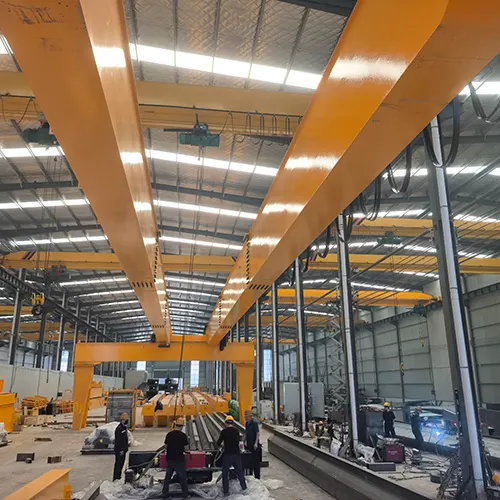


Yuantai Cranes
Overhead Crane Manufacturer with CE, ISO, SGS, CNEX Certificates.
- Main Specifications - Capacity: 0.5–550 tons | Span: up to 40m | Speed: 0.8–12 m/min | Duty: A3–A7 | Power: 380–690V, 50/60Hz | Control: pendant/remote/cabin
- Full engineering: FEA/PLC/VFD + in-house build + global delivery + on-site support, for workshops, factories, EPC contractors, industrial projects, etc.
- Support: design, manufacturing, testing, service – end-to-end, customized lifting solutions worldwide.
How to Get an Accurate Crane Price for Your Application?
Tips: Copy the spec list, fill in your details, and paste it into the form on the right/ down-below for a quick price.
- Crane type:_____ . (e.g., overhead crane, gantry crane, jib crane)
- Max weight to lift:_____ tons. (e.g., 2t, 5t, 10t, 20t, 50t)
- Lifting height:_____ m. (How high does the hook need to reach?
- Workshop width (span):_____ m . (Distance between the two crane rails)
- Travel distance:_____ m . (How long does the crane need to move along the runway?)
- Control type:_____. (Pendant / remote / cabin Control)
- Power supply:_____. (Local voltage & frequency – e.g., 380V, 50Hz, 3-phase)
- What will it be used for?_____ (e.g., steel fabrication, concrete products, mold handling, general manufacturing, etc.)
- Any special requirements?_____ (e.g., extreme temperature, dusty or explosive environment, special paint color, etc.)
Just leave a message via the contact form and our hoist and crane engineer will contact you with in 24working hours.
Get Your Custom Quote–Quick & Easy
Fill in what you know. Skip what you don't – we'll help.Any question will be reply with 24 working hours