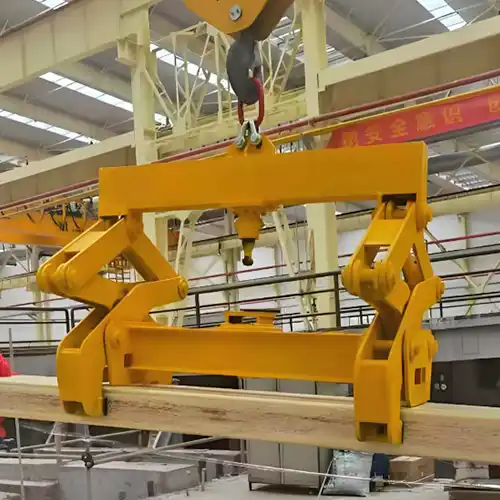
Comparing Mechanical vs. Motorized Slab Tongs for Industries
Compare mechanical and motorized slab tongs for efficiency, cost, performance, and suitability in various industrial environments and needs.
| Crane Type | Mechanical Slab Tongs: Simple & economical, with no separate power supply, for occasional or controlled slab handling.Motorized Slab Tongs: Powered gripping, better control & positionin, for frequent slab handling & demanding applications. |
| Crane Capacity | 1–100 ton+, customized according to slab weight, gripping method and load configuration |
| Span Length | Working Range_ Customized gripping width and lifting geometry according to slab dimensions, storage layout and crane hook arrangement |
| Lifting Height | Determined by the supporting crane or hoist; typically 6–30 m+ |
| Coverage Area Type | Steel production lines, casting bays, slab storage yards, rolling mills, workshops, warehouses, ports and outdoor material yards |
| Application | Steel slab handling, slab stacking, steel mills, rolling mills, foundries, ports, metal processing and heavy material handling |
| Certifications | CE / ISO / SGS / Other third-party inspection |
| Customization | Type: Mechanical / Motorized · Single Slab / Multiple Slabs · Operation: Self-Locking Mechanical / Electric Motorized · Environment: Steel Mill / Foundry / Outdoor / Dusty / Corrosive · Crane Interface: Hook / Hoist / Lifting Beam / Custom Suspension |
Crane Manufacturer: Yuantai Cranes – 30+ Years Professional Crane Manufacturer from China
Category: Featured
Tags: SlabHandling
Your Trusted Overhead Crane Manufacturer & Supplier
Comparing Mechanical vs. Motorized Slab Tongs for Industries
Compare mechanical and motorized slab tongs for efficiency, cost, performance, and suitability in various industrial environments and needs. Contact us to get your customized slab tongs and and slab handling crane for your needs.
Overview of Slab Tongs
Overview of Slab Tongs
Slab tongs are essential lifting tools used in industries like steel mills to handle large, heavy slabs of metal. They are designed to securely grip and lift these slabs, which are typically used in manufacturing processes. The tongs are attached to cranes or hoists, allowing operators to move slabs across different areas of the workshop or mill.
There are two main types of slab tongs: mechanical and motorized. Each has distinct features and is suited for different operational needs. Mechanical tongs are manually operated, while motorized tongs use powered mechanisms for lifting and handling. The choice between these two types can impact the efficiency and safety of an industrial operation.
Importance of Choosing the Right Slab Tongs
The decision between mechanical and motorized slab tongs is more than just a preference—it affects several key factors in an industrial operation:
- Efficiency: The right slab tongs will streamline the lifting process, reducing delays and improving overall productivity.
- Cost: Mechanical tongs are usually cheaper initially, but motorized tongs may offer better long-term value due to their automation, reducing labor and boosting efficiency.
- Safety: Handling large slabs of metal can be dangerous. Choosing the right tongs ensures greater control and precision, reducing the risk of accidents during operation.

Mechanical Slab Tongs
Definition and Functionality
Mechanical slab tongs are manually operated tools used to lift and move heavy metal slabs. These tongs are designed with a gripping mechanism that locks onto the slab when the operator engages it. Once secured, the tongs are lifted by a crane or hoist, allowing the slab to be transported across the mill or workshop.
Mechanical tongs rely on simple mechanical principles, such as springs, levers, and hooks. There is no motorized or powered assistance, which means the operator controls the movement entirely through manual effort.
Key Features
- Simplicity: Mechanical tongs have a straightforward design, making them easy to operate and understand.
- Cost-Effectiveness: Due to their simple construction, mechanical tongs are typically more affordable than motorized options.
- Maintenance Requirements: These tongs have fewer components and do not rely on electrical or powered systems, so they are easier and cheaper to maintain.
Manual Operation vs. Powered Assistance
Mechanical slab tongs do not require any powered assistance. They depend on the operator's ability to handle the tongs manually, which makes them more labor-intensive but less complex in terms of operation and maintenance.
Pros
- Lower Upfront Cost: Mechanical slab tongs are less expensive than motorized alternatives, making them a budget-friendly choice for businesses with tight budgets.
- Simple Design and Fewer Components: With fewer parts that can break down, mechanical tongs are easier to maintain and repair.
- Lower Maintenance Costs: Because they have no complex electrical or motorized systems, the cost of maintaining mechanical tongs is generally lower.
- Suitable for Lighter Loads and Controlled Environments: Mechanical tongs work well for lighter slabs or in settings where heavy lifting is not required.
Cons
- Requires More Labor and Human Effort: Since these tongs rely on manual operation, they demand more physical labor from the operator. This can increase fatigue and the need for more workers.
- Limited Precision and Flexibility: Mechanical tongs offer less control over the lifting process, leading to potential handling challenges in complex or precise tasks.
- Potential for Higher Wear and Tear Over Time: Frequent use can lead to faster wear on the mechanical components, potentially reducing the lifespan of the tongs and increasing repair needs.
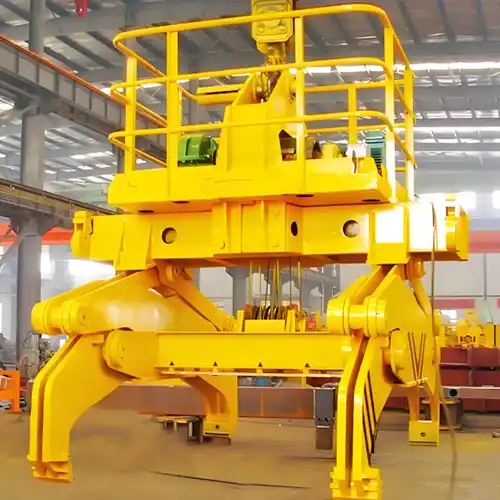
Motorized Slab Tongs
Definition and Functionality
Motorized slab tongs are powered lifting devices designed to handle large metal slabs with more precision and ease than mechanical tongs. These tongs use motors to open and close the gripping mechanism, allowing for more controlled and automated lifting. The motorized system is typically operated by a control panel or remote, enabling the operator to handle slabs without much manual effort.
Motorized slab tongs are designed to work with cranes or hoists, where the power source controls the gripping and lifting mechanism. These tongs can adjust their gripping force and handling speed, which provides more accuracy in high-demand environments.
Key Features
- Powered Lifting: The motorized system drives the lifting and handling process, reducing the need for manual effort.
- Enhanced Precision: Motorized tongs offer more control over how slabs are gripped and lifted, allowing for smoother operations and fewer errors.
- Automation Capabilities: Some motorized slab tongs include automation features, such as sensors and programmable controls, which can increase efficiency and reduce human error.
Pros
- Increased Efficiency: Motorized slab tongs can lift and move slabs faster than mechanical tongs, improving productivity and reducing downtime.
- Reduced Labor Costs: Because the system is powered, operators can move slabs with less effort, reducing the need for extra labor.
- Greater Lifting Capacity: Motorized tongs are often built to handle heavier loads, making them suitable for large or thick slabs.
- Precision in Handling and Ease of Use: With motorized controls, these tongs provide smoother, more precise handling, improving safety and accuracy in operations.
- Capability to Handle Heavier Loads and Higher Frequency Operations: These tongs are designed for continuous use in high-frequency environments, making them ideal for industries that require rapid and frequent slab movement.
Cons
- Higher Initial Cost: Motorized slab tongs are more expensive upfront due to the complexity of the motorized systems and automation features.
- Requires More Complex Maintenance and Potential Downtime for Repairs: These tongs rely on motors and electrical components, which means they require more regular maintenance and can be more prone to breakdowns.
- Dependence on Power Sources and Systems: Motorized tongs depend on electrical power or hydraulics to function. If there is an issue with the power source or system, it can lead to operational delays or stoppages.
Key Comparison Factors
Cost Considerations
Upfront Cost Differences:
- Mechanical Slab Tongs: These tend to be more affordable at the start, with lower purchase prices. Their simple design and manual operation contribute to their lower cost.
- Motorized Slab Tongs: The initial cost is higher due to the complexity of the motorized components and automation features. While the upfront investment is greater, these tongs offer higher productivity, which can justify the cost in larger operations.
Long-Term Operational Costs:
- Mechanical Slab Tongs: Generally, these have lower long-term operational costs since there are fewer components and no need for electrical power. However, they may require more labor and higher maintenance over time as they can wear out faster.
- Motorized Slab Tongs: While they have higher maintenance costs due to motors and electronics, their ability to reduce labor costs and improve efficiency can offset these expenses. Energy consumption also needs to be factored into long-term costs, but this is usually outweighed by the increased productivity.
Complexity and Ease of Operation
Level of Training and Expertise Needed:
- Mechanical Slab Tongs: These require minimal training. Operators only need to know how to manually operate the gripping mechanism, which is fairly straightforward and easy to learn.
- Motorized Slab Tongs: These require more specialized training. Operators need to understand how to control the powered system and respond to automated features. While the tongs are easy to use once trained, initial training can be time-consuming.
Ease of Handling and Operational Flexibility:
- Mechanical Slab Tongs: Manual operation can be more cumbersome, requiring more physical effort from the operator. There is less flexibility in handling, and operators must adjust to each lifting situation.
- Motorized Slab Tongs: Powered operation makes handling slabs smoother and more efficient. These tongs can handle different types of loads with more flexibility and precision, reducing human effort and improving control over various lifting tasks.
Performance and Efficiency
Speed, Precision, and Lifting Capacity Comparison:
- Mechanical Slab Tongs: These are generally slower, as they rely on manual effort and less controlled mechanisms. Their lifting capacity is lower compared to motorized tongs, and precision may not be as high, especially in more complex operations.
- Motorized Slab Tongs: Motorized tongs offer faster lifting and better precision. They can handle heavier loads with greater ease and are typically more efficient in high-frequency operations. The ability to adjust the grip and speed allows for a smoother and faster process.
How Each System Affects Overall Production Time and Throughput:
- Mechanical Slab Tongs: Their slower lifting process and manual operation can lead to longer turnaround times and potentially lower throughput. They are best suited for less demanding operations where high volumes aren’t the main focus.
- Motorized Slab Tongs: These are designed for high efficiency and continuous use, which results in faster production times and higher throughput. They help reduce downtime and improve overall operation speed.
Safety and Risk Factors
Safety Features of Mechanical vs. Motorized Slab Tongs:
- Mechanical Slab Tongs: The simplicity of mechanical tongs means fewer safety features. However, they may offer less risk in terms of electrical failures. They do require more physical labor, which could lead to worker fatigue or injuries over time.
- Motorized Slab Tongs: Motorized tongs usually include more safety features, such as automatic safety stops, overload protection, and better precision in lifting. However, they come with the risk of electrical issues or mechanical failures that could affect safety.
Risk Management in Terms of Accidents, Damage, and Wear:
- Mechanical Slab Tongs: The risk of accidents in mechanical systems stems from human error, fatigue, or improper handling. Over time, parts can wear out and cause damage to both the tongs and the slab.
- Motorized Slab Tongs: These systems reduce the risk of human error by automating some parts of the operation, but failures in the motor or control system can lead to unexpected accidents. Regular maintenance can reduce these risks.
Maintenance and Durability
Long-Term Reliability and Maintenance Demands:
- Mechanical Slab Tongs: These require regular maintenance, especially the moving parts. While they have fewer components, they wear out more quickly, leading to potential downtime. They are also more vulnerable to damage from rough handling.
- Motorized Slab Tongs: Motorized tongs require more complex maintenance due to their electrical and mechanical components. They need regular servicing, including checks on the motor, power supply, and automation features. However, they tend to be more durable for long-term, heavy-duty use.
Impact on Operations During Maintenance or Repairs:
- Mechanical Slab Tongs: Maintenance downtime is typically shorter and easier to manage. However, wear and tear could affect their reliability over time, leading to more frequent repairs.
- Motorized Slab Tongs: When motorized tongs require maintenance, it can result in longer downtime due to the complexity of the repair. But, since they are generally more durable, the overall need for repairs might be less frequent, especially in high-demand environments.
| Key Factor | Mechanical Slab Tongs | Motorized Slab Tongs |
|---|---|---|
| Cost Considerations | ||
| Upfront Cost | Lower initial cost due to simpler design and manual operation. | Higher initial cost because of motorized parts and automation. |
| Long-Term Costs | Lower operational costs, but more labor and maintenance needed over time. | Higher maintenance costs, but saves on labor and boosts efficiency. |
| Complexity and Ease of Use | ||
| Training Needed | Simple to use with minimal training. | Requires special training for handling powered systems. |
| Ease of Use | More physical effort required and less flexibility. | Easier to handle with less effort and more control over different loads. |
| Performance and Efficiency | ||
| Speed, Precision, and Capacity | Slower, less precise, and can lift lighter loads. | Faster, more precise, and can lift heavier loads with better control. |
| Production Speed | Slower production with lower throughput. Best for small-scale jobs. | Faster production with higher throughput, ideal for high-demand environments. |
| Safety and Risk Factors | ||
| Safety Features | Fewer safety features, but no risk of electrical failures. Requires more manual effort, which could lead to fatigue. | More safety features like automatic stops and overload protection, but risk of motor failures. |
| Risk of Accidents/ Wear | Higher risk from human error or fatigue, parts wear out more quickly. | Less human error risk due to automation, but motor failures can cause accidents. |
| Maintenance and Durability | ||
| Maintenance Needs | Requires regular maintenance and can wear out quickly. | Needs more complex maintenance but lasts longer with less frequent repairs. |
| Impact of Repairs | Short downtime for repairs but more frequent repairs due to wear. | Longer downtime for repairs, but repairs are less frequent. |
Suitability for Different Industrial Needs
Heavy-Duty Applications
For high-lifting capacities and heavy industrial environments, motorized slab tongs are generally the better choice. These tongs can handle larger, heavier slabs with more ease and precision. Their powered system provides the strength and control needed to lift extremely heavy loads safely, making them ideal for steel mills, foundries, and other heavy-duty operations where large slabs are handled regularly.
Advantages of Motorized Tongs for Heavy-Duty Use:
- Higher lifting capacity
- Better control and precision for large loads
- Reduced physical labor required
- Suitable for high-frequency lifting tasks without compromising safety or performance
Low to Medium Capacity Operations
In smaller or less demanding environments, mechanical slab tongs may still be the preferred choice. For operations that don’t require heavy lifting or frequent handling of large slabs, mechanical tongs can do the job effectively and at a lower cost. These environments might include small workshops, lighter metal processing tasks, or controlled settings where efficiency and precision aren’t as critical.
Why Mechanical Tongs Work in Low to Medium Capacity Operations:
- Lower upfront cost
- Simpler design and operation
- Sufficient lifting capacity for lighter materials or occasional use
- Less need for advanced features or automation
Fast-Paced or High-Frequency Operations
When operations require constant or high-frequency lifting and transport of slabs, motorized slab tongs are the better option. The ability to automate and power the lifting process ensures that slabs can be moved quickly and efficiently, reducing the need for manual labor and speeding up production times. These systems excel in environments like high-production steel mills, manufacturing lines, or foundries, where time is a critical factor.
Why Motorized Tongs Are Ideal for Fast-Paced Operations:
- Higher speed and efficiency in lifting and moving slabs
- Reduced physical strain on operators, allowing for continuous operation
- Greater flexibility in handling various sizes and weights of slabs
- Automation capabilities that support continuous operations without delays
Cost-Conscious Operations
In businesses where budget constraints are a significant consideration, mechanical slab tongs may be the more budget-friendly option. While motorized tongs provide more advanced features, the initial investment in mechanical tongs is much lower. For small to medium operations where automation and heavy lifting are not the main focus, mechanical tongs provide an affordable and reliable solution.
Why Mechanical Tongs Are a Good Fit for Cost-Conscious Operations:
- Lower initial purchase cost
- Minimal maintenance and repair costs
- Simple to operate with little need for specialized training
- Ideal for low-demand, low-frequency operations where budget constraints are key
Conclusion
To summarize the main differences between mechanical and motorized slab tongs:
- Mechanical Slab Tongs are simpler, more affordable, and easier to maintain. They are best suited for low to medium capacity operations and environments where heavy lifting is not a frequent need. However, they require more manual effort and may have limitations in speed and precision.
- Motorized Slab Tongs offer enhanced efficiency, higher lifting capacities, and better precision. They are ideal for high-frequency, fast-paced, or heavy-duty operations, but they come with higher initial costs and more complex maintenance needs.
The choice between mechanical and motorized tongs hinges on factors like lifting capacity, production speed, cost considerations, and maintenance requirements.
Final Recommendation
- For high-capacity, fast-paced operations, and those seeking improved efficiency and precision, motorized slab tongs are the better choice. They are designed to handle heavy loads and high-frequency tasks, making them ideal for large-scale industrial settings.
- For smaller, less demanding environments, where budget constraints are a concern, mechanical slab tongs provide an affordable and reliable solution. They work well for light-duty operations and settings where less frequent lifting is required.
Businesses should evaluate their specific lifting needs, production volume, and budget to select the system that will best enhance efficiency and safety while minimizing operational costs.
Slab Tong Selection Guide: Mechanical vs. Motorized
Choose mechanical tongs for simple handling; choose motorized tongs when you need powered gripping, frequent operation, or better control. The choice depends on slab weight and dimensions, gripping position and range, handling frequency, required operator control, slab temperature, and existing crane and hook arrangement. Mechanical tongs have a simpler gripping mechanism and are usually easier to maintain. Motorized tongs use a powered mechanism and can be operated from a pendant, radio remote, or control system.
1. How do I choose between mechanical and motorized slab tongs?
Choose mechanical tongs for simple handling; choose motorized tongs when you need powered gripping, frequent operation, or better control.
The choice depends on:
- Slab weight and dimensions
- Gripping position and range
- Handling frequency
- Required operator control
- Slab temperature
- Existing crane and hook arrangement
Mechanical tongs have a simpler gripping mechanism and are usually easier to maintain. Motorized tongs use a powered mechanism and can be operated from a pendant, radio remote, or control system.
2. Are mechanical slab tongs suitable for heavy steel slabs?
Yes. Mechanical slab tongs can handle heavy steel slabs when the tong is designed for the actual load and gripping conditions.
Tong capacity is not determined by the operating method alone. The design must consider:
- Slab weight
- Slab length, width, and thickness
- Gripping force
- Jaw design
- Load distribution
- Contact surface
- Slab temperature
- Handling frequency
For heavy slabs, provide the actual slab dimensions and weight before selecting the tong.
3. When should I buy motorized slab tongs?
Motorized slab tongs make sense when slabs are handled frequently or the operator needs powered gripping and repeatable control.
They are a good fit for production lines, steel plants, and other operations where the tong opens and closes many times during a shift.
Motorized tongs can also be connected to pendant controls, radio remote controls, or PLC systems. This can reduce manual gripping work and make repeated handling easier to control.
For occasional slab handling, a mechanical tong may be the simpler and lower-cost choice.
4. How much do mechanical and motorized slab tongs cost?
Mechanical slab tongs normally cost less than motorized models because the gripping mechanism is simpler.
A basic mechanical slab tong may start at around US$2,000, while customized or motorized models can cost much more.
The final price depends on:
- Tong capacity
- Slab dimensions
- Gripping range
- Mechanical or motorized operation
- Operating temperature
- Control system
- Duty cycle
- Customization
For a useful quotation, suppliers need the actual slab and operating data rather than the required tong capacity alone.
5. Can slab tongs be customized for my crane and slab dimensions?
Yes. Slab tongs can be designed to match the slab dimensions, gripping position, load, temperature, and crane hook arrangement.
Common customization includes:
- Slab weight and size
- Gripping width and range
- Single or multiple slab handling
- Mechanical or motorized gripping
- High-temperature operation
- Hook connection
- Lifting beam connection
- Pendant, radio remote, or PLC control
The tong should be checked against the existing crane hook and lifting arrangement before production.
6. What information do I need to request a slab tong quotation?
Provide the slab weight, length, width, thickness, temperature, gripping position, handling frequency, and crane hook information.
Also provide:
- Number of slabs handled at one time
- Required gripping range
- Crane capacity
- Hook type and dimensions
- Lifting height
- Operating environment
- Required control method
- Photos or drawings of the slab and crane hook
This information allows the supplier to select the tong capacity, gripping mechanism, and crane connection correctly.
Quick Buying Guide
| Your application | More suitable choice |
|---|---|
| Occasional slab handling | Mechanical slab tong |
| Simple lifting and gripping | Mechanical slab tong |
| Frequent production handling | Motorized slab tong |
| Remote gripping required | Motorized slab tong |
| PLC or automated handling | Motorized slab tong |
| High-temperature slabs | Mechanical or motorized, depending on design |
| Special slab dimensions | Customized tong |

Yuantai Cranes
Overhead Crane Manufacturer with CE, ISO, SGS, CNEX Certificates.
- Main Specifications - Capacity: 0.5–550 tons | Span: up to 40m | Speed: 0.8–12 m/min | Duty: A3–A7 | Power: 380–690V, 50/60Hz | Control: pendant/remote/cabin
- Full engineering: FEA/PLC/VFD + in-house build + global delivery + on-site support, for workshops, factories, EPC contractors, industrial projects, etc.
- Support: design, manufacturing, testing, service – end-to-end, customized lifting solutions worldwide.
How to Get an Accurate Crane Price for Your Application?
Tips: Copy the spec list, fill in your details, and paste it into the form on the right/ down-below for a quick price.
- Crane type:_____ . (e.g., overhead crane, gantry crane, jib crane)
- Max weight to lift:_____ tons. (e.g., 2t, 5t, 10t, 20t, 50t)
- Lifting height:_____ m. (How high does the hook need to reach?
- Workshop width (span):_____ m . (Distance between the two crane rails)
- Travel distance:_____ m . (How long does the crane need to move along the runway?)
- Control type:_____. (Pendant / remote / cabin Control)
- Power supply:_____. (Local voltage & frequency – e.g., 380V, 50Hz, 3-phase)
- What will it be used for?_____ (e.g., steel fabrication, concrete products, mold handling, general manufacturing, etc.)
- Any special requirements?_____ (e.g., extreme temperature, dusty or explosive environment, special paint color, etc.)
Just leave a message via the contact form and our hoist and crane engineer will contact you with in 24working hours.
Get Your Custom Quote–Quick & Easy
Fill in what you know. Skip what you don't – we'll help.Any question will be reply with 24 working hours