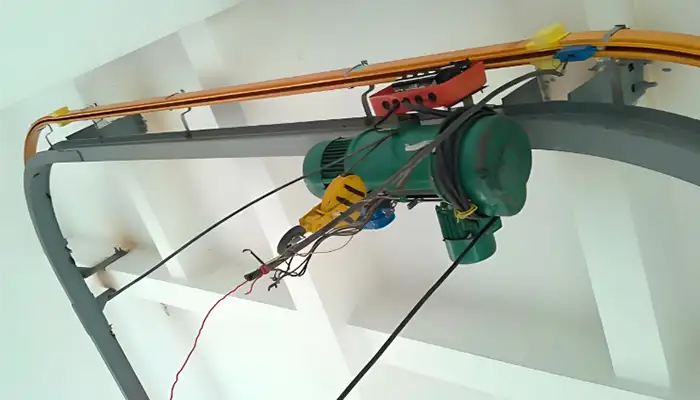
MD1 Electric Hoist on Curved Rails: Unlocking Tonnage, Rail Types, and Turning Radii
Content Quick Link
The MD1 Electric Hoist is a versatile lifting solution designed for efficient material handling in various industrial settings. Known for its robust construction and reliability, this electric hoist can handle a range of tonnages, making it suitable for different applications. It operates smoothly on curved or straight tracks, ensuring flexibility in movement. The MD1 Electric Hoist is particularly popular in manufacturing environments where space optimization and the ability to navigate turns are crucial. Its compatibility with various crane types, such as single-girder cranes and gantry cranes, enhances its utility, allowing it to adapt to specific operational needs.
Importance of Understanding Tonnage, Rail Types, and Turning Radii
The interplay between tonnage, rail types, and turning radii is essential for selecting the right electric hoist and ensuring optimal performance. Tonnage refers to the weight capacity the hoist can safely lift. Choosing a hoist that matches the load requirements of your specific application is vital to prevent accidents and equipment failure.
Rail types significantly affect the operational efficiency of the hoist. The MD1 Electric Hoist can be installed on various rail systems, including U-shaped tracks and I-beam tracks. Each type of rail is designed to accommodate specific weight capacities and operating conditions, making it crucial to select the appropriate rail for your hoist. For instance, U-shaped tracks are ideal for lower tonnages, while I-beam tracks can support heavier loads.
Turning radii also play a significant role in the performance of the MD1 Electric Hoist. The turning radius is the minimum distance required for the hoist to navigate a turn on the track. A smaller turning radius allows for more compact and efficient operation in confined spaces, which is often necessary in factory settings. Understanding the turning radius associated with different tonnages and rail types ensures that your lifting equipment operates smoothly and prevents derailment, enhancing safety and efficiency in your operations.
By grasping these fundamental concepts, operators and decision-makers can make informed choices that maximize the effectiveness of the MD1 Electric Hoist, ensuring it meets the specific demands of their operational environment.

curved rail or track monorail electric hoist
Overview of MD1 Electric Hoists
Description and Features of the MD1 Electric Hoist
The MD1 Electric Hoist is a compact and powerful lifting device designed for a variety of industrial applications. It is known for its robust construction, which ensures durability and long service life even in demanding environments. Key features of the MD1 Electric Hoist include:
- Load Capacity: The MD1 Electric Hoist is available in multiple tonnages, allowing it to handle loads ranging from 0.25 tons to 32 tons. This versatility makes it suitable for various tasks, from light material handling to heavy-duty lifting.
- Compact Design: Its compact design enables it to operate in tight spaces, making it an ideal choice for factories, workshops, and warehouses. The hoist's low profile allows it to fit into areas with limited headroom.
- Curved and Straight Track Compatibility: The MD1 Electric Hoist is compatible with both curved U-shaped tracks and straight I-beam tracks. This flexibility allows for efficient movement along complex paths, enhancing workflow in production lines.
- Safety Features: Safety is a top priority with the MD1 Electric Hoist. It is equipped with overload protection mechanisms to prevent lifting beyond its rated capacity, ensuring the safety of both the equipment and operators. Additionally, the hoist may feature emergency stop buttons and limit switches for enhanced operational safety.
- Ease of Operation: The hoist is designed for user-friendly operation. It typically comes with a simple control panel, allowing operators to lift and lower loads with ease. Some models may offer remote control options, further improving accessibility and safety.
- Versatility in Applications: The MD1 Electric Hoist is suitable for a wide range of applications, including assembly lines, mechanical mold processing, and maintenance operations. Its adaptability makes it a valuable asset in various industrial sectors.
Types of Installation Methods: Fixed vs. Suspended
When considering the installation of the MD1 Electric Hoist, understanding the two primary methods—fixed and suspended—is essential for optimizing its performance in specific environments.
Fixed Installation:
Definition: Fixed installation involves securely mounting the MD1 Electric Hoist to a stationary structure, such as a ceiling beam or a dedicated support framework. This method ensures that the hoist remains in a fixed position, providing stable lifting capabilities.
Advantages:
- Stability: Fixed installations provide a robust support system, minimizing vibrations and enhancing load stability during lifting operations.
- Permanent Setup: This installation method is ideal for operations that require frequent lifting of similar loads in the same location, allowing for efficiency and consistency in material handling.
- Space Optimization: Fixed hoists can be installed at optimal heights, allowing for better use of vertical space in the facility.
- Considerations: Ensure that the mounting structure can safely support the weight of the hoist and the loads being lifted. Regular inspections should be conducted to maintain safety standards.
Suspended Installation:
Definition: Suspended installation involves hanging the MD1 Electric Hoist from a beam or track system, allowing it to move freely along the length of the track. This method provides increased flexibility in the workspace.
Advantages:
- Mobility: The suspended installation allows the hoist to cover a larger area, making it suitable for tasks that require moving materials from one location to another within a facility.
- Adaptability: Operators can easily reposition the hoist as needed, accommodating different lifting tasks without the need for permanent changes to the facility layout.
- Efficiency: This setup can enhance workflow efficiency by enabling quick transitions between lifting operations in different areas.
- Considerations: Ensure that the suspension system is properly designed and installed to handle the dynamic loads during operation. Regular maintenance checks should be performed to ensure that all components remain secure and functional.
By understanding the features of the MD1 Electric Hoist and the implications of different installation methods, operators can make informed decisions that maximize the efficiency and safety of their lifting operations.
The Role of Tonnage
Importance of Tonnage in Selecting Hoists
Tonnage is a crucial factor when selecting electric hoists, as it directly impacts the hoist's performance and suitability for specific lifting tasks. The tonnage rating indicates the maximum weight the hoist can safely lift, and understanding this capacity is essential for ensuring operational safety and efficiency. Here are some key reasons why tonnage matters:
- Safety Assurance: Selecting a hoist with the appropriate tonnage rating is vital for preventing accidents and injuries. Overloading a hoist beyond its rated capacity can lead to mechanical failures, compromising the safety of operators and nearby personnel.
- Optimized Performance: Using a hoist that matches the load requirements enhances operational efficiency. A hoist with insufficient capacity may struggle to lift the intended loads, resulting in increased wear and tear, reduced lifespan, and potential breakdowns.
- Cost-Effectiveness: Choosing the correct tonnage can also lead to cost savings. A hoist that is too large may incur unnecessary expenses, both in terms of initial investment and ongoing operational costs, such as energy consumption and maintenance.
- Compliance with Regulations: Many industries have regulations regarding load capacities for lifting equipment. Selecting a hoist with the correct tonnage ensures compliance with safety standards and reduces the risk of regulatory violations.
How Tonnage Affects the Choice of Rail Type
The tonnage of an electric hoist significantly influences the type of rail system used, as different loads require specific rail designs to ensure stability and safety. Here's a breakdown of how tonnage affects rail type selection, along with examples of specific tonnage capacities and their corresponding rail types:
0.25-ton U-shaped Track Model (16-22b):
- Turning Radius: 0.8 meters
- Rail Type: U-shaped tracks are suitable for lighter loads, providing a compact solution for limited spaces.
0.5-ton Curved Track Model (16-28b):
- Turning Radius: 1.5 meters
- Rail Type: This model utilizes a curved track that accommodates more complex lifting paths while maintaining stability.
1-ton Curved Track Model (16-28b):
- Turning Radius: 1.5 meters to 4 meters
- Rail Type: Curved tracks for this tonnage allow for versatile operation while handling moderate loads effectively.
2-ton U-shaped I-Beam Track Model (22a-32c):
- Turning Radius: 2 meters to 3 meters
- Rail Type: I-beam tracks offer enhanced structural integrity for heavier loads, providing stability during operation.
3-ton Curved Track Model (22a-32c):
- Turning Radius: 2 meters to 4 meters
- Rail Type: Curved tracks designed for 3-ton capacities provide flexibility for maneuvering around obstacles while supporting heavier loads.
5-ton U-shaped Runway Model (16-28b):
- Turning Radius: 2.5 meters to 5 meters
- Rail Type: The U-shaped design is effective for heavier loads, allowing for smoother operation and minimizing wear on the rail.
10-ton U-shaped Guide Rail Model (16-28b):
- Turning Radius: 2.5 meters to 7.5 meters
- Rail Type: Heavier loads necessitate robust rail systems, and the U-shaped guide rail provides the necessary support and stability for effective operation.
The role of tonnage is essential when selecting MD1 Electric Hoists and corresponding rail types. By considering the specific lifting requirements and the relationship between load capacity and rail design, operators can ensure safe and efficient lifting operations tailored to their unique industrial needs.

Rail Types for MD1 Electric Hoists
Overview of Common Rail Types Used with MD1 Electric Hoists
When selecting rail systems for MD1 Electric Hoists, understanding the various rail types and their installation requirements is essential. Here are the primary options:
U-Shaped Tracks
U-shaped tracks are ideal for compact installations and lighter loads. Their design provides stability and ensures smooth operation for electric hoists, particularly in confined spaces.
- Installation Requirements: These tracks must be securely mounted and leveled to guarantee safe operation. Proper alignment is crucial to prevent derailment during operation.
- Compatibility: U-shaped tracks are suitable for smaller tonnage hoists (e.g., 0.25-ton to 5-ton models) and can be paired with special curved running trolleys for smoother turns.
I-Beam Tracks
I-beam tracks are designed for larger capacities and heavy-duty applications. Their robust construction effectively supports higher tonnages.
- Installation Requirements: Installation involves securing the beams to a solid support structure and ensuring proper alignment. These beams can accommodate both straight and curved paths for electric hoists.
- Compatibility: Commonly used with heavier models (e.g., 10-ton and above), I-beam tracks provide stability and reduce the risk of flexing under heavy loads.
Curved Tracks
Curved tracks facilitate maneuvering around obstacles and optimizing space. They can be constructed as U-shaped or I-beam tracks, depending on load requirements.
- Installation Requirements: Curved tracks require precise measurements to ensure correct turning radii and smooth transitions for the hoist. Attention to detail is essential during installation to maintain safety.
- Compatibility: Suitable for various tonnage hoists, curved tracks allow flexibility in design and functionality.
Selection Criteria for Rail Types Based on Tonnage
Choosing the right rail type for MD1 Electric Hoists involves evaluating several factors, including tonnage and turning radius requirements. Below is a breakdown of the turning radii for different hoist capacities:
Turning Radii for Square Wire Rope Electric Hoists
When selecting square wire rope electric hoists, it's essential to consider the turning radii available for various models. These radii influence the hoist's maneuverability and operational efficiency, especially in tight spaces.
- For the 16-ton U-shaped track, the available turning radius options are varied, ranging from 3 meters to 7.2 meters. Specifically, the options include 3 meters, 3.6 meters, 4.8 meters, 6 meters, and 7.2 meters. These choices provide flexibility in installation and operation, allowing for efficient movement in different work environments.
- The 20-ton circular track offers similar versatility with its turning radius options. Available radii include 3.2 meters, 3.7 meters, 4.9 meters, 6.1 meters, and 7.3 meters. This range ensures that operators can select the appropriate radius based on their specific operational needs and spatial constraints.
- For the HC square electric hoist, the 25-ton curved track presents turning radius options of 3.2 meters, 3.8 meters, 5 meters, 6.2 meters, and 7.4 meters. This variety enhances maneuverability, making it suitable for applications that require navigating around obstacles.
- Finally, the HC square electric hoist 32-ton curved track also provides multiple turning radius options, including 3.3 meters, 3.8 meters, 5 meters, 6.2 meters, and 7.4 meters. This adaptability is crucial for accommodating different operational layouts and ensuring smooth operation within industrial environments.
Overall, understanding the available turning radii for these electric hoists is vital for selecting the right model to meet specific lifting requirements and maximize operational efficiency.
Important Notice: For practical use, please consult the electric hoist manufacturer and supplier. Additionally, note that using the MD1 electric hoist on U-shaped tracks requires a special curved running trolley. This configuration ensures smoother and more stable operation during turns, preventing derailment. Understanding the available turning radii for these electric hoists is vital for selecting the right model to meet specific lifting requirements and maximize operational efficiency.
Turning Radii Explained
Turning Radii and Their Significance in Operations
Turning radii refer to the minimum distance required for an electric hoist to make a turn. This measurement is crucial in defining how effectively a hoist can maneuver within a given workspace. A smaller turning radius allows for greater flexibility, enabling the hoist to operate efficiently in confined areas or around obstacles. Understanding turning radii is vital for optimizing workflows, especially in industrial environments where space is often limited.
Factors Influencing Turning Radii
Several factors affect the turning radii of electric hoists, including:
- Tonnage: The weight capacity of the hoist can directly influence its turning radius. Heavier hoists may require larger radii to maintain stability during turns, ensuring that the load is safely supported throughout the maneuver.
- Rail Types: Different rail configurations (such as U-shaped and I-beam tracks) can affect how a hoist navigates curves. The design of the rail impacts the overall performance of the hoist, especially during turns.
- Hoist Design: The engineering and design of the hoist, including its center of gravity and wheel configuration, play a significant role in determining the turning radius. A well-designed hoist will enable smoother transitions during operation.
Importance of Using a Special Curved Running Trolley for MD1 Electric Hoists
For MD1 electric hoists, utilizing a special curved running trolley is essential for optimal performance on U-shaped tracks. This specific trolley is designed to enhance stability and ensure a smooth operation while navigating turns.
- Impact on Stability: The curved running trolley helps distribute the load more evenly, reducing the risk of tipping or derailment during turns. This stability is especially important when handling heavier loads, where maintaining balance is critical.
- Smooth Operation: A properly configured curved running trolley minimizes friction and wear on the tracks, allowing for smoother transitions. This functionality leads to improved efficiency in operations and enhances the lifespan of the hoist and rail system.
In conclusion, understanding turning radii and their influencing factors is crucial for selecting the right electric hoist and ensuring safe and efficient operations. The implementation of a special curved running trolley for MD1 electric hoists further enhances stability and smoothness, particularly when navigating tighter turning radii on U-shaped tracks.
Applications of MD1 Electric Hoists
Suitable Environments and Industries
MD1 electric hoists are versatile tools that find applications across various industries, thanks to their adaptability and efficiency. Below are some key environments where MD1 electric hoists excel:
- Factory Assembly Lines:
MD1 electric hoists are widely used in factory assembly lines for their ability to facilitate the smooth and efficient movement of components. They help streamline workflows by lifting and positioning parts with precision, significantly enhancing productivity. The hoists can be integrated with U-shaped tracks to navigate complex assembly setups effectively. - Shot Blasting Machines:
In the shot blasting industry, MD1 electric hoists play a crucial role in handling heavy machinery and equipment. They are designed to withstand the rigorous demands of shot blasting operations, providing the necessary lifting power while ensuring reliability and safety. Their turning radii capabilities allow for maneuverability in tight spaces, making them ideal for this application. - Mechanical Mold Processing:
The use of MD1 electric hoists in mechanical mold processing is critical for moving heavy molds and components with ease. These hoists provide the strength and precision required to handle intricate molds safely. Their ability to operate on curved tracks enhances flexibility, allowing for efficient movement within mold production facilities. This application is particularly beneficial in industries such as automotive manufacturing, where precision and efficiency are paramount.
Overall, the adaptability of MD1 electric hoists makes them a preferred choice across various sectors, ensuring that lifting operations are performed safely and efficiently in diverse industrial environments.
Conclusion
In summary, understanding the interplay between tonnage, rail types, and turning radii is essential for optimizing the performance of MD1 electric hoists. Tonnage determines the selection of appropriate rail types, with specific models designed to accommodate different load capacities. Each tonnage category corresponds to distinct turning radii, influencing how the hoist navigates curves and corners within operational environments. By selecting the right combination of hoist, rail type, and turning radius, operators can ensure smoother and safer lifting operations.
The MD1 electric hoist stands out for its versatility and efficiency across a wide range of applications, including factory assembly lines, shot blasting machines, and mechanical mold processing. Its design allows for easy integration with both U-shaped and I-beam tracks, enabling seamless movement in various industrial settings. The ability to accommodate different tonnages and turning radii further enhances its operational capabilities, making it a reliable choice for industries requiring precise and efficient lifting solutions. Ultimately, the MD1 electric hoist is an invaluable tool that contributes to improved productivity and streamlined operations in diverse environments.

Article by Bella ,who has been in the hoist and crane field since 2016. Bella provides overhead crane & gantry crane consultation services for clients who need a customized overhead travelling crane solution.Contact her to get free consultation.
Yuantai Cranes
Overhead Crane Manufacturer with CE, ISO, SGS, CNEX Certificates.
- Main Specifications - Capacity: 0.5–550 tons | Span: up to 40m | Speed: 0.8–12 m/min | Duty: A3–A7 | Power: 380–690V, 50/60Hz | Control: pendant/remote/cabin
- Full engineering: FEA/PLC/VFD + in-house build + global delivery + on-site support, for workshops, factories, EPC contractors, industrial projects, etc.
- Support: design, manufacturing, testing, service – end-to-end, customized lifting solutions worldwide.
How to Get an Accurate Crane Price for Your Application?
Tips: Copy the spec list, fill in your details, and paste it into the form on the right/ down-below for a quick price.
- Crane type:_____ . (e.g., overhead crane, gantry crane, jib crane)
- Max weight to lift:_____ tons. (e.g., 2t, 5t, 10t, 20t, 50t)
- Lifting height:_____ m. (How high does the hook need to reach?
- Workshop width (span):_____ m . (Distance between the two crane rails)
- Travel distance:_____ m . (How long does the crane need to move along the runway?)
- Control type:_____. (Pendant / remote / cabin Control)
- Power supply:_____. (Local voltage & frequency – e.g., 380V, 50Hz, 3-phase)
- What will it be used for?_____ (e.g., steel fabrication, concrete products, mold handling, general manufacturing, etc.)
- Any special requirements?_____ (e.g., extreme temperature, dusty or explosive environment, special paint color, etc.)
Just leave a message via the contact form and our hoist and crane engineer will contact you with in 24working hours.
Get Your Custom Quote–Quick & Easy
Fill in what you know. Skip what you don't – we'll help.Any question will be reply with 24 working hours