Double Hook Overhead Crane 20 Ton Hook & 10 Ton Hook
20-ton main hook and 10-ton auxiliary hook double girder overhead crane for a Philippines factory. Compare double-hook and two-crane solutions.
| Coverage Area Type | Square / Rectangular, Linear travel / Rotation 360, 180, 120 degree |
| Application | Material handling, lifting, positioning, assembly, maintenance, loading/unloading, |
| Certifications | CE / ISO / SGS / Other third-party inspection |
| Customization | Customized material handling cranes solutions available for indoor, outdoor, hazardous, corrosive, c |
Crane Manufacturer: Yuantai Cranes – 30+ Years Professional Crane Manufacturer from China
Category: 20 Ton Overhead Crane
Tags: 20TonOverheadCrane,philippines
Your Trusted 20 Ton Overhead Crane Manufacturer & Supplier
20T Double Girder Crane + 10T Auxiliary Hook — Philippines Project
Factory-Direct Dual-Hook Solution for Philippine Workshops & Industrial Yards
When a factory handles both heavy machinery and smaller production components, it may need more than one lifting capacity.
For example, some lifting jobs may require a 20-ton crane, while others involve loads of only 5–8 tons. Should the factory install one 20-ton overhead crane with a 10-ton auxiliary hoist, or purchase two separate cranes: one 20-ton crane and one 10-ton crane?
The answer depends on how the cranes will be used, whether they need to move independently, and how the factory is arranged.
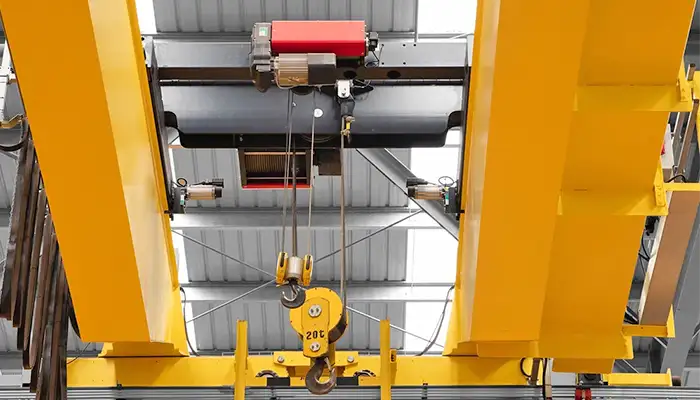
20/10 Ton Double Girder Overhead Crane Project Overview
The customer needed an overhead crane capable of handling loads of different weights inside the factory.
Yuantai Crane supplied a NLH double girder overhead crane equipped with a 20-ton main hoist and a 10-ton auxiliary hoist.
Instead of using two separate crane bridges, the two hoisting mechanisms are installed on one double girder bridge structure. The operator can select the appropriate hook according to the weight of the material being lifted.
Project specifications
| Item | Technical Details |
|---|---|
| Project location | Philippines |
| Manufacturer | Yuantai Crane – China |
| Crane type | NLH double girder overhead crane |
| Main hook capacity | 20 ton |
| Auxiliary hook capacity | 10 ton |
| Crane span | 6.8 m |
| Main hook lifting height | 14.29 m |
| Auxiliary hook lifting height | 14.74 m |
| Power supply | 400V / 60Hz / 3-phase |
The two hooks have different specified lifting heights, so both values need to be considered when planning the factory's lifting operations.
The crane design must also account for the available building height, trolley arrangement, hook approach, runway dimensions and clearance from surrounding structures.
A short span with a high lifting height
One detail worth noting is the combination of a 6.8 m span and lifting heights exceeding 14 m.
The span is relatively short compared with the commonly used 7.5–31.5 m range of standard overhead crane configurations. The 14.29 m and 14.74 m lifting heights, on the other hand, require careful attention to the hoist and trolley arrangement.
The manufacturer needs to check the bridge girder dimensions, end carriage arrangement, hoist drum capacity and available headroom together. A crane that meets the lifting capacity and span requirements must also provide the required hook travel without interfering with the factory building.
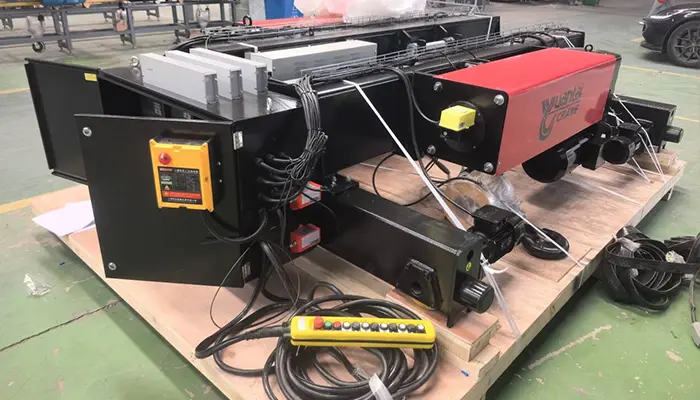
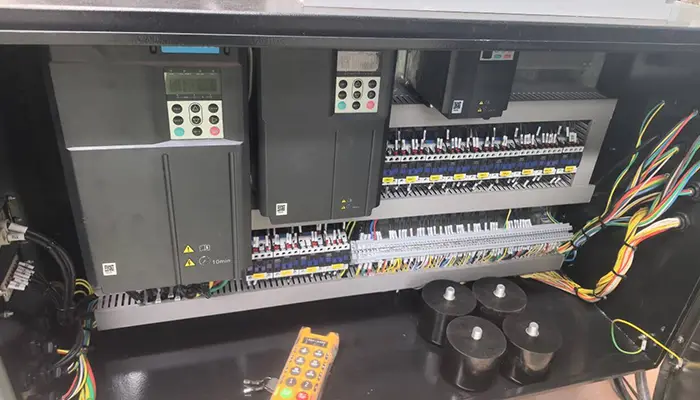
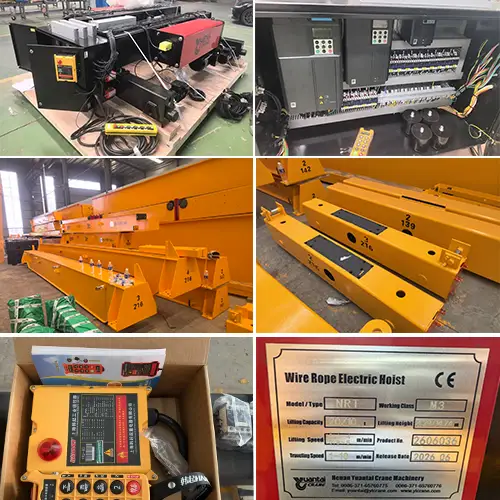
Electrical control box
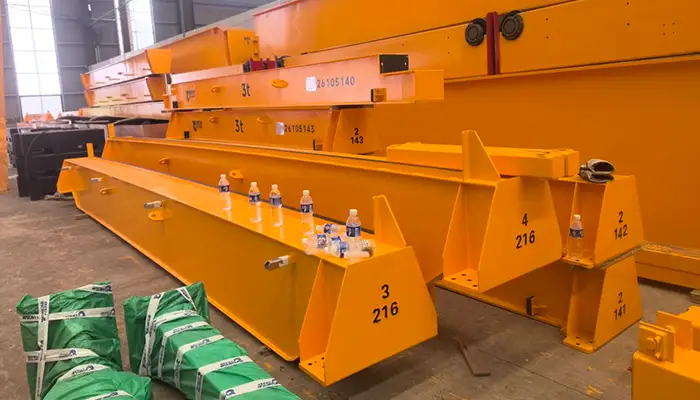
Main girder of the double girder overhead crane 20 ton
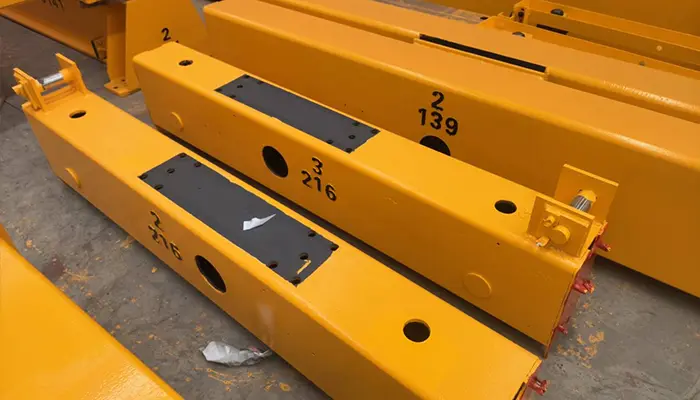
End carriages and end trucks of the double girder 20 ton overhead travelling bridge crane
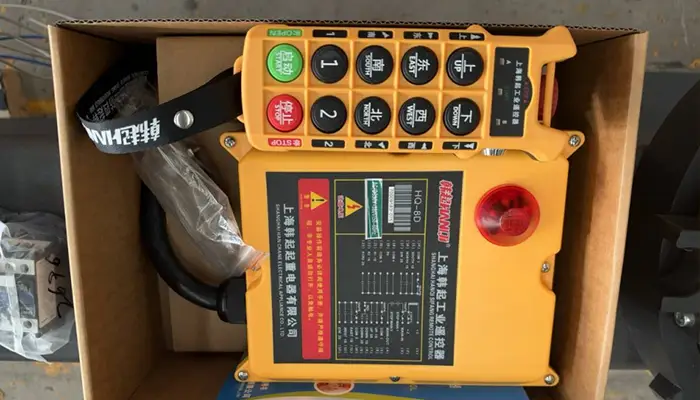
Remote control with English and Chinere instrucitons
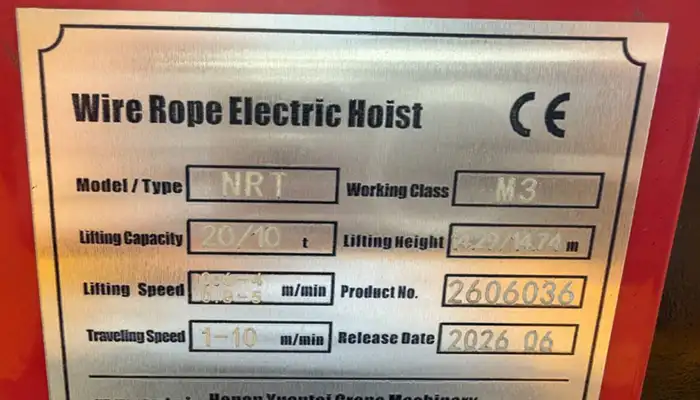
Name plate of the double hook overhead crane with 20 ton main hook and 10 ton hook for light loads handling
What Is a 20/10 Ton Double Hook Overhead Crane?
A 20/10 ton double hook overhead crane is equipped with two hoisting mechanisms: a 20-ton main hoist for heavier machinery, steel structures and other loads within its rated capacity, and a 10-ton auxiliary hoist for lighter machinery, production components and maintenance work within its rated capacity. Both hoists are installed on the same double girder crane bridge. They share the bridge travelling system and move along the same runway.
What Is a 20/10 Ton Double Hook Overhead Crane?
A 20/10 ton double hook overhead crane is equipped with two hoisting mechanisms:
- 20-ton main hoist: Used for heavier machinery, steel structures and other loads within its rated capacity.
- 10-ton auxiliary hoist: Used for lighter machinery, production components and maintenance work within its rated capacity.
Both hoists are installed on the same double girder crane bridge. They share the bridge travelling system and move along the same runway.
This type of crane is also known as:
- 20/10 ton double girder overhead crane
- 20 ton overhead crane with 10 ton auxiliary hoist
- Double girder overhead crane with two hoists
- Double hook bridge crane
- Dual-hoist EOT crane
- 20 ton bridge crane with auxiliary hook
- 20 ton EOT crane with main and auxiliary hooks
How do the main hook and auxiliary hook work?
Imagine a machinery factory that handles large machine bases, steel frames, motors and gearboxes.
The operator can use the 20-ton main hook for a heavy machine assembly and the 10-ton auxiliary hook for smaller components.
Here are some examples:
| Typical lifting task | Suitable hook |
|---|---|
| 18-ton steel structure | 20-ton main hook |
| 15-ton machinery component | 20-ton main hook |
| 8-ton fabricated component | 10-ton auxiliary hook |
| 5-ton production material | 10-ton auxiliary hook |
| 2-ton maintenance component | 10-ton auxiliary hook |
These are illustrative loads, not actual customer lifting records. The weight of the lifting attachment must also be included when checking the permissible load.
Using the auxiliary hoist for suitable lighter loads means the operator does not need to use the 20-ton main hoist for every lifting task.
Can both hooks lift the same load at the same time?
This depends on the crane design.
If the factory needs both hooks to lift or turn one long component, this requirement must be specified before manufacturing. The manufacturer needs to check the load distribution, hook spacing, trolley structure and hoist controls.
The rated capacities of the two hoists cannot simply be added together. A 20-ton main hoist and a 10-ton auxiliary hoist do not automatically give the crane a 30-ton lifting capacity.
What about the distance between the two hooks?
The main and auxiliary hooks are arranged on the same trolley assembly. Their relative positions are determined by the trolley design.
This is important when handling long steel structures, machinery frames or components with lifting points at different locations.
Buyers should check the distance between the hooks, their positions across the bridge, and the available hook travel on the general arrangement drawing. These dimensions determine whether both hooks can reach the required lifting points.
Typical Applications of a 20 Ton Main Hook and 10 Ton Auxiliary Hook Overhead Crane
A 20/10 ton overhead crane is worth considering when a factory handles loads of different weights within the same production area. The main hook takes care of heavier lifting jobs, while the auxiliary hook handles suitable lighter loads. The following are some typical applications.
Steel Structure Fabrication Workshops
Typical loads: steel beams, fabricated frames, columns, welded structures and heavy steel components.
Steel structure manufacturing involves several lifting operations. A workshop may need to move large welded assemblies from fabrication to finishing, while also handling smaller steel components between workstations.
The 20-ton main hook can handle heavier steel structures and assemblies. The 10-ton auxiliary hook can be used for smaller fabricated parts and intermediate production materials.
For a steel fabrication workshop, a 20/10 ton double girder EOT crane can provide two lifting capacities across the same production bay.
Related applications:
- Overhead crane for steel fabrication workshop
- 20 ton bridge crane for steel structure manufacturing
- Double girder overhead crane for steel beams
- Overhead crane for welded steel assemblies
Machinery Manufacturing and Assembly Plants
Typical loads: machine bases, gearboxes, motors, housings and assembled machinery.
Machinery factories often need to lift large assemblies as well as individual components.
A large machine base may require the 20-ton main hook, while motors, gearboxes and smaller components can be handled by the 10-ton auxiliary hook.
This arrangement is useful during machine assembly, equipment installation and workshop maintenance.
Related applications:
- 20 ton EOT crane for machinery manufacturing
- Overhead crane for machine assembly workshop
- Double hook overhead crane for industrial equipment
- 10 ton auxiliary hoist for machinery handling
Heavy Equipment Manufacturing
Typical loads: equipment frames, hydraulic components, large fabricated parts and heavy assemblies.
Manufacturers of construction equipment, agricultural machinery and other industrial equipment often handle components of different weights in the same workshop.
The main hook can lift heavy frames and assembled structures, while the auxiliary hook handles suitable medium-weight components.
A double girder overhead crane with two hoists can be considered when both lifting capacities are needed within the same crane coverage area.
Steel Processing and Metalworking Plants
Typical loads: steel plates, processed sections, tooling, fabricated components and production equipment.
Steel processing workshops may use the main hook for heavy tooling, large assemblies and production equipment. The auxiliary hook can handle lighter components and other materials within its rated capacity.
The lifting attachment also needs to be considered.
For example, when lifting steel plates with a spreader beam, the beam's own weight must be included in the total suspended load. The same applies to plate clamps, magnetic lifters and other lifting devices.
If a 20-ton crane uses a lifting beam weighing 1.2 tons, the remaining capacity available for the payload is 18.8 tons, subject to the crane and lifting equipment ratings.
Industrial Equipment Installation and Maintenance
Typical loads: pumps, motors, gearboxes, machine parts and replacement equipment.
Maintenance work does not always require a 20-ton lifting capacity.
The 10-ton auxiliary hook can handle suitable motors, pumps and replacement components, while the main hook remains available for heavier equipment installation and replacement.
This arrangement is useful in factories where production and maintenance activities share the same overhead crane system.
One 20/10 Ton Double Girder Crane or Two Separate Overhead Cranes?
This is one of the most important decisions for a factory that needs both 20-ton and 10-ton lifting capacities. There are two possible arrangements, and both can handle different lifting capacities, but their operating arrangements are quite different.
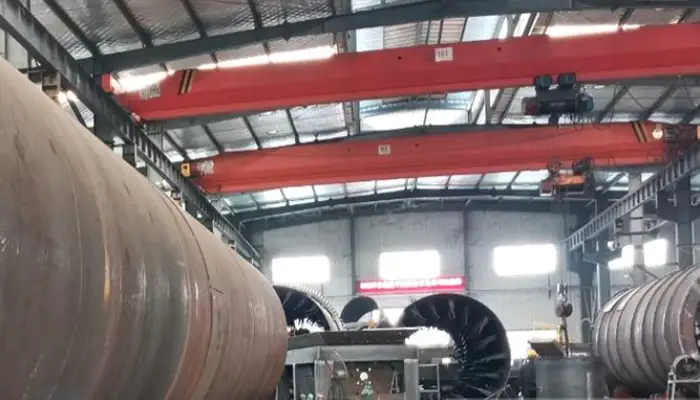
2 sets of single girder overhead cranes
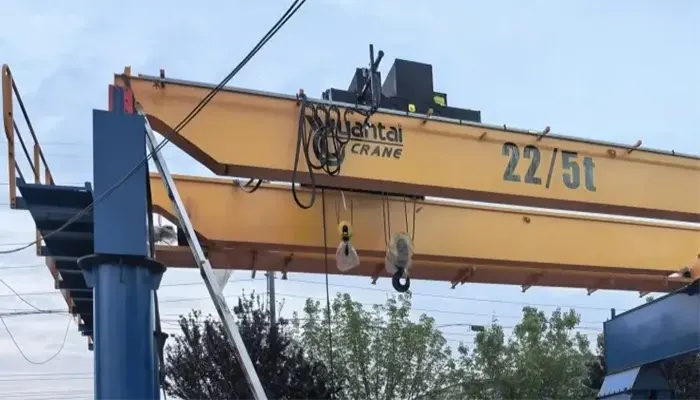
double girder electric hoist trolley overhead crane with 22 ton main hook and 5 ton auxiliary hook
Two Possible Arrangements
Option 1: One 20/10 ton double girder overhead crane
- One double girder bridge.
- One 20-ton main hoist.
- One 10-ton auxiliary hoist.
- One crane travelling system.
Option 2: Two separate single girder overhead cranes
- One 20-ton single girder crane.
- One 10-ton single girder crane.
- Two separate bridge structures.
- Two independent crane travelling systems.
One Crane Bridge Instead of Two
With a 20/10 ton double girder overhead crane, both hoists are installed on one crane bridge.
The main and auxiliary hooks travel with the same bridge along the runway. The operator selects the appropriate hoist for the lifting task.
With two separate overhead cranes, each crane has its own bridge girders, end carriages, travelling motors and hoisting mechanism.
If both lifting capacities are needed in the same working area, one crane with two hoists can reduce the amount of duplicated crane equipment.
Runway Structure and Wheel Loads
The runway is an important part of the total overhead crane system.
For one 20/10 ton double girder crane, the runway is designed according to the crane's own weight, trolley weight, rated loads, wheel arrangement and operating conditions.
For two separate cranes, the runway must be checked for the wheel loads of both cranes and the relevant operating load combinations. The possibility of the cranes approaching each other on the same runway also needs to be considered.
A double girder crane does not automatically require a lighter runway than two single girder cranes. The actual comparison depends on the engineering calculations.
Before purchasing, request the manufacturer's wheel load diagram. This information is needed to check the runway beams, rails, supporting columns and connections.
Two Lifting Capacities in the Same Working Area
A double hook overhead crane gives the operator access to two lifting capacities within one crane coverage area.
For example:
- Use the 20-ton main hook to lift a heavy machine assembly.
- Use the 10-ton auxiliary hook to move smaller production components.
- Move the bridge crane along the runway to serve different workstations.
The operator can select the appropriate hoist without having to move a second crane into position.
Less Duplicated Crane Equipment
Two separate overhead cranes require two complete bridge structures and two sets of crane travelling mechanisms.
A 20/10 ton double girder crane integrates both lifting functions into one bridge structure.
This can reduce duplicated equipment, simplify the crane arrangement and make maintenance management more straightforward.
There are still two hoisting mechanisms to maintain. Each has its own motor, brake, wire rope, drum and lifting components, so the auxiliary hoist should not be overlooked in the maintenance plan.
Independent Crane Movement
This is where the two options differ most.
With one double girder crane and two hoists, both hooks travel with the same bridge. They cannot move independently along the runway.
With two separate overhead cranes, each bridge can travel independently, subject to the runway layout and collision protection arrangements.
If the 20-ton and 10-ton lifting jobs take place in different locations at the same time, two separate cranes may be more suitable.
Comparison: One 20/10 Ton Crane vs. Two Separate Single Girder Cranes
| Comparison | One 20/10-ton double girder crane | Two separate single girder cranes |
|---|---|---|
| Crane bridges | One | Two |
| Lifting capacity | 20-ton main + 10-ton auxiliary | 20-ton crane + 10-ton crane |
| Hoisting mechanisms | Two | Two |
| Crane travel | Shared bridge movement | Independent bridge movement |
| Working area | Same crane coverage area | Can serve different areas |
| Simultaneous operations | Depends on hoist and control design | Independent crane operations are possible |
| Runway design | Based on one crane's wheel loads | Must consider both cranes and their operating combinations |
| Crane equipment | Less duplicated bridge and travel equipment | Two complete crane travelling systems |
| Maintenance | Two hoists and one travelling system | Two hoists and two travelling systems |
| Suitable applications | Different lifting capacities within one shared area | Separate work areas or independently moving cranes |
Which option should you choose?
If both lifting capacities are needed in the same working area and independent crane movement is not necessary, a 20/10 ton double girder overhead crane is worth considering.
If two production teams need to operate cranes independently, or if the lifting jobs take place in different areas, two separate overhead cranes may be a better fit.
The decision should be based on the production layout and lifting frequency, not simply on the crane capacities.
When Are Two Separate Overhead Cranes a Better Choice?
Although a double girder crane with two hoists can reduce duplicated equipment, it is not suitable for every factory.
Two separate cranes may be more practical in the following situations.
1. Two production areas need independent crane movement.
If one crane handles materials in one area while another needs to move to a different workstation, separate cranes provide more flexibility.
2. Both cranes need to operate at different positions simultaneously.
If two operators need to carry out independent lifting tasks at the same time, separate cranes may better suit the production process.
The runway and crane operating arrangements must still be designed to prevent interference and collisions.
3. The factory has separate production bays.
If the 20-ton and 10-ton lifting operations take place in different buildings or on different runway systems, separate cranes are usually easier to arrange.
4. Different lifting routes are required.
A double hook overhead crane has one shared bridge. Both hoists travel together along the runway.
If the two lifting operations require different travel paths, independent cranes may be necessary.
When two cranes share the same runway, the design may also need anti-collision sensors, travel limit controls, warning devices and suitable operating procedures.
Why Choose a Double Girder Structure for a 20/10 Ton Crane?
Buyers may also wonder whether a single girder overhead crane can carry a 20-ton main hoist and a 10-ton auxiliary hoist. The answer depends on the actual crane design. Single girder cranes can be engineered for various hoist arrangements, but the trolley, girder and wheel load limitations need to be considered. For a 20/10 ton configuration, a double girder structure offers several design advantages.
More Room for the Two Hoisting Mechanisms
A double girder crane has two main bridge girders supporting the trolley and hoisting equipment.
This provides greater flexibility when arranging the main and auxiliary hoists, particularly when the crane requires different lifting heights, hook positions or special hoisting equipment.
The trolley and bridge structure can be designed around the required load distribution and hook arrangement.
Suitable for Heavy Industrial Lifting
Double girder overhead cranes are commonly used for higher-capacity lifting applications, particularly in steel plants, machinery factories, equipment manufacturing and heavy industrial workshops.
They can accommodate different trolley and hoist arrangements, depending on the lifting capacity, span and duty requirements.
For this Philippines project, the double girder configuration provides the required structure for the 20-ton main hoist and 10-ton auxiliary hoist.
More Flexibility in Hook Arrangement
A double girder overhead crane can be designed with:
- Main and auxiliary hoists.
- Two hoists with different rated capacities.
- Different lifting heights.
- Different hook positions.
- Special lifting beams and attachments.
- Application-specific trolley arrangements.
The actual hook coverage depends on the trolley design and its travel limits.
Buyers should check the general arrangement drawing to make sure the two hooks can reach the required lifting positions.
Low-Headroom NLH Design
The NLH is a low-headroom double girder overhead crane configuration.
Its hoist and trolley arrangement is designed to make better use of the available vertical space compared with a conventional trolley arrangement.
This is useful when the factory needs a high hook lifting position but has limited space between the runway and roof structure.
For the Philippines project, the required lifting heights are more than 14 m. The available headroom, trolley height and hook approach therefore need to be checked carefully.
Rather than comparing crane model names alone, buyers should ask for the actual dimensions on the general arrangement drawing.
Important Specifications to Check Before Ordering a 20/10 Ton Overhead Crane
The lifting capacities are only part of the crane specification. The following details also affect the design, price and suitability of the equipment.
Main and Auxiliary Hook Lifting Heights
The two hooks do not necessarily have the same maximum lifting height.
For this Philippines project:
- Main hook: 14.29 m.
- Auxiliary hook: 14.74 m.
If both hoists need to reach particular positions in the factory, provide the required lifting height for each hook separately.
The manufacturer should confirm the maximum and minimum hook positions, available lifting travel and clearances on the approved drawing.
Hoisting Speeds
The main and auxiliary hoists may have different lifting speeds.
The main hoist generally handles heavier loads, while the auxiliary hoist may be used more frequently for lighter components.
The required speeds depend on the production cycle, load weight and positioning accuracy.
For applications requiring smooth starting, stopping and accurate load positioning, variable frequency drive (VFD) control can be considered.
When comparing quotations, ask for the following details separately:
- Main hoist lifting speed.
- Auxiliary hoist lifting speed.
- Trolley travelling speed.
- Crane travelling speed.
- Whether variable speed control is included.
Working Duty Classification
Crane duty classification depends on how frequently the crane operates and the loads it handles.
A maintenance workshop that performs occasional heavy lifts has different requirements from a production plant that handles materials throughout several shifts.
The manufacturer should assess:
- Average lifting load.
- Maximum lifting load.
- Number of lifting cycles.
- Daily operating hours.
- Load spectrum.
- Expected service life.
The main and auxiliary hoists may also have different usage patterns. For example, the auxiliary hoist may perform many more lifting cycles than the main hoist.
The duty classification should reflect these actual operating conditions under the selected ISO, FEM or GB design standard.
Distance Between the Two Hooks
The distance between the main and auxiliary hooks affects the types of loads the crane can handle.
This is particularly important for long steel structures, machinery frames and components with multiple lifting points.
Check the hook center distance, hook positions and available trolley travel before confirming the design.
Factory Structure and Runway Design
For a new or existing factory, the following dimensions and structural information should be provided:
- Crane span and runway rail gauge.
- Runway rail type and size.
- Runway beam dimensions.
- Supporting column arrangement.
- Maximum allowable wheel loads.
- Floor-to-rail elevation.
- Roof structure and overhead clearance.
- Required hook approaches.
- Available maintenance access.
The crane manufacturer should provide the wheel load data for structural verification.
Electrical Supply and Operating Controls
This Philippines project uses a 400V, 60Hz, 3-phase power supply.
The hoisting motors, travel motors and electrical control system should be selected to match the actual factory power supply.
Buyers should also specify the preferred operating method:
- Pendant control.
- Radio remote control.
- Operator cabin.
For a double hook overhead crane, the controls should clearly distinguish between the main and auxiliary hoists. Each hoist also needs the appropriate overload protection, upper and lower limit switches, braking system and other required safety devices.
Is a 20/10 Ton Double Girder Overhead Crane More Cost-Effective?
When comparing one 20/10 ton double girder crane with two separate overhead cranes, do not compare only the purchase prices.
The total project cost includes the crane structures, hoists, travelling mechanisms, electrical systems, runway requirements, transportation, installation and maintenance.
| Cost item | One 20/10-ton double girder crane | Two separate single girder cranes |
|---|---|---|
| Bridge structures | One | Two |
| Hoisting mechanisms | Two | Two |
| Crane travelling systems | One | Two |
| Electrical control systems | One integrated system | Two crane systems |
| Runway design | Based on one crane's loads | Based on both cranes and operating combinations |
| Installation | One crane system | Two crane systems |
| Maintenance | Two hoists and one bridge system | Two complete crane systems |
A double girder crane with two hoists may reduce duplicated bridge and travelling equipment. It can also simplify the installation when both lifting capacities serve the same production area.
However, two separate cranes offer independent movement. This may be important enough to justify the additional investment in some production environments.
The most useful way to compare the two options is to request quotations based on the same lifting requirements, working area, duty classification and installation scope.
This gives the buyer a more realistic comparison of the initial investment and long-term operating requirements.
Information to Prepare Before Requesting a Crane Quotation
If you are planning to purchase a 20-ton overhead crane with a 10-ton auxiliary hoist, the following information will help the manufacturer prepare a suitable technical proposal.
| Required information | Example / purpose |
|---|---|
| Main hook capacity | 20 ton |
| Auxiliary hook capacity | 10 ton |
| Crane span | 6.8 m |
| Main hook lifting height | 14.29 m |
| Auxiliary hook lifting height | 14.74 m |
| Power supply | 400V / 60Hz / 3-phase |
| Working area | Workshop dimensions and lifting coverage |
| Runway details | Rail type, gauge and runway beam drawings |
| Working frequency | Operating hours and lifting cycles |
| Load information | Weight, dimensions and lifting points |
| Lifting attachments | Beams, clamps, magnets or other equipment |
| Control method | Pendant, radio remote or cabin |
| Duty classification | Based on actual operating conditions |
It is also helpful to provide photographs of the workshop, building drawings and examples of the heaviest and most frequently handled loads.
For the load information, pay particular attention to three things:
- The heaviest load the crane needs to lift.
- The loads handled most frequently.
- The largest components by dimensions and lifting point arrangement.
These details help the engineering team determine the required lifting capacity, working duty and hook arrangement.
Customized 20 Ton Double Girder EOT Crane Solutions by Yuantai Crane
Yuantai Crane manufactures customized overhead cranes for machinery factories, steel fabrication workshops, heavy equipment manufacturers, warehouses and other industrial applications.
For this Philippines project, we supplied a NLH double girder overhead crane with a 20-ton main hook and a 10-ton auxiliary hook. The crane has a 6.8 m span, lifting heights of 14.29 m and 14.74 m, and a 400V, 60Hz, 3-phase electrical configuration.
This arrangement allows the factory to handle heavy and medium-weight materials using two hoists on one crane bridge.
If you are planning to purchase a 20 ton overhead crane, 20 ton bridge crane or 20 ton EOT crane with a 10 ton auxiliary hook, our engineering team can help you compare a double girder two-hoist arrangement with two separate overhead cranes.
Send us your lifting requirements, workshop drawings and power supply details. We will review the working conditions and prepare a suitable crane proposal.
Yuantai Crane – China Overhead Crane Manufacturer
Customized double girder overhead cranes and EOT crane systems for industrial lifting and material handling.
Frequently Asked Questions About 20/10 Ton Overhead Cranes
Answers to common questions about 20/10 ton double hook overhead cranes, covering the basic configuration, the difference from a standard 20-ton crane, combined lifting limits, machinery manufacturing suitability, single crane vs. two separate cranes, quotation requirements, QD vs. NLH designs, 400V/60Hz operation, pricing factors, and installation on an existing runway.
What is a 20/10 ton double hook overhead crane?
A 20/10 ton double hook overhead crane has two hoisting mechanisms: a 20-ton main hoist and a 10-ton auxiliary hoist. Both are installed on the same crane bridge.
The operator can use the main hook for heavier loads and the auxiliary hook for lighter loads. Both hooks travel with the same bridge, so they do not have independent crane travel.
What is the difference between a 20 ton and a 20/10 ton overhead crane?
A standard 20-ton overhead crane has one 20-ton main hoist.
A 20/10 ton overhead crane has an additional 10-ton auxiliary hoist. This gives the factory another lifting option for medium-weight materials and smaller components.
The auxiliary hoist adds its own motor, brake, wire rope and lifting mechanism, so the trolley and crane structure must be designed for the additional equipment.
Can a 20 ton main hook and 10 ton auxiliary hook lift 30 tons together?
Not automatically. The two rated capacities cannot simply be added together to obtain a 30-ton lifting capacity.
If both hooks need to support the same load, the crane must be specifically designed and approved for that operation. The manufacturer needs to check the combined loading, load distribution, hoist synchronization and structural capacity.
Is a 20 ton double girder overhead crane suitable for machinery manufacturing?
Yes. A 20-ton double girder overhead crane can handle machine bases, industrial equipment, heavy components and assembled machinery.
With a 10-ton auxiliary hoist, the crane can also handle suitable medium-weight components within the same working area. This arrangement is useful in machinery manufacturing, assembly and maintenance workshops.
Should I choose one 20/10 ton double girder crane or two separate overhead cranes?
Choose one 20/10 ton double girder crane when both lifting capacities are needed in the same working area and the two hoists do not require independent crane travel.
Consider two separate overhead cranes when different production areas need independent operation or when two lifting operations must take place at different positions simultaneously.
The main difference is whether the two lifting operations need independent crane movement.
What information is needed for a 20 ton overhead crane quotation?
The manufacturer needs the main and auxiliary hook capacities, crane span, lifting heights, runway dimensions, power supply, working frequency and load details.
Workshop drawings and photographs are also useful, particularly when the crane will be installed on an existing runway.
What is the difference between QD and NLH double girder overhead cranes?
A conventional QD double girder crane generally uses an open winch trolley mounted above the bridge girders.
The NLH is a low-headroom configuration designed to reduce the vertical space occupied by the hoisting mechanism.
The actual headroom depends on the crane capacity, lifting height and trolley arrangement. Buyers should compare the general arrangement drawings and hook approach dimensions before selecting the crane.
Can a 20 ton overhead crane operate on 400V, 60Hz power?
Yes, provided the motors and electrical components are selected for 400V, 60Hz, 3-phase operation.
The voltage and frequency should be confirmed before manufacturing. This is particularly important when purchasing an overhead crane from China, where standard electrical configurations may differ from the factory's actual power supply.
What determines the price of a 20/10 ton overhead crane?
The price depends on the crane structure, main and auxiliary hoists, span, lifting heights, working duty, lifting speeds, electrical components and control system.
Transportation, runway beams, installation and commissioning also affect the total project cost.
A 20/10 ton NLH double girder crane should be quoted according to the complete technical specification rather than compared directly with a standard 20-ton single-hoist crane.
What should I check when installing a 20/10 ton overhead crane on an existing runway?
The runway must be checked against the new crane's maximum and minimum wheel loads.
Ask the manufacturer for the wheel load diagram and relevant crane dimensions. A structural engineer should verify the runway beams, rails, supporting columns and connections before installation.
The available headroom, hook approach, rail gauge and installation clearance should also be checked against the approved crane drawings.

Yuantai Cranes
Overhead Crane Manufacturer with CE, ISO, SGS, CNEX Certificates.
- Main Specifications - Capacity: 0.5–550 tons | Span: up to 40m | Speed: 0.8–12 m/min | Duty: A3–A7 | Power: 380–690V, 50/60Hz | Control: pendant/remote/cabin
- Full engineering: FEA/PLC/VFD + in-house build + global delivery + on-site support, for workshops, factories, EPC contractors, industrial projects, etc.
- Support: design, manufacturing, testing, service – end-to-end, customized lifting solutions worldwide.
How to Get an Accurate Crane Price for Your Application?
Tips: Copy the spec list, fill in your details, and paste it into the form on the right/ down-below for a quick price.
- Crane type:_____ . (e.g., overhead crane, gantry crane, jib crane)
- Max weight to lift:_____ tons. (e.g., 2t, 5t, 10t, 20t, 50t)
- Lifting height:_____ m. (How high does the hook need to reach?
- Workshop width (span):_____ m . (Distance between the two crane rails)
- Travel distance:_____ m . (How long does the crane need to move along the runway?)
- Control type:_____. (Pendant / remote / cabin Control)
- Power supply:_____. (Local voltage & frequency – e.g., 380V, 50Hz, 3-phase)
- What will it be used for?_____ (e.g., steel fabrication, concrete products, mold handling, general manufacturing, etc.)
- Any special requirements?_____ (e.g., extreme temperature, dusty or explosive environment, special paint color, etc.)
Just leave a message via the contact form and our hoist and crane engineer will contact you with in 24working hours.
Get Your Custom Quote–Quick & Easy
Fill in what you know. Skip what you don't – we'll help.Any question will be reply with 24 working hours