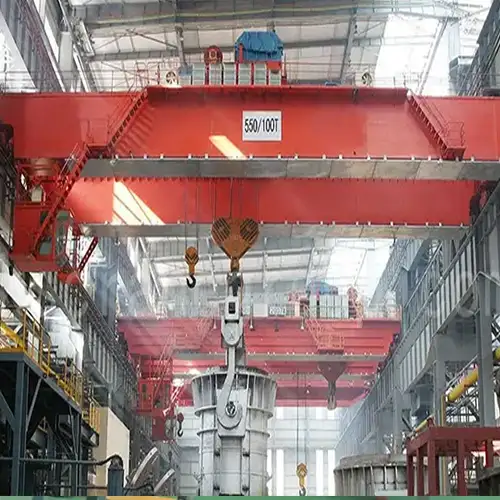
Triple Hook Overhead Crane – Melt Shop 50–200 Ton
Discover triple hook overhead cranes for melt shops. Safely lift molten steel ladles, tundishes, and auxiliary loads with capacities from 50 to 200+ tons. Ideal for ladle cranes, melting cranes, and efficient melt shop operations.
| Crane Type | Triple Hook Overhead Crane – Melt Shop 50–200 Ton |
| Crane Capacity | 50–200 Ton |
| Span Length | 15 – 30+ meters or customized |
| Lifting Height | 10 – 25+ meters or customized |
| Coverage Area Type | Rectangular, Linear travel |
| Application | A Triple Hook Overhead Crane (50–200 ton) for melt shops is used in steel plants for handling molten steel ladles, scrap charging, tundish and mold operations in continuous casting, slag pot removal, and heavy furnace maintenance. Its three-hook design en |
| Certifications | CE / ISO / SGS / Other third-party inspection |
| Customization | Customized material handling cranes solutions available for indoor, outdoor, hazardous, corrosive, c |
Crane Manufacturer: Yuantai Cranes – 30+ Years Professional Crane Manufacturer from China
Category: Casting Crane
Tags: castingcrane
Your Trusted Triple Hook Overhead Crane Manufacturer & Supplier
Triple Hook Overhead Crane – Melt Shop Applications
50–200 Ton Ladle & Melting Cranes
Explore triple hook overhead cranes for melt shop operations. Handle molten steel, tundishes, and auxiliary loads safely with capacities from 50 to 200+ tons. Learn about ladle cranes, melting cranes, multi-hoist workflow, and melt shop crane applications.
Triple Hook Overhead Crane – Melt Shop Applications
Triple hook overhead cranes are a type of heavy-duty bridge crane commonly used in steel mill melt shops. Unlike standard single or double hook cranes, these cranes have three independent hoists that allow operators to handle multiple loads at the same time. This design is particularly useful in melt shops where molten steel, ladles, and other heavy materials need to be moved quickly and safely across the workshop.
Using a triple hook crane helps streamline workflow. For example, while the main hook carries a full ladle of molten steel, an auxiliary hook can lift a smaller ladle or a piece of maintenance equipment without stopping operations. This setup not only saves time but also reduces the number of crane movements, which is important in tight workshop layouts.
- Simultaneous lifting: Main, auxiliary, and third hooks can operate independently, allowing multiple tasks at once.
- Heavy load handling: Capable of handling molten steel ladles, tundishes, and other heavy components safely.
- Flexibility: Can lift small tools and refractory materials on the third hook while the main hoists are in use.
- Improved safety: Separating heavy and light loads reduces the risk of accidents from overloading or swinging loads.
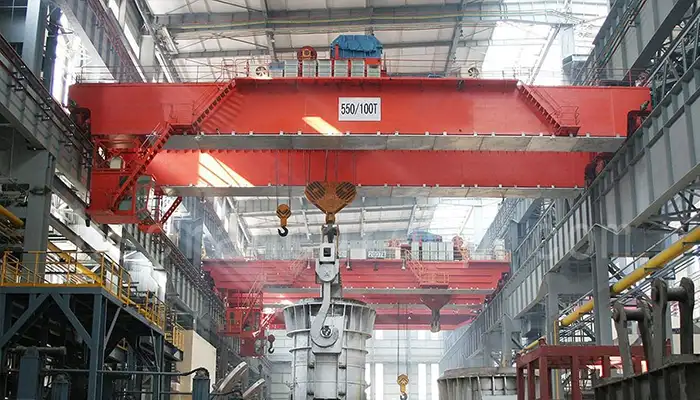
Triple hook cranes are often chosen for melt shops with a high level of activity, where different stages of the process happen in parallel. They are also adaptable to different layouts, making it possible to fit new cranes into existing workshops without major reconstruction.
In short, these cranes are practical solutions for moving large, heavy, and varied loads efficiently in melt shops. They keep the process smooth, reduce waiting times, and allow the workshop team to focus on production rather than constantly coordinating crane use.
Crane Types and Configurations
Triple hook overhead cranes, including ladle cranes and melting cranes, are built for heavy-duty lifting in steel melt shops. They are always double girder, top-running, which provides the strength, stability, and safety needed to handle molten steel ladles, tundishes, and other heavy components efficiently. These melt shop cranes are designed to manage multiple lifting tasks at the same time, improving workflow and reducing downtime.
Hoist Configurations
Each of the three hoists is designed for a specific load category, ensuring safe and efficient operation in overhead crane applications:
- Main Hoist: Handles the heaviest loads, such as full molten steel ladles or large tundishes, making it essential for ladle crane operations.
- Auxiliary Hoist(s): Carries medium-weight loads, including smaller ladles, spare components, or maintenance equipment, supporting ongoing production without interrupting main lifting tasks.
- Third Hoist: Lifts light loads such as tools, refractory material, or spare parts, allowing smaller tasks to run alongside heavy lifting.
Lifting Mechanisms
- Wire Rope Crab Trolley: Most common for heavy-duty melt shop crane operations, offering smooth, controlled lifting of large molten steel loads.
- Open Winch Trolley: Used for lighter auxiliary tasks or in situations where simple, durable lifting is needed.
- Hybrid Drives (Optional): Combine precision and power for controlled handling of sensitive loads like small tundishes or tooling.
Optional Features
- Multiple Trolleys: Each hoist can move independently along the bridge, increasing flexibility and workflow efficiency.
- Variable Speed Drives: Adjust hoist and bridge speeds according to load weight, ensuring safe and precise handling.
- Remote Operation: Allows operators to control the crane safely from a distance, particularly around hot ladles or hazardous melt shop areas.
- Anti-Sway & Positioning Systems: Maintain stable and accurate placement of heavy loads, reducing the risk of accidents.
General Technical Specifications for Triple Hook Overhead Cranes in Melt Shops
Triple hook overhead cranes, including ladle cranes and melting cranes, can be customized to fit the layout and workflow of any melt shop. Specifications vary depending on lifting requirements, workshop dimensions, and the type of loads, but the following ranges cover most heavy-duty applications for melt shop cranes handling molten steel, tundishes, equipment, and auxiliary materials.
Load Capacity
The three independent hoists are designed to handle different types of loads safely and efficiently:
- Main Hoist: 50 – 200+ tons, capable of lifting heavy molten steel ladles, tundishes, or furnace components.
- Auxiliary Hoist(s): 10 – 50+ tons, for medium-weight loads such as smaller ladles, spare parts, or maintenance equipment.
- Third Hoist: 5 – 20 tons, for lighter loads like tools, refractory materials, or small spare components.
Span and Lift Height
- Span: 15 – 30+ meters, adjustable to fit the workshop layout and cover furnace areas, ladle transport paths, and casting stations.
- Lift Height: 10 – 25+ meters, depending on roof clearance and process requirements, allowing safe lifting of molten steel and heavy materials.
Hoisting Classification
- FEM: 3–5m, depending on lifting frequency and load type.
- ISO: M5–M8, suitable for heavy-duty melt shop cranes.
- CMAA Class: C–F, ensuring compliance with industrial standards for overhead cranes.
Travel Speeds
- Hoist Speed: Adjustable per hoist; 0–20 / 0–30 / 0–40 m/min depending on load and lifting task.
- Trolley Speed: 0–30 m/min for moving hoists along the bridge efficiently.
- Bridge Speed: 0–60 m/min for safe movement across the workshop runway.
Power Supply
- Motors: 380–690 V / 50–60 Hz / 3-phase, capable of handling heavy ladle crane operations.
- Control Circuits: 110–220 V with integrated safety interlocks and remote operation options for safe crane handling.
Rails and Wheel Load
- Rail Type: DIN or custom rails designed for high loads in melt shop overhead cranes.
- Wheel Load: 30 – 70 tons per wheel, depending on bridge size, crane capacity, and lifting tasks.
Safety and Control Systems
- Overload Protection: Prevents lifting beyond rated capacity for molten steel or heavy tundishes.
- Limit Switches: Ensure hoists stop safely at upper and lower travel limits.
- Emergency Stop: Quickly halts bridge, trolley, and hoist movements if needed.
- Anti-Collision & Anti-Sway Devices: Maintain stability for multiple simultaneous lifts.
- Remote Operation: Allows operators to control the crane safely from a distance, especially near hot or hazardous materials.
Crane Structure & Key Components
The structure of a triple hook overhead crane, including ladle cranes and melting cranes, is specifically designed for melt shop crane operations. Every component, from the main girder to the hooks, is engineered to handle heavy molten steel, tundishes, and other workshop loads safely and reliably, while maintaining efficient workflow. These cranes are ideal for handling molten steel ladles, maintenance equipment, and auxiliary materials simultaneously.
Main Girder & End Trucks
The backbone of a melt shop crane is its bridge structure.
- Main girders are heavy-duty steel beams that support all three hoists and withstand high loads typical in steel melt shop operations.
- End trucks carry the crane weight along the runway rails, designed to handle high wheel loads and ensure smooth bridge movement.
- Together, the girder and end trucks provide the stability needed for simultaneous lifting of heavy molten steel ladles and medium loads.
Trolleys & Hoists
Independent movement of each hoist is key for operational efficiency.
- Each hoist is mounted on its own trolley, allowing it to move along the bridge without interfering with the other hoists.
- This setup enables simultaneous operation of all three hooks, keeping production flowing and reducing crane idle time.
- Suitable for handling heavy, medium, and light loads, from molten steel ladles to tools and spare parts.
Hooks & Lifting Attachments
Triple hook overhead cranes provide versatility for different lifting tasks in melt shops.
- Main hook: Lifts heavy molten steel ladles or large tundishes.
- Auxiliary hook: Handles medium-weight loads such as smaller ladles, equipment, or maintenance components.
- Third hook: Manages light loads like tools, refractory materials, or spare parts.
Optional lifting attachments expand functionality:
- Grabs for bulk material handling.
- Ladle tilters for precise pouring of molten steel.
- Magnetic lifting devices for ferrous components.
This flexibility allows ladle cranes and melting cranes to handle nearly any lifting task in a melt shop efficiently.
Electrical & Control System
- Motors are paired with frequency inverters to ensure smooth starts and stops of hoists and the bridge.
- Optional PLC or automation systems provide precise control and can integrate with other melt shop processes.
- Intelligent control features reduce operator fatigue and improve overall lifting accuracy.
Safety Features
- Anti-sway devices minimize load swinging during transport of molten steel ladles.
- Load monitoring systems ensure the crane never exceeds rated capacity.
- Emergency brakes can stop the bridge, trolley, or hoists immediately if necessary.
- Proximity sensors and interlocks help prevent collisions and protect operators from accidents.
Operational Workflow
Triple hook overhead cranes are designed to keep melt shop operations moving smoothly. Each hook has a specific role, allowing operators to handle multiple tasks without stopping the process.
Main Hook
- Used for the heaviest loads, including full molten steel ladles and large tundishes.
- Handles critical material transfers, such as moving steel from the furnace to the pouring station.
- Requires careful operation due to weight and temperature, often guided by skilled operators or remote control.
Auxiliary Hook
- Handles medium-weight items, like smaller ladles, tundishes, or equipment.
- Can operate simultaneously with the main hook, reducing waiting times for crane availability.
- Often used for positioning components for maintenance or intermediate transport.
Third Hook
- Dedicated to light loads, including tools, refractory materials, or maintenance support items.
- Enables small tasks to run concurrently without interrupting main production lifts.
- Useful for moving spare parts or assisting in repair work while heavy lifting continues.
Benefits of Simultaneous Operation
- Reduced crane movement: Each hoist moves independently, minimizing unnecessary travel.
- Faster material handling: Multiple loads can be lifted and transported at the same time.
- Improved throughput: Production flows more efficiently because the crane supports several tasks without delay.
Workshop Layout & Installation Considerations
The layout of a melt shop is critical when installing a triple hook overhead crane. Proper planning ensures that the crane can move safely, cover all necessary areas, and operate efficiently without interfering with other equipment or workflow.
Recommended Layout
- Position the crane so all furnace areas, ladle transport paths, tundish stations, and equipment zones are within reach of the hooks.
- Ensure that the main hook can reach the heaviest lifting points, while the auxiliary and third hooks cover medium and light load areas.
- Plan paths to avoid collisions with other cranes, columns, or fixed structures.
Clearances
- Distance from hook to roof and walls: Maintain enough headroom to safely lift and tilt molten steel ladles without risk of hitting the ceiling or walls.
- Lateral clearance between hooks: Keep sufficient space between main, auxiliary, and third hooks to operate simultaneously without interference.
- Headroom for swinging loads: Ensure that ladles and other heavy components can swing slightly without hitting the roof or other equipment, which is essential for safe operations.
Integration
- Triple hook cranes can be installed on existing crane rails if they are rated for heavy loads and meet structural requirements.
- For new installations, design the runway rails, supports, and foundations to match the crane span, load capacity, and workshop layout.
- Consider future expansions or changes in workflow; a well-planned layout allows the crane to remain functional as production needs evolve.
A carefully planned workshop layout ensures that the triple hook crane can lift, move, and place loads safely and efficiently. Proper clearances and integration with the existing setup reduce downtime, prevent accidents, and allow multiple tasks to happen at the same time.
Applications in Melt Shop
Triple hook overhead cranes, including ladle cranes and melting cranes, are a critical part of melt shop crane operations. Designed to handle heavy, medium, and light loads, these cranes allow multiple tasks to happen at the same time, keeping production flowing and reducing downtime. Their versatility makes them ideal for handling molten steel ladles, tundishes, refractory materials, and auxiliary equipment safely and efficiently.
Molten Steel Handling and Transport
Moving molten steel is one of the most demanding tasks in a melt shop. Melt shop cranes must handle extreme weights and high temperatures while minimizing risk to personnel and equipment.
- The main hook lifts full molten steel ladles from the furnace or preheating stations.
- Anti-sway devices and precise hoist control help reduce swinging, ensuring smooth and safe transport.
- Operators can move molten steel over long distances without manual intervention, improving workflow efficiency.
Ladle Positioning for Furnace and Continuous Casting
Accurate positioning of ladles is essential for consistent pouring and high-quality steel production. Triple hook overhead cranes allow multiple ladles to be prepared or moved simultaneously.
- The main hoist positions full ladles over furnaces or continuous casting lines.
- The auxiliary hoist can hold smaller ladles ready for secondary operations.
- Simultaneous preparation of multiple ladles reduces delays, keeping melt shop operations smooth and continuous.
Tundish Handling and Maintenance Support
Tundishes are medium-weight components that require careful handling during both casting and maintenance. Using ladle cranes or triple hook melt shop cranes, operators can manage tundishes without interrupting other tasks.
- The auxiliary hoist moves tundishes into position for casting or maintenance.
- The third hook lifts tools, spare parts, or materials needed for maintenance tasks.
- This setup allows repairs and production tasks to run in parallel without stopping primary operations.
Equipment Lifting and Installation
Installing or replacing heavy equipment in a melt shop can be complex. Melting cranes provide the flexibility to lift large components while simultaneously managing supporting items.
- Heavy equipment is lifted with the main hoist, while the auxiliary and third hoists handle smaller items.
- This reduces the number of crane movements and helps maintain a safer workflow.
- Equipment installation or replacement is faster, more organized, and less disruptive to production.
Handling Refractory Materials, Spare Parts, and Tooling
Even lighter materials such as refractory bricks, tools, and spare parts require careful handling in a melt shop. Overhead cranes with a third hook make it easy to move these items without interfering with heavy lifting.
- The third hook lifts small loads while the main and auxiliary hoists continue heavy operations.
- Workflow interruptions are minimized, keeping the shop floor clear and safe.
- Multiple small tasks can run alongside main production, improving overall efficiency and reducing downtime.
Maintenance & Inspection Guidelines for Triple Hook Overhead Cranes in Melt Shops
Regular maintenance and inspection of triple hook overhead cranes, including ladle cranes and melting cranes, is essential to keep melt shop operations safe and efficient. Following these procedures helps prevent downtime, extend crane life, reduce wear on critical components, and maintain safe handling of molten steel ladles, tundishes, and heavy equipment.
Pre-Operation Checks
Before each shift, operators should perform pre-operation inspections on all melt shop cranes to ensure safe and reliable function. These checks catch small problems before they escalate into costly repairs or safety hazards.
- Inspect hooks for cracks, deformation, or excessive wear, especially the main hook used for heavy molten steel ladles.
- Check limit switches to make sure all hoists stop correctly at upper and lower travel limits.
- Examine wire ropes for fraying, kinking, or corrosion, ensuring smooth lifting performance for heavy, medium, and light loads.
- Test electrical systems, including control panels, emergency stop buttons, and remote control operation, which is critical for safe crane handling.
Scheduled Inspections
Scheduled inspections ensure the structural integrity and mechanical reliability of all components in melt shop overhead cranes. Depending on usage, these checks can be daily, weekly, or monthly.
- Verify main girder, bridge, and end trucks for structural integrity.
- Inspect hoist mechanisms, including drum alignment, brakes, and gearboxes, to ensure precise lifting.
- Check the control system for unusual behavior, faults, or errors in ladle crane operation.
- Examine trolleys, wheels, and rails for wear, cracks, or misalignment that could affect smooth hoist travel.
Lubrication and Alignment
Proper lubrication and alignment reduce friction, prevent premature wear, and maintain smooth operation for triple hook cranes in melt shop environments.
- Lubricate trolley wheels, bridge wheels, and hoist mechanisms according to manufacturer guidelines.
- Ensure trolley and bridge alignment on rails to avoid uneven load distribution or excessive stress on the crane structure.
- Monitor wire rope tension regularly to maintain optimal lifting performance for ladle handling and heavy-duty material transport.
Load Testing
Periodic load testing ensures that each hoist on the triple hook overhead crane can handle its rated capacity safely. This is especially important after repairs, modifications, or installation of new lifting attachments.
- Conduct load testing following FEM, ISO, or local regulatory standards.
- Test each hoist independently as well as during simultaneous operation to verify stability under full working load.
- Record all results and maintain inspection logs for regulatory compliance and operational tracking.
Advantages of Triple Hook Overhead Cranes
Triple hook overhead cranes, often used as ladle cranes or melting cranes in steel melt shops, are designed to handle heavy, medium, and light loads efficiently. These melt shop cranes improve workflow, safety, and flexibility, making them an essential part of modern steel production.
Multi-Task Handling
Triple hook overhead cranes allow simultaneous lifting of multiple load types, which improves productivity across the melt shop.
- The main hook handles heavy ladles of molten steel, while the auxiliary hook moves medium loads like tundishes or equipment.
- The third hook manages light loads such as tools, refractory materials, or spare parts.
- This setup keeps operations moving without waiting for a single hook to finish, making ladle handling and material transport faster and smoother.
Operational Flexibility
These melt shop cranes can adapt to a variety of processes in the shop, from furnace operations to maintenance tasks.
- Main, auxiliary, and third hooks can be repositioned to cover different zones, including ladle transport paths and tundish stations.
- Supports melting crane operations, casting line work, and equipment installation simultaneously.
- Reduces downtime by allowing multiple lifting tasks to happen at once, without reconfiguring the crane.
Safety
Using a triple hook system in overhead cranes separates heavy and light loads, reducing risks during lifting.
- Heavy molten steel ladles on the main hook don't interfere with lighter loads handled by auxiliary or third hooks.
- Features like anti-sway devices, load monitoring, and interlocks further enhance safe operation.
- Helps prevent collisions and swinging loads in busy melt shop environments.
Scalability
Triple hook ladle cranes and melt shop cranes are scalable to fit workshops of different sizes and layouts.
- Span, lift height, and load capacities can be adjusted to suit small or large melt shops.
- Efficient operation is possible whether the shop has a single furnace line or multiple ladle handling stations.
Customizable
These overhead cranes can be tailored to specific production needs in melt shops.
- Hoist capacities are selected according to molten steel ladle sizes and weights of medium and light loads.
- Bridge span and hoist travel distances can be designed to match workshop layout and operational flow.
- Optional features like remote operation, automation, or load positioning systems can be integrated.
Conclusion
Triple hook overhead cranes, including ladle cranes and melting cranes, are a key part of any melt shop crane setup. They allow teams to lift molten steel ladles, tundishes, equipment, and small loads safely and efficiently—all at the same time.
These melt shop cranes work well for both new installations and as replacements for older overhead cranes. They can be adapted to fit the layout, workflow, and lifting needs of any steel melt shop.
With options to customize load capacity, span, lift height, hoist type, and control systems, these cranes can handle heavy, medium, and light loads while keeping the workshop safe and productive.
Whether used as a ladle crane, melting crane, or general overhead crane, a triple hook design helps melt shops improve workflow, boost efficiency, and maintain safe operations.

Yuantai Cranes
Overhead Crane Manufacturer with CE, ISO, SGS, CNEX Certificates.
- Main Specifications - Capacity: 0.5–550 tons | Span: up to 40m | Speed: 0.8–12 m/min | Duty: A3–A7 | Power: 380–690V, 50/60Hz | Control: pendant/remote/cabin
- Full engineering: FEA/PLC/VFD + in-house build + global delivery + on-site support, for workshops, factories, EPC contractors, industrial projects, etc.
- Support: design, manufacturing, testing, service – end-to-end, customized lifting solutions worldwide.
How to Get an Accurate Crane Price for Your Application?
Tips: Copy the spec list, fill in your details, and paste it into the form on the right/ down-below for a quick price.
- Crane type:_____ . (e.g., overhead crane, gantry crane, jib crane)
- Max weight to lift:_____ tons. (e.g., 2t, 5t, 10t, 20t, 50t)
- Lifting height:_____ m. (How high does the hook need to reach?
- Workshop width (span):_____ m . (Distance between the two crane rails)
- Travel distance:_____ m . (How long does the crane need to move along the runway?)
- Control type:_____. (Pendant / remote / cabin Control)
- Power supply:_____. (Local voltage & frequency – e.g., 380V, 50Hz, 3-phase)
- What will it be used for?_____ (e.g., steel fabrication, concrete products, mold handling, general manufacturing, etc.)
- Any special requirements?_____ (e.g., extreme temperature, dusty or explosive environment, special paint color, etc.)
Just leave a message via the contact form and our hoist and crane engineer will contact you with in 24working hours.
Get Your Custom Quote–Quick & Easy
Fill in what you know. Skip what you don't – we'll help.Any question will be reply with 24 working hours