Freestanding Bridge Crane | Single Girder Overhead Crane
Video Introduction of Single Girder Freestanding Bridge Crane
This short video shows an indoor freestanding bridge crane with a single girder top running bridge and a freestanding runway.
The crane runs on its own runway columns and is used to lift and move materials inside workshops, factories, warehouses, and production areas. The electric hoist travels along the bridge girder, while the bridge crane travels along the runway.
The freestanding runway does not need to be hung from the workshop roof. This arrangement is often used where the existing building is not suitable for supporting an overhead crane runway.
Why Use a Freestanding Bridge Crane?
The main reason is simple: the crane has its own runway structure.
A conventional overhead crane may use the building columns or a building-supported runway. A freestanding system uses separate runway columns and foundations.
This can work well when:
- The workshop has no existing crane runway.
- The building structure cannot take the crane loads.
- A new lifting area is being added to an existing workshop.
- Materials need to be moved between fixed workstations.
- The customer wants the crane system independent from the building structure.
The runway layout can be arranged according to the available floor space, crane span, travel distance, and lifting area.
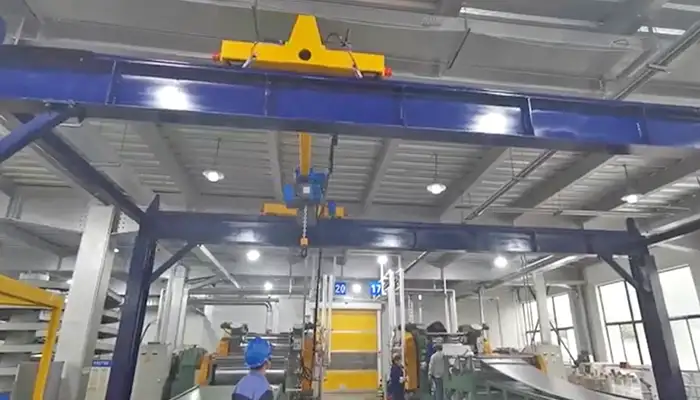 freestanding single girder bridge crane
Related Crane Specifications
| Specification | Typical Configuration |
|---|---|
| Crane Type | Freestanding Single Girder Top Running Overhead Crane |
| Application | Indoor material handling |
| Capacity | 1–20 tons |
| Span | Project dependent |
| Lifting Height | Project dependent |
| Runway | Freestanding steel runway |
| Hoist | Electric wire rope hoist |
| Control | Pendant control / Radio remote |
| Power Supply | 380/400/415 V, 50 Hz, 3-phase |
| Duty Class | ISO A3–A5 |
| Bridge Girder | Single girder |
| Runway Support | Independent columns |
| Manufacturer | Yuantai Crane |
The final crane size and runway structure are determined from the actual load, span, lifting height, travel distance, operating frequency, and workshop conditions.
What Do You Need to Specify a Freestanding Bridge Crane?
For a preliminary quotation, the following information is normally enough:
| Required Information | Example |
|---|---|
| Lifting Capacity | 5 tons |
| Crane Span | 15 m |
| Lifting Height | 6 m |
| Runway Length | 50 m |
| Working Frequency | 8 hours/day |
| Power Supply | 400 V, 50 Hz, 3-phase |
| Control | Pendant / Radio remote |
| Load Type | Steel parts, machinery, pallets, etc. |
A workshop drawing is helpful if the runway columns, foundation locations, or available lifting area need to be checked.
FAQs
1. When should I use a freestanding bridge crane?
Use a freestanding bridge crane when you need an indoor overhead lifting system but do not have a suitable building-supported runway. It is also useful when the crane needs to be kept independent from the existing building structure.
2. What capacity can a single girder freestanding bridge crane handle?
Single girder freestanding bridge cranes are commonly used for loads from 1 to 20 tons. The actual capacity depends on the span, lifting height, operating conditions, and crane duty.
3. How much does a freestanding bridge crane cost?
There is no single price because the runway structure is part of the system. The cost depends on the crane capacity, span, runway length, lifting height, hoist, controls, duty class, and foundation requirements.
For a useful quotation, provide the capacity, span, lifting height, and runway length first.
4. Does the runway need to be connected to the workshop building?
No. A freestanding runway is supported by its own columns. The building and crane runway can therefore be designed as separate structures, subject to the site and foundation conditions.
5. Can the runway be made to fit an existing workshop?
Yes. The runway length, column positions, crane span, and lifting area can be worked out from the workshop layout and the required material handling path.
6. What information should I send for a quotation?
Start with four numbers: lifting capacity, crane span, lifting height, and runway length. Add the power supply and working frequency if available. A workshop drawing is useful for a detailed design.
Related Videos
- Freestanding Runway Bridge Crane – No Corbels? No Problem!
- Yuantai 3T+3T Double Girder Overhead Crane – Maldives Timber Factory
- 2 Ton Low Headroom Free Standing Bridge Crane with Electric Chain Hoist
- 1 Ton Freestanding Overhead Crane | Top Running Overhead Crane Design
- Freestanding Bridge Crane | Single Girder Overhead Crane
- Double Girder Freestanding Bridge Crane | Indoor Crane

Article by Bella ,who has been in the hoist and crane field since 2016. Bella provides overhead crane & gantry crane consultation services for clients who need a customized overhead travelling crane solution.Contact her to get free consultation.
Yuantai Cranes
Overhead Crane Manufacturer with CE, ISO, SGS, CNEX Certificates.
- Main Specifications - Capacity: 0.5–550 tons | Span: up to 40m | Speed: 0.8–12 m/min | Duty: A3–A7 | Power: 380–690V, 50/60Hz | Control: pendant/remote/cabin
- Full engineering: FEA/PLC/VFD + in-house build + global delivery + on-site support, for workshops, factories, EPC contractors, industrial projects, etc.
- Support: design, manufacturing, testing, service – end-to-end, customized lifting solutions worldwide.
How to Get an Accurate Crane Price for Your Application?
Tips: Copy the spec list, fill in your details, and paste it into the form on the right/ down-below for a quick price.
- Crane type:_____ . (e.g., overhead crane, gantry crane, jib crane)
- Max weight to lift:_____ tons. (e.g., 2t, 5t, 10t, 20t, 50t)
- Lifting height:_____ m. (How high does the hook need to reach?
- Workshop width (span):_____ m . (Distance between the two crane rails)
- Travel distance:_____ m . (How long does the crane need to move along the runway?)
- Control type:_____. (Pendant / remote / cabin Control)
- Power supply:_____. (Local voltage & frequency – e.g., 380V, 50Hz, 3-phase)
- What will it be used for?_____ (e.g., steel fabrication, concrete products, mold handling, general manufacturing, etc.)
- Any special requirements?_____ (e.g., extreme temperature, dusty or explosive environment, special paint color, etc.)
Just leave a message via the contact form and our hoist and crane engineer will contact you with in 24working hours.
Get Your Custom Quote–Quick & Easy
Fill in what you know. Skip what you don't – we'll help.Any question will be reply with 24 working hours