Import Crane Kits from China or Build Locally?
Content Quick Link
Import Crane Kits from China or Build Locally: A Straight-Talking Guide for Crane Businesses
A practical comparison of three business models — local manufacturing, complete crane import, and crane kit or component import for local assembly — written for overseas crane manufacturers, local fabricators, crane assembly companies, and engineering contractors.
Why This Decision Comes Up So Often
Every crane business eventually faces the same pressure: more orders than the workshop can handle, and a choice between expanding the factory or importing from China. This section explains why that framing is too narrow, and why the better question is about which parts of the crane to make and which to buy.
The Question Behind the Question
Almost every overseas crane company reaches a point where the order book is fuller than the workshop can handle. The instinctive reaction is either "let's build a bigger factory" or "let's just buy the whole crane from China."
Both are expensive answers to a question that hasn't been asked properly.
The real question is narrower: which parts of the crane should we make, and which parts should we buy? Most companies that get this right end up doing both — fabricating the structures they're good at, and importing the mechanical and electrical assemblies that would cost too much to build at their volume.
This guide compares three ways of organising that split, with the technical and commercial data you need to make a decision you can defend to your board.
Who This Article Is Written For
This is not a general crane buying guide. It is written for four types of readers:
| Reader type | What they need to decide |
|---|---|
| Overseas crane manufacturers | Whether to expand in-house production or outsource components to China |
| Local steel fabricators | Whether to move into crane assembly and which components to import |
| Crane assembly companies | How to widen the product range without building every production line |
| Engineering contractors (EPC firms) | How to source crane equipment for industrial projects without owning a factory |
If you are a first-time crane buyer looking for a single crane for your own plant, this article is more detail than you need. The rest of the guide assumes you are building, assembling, or supplying cranes as a business.
Market Context: Why This Decision Matters Now
The overhead crane market is valued at USD 4.80 billion in 2026 and is projected to reach USD 7.05 billion by 2034, growing at a CAGR of 4.93%. This growth is driven by increasing adoption of smart and connected crane systems, rising demand for high load capacity material handling equipment, and growing use of automated cranes in manufacturing facilities.
China's crane export activity reflects this momentum. In September 2025 alone, China exported USD 110.7 million of gantry cranes (723 units), a year-on-year increase of 331% in value and 253% in volume. Top destinations included Singapore, Turkey, Bangladesh, Egypt, Indonesia, Brazil, and Russia. For overseas companies evaluating their manufacturing strategy, the Chinese supply chain is not a marginal option — it is a mature, export-oriented ecosystem serving diverse regulatory environments.
The Three Models, Side by Side
Here is the short version before the detail. Each model represents a different split between what you make and what you buy.
| Model | What you make | What you buy |
|---|---|---|
| A — Local manufacturing | The whole crane, in your own workshop | Raw steel, bought-in motors, electrical parts |
| B — Complete crane import | Nothing — you sell and install | A finished crane from China |
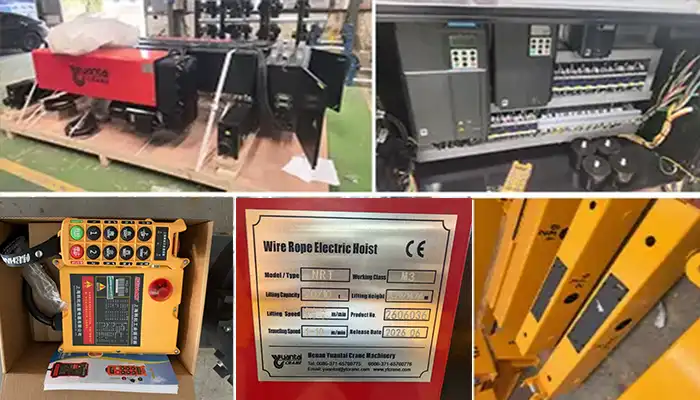
| C — Kit / component import | Bridge girders, assembly, installation | End carriages, hoists, travel drives, controls |
Sections 2 to 4 walk through each model using the same five headings: what it involves, what you need to invest, where it wins, where it hurts, and who it suits. Section 5 puts them in one table. Section 6 turns the comparison into a decision you can actually make. Section 7 covers common mistakes. Section 8 wraps up with next steps.
Model A — Manufacture Cranes Locally
Building everything in-house gives you full control, but it also means funding every production process yourself. This section breaks down what local manufacturing really requires in equipment, tolerance capability, and working capital — and where it stops making financial sense.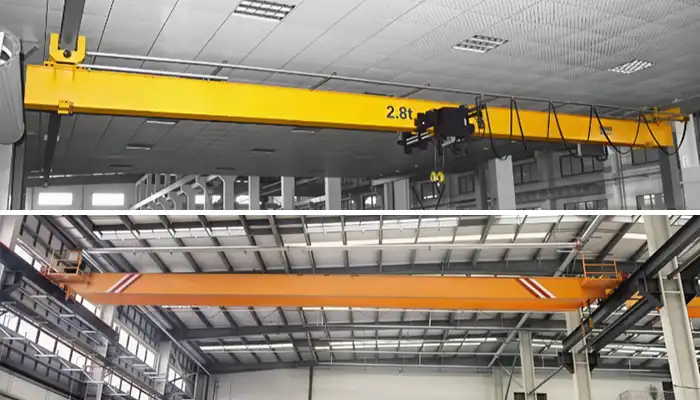 top running crane kit and underhung bridge crane kit for sale
What It Involves
You build the complete crane under your own roof: steel cutting, welding, machining, wheel production, mechanical assembly, electrical installation, and testing.
What You Need to Invest In
- Steel fabrication and welding equipment
- Large machining equipment and production tooling
- Wheel and shaft machining facilities
- Hoist and trolley manufacturing capability
- Electrical assembly and test equipment
- Floor space, skilled labour, and QC staff
Technical benchmark: End carriage and trolley frame assembly requires gauge and diagonal control to GB/T 10183-2023 tolerances: trolley rail gauge within ±2 mm, main-runner diagonal within 5 mm on spans up to 25 m and 8 mm above that, and wheel vertical and horizontal skew within L/400 on the same axle line. These are not casual fabrication tolerances — they require dedicated assembly bays, levelled set-up stations, and trained inspectors.
Where It Wins
- You control quality and delivery dates completely
- No freight bills, no customs clearance, no import duty
- Local customization is straightforward — you walk onto the floor and change the drawing
- After-sales response is fast because the people who built it are down the corridor
- Keeps skilled manufacturing jobs local and strengthens your brand
Where It Hurts
- Capital goes out long before the first crane ships
- Every new product type means another ramp-up
- Low-volume or specialised components are hard to justify financially
- Product range stays narrow unless you keep pouring money into new lines
Duty class constraint: Under FEM 9.511 / ISO 4301-1, hoist mechanisms are classified from 1Em through 5m (M1–M8) based on load spectrum and daily runtime. A mechanism rated for M5 (moderate duty, up to 4 hours daily) cannot be economically justified on a low-volume production line. The mechanism's theoretical service life ranges from 800 hours (M1) to 100,000 hours (M8) depending on load collective. Building every duty class in-house means maintaining tooling and expertise across the entire spectrum — a costly proposition for anything below high volume.
Who It Suits
- Companies that already have fabrication capacity and a steady order book
- Products where transport cost or on-site modification outweighs any import saving
- Businesses with the engineering depth to design and verify every component themselves
Model B — Import Complete Cranes from China
Buying the whole crane from a Chinese factory removes the need for a workshop entirely, but it shifts the risk to freight, customs, and compliance. This section covers what the overseas buyer actually handles, what the landed cost really looks like, and where the hidden burdens sit.
What It Involves
A Chinese factory builds the complete crane to an agreed technical scope. You take delivery and run the local side of the business.
What the Overseas Buyer Handles
- Local sales and customer relationships
- Project coordination
- Installation and commissioning
- After-sales support and spare parts, as agreed in the contract
Where It Wins
- No factory required — the lowest internal workload of the three models
- Fastest route to a full product range, including cranes you've never built
- No production line to develop for each new crane type
- Works well for distributors and engineering firms with no fabrication shop
Export cost data: For a 20-ton double-girder overhead crane, Chinese export pricing typically falls in the USD 15,000–25,000 per unit range for standard configurations, with the September 2025 gantry crane export average at USD 153,100 per unit for larger gantry systems. This price range reflects the scale advantage of Chinese manufacturers serving global markets.
Where It Hurts
- Highest freight and packaging cost per unit
- Long lead times, plus exposure to customs delays
- Less visibility into component-level quality
- Hard to customize on site once the crane has shipped
- Branding, conformity, and warranty responsibility all need to be written into the contract — verbally agreed "understandings" tend to evaporate when something goes wrong
Compliance burden: For European market access, the crane must carry CE marking under Machinery Directive 2006/42/EC. The overseas buyer must either accept the Chinese manufacturer's declaration of conformity or arrange independent verification. A certificate held by the supplier does not automatically cover every customized configuration or every destination market.
Who It Suits
- Distributors, trading companies, and engineering firms
- Projects where the buyer has no fabrication capability at all
- Standard crane configurations with predictable, repeatable demand
Model C — Import Crane Kits or Major Components for Local Assembly
The middle path: import the mechanical and electrical assemblies, build the structures yourself, and keep the assembly work local. This section explains the usual split of work, the interface tolerances that make or break a kit order, and why this model suits so many established crane businesses.
What It Involves
The Chinese factory supplies agreed components and coordinated assemblies. Your workshop completes the remaining fabrication, assembly, and commissioning.
The Usual Split of Work
| Scope | Imported from China | Made locally |
|---|---|---|
| End carriages and wheel assemblies | ✓ | |
| Hoists and hoist trolleys | ✓ | |
| Travel mechanisms, motors, gearboxes, brakes | ✓ | |
| Control panels and power supply systems | ✓ | |
| Bridge girders and gantry structures | ✓ | |
| Connection plates and mounting interfaces | ✓ | |
| Final assembly and electrical integration | ✓ | |
| Installation and commissioning | ✓ |
Where It Wins
- Balanced investment — no need to build every production line
- You keep control of structural fabrication and final assembly, which is usually where your local cost advantage sits
- Freight is lower than shipping complete cranes
- Local customization is easy because the final assembly happens in your workshop
- Faster response to local project requirements
Interface precision: Laser-cut connection plates between the end carriage and main girder can be controlled to positional tolerance within 0.5 mm. This level of precision is achievable in Chinese OEM production and eliminates the most common source of fit-up rework on the assembly floor.
Where It Hurts
- Interface coordination is critical. Connection dimensions, bolt-hole positions, and electrical interfaces all have to match, and a few millimetres of drift at the drawing stage becomes a week of rework on the floor
- Requires drawing approval and a written division of responsibility before production
- Quality responsibility is split between you and the supplier
- You still need assembly capability and skilled fitters
Technical verification required: Before releasing a kit order, confirm:
- Wheelbase and wheel diameter
- Rail gauge and rail profile (e.g., 43 kg/m or QU70)
- Connection plate dimensions and bolt-hole spacing
- Mounting hole positions
- Electrical interface and control voltage
- Maximum wheel load and structural loads
Who It Suits
- Established crane manufacturers with fabrication workshops
- Crane assembly businesses with technical staff and installation teams
- Companies wanting to widen their product range without full vertical integration
Side-by-Side Comparison
Once the three models are laid out next to each other, the trade-offs become obvious. This section puts the commercial and technical factors into two tables so you can see exactly where each model wins and loses.
The Comparison Table
The first table covers the commercial and operational factors — investment, control, freight, lead time, and suitability.
| Factor | Model A — Local manufacturing | Model B — Complete crane import | Model C — Kit / component import |
|---|---|---|---|
| Capital investment | High | Low | Medium |
| Manufacturing control | Full | Low | Partial |
| Product range flexibility | Limited without further investment | High | High |
| Freight cost per unit | None | Highest | Medium |
| Lead time | Depends on local capacity | Long (production plus shipping) | Medium |
| Customization after order | High, on site | Low once shipped | High, during local assembly |
| Quality responsibility | Fully in-house | Split / supplier-led | Split between parties |
| Skill and facility requirement | High | Low | Medium |
| Best for | Established manufacturers | Distributors, EPC firms | Assembly companies, fabricators |
Technical Comparison: What the Data Says
The second table looks at the technical parameters — duty class range, wheel load capacity, tolerance capability, and documentation responsibility.
| Technical parameter | Model A (Local) | Model B (Complete import) | Model C (Kit import) |
|---|---|---|---|
| Duty class capability | Limited to in-house design range (typically M3–M5) | Full range available (M1–M8) | Full range available (M1–M8) |
| Wheel load capacity | Constrained by local machining | 70–200 kN for 20t class | Matched to kit specification |
| End carriage tolerance | Requires dedicated bay | Factory-controlled | Achievable to ±2 mm gauge |
| CE documentation | Self-certified | Supplier-assisted | Split responsibility |
| Customization lead time | Immediate (on floor) | 8–16 weeks + shipping | 6–12 weeks + shipping |
How to Read It
No model wins on every row. Model A wins on control and lead time but loses on capital and range. Model B wins on range and upfront investment but loses on freight and control. Model C sits in the middle on most rows — which is precisely why it suits so many companies.
The right choice comes down to three things: what you can already build, how much you order, and where you want to be in five years.
Decision Framework: Which Model Fits Your Business?
This section turns the comparison into a five-step decision process. Work through the steps in order — capability first, then volume, then landed cost, then the responsibility split, and finally the growth plan.
Step 1 — Be Honest About Your Existing Capability
Ask yourself:
- Do we have steel fabrication and welding facilities?
- Can we machine wheels and shafts to the required tolerance?
- Do we have an assembly workshop and skilled fitters?
- Can we handle electrical assembly and testing?
- Do we have engineers who can review drawings and confirm interfaces?
Every "no" pushes that part of the work toward the import side of the ledger.
Step 2 — Look at Volume and Product Mix
- High volume, standard products: local manufacturing gets easier to justify
- Low volume, many product types: importing kits or complete cranes is usually more practical
- Repeat orders: a stable relationship with a Chinese OEM pays off over time
- One-off or heavily customized projects: complete crane import or project-specific manufacturing tends to fit better
Step 3 — Work Out the Full Landed Cost
Don't compare factory prices. Compare total cost:
- Local material, labour, and manufacturing expense
- Imported component or kit price
- International freight and export packaging
- Import duties, taxes, and customs clearance
- Local assembly, installation, and commissioning
- Spare parts, warranty, and after-sales support
A lower factory price can vanish once freight, duty, and local rework are added. A higher local manufacturing cost can still win if it avoids those extras. A component priced at USD 8,000 FOB can land at USD 11,000–13,000 depending on destination and clearance costs.
Step 4 — Nail Down the Responsibility Split
Before signing anything, confirm in writing:
- Who owns the design and drawings?
- Who approves drawing changes?
- Who is responsible for manufacturing quality?
- Who handles warranty claims?
- Who is responsible for product conformity and certification?
- Who pays if imported parts don't fit local structures?
Model C lives or dies on this being clear. A kit is only as good as the interface agreement behind it.
Step 5 — Match the Model to Your Growth Plan
Many companies follow a natural progression:
- Start by importing individual components — end carriages, hoists
- Expand to crane kits as assembly capability grows
- Add complete crane supply for product types you don't build
- Invest in local manufacturing only where volume and margin justify it
You don't have to pick one model forever. Start with Model C if that fits, and grow into a mix of all three as the business changes.
Common Mistakes to Avoid
Most problems in crane import projects come from a handful of recurring mistakes. This section lists the five that cost the most time and money, and explains how to sidestep each one.
Assuming Import Is Always Cheaper
The factory price is one line in the cost sheet. Freight, duty, inspection, local handling, and rework often change the picture entirely — sometimes by the time the container lands.
Importing Components Without Confirming Interface Dimensions
A 5 mm difference in bolt-hole spacing can stop an otherwise perfect end carriage from fitting your bridge girder. Approve interface drawings before production, every time. Laser-cut connection plates can hold 0.5 mm positional tolerance, but only if the drawing you approve specifies the correct dimensions.
Splitting Quality Responsibility Without a Written Agreement
If the imported hoist fails and the locally fabricated girder is also out of tolerance, who pays? Sort this out before the first order, not after the first complaint.
Underestimating Local Assembly Skill Requirements
A crane kit still needs skilled fitters, welders, and electricians. The GB/T 10183-2023 tolerance requirements for gauge and diagonal alignment are not forgiving of untrained assembly. If you don't have the skills, Model C turns out to be harder than it looked on paper.
Choosing a Model on Purchase Price Alone
The cheapest quote is not always the lowest total cost. Weigh landed cost, lead time, risk, and after-sales support together. A M5-rated hoist with a shorter theoretical service life (8,000 hours at moderate load) may appear cheaper than an M6-rated unit (16,000 hours), but the replacement cycle cost over ten years tells a different story.
Conclusion and Next Steps
This section summarises when each model makes sense, gives a recommended starting point for most overseas buyers, and lists exactly what to prepare before contacting a supplier for a quotation.
When Each Model Makes Sense
- Model A (local manufacturing): strong existing capability plus steady, high volume
- Model B (complete crane import): no fabrication capability, broad product range needed
- Model C (kit / component import): fabrication capability plus a need to widen range without full investment
A Sensible Starting Point for Most Overseas Buyers
For most overseas crane companies, Model C is the practical place to start. It keeps structural fabrication and final assembly in-house, where your local advantage is strongest, while importing the mechanical and electrical components that are harder and more expensive to build at low volume.
As volume grows and the product range settles, you can decide which components are worth bringing in-house — and which are better left to a specialist supplier.
What to Prepare Before Asking for a Quotation
For component or kit supply:
- Product type and quantity
- Drawings or reference photos
- Connection dimensions and interface requirements
- Duty classification (FEM/ISO class)
- Destination country
- Branding requirements
- Expected delivery date
For complete cranes, also include:
- Capacity, span, and lifting height
- Duty classification and expected operating hours per day
- Building or runway information
- Operating conditions (temperature, dust, hazardous area classification)
- Applicable design standards (EN, FEM, CMAA, GB/T)
Next Step
Send over your current manufacturing capability, the product range you're aiming for, and your expected order volume. With those three pieces of information, a supplier can tell you whether components, kits, or complete cranes make the most commercial sense for your business.
Frequently Asked Questions
These are the questions overseas buyers ask most often when evaluating Chinese crane suppliers. The answers are short and practical — follow the links or contact a supplier directly for project-specific guidance.
What is the difference between OEM and ODM in crane manufacturing?
OEM means the Chinese factory builds to your drawings and specifications. ODM means the factory contributes or provides the design, and you put your brand on it. Most overseas crane companies start with OEM for components and may move to ODM for complete cranes where they lack in-house design capability.
Can I import crane kits and assemble them locally under my own brand?
Yes. This is one of the most common arrangements. The Chinese factory supplies end carriages, hoists, travel drives, and controls. You fabricate the bridge girders, assemble the crane, and sell it under your own nameplate. The key is agreeing the interface dimensions — wheelbase, rail gauge, bolt-hole spacing, and electrical connections — before production starts.
What duty class should I specify for a crane kit?
It depends on how hard the crane will work. Under FEM 9.511 / ISO 4301-1, M3–M4 suits light workshop use (up to 2 hours daily), M5 covers moderate duty (up to 4 hours), M6 handles heavy duty (up to 8 hours), and M7–M8 are for continuous or near-continuous operation. Specifying a higher duty class than needed adds cost; specifying too low shortens service life. Provide your expected operating hours per day and load spectrum when requesting a quote.
What tolerances should I expect on imported end carriages?
Reputable Chinese OEM factories work to GB/T 10183-2023: trolley rail gauge within ±2 mm, diagonal within 5 mm on spans up to 25 m, and wheel skew within L/400. Laser-cut connection plates can hold 0.5 mm positional tolerance. Ask for dimensional inspection records with the shipment.
How long does it take to get a crane kit from China?
Production typically takes 6–12 weeks depending on customization and order size. Add 3–6 weeks for ocean freight and customs clearance depending on destination. Complete cranes take 8–16 weeks plus shipping. Plan for a buffer if your project has a fixed installation date.
What certifications should a Chinese crane manufacturer hold?
Look for ISO 9001 quality management system certification, CE marking under Machinery Directive 2006/42/EC for European market access, and ISO 3834-2 for welding quality. For specific projects, you may also need FEM or CMAA compliance documentation. Verify that the certificate scope covers the specific products you intend to source.
Who is responsible for CE marking if I import a complete crane?
Under the Machinery Directive, the entity placing the crane on the European market is responsible for CE conformity. If you import a complete crane and sell it under your brand, you are the responsible party. The Chinese manufacturer can provide technical documentation and test reports, but you must ensure the declaration of conformity is accurate and covers the specific configuration.
Can I get spare parts after the initial order?
Yes, but confirm this in the supply agreement. Ask for a recommended spare parts list, lead times for replacement components, and whether the manufacturer maintains stock of parts for your specific crane model. For critical components like hoist motors, gearboxes, and brakes, consider ordering a small stock of spares with the initial shipment.
What is the minimum order quantity for OEM crane components?
It varies by supplier and component type. For standard end carriages and hoists, some factories accept single-unit trial orders. For customized components or complete kits, minimum quantities may apply. If you are testing a new supplier, start with a small trial order of standard components before committing to a full kit or complete crane.
How do I verify the quality of imported crane components before shipment?
Arrange a pre-shipment inspection. This can be done by your own engineer, a third-party inspection company, or the manufacturer's QC team with your representative present. Check dimensions against approved drawings, verify material certificates, review functional test records for hoists and drives, and confirm that branding and nameplates match your requirements. For high-value orders, consider witnessing the factory acceptance test.
What are the typical payment terms for OEM crane orders from China?
Common terms are 30% deposit with order and 70% before shipment, or 30% deposit, 70% against copy of bill of lading. For repeat orders with an established supplier, you may negotiate more flexible terms. Avoid paying the full amount upfront unless you have a long-standing relationship and verified inspection process.
Can Chinese manufacturers customize cranes for different voltages and frequencies?
Yes. Most factories can configure motors, control panels, and electrical systems for 380V/50Hz, 415V/50Hz, 440V/60Hz, 480V/60Hz, and other common supply standards. Provide the required voltage, frequency, phase, and control voltage when requesting a quotation. For special requirements like 690V or hazardous-area electrical equipment, confirm the supplier's capability upfront.
Appendix
Reference material for buyers who need to check terminology, verify interface dimensions before ordering, or confirm duty class requirements against FEM and ISO standards.
Glossary
| Term | Meaning |
|---|---|
| OEM | Original Equipment Manufacturer — builds equipment for another company to sell under its own brand |
| ODM | Original Design Manufacturer — contributes or provides the product design and also handles production |
| Private label | The buyer sells the manufactured product under its own brand |
| Crane kit | A coordinated set of components and assemblies supplied for local assembly |
| End carriage | The travelling assembly at either end of an overhead crane bridge |
| Hoist trolley | The wheeled assembly that carries the hoist along the bridge girder |
| FEM 9.511 | Federation Européenne de la Manutention standard for hoist duty classification |
| ISO 4301-1 | International standard for crane and mechanism classification based on service conditions |
| GB/T 10183-2023 | Chinese national standard for overhead crane manufacturing tolerances |
Interface Checklist Before Ordering Kits
Use this checklist to confirm the dimensions and specifications that most often cause fit-up problems on the assembly floor.
| Check item | What to confirm | Typical tolerance / spec |
|---|---|---|
| Wheelbase | Distance between wheel centres on the same end carriage | Match to bridge girder connection |
| Wheel diameter | Selected according to wheel load and rail profile | Typically 250–500 mm for 5–20t class |
| Rail gauge | Distance between rail centre lines | ±2 mm per GB/T 10183-2023 |
| Rail profile | Rail type used on the runway | 43 kg/m, QU70, QU80, or as specified |
| Connection plate dimensions | Plate size and bolt-hole spacing | Laser-cut to 0.5 mm positional tolerance |
| Mounting hole positions | Bolt pattern matching bridge girder | Verify against approved drawing |
| Electrical interface | Control voltage and power supply | 24V/48V control; 380–480V power as specified |
| End carriage height and width | Overall dimensions for clearance | Match to building headroom |
| Maximum wheel load | Load per wheel under rated capacity | 70–200 kN for 20t class typical |
| Duty classification | FEM/ISO mechanism group | M3–M8 depending on application |
Sample Division-of-Responsibility Matrix
Use this matrix as a starting point for the written agreement. Adjust it to match the actual supply scope of your kit order.
| Scope item | Imported (Model C) | Local (Model C) |
|---|---|---|
| End carriages and wheels | ✓ | |
| Hoists and trolley | ✓ | |
| Travel drives and brakes | ✓ | |
| Control panels | ✓ | |
| Bridge girders | ✓ | |
| Connection plates | ✓ | |
| Final assembly | ✓ | |
| Electrical integration | ✓ | |
| Installation and commissioning | ✓ | |
| Warranty on imported parts | ✓ | |
| Warranty on local work | ✓ | |
| CE conformity documentation | Shared | Shared |
Duty Class Quick Reference (FEM 9.511 / ISO 4301-1)
Use this table to match the hoist mechanism group to the actual operating conditions. Specifying too low shortens service life; specifying too high adds unnecessary cost.
| FEM Group | ISO Class | Typical Daily Runtime | Theoretical Service Life | Typical Application |
|---|---|---|---|---|
| 1Em | M1 | Up to 0.5 hours | 800 hours | Light maintenance, occasional use |
| 2Em | M2 | Up to 1 hour | 1,600 hours | Light workshop, infrequent lifting |
| 3Em | M3 | Up to 2 hours | 3,200 hours | General workshop, assembly |
| 4Em | M4 | Up to 4 hours | 6,300 hours | Moderate duty, machinery plant |
| 5Em | M5 | Up to 8 hours | 12,500 hours | Heavy duty, steel warehouse |
| 6Em | M6 | Up to 16 hours | 25,000 hours | Continuous process, foundry |
| 7Em | M7 | Up to 24 hours | 50,000 hours | Heavy process, steel plant |
| 8Em | M8 | Continuous | 100,000 hours | Critical continuous operation |
Note: Service life values are approximate and depend on load spectrum. Always specify the duty class based on actual expected operating conditions, not on capacity alone.
Related Articles
Reference articles for overseas crane companies evaluating Chinese OEM manufacturing, covering cooperation models, kit vs. local manufacturing decisions, brand building, sourceable products, supplier selection, technical requirements, quality control, and order pricing.
Focus: Explain OEM manufacturing, how overseas companies cooperate with Chinese crane factories, what can be manufactured, and how the cooperation works.
Why it matters: Buyers need to understand whether they can use a Chinese factory as a manufacturing partner without building their own production facilities or giving up their local market and brand.
Target buyers: Local crane manufacturers, crane engineering companies, established crane distributors, and companies planning to launch their own crane product range.
Focus: Compare three business models: local manufacturing, importing complete cranes, and importing crane kits or major components for local assembly.
Why it matters: This is a practical investment decision. Buyers want to know which parts they should manufacture themselves and which parts are more suitable to source from China.
Focus: Private-label manufacturing, customer branding, nameplates, drawings, product specifications, packaging, warranty, and division of responsibilities.
Why it matters: Buyers may have their own customers and sales channels but lack the manufacturing capacity to produce every crane or component themselves. They need to know whether they can sell products under their own brand.
Focus: Explain the products buyers can source: end carriages, hoists, trolleys, travel mechanisms, wheels, motors, brakes, electrical systems, crane kits, and complete overhead and gantry cranes.
Why it matters: Many buyers know they want to source from China but are unsure how much of the crane manufacturing process they can outsource. This article helps them identify the products relevant to their business.
Focus: Factory capability, engineering team, manufacturing processes, welding and machining, assembly, testing, export experience, and supplier verification.
Why it matters: Overseas buyers face difficulty distinguishing a real manufacturer from a trading company or a supplier that outsources most of the work. They need evidence of manufacturing and engineering capability.
Focus: What buyers need to provide before production: GA drawings, capacity, span, lifting height, duty class, wheel loads, connection dimensions, motors, electrical requirements, operating environment, and applicable standards.
Why it matters: Incomplete specifications cause quotation delays, design changes, component mismatches, and problems during local assembly. This article helps buyers prepare a useful technical inquiry.
Focus: Incoming material inspection, welding, machining, component verification, assembly, functional testing, load testing where applicable, FAT, inspection reports, and third-party inspection.
Why it matters: The buyer may not be present during manufacturing. They need to know what evidence to request and how to check that the delivered products match the approved drawings and specifications.
Focus: How OEM prices are calculated, customization costs, minimum order quantities, sample orders, production lead times, export packaging, freight, Incoterms, payment terms, and warranty.
Why it matters: Buyers need to calculate the total purchasing cost, not just the factory quotation. They also need to understand whether their order volume and delivery requirements are practical.

Article by Bella ,who has been in the hoist and crane field since 2016. Bella provides overhead crane & gantry crane consultation services for clients who need a customized overhead travelling crane solution.Contact her to get free consultation.
Yuantai Cranes
Overhead Crane Manufacturer with CE, ISO, SGS, CNEX Certificates.
- Main Specifications - Capacity: 0.5–550 tons | Span: up to 40m | Speed: 0.8–12 m/min | Duty: A3–A7 | Power: 380–690V, 50/60Hz | Control: pendant/remote/cabin
- Full engineering: FEA/PLC/VFD + in-house build + global delivery + on-site support, for workshops, factories, EPC contractors, industrial projects, etc.
- Support: design, manufacturing, testing, service – end-to-end, customized lifting solutions worldwide.
How to Get an Accurate Crane Price for Your Application?
Tips: Copy the spec list, fill in your details, and paste it into the form on the right/ down-below for a quick price.
- Crane type:_____ . (e.g., overhead crane, gantry crane, jib crane)
- Max weight to lift:_____ tons. (e.g., 2t, 5t, 10t, 20t, 50t)
- Lifting height:_____ m. (How high does the hook need to reach?
- Workshop width (span):_____ m . (Distance between the two crane rails)
- Travel distance:_____ m . (How long does the crane need to move along the runway?)
- Control type:_____. (Pendant / remote / cabin Control)
- Power supply:_____. (Local voltage & frequency – e.g., 380V, 50Hz, 3-phase)
- What will it be used for?_____ (e.g., steel fabrication, concrete products, mold handling, general manufacturing, etc.)
- Any special requirements?_____ (e.g., extreme temperature, dusty or explosive environment, special paint color, etc.)
Just leave a message via the contact form and our hoist and crane engineer will contact you with in 24working hours.
Get Your Custom Quote–Quick & Easy
Fill in what you know. Skip what you don't – we'll help.Any question will be reply with 24 working hours