OEM Crane Manufacturing: Drawings & Technical Requirements
Content Quick Link
OEM Crane Manufacturing: Drawings, Specifications & Technical Requirements
A practical guide for overseas crane manufacturers, distributors, and engineering contractors sourcing from China.
Ordering a 10-ton overhead crane is not the same as ordering a 10-ton crane that fits your building, your duty cycle, and your local assembly crew. That might sound obvious. But in practice, many overseas buyers send a short message like "We need a 10-ton crane, please quote" and then wonder why the quotation has a dozen follow-up questions attached.
The truth is, a crane manufacturer in China cannot select the right hoist, end carriages, motors, or electrical panel from capacity alone. They need to know the span, lifting height, working duty, wheel loads, mounting dimensions, power supply, and operating environment. When some of that is missing, the manufacturer has to guess. And guesses during quotation turn into design changes, component mismatches, and delays during local assembly.
This guide walks you through what to prepare before you contact an OEM crane manufacturer, which drawings to send, and what technical details should be locked down before production starts. The revised edition includes specific numerical data on duty classification, wheel loads, and connection details—so you can actually use it during a technical review, not just read it once.
First, Define What You Want to Source from an OEM Crane Manufacturer
Not every overseas buyer needs a complete crane. Some manufacturers outsource only the hoisting mechanism or end carriages. Others buy complete crane kits and fabricate the main girders locally. The scope of supply should be clear from the beginning because it determines which drawings, dimensions, and technical specifications the OEM manufacturer needs.
Individual Crane Components
If you are an established crane manufacturer, you may already have your own structural design and need an OEM supplier for specific mechanical or electrical components.
Commonly sourced crane components include:
- Electric wire rope hoists and electric chain hoists
- Hoisting trolleys and traveling mechanisms
- Crane end carriages and wheel assemblies
- Crane wheels, shafts, and bearings
- Geared motors and brakes
- Couplings and transmission components
- Electrical control panels and control systems
- Crane kits and customized mechanical assemblies
For component sourcing, the most important information is usually the rated capacity, connection dimensions, mounting positions, operating speeds, motor specifications, and installation interfaces.
Take end carriages as an example. If you only provide the required wheel load, the Chinese OEM manufacturer still needs the wheelbase, wheel diameter, rail type, connection dimensions, and structural arrangement. As a reference, catalogued end carriages for 9-inch and 10-inch wheels typically use wheelbases ranging from 7 ft 6 in to 10 ft 6 in, and are rated for rails from 30 lb/yd through 80 lb/yd depending on the wheel load requirement.
Complete Overhead Crane or Gantry Crane Kits
Some overseas manufacturers prefer to fabricate the main girders locally and purchase the mechanical and electrical systems from China. A typical OEM crane kit may include:
- Electric hoist or open winch
- Hoisting trolley
- End carriages
- Long-travel drive mechanisms
- Wheels and gearboxes
- Motors and brakes
- Electrical control panel
- Cable festoon or conductor rail system
- Safety devices and accessories
In this arrangement, connection dimensions become particularly important. The imported components must fit the locally manufactured crane structure without unnecessary modifications.
Complete OEM Crane Manufacturing
If you want the Chinese manufacturer to supply the complete overhead crane or gantry crane, the technical scope is broader. The manufacturer will need to evaluate:
- Overall crane arrangement and structural dimensions
- Rated lifting capacity and working duty
- Main girder and end carriage design
- Hoisting and traveling mechanisms
- Wheel loads and runway requirements
- Electrical systems and control methods
- Operating environment and safety requirements
- Applicable design and manufacturing standards
| OEM sourcing arrangement | Main technical information required |
|---|---|
| Individual components | Component drawings, ratings, mounting dimensions, connection details |
| Complete crane kits | Crane GA drawing, wheel loads, mechanism specifications, structural interfaces |
| Complete cranes | Full crane specifications, structural design, mechanical and electrical requirements, standards |
Before requesting an OEM crane quotation, make sure both parties understand what is included in the supply scope. This avoids confusion about which components, drawings, and engineering responsibilities belong to the buyer and which belong to the manufacturer.
Essential Technical Specifications for OEM Crane Manufacturing
This is the information an OEM manufacturer will normally need to evaluate a customized crane project. Some parameters are basic selection requirements. Others directly affect structural calculations, component sizing, and manufacturing drawings.

Rated Lifting Capacity
The rated lifting capacity is the maximum load the crane is designed to lift under its specified operating conditions. Buyers should specify:
- Main hoist capacity
- Auxiliary hoist capacity, if applicable
- Whether the crane has one or two hoists
- Type of lifting attachment
- Any special load-handling requirements
For example, a 20/5-ton double-girder overhead crane has a 20-ton main hoist and a 5-ton auxiliary hoist. Both capacities need to be considered when selecting the hoisting mechanisms and designing the crane.
If the crane handles special loads—steel coils, aluminum ingots, dies, containers, or heavy machinery—provide details about the lifting attachment as well. Examples include C-hooks for steel coils, electromagnets for steel plates or scrap metal, grabs for bulk materials, spreader beams for long or oversized loads, and specialized lifting clamps for industrial production lines.
A useful point: Make clear whether the stated capacity refers to the maximum load being lifted or whether the lifting attachment is included in the rated capacity requirement. The final arrangement must comply with the applicable crane design and safety requirements.
Crane Span
The crane span is the horizontal distance between the centerlines of the two runway rails. It is one of the main dimensions affecting overhead crane design.
Buyers should provide:
- Required crane span in meters
- Distance between runway rail centerlines
- Existing runway arrangement
- Any limitations caused by building columns or other structures
- Whether the span is fixed or subject to further confirmation
Do not confuse crane span with building width. The building's internal width may be different from the actual distance between the runway rail centerlines. For existing factories, it is best to provide the runway layout or a building drawing showing the rail positions.
Lifting Height and Available Headroom
Lifting height refers to the required vertical hook travel. Headroom refers to the space needed above the hook or lifting reference point to accommodate the crane's hoisting arrangement. These dimensions should be considered together.
The manufacturer needs to know:
- Required hook lifting height
- Floor-to-runway rail height
- Available space above the runway
- Roof beam and ceiling clearances
- Required minimum hook approach
- Whether a standard or low-headroom hoist is needed
Two factories may both require a 10-ton overhead crane with a 10-meter lifting height. But if one building has limited headroom, it may require a low-headroom hoist or a different trolley arrangement. Providing only the lifting height can lead to an unsuitable crane configuration. Send the available building dimensions as well.
Working Duty Class and Load Spectrum
Working duty is one of the specifications buyers sometimes overlook. Two cranes with the same rated capacity can require very different mechanical and structural configurations depending on how frequently they operate and how heavily they are loaded.
The manufacturer needs to understand:
- Number of lifting cycles per hour
- Average load compared with rated capacity
- Operating hours per day
- Number of working shifts
- Expected service life
- Frequency of heavy-load lifting
- Required working intensity
A 10-ton overhead crane used occasionally for maintenance work does not have the same duty requirements as a 10-ton crane operating continuously in a steel factory.
Numerical Basis for Duty Classification
Duty classification is not a qualitative label alone. It corresponds to specific numerical criteria that affect motor selection, bearing life, and structural fatigue verification.
ISO 4301-1 / GB/T 3811 (A1–A8): The Chinese GB/T 3811 system, harmonized with ISO 4301-1, defines eight duty classes based on two primary parameters: the load spectrum factor (Kp) and the total number of working cycles (C) over the design life.
| Duty Class | Typical Application | Annual Operating Hours (approx.) | Load Spectrum (approx. average load / rated) | Minimum Total Cycles (C) |
|---|---|---|---|---|
| A1–A3 | Maintenance shops, installation sites, light warehousing | ≤ 200 | ≤ 25% | ≥ 16,000 (A1) |
| A4–A5 | Machining workshops, general manufacturing | 200–600 | 25%–50% | Increases progressively |
| A6–A7 | Metallurgical plants, ports, heavy fabrication | 600–2,000 | 50%–75% | Significantly higher |
| A8 | Continuous steel production, severe duty | > 2,000 | > 75% | ≥ 2,000,000 |
The load spectrum factor Kp is calculated as:
Kp = Σ (Pᵢ / Pₘₐₓ)³ × (tᵢ / T)
where Pᵢ is the individual load level, Pₘₐₓ is the rated capacity, tᵢ is the time at that load level, and T is the total operating time. This cubic relationship means that relatively few heavy lifts disproportionately increase the required duty class.
CMAA Classification (Class A through F): The American system defines six classes with specific operational descriptions that are easier to apply without detailed cycle counting.
| CMAA Class | Service Description | Typical Application | Lifts per Hour (guideline) | Load Level |
|---|---|---|---|---|
| A | Standby / infrequent | Power plants, motor rooms | Long idle periods | Slow, precise handling |
| B | Light service | Repair shops, light warehousing | Up to 5 | Up to rated capacity |
| C | Moderate service | Machine shops | Up to 10 | Average 50% of rated |
| D | Heavy service | Foundries, container yards | Constant operation | 50% of rated constantly |
| E | Severe service | Scrap yards, cement mills | 20+ | At or near rated capacity |
| F | Continuous severe | Custom specialty cranes | Non-stop | Near maximum under extreme conditions |
FEM Classification (1Dm through 5m): The European system uses load spectrum and operating time to assign classes to hoists, trolleys, and bridge motors separately. The progression runs from 1Dm/1Cm (standby) through 1Bm (light), 1Am (light-medium), 2m (medium-heavy), 3m (heavy), to 4m/5m (severe).
Critical point: ISO, FEM, GB/T, and CMAA classifications are not directly interchangeable. A crane designed to CMAA Class C does not automatically satisfy FEM 2m or GB/T A5 requirements. If your project requires a specific classification, state the standard and class explicitly in the inquiry.
For buyers who do not have a confirmed duty class, provide the actual operating conditions: cycles per hour, average load as a percentage of capacity, daily operating hours, and design life in years. The OEM engineering team can then perform the classification calculation and recommend the appropriate class.
Wheel Loads and Wheelbase
Wheel load is important for both crane design and the supporting building structure. The maximum wheel load is the load transmitted through an individual crane wheel to the runway rail under a specified loading condition.
Buyers should confirm or request the following information:
- Maximum wheel load
- Minimum wheel load, where required
- Number of wheels
- Wheel arrangement
- Wheelbase
- Crane dead weight
- Rail type and rail size
- Applicable dynamic and load combination requirements
Why Wheel Load Data Must Be Specific, Not Approximate
The wheel load affects the design and verification of runway beams, building columns, crane rails, end carriages, wheel assemblies, and bearings. For an existing factory, the building engineer may need the maximum wheel load before approving installation.
CMAA Equivalent Durability Wheel Load: Under CMAA Specification 70, the allowable wheel load is not simply a static maximum. It is an equivalent durability wheel load that accounts for the cumulative fatigue effect over the crane's design life. Catalogued end trucks are assigned durability wheel load ratings based on wheel diameter, wheelbase, and rail size. When the actual calculated wheel load exceeds the catalogued equivalent durability value, the actual equivalent durability wheel load must be recalculated according to CMAA 70 paragraph 4.13.
| Wheel Diameter | Wheelbase | Rail Size | Equivalent Durability Wheel Load (lbs) | Approx. (kN) |
|---|---|---|---|---|
| 8 in | 7 ft 6 in | 30 lb/yd | 12,747 | 56.7 |
| 8 in | 7 ft 6 in | 40 lb/yd | 14,990 | 66.7 |
| 8 in | 7 ft 6 in | 60 lb/yd | 20,986 | 93.4 |
| 8 in | 7 ft 6 in | 80 lb/yd | 22,485 | 100.0 |
For 15-inch and 18-inch wheel diameter end trucks, the maximum allowable bending moment is 1,907,000 in-lbs and 3,554,000 in-lbs respectively, and the minimum bridge end truck wheelbase is equal to 1/7 of the span or the gage plus 36 inches, whichever is greater.
Practical implication for OEM buyers: When you specify a required capacity and span, the OEM manufacturer calculates the wheel loads. But if you are purchasing end carriages separately for a locally fabricated bridge, you must provide the OEM with the calculated maximum and minimum wheel loads, not just the crane capacity. The relationship between crane capacity and wheel load depends on the bridge dead weight, trolley position, and span—factors the end carriage manufacturer cannot determine from capacity alone.
Connection and Mounting Dimensions
This section is particularly important when purchasing crane components for local assembly. A component may have the correct rated capacity and motor power but still fail to fit the existing structure because the mounting dimensions are different.
Depending on the product, the OEM manufacturer may need:
- End carriage connection dimensions
- Main girder connection plate dimensions
- Bolt hole positions and diameters
- Hoist mounting dimensions
- Trolley rail dimensions
- Wheel diameter and rail compatibility
- Shaft diameter and coupling dimensions
- Motor mounting arrangement
- Installation tolerances
- Required bolt grades and connection details
High-Strength Bolt Specifications for End Carriage Connections
End carriage-to-girder connections are typically made with high-strength bolts. The specific grade, size, lubrication, and tightening requirements are not optional details—they determine whether the connection maintains preload under dynamic crane loads.
| Item | Specification |
|---|---|
| Bolt grade | 10.9 (hexagonal head) |
| Surface treatment | Zinc-flake (tZn), high-voltage |
| Size | M20 |
| Washer | C 45, HV, tZn, HV 21 |
| Lubrication | MoS₂ (molybdenum disulfide) |
| Nut | High-tensile, galvanized, MoS₂ lubricated |
Reuse limits: High-tensile bolts and mounting plates may only be installed with tightening torque a maximum of two times. If installed more than twice with tightening torque, the bolts and mounting plates must be scrapped. If it becomes necessary to loosen the bolts during installation, the same bolts may be reused one additional time maximum—otherwise the lubrication is no longer sufficient. Bolts that have been installed on a crane for a lengthy period may not be reused.
Installation sequence: The end carriages should initially be manually screwed until hand-tight. Final tightening to the specified torque is performed only after the crane is on the track and the trolley and all other components are installed. This allows the main girders to settle and prevents the crane from being warped on the track.
Positional tolerance: For precision OEM connections, laser-cut connection plates can achieve positional tolerance within 0.5 mm, with rigid connection via 10.9-grade high-strength bolts to ensure the geometric integrity of the bridge structure.
When ordering a 10-ton electric hoist trolley, provide the runway or girder interface dimensions, available installation space, and required trolley arrangement. When ordering end carriages, provide the wheelbase, wheel diameter, rail profile, connection plate dimensions, and the distance between the supporting connection points. Do not rely on product names or capacity ratings alone. Actual dimensions should be checked against the buyer's drawings before production.
Hoisting and Traveling Speeds
The required operating speeds affect motor power, gearbox selection, braking arrangements, and control systems. Specify the following speeds separately:
| Movement | Information required |
|---|---|
| Main hoisting | Required lifting speed |
| Auxiliary hoisting | Required lifting speed, if applicable |
| Cross travel | Trolley traveling speed |
| Long travel | Crane traveling speed |
Also indicate whether you require single-speed operation, dual-speed operation, variable frequency drive (VFD), smooth acceleration and deceleration, accurate positioning, or synchronized operation for multiple hoists. For production lines and precision handling applications, VFD control may be required to provide smoother starting, stopping, and positioning.
Operating Environment
The operating environment affects component selection, motor protection, electrical equipment, materials, and sometimes the crane's entire design. Do not simply write "indoor use" or "outdoor use." Give the actual working conditions wherever possible.
| Environmental condition | Information to provide |
|---|---|
| Temperature | Minimum and maximum ambient temperature |
| Humidity | Normal humidity and condensation risk |
| Dust | Steel dust, cement dust, grain dust, or other particles |
| Corrosion | Coastal exposure, chemicals, or corrosive atmosphere |
| Hazardous areas | Gas or dust classification and zone information |
| Outdoor operation | Rain, wind, sunlight, and icing conditions |
| High-temperature areas | Furnace radiation, hot materials, or elevated ambient temperature |
Different industrial applications have different requirements. Steel plants may require protection against high temperatures, metal dust, and intensive operation. Chemical plants may require corrosion-resistant components or explosion-protected electrical equipment. Oil and gas facilities may require cranes designed for classified hazardous areas. Outdoor gantry cranes may need wind-resistant design, rain protection, and suitable electrical enclosures. Cement and mining plants may require additional protection against abrasive dust.
For explosion-proof crane projects, provide the hazardous area classification, gas or dust group, temperature class, and required equipment protection level. These details must be reviewed against the applicable standards before selecting the explosion-protected motors and electrical components.
What Drawings Should You Send to an OEM Crane Manufacturer?
Technical specifications tell the manufacturer what the crane needs to do. Engineering drawings show how the crane or its components need to fit together. For custom overhead crane manufacturing, drawings are particularly important when the project involves existing buildings, customized components, or local fabrication. You do not necessarily need to prepare every manufacturing drawing yourself. However, providing the available GA drawings, component drawings, and interface dimensions will make the technical review much easier.
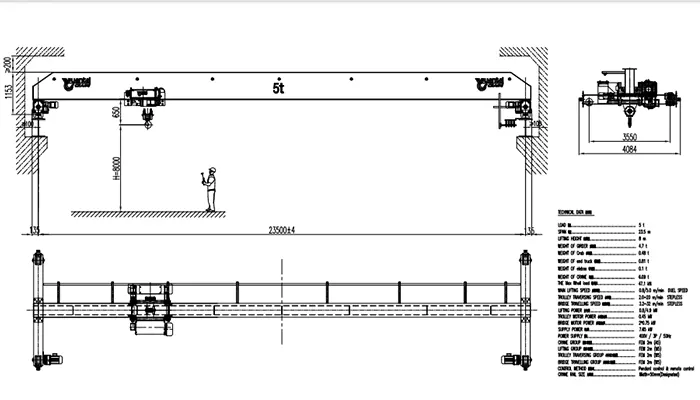
Crane General Arrangement (GA) Drawing
The crane GA drawing is usually the most useful starting point for a complete crane or crane kit inquiry. It should show the overall crane configuration and major dimensions. A typical overhead crane GA drawing includes:
- Overall crane span
- Main girder arrangement
- End carriage dimensions
- Crane overall length and width
- Hook lifting height
- Overall crane height
- Headroom and hook approach
- Hoist and trolley arrangement
- Wheel positions
- Runway rail positions
- Relevant building clearances
For existing factory projects, a building layout or runway drawing is also helpful. The manufacturer can use this information to check the installation space and identify possible dimensional conflicts before preparing the final crane design.
Component and Assembly Drawings
If you are sourcing individual crane components or complete crane kits, component drawings are just as important as the GA drawing. Common drawings include:
| Component | Useful drawing information |
|---|---|
| End carriage | Overall dimensions, wheelbase, wheel diameter, connection plates |
| Electric hoist | Mounting dimensions, trolley arrangement, lifting height |
| Hoisting trolley | Wheel arrangement, rail dimensions, mounting interfaces |
| Wheel assembly | Wheel diameter, shaft dimensions, bearings, material |
| Travel mechanism | Motor, gearbox, coupling, mounting dimensions |
| Motor and gearbox | Output shaft, mounting position, connection dimensions |
| Electrical cabinet | Overall dimensions, cable entry, installation arrangement |
If you are purchasing an OEM end carriage for a locally fabricated overhead crane, the manufacturer needs more than the required capacity. The connection arrangement and actual structural dimensions must also be checked.
Structural and Connection Drawings
For buyers manufacturing crane structures locally, structural drawings help ensure that imported components can be installed correctly. Useful information includes:
- Main girder cross-section
- Girder end connection details
- End carriage connection plates
- Bolt hole positions
- Plate thickness
- Weld details
- Rail and wheel interfaces
- Structural material specifications
- Fabrication and installation tolerances
If the main girders are manufactured locally while the end carriages and hoisting systems come from China, both parties should agree on the connection dimensions before production. This is one of the most important steps in avoiding assembly problems.
Existing Crane Drawings for Replacement or Modification Projects
If you are purchasing replacement crane parts, provide the original drawings whenever available. Useful documents include:
- Original crane GA drawing
- Existing component assembly drawings
- Motor and gearbox nameplate photographs
- Hoist identification information
- Wheel and rail dimensions
- Mounting measurements
- Photographs of the installation position
What if you do not have the original drawings? That is fairly common with older cranes. You can start by providing clear photographs, nameplate information, and actual measurements. The OEM manufacturer can conduct an initial assessment and identify the missing dimensions. Critical interfaces should still be measured and verified before manufacturing replacement components.
Mechanical and Electrical Requirements for OEM Crane Manufacturing
After confirming the basic crane specifications and drawings, the next step is to define the mechanical and electrical configuration. These requirements directly affect the selection of hoists, motors, gearboxes, brakes, control panels, and other crane components.
Hoisting Mechanism Requirements
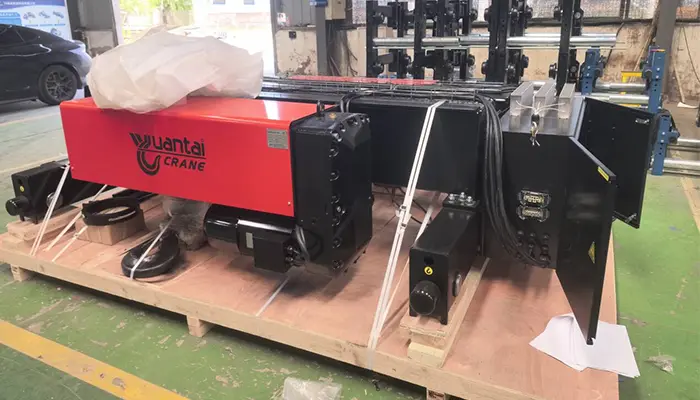
The required hoisting mechanism depends on lifting capacity, lifting height, duty class, and operating conditions. Common configurations include:
- Electric wire rope hoists
- Electric chain hoists
- Open winch systems
- Standard hoisting trolleys
- Low-headroom hoisting systems
- Customized dual-hoist arrangements
| Parameter | Required information |
|---|---|
| Hoist type | Wire rope hoist, chain hoist, or open winch |
| Capacity | Rated lifting capacity |
| Lifting height | Required hook travel |
| Hoisting speed | Single-speed, dual-speed, or VFD |
| Rope arrangement | Reeving and rope configuration, where specified |
| Brake | Required braking arrangement |
| Duty | Applicable working duty classification |
| Installation | Mounting and trolley arrangement |
For a replacement hoist project, existing mounting dimensions and the available installation space should be checked carefully.
Motor and Gearbox Specifications
Motor requirements should be confirmed before ordering OEM crane components. A motor that has the correct power rating may still be unsuitable if the voltage, frequency, speed, mounting arrangement, or protection rating does not match the project.
| Parameter | Typical information to specify |
|---|---|
| Motor power | kW |
| Voltage | 380 V, 400 V, 415 V, 440 V, 480 V, etc. |
| Frequency | 50 Hz or 60 Hz |
| Phase | Single-phase or three-phase |
| Speed | Motor speed in rpm |
| Protection rating | IP54, IP55, IP65, etc. |
| Insulation class | F, H, or project-specific |
| Duty rating | Based on operating requirements |
| Brake | Type and braking requirements |
| Mounting | Flange, foot-mounted, or customized arrangement |
Also specify whether you require IEC standard motors, particular motor brands, or components compatible with existing equipment. For international buyers, voltage and frequency deserve particular attention. A motor designed for a 380 V, 50 Hz supply should not automatically be assumed suitable for a 480 V, 60 Hz installation.
Electrical System and Control Requirements
The electrical configuration should match the local power supply and the way the crane will be operated. Important details include:
- Power supply voltage and frequency
- Three-phase or single-phase supply
- Conductor bar or cable reel power supply
- Cable festoon system
- Pendant control or radio remote control
- VFD control
- Electrical control cabinet
- Limit switches
- Overload protection
- Emergency stop
- Anti-collision devices
- Audible and visual warning devices, where required
A crane operating in a factory with multiple lifting stations may require radio remote control, while a simpler workshop crane may use pendant control. The electrical requirements should be confirmed for the actual installation country and project. Do not leave the manufacturer to assume the local power supply.
Which Crane Design and Manufacturing Standards Should Buyers Specify?
International OEM crane projects may involve several different design and manufacturing standards. The buyer should identify the required standards at the inquiry stage, especially when the crane will be installed in a regulated industrial facility or supplied to a project with specific engineering requirements.
| Standard | Main application |
|---|---|
| ISO 4301-1 | Classification based on working cycles and load spectrum |
| FEM 1.001 | Crane design and classification |
| GB/T 3811 | Chinese crane design rules |
| GB/T 14405 | General overhead cranes |
| GB/T 14406 | General gantry cranes |
| EN 15011 | Bridge and gantry cranes |
| CMAA 70 | Top-running bridge and gantry-type multiple-girder cranes |
| CMAA 74 | Top-running and under-running single-girder electric traveling cranes |
The standards used for design, manufacturing, inspection, and certification should be distinguished. For example, a project may require:
- Crane design according to EN 15011
- Electrical components meeting applicable IEC requirements
- CE conformity assessment under the applicable EU legislation
- Third-party inspection before shipment
- Specific load testing and documentation
For projects in applicable Eurasian Economic Union markets, buyers may also need to confirm EAC conformity requirements.
One important point: CE, ISO 9001, SGS inspection, and other certificates serve different purposes. An ISO 9001 quality management certificate does not by itself demonstrate that a particular crane design complies with the required crane safety standards. If your project requires CE, EAC, or third-party certification, specify the exact requirement and applicable scope before placing the OEM order.
What Problems Can Incomplete Crane Specifications Cause?
Incomplete technical information is one of the main reasons OEM crane projects require additional clarification after the initial quotation. Sometimes the missing detail seems minor, but it can affect the entire component arrangement.
| Missing information | Possible problem |
|---|---|
| No GA drawing | Incorrect assumptions about installation dimensions |
| Unconfirmed span | Main girder redesign |
| Missing lifting height | Hoist or trolley configuration mismatch |
| Unclear duty class | Incorrect mechanism or motor selection |
| Missing wheel loads | Runway and building design problems |
| No mounting dimensions | Components may not fit the local structure |
| Unclear voltage or frequency | Motor and electrical equipment mismatch |
| Undefined operating environment | Inadequate equipment protection |
| Unspecified design standards | Technical revisions and compliance issues |
| No connection drawings | Delays during local assembly |
Consider an overseas crane manufacturer purchasing end carriages and hoisting mechanisms from China while fabricating the main girders locally. If the end carriage connection dimensions are not confirmed before production, the locally manufactured girder may not match the imported end carriage. The buyer may then need to modify the girder connection plates or request changes to the OEM components. Either way, it adds work and can delay assembly.
A similar situation can occur with hoists. A hoist may meet the required capacity and lifting height but still be unsuitable because its overall dimensions and hook approach do not match the available building space. The practical solution is straightforward: identify the critical dimensions and technical interfaces before approving the manufacturing drawings.
How to Prepare a Complete OEM Crane Technical Inquiry
You do not need to have every engineering detail finalized before contacting an OEM crane manufacturer. For an initial quotation, the manufacturer can work with preliminary specifications and available drawings. The important thing is to distinguish confirmed information from items that still need engineering review.
Define the Scope of Supply
State whether you need individual crane components, an overhead crane kit, a gantry crane kit, a complete overhead crane, a customized industrial crane system, or replacement parts for an existing crane. Also clarify which parts will be manufactured locally and which will be supplied by the Chinese OEM manufacturer.
Provide Basic Crane Specifications
At a minimum, include crane type, rated capacity, span, lifting height, duty class (if known), required hoisting and traveling speeds, indoor or outdoor operation, and operating environment. These details allow the manufacturer to make an initial technical assessment.
Attach Available Engineering Drawings
Send the GA drawing first if available. For component sourcing and local assembly, also include component assembly drawings, mounting drawings, connection details, existing crane drawings, and building or runway layout. If you only have preliminary sketches, send them along with the available dimensions. The engineering team can identify what else is needed.
Confirm Mechanical and Electrical Requirements
Specify motor power, voltage, frequency, speed, brake requirements, control methods, and power supply arrangements. If you have a preferred component brand or an existing electrical system that must be retained, mention it at this stage.
Identify Standards and Inspection Requirements
State the required crane design standards, manufacturing standards, inspection scope, load testing, and certification documents. This is especially important for EPC projects and industrial facilities with strict procurement specifications.
Confirm Local Assembly Requirements
For overseas crane manufacturers, this step deserves particular attention. Confirm which components will be supplied by the OEM, which structural parts will be fabricated locally, connection dimensions and tolerances, required assembly drawings, local electrical requirements, installation and commissioning responsibilities, and testing and handover documentation. The goal is to make sure the imported components and locally manufactured structures work together as one complete crane system.
OEM Crane Technical Specification Checklist: What to Send Your Manufacturer
Before sending an RFQ (Request for Quotation), use the following checklist to check whether the main technical information is available.
| Information category | Details to provide |
|---|---|
| Project information | Industry, application, installation country |
| Crane configuration | Overhead crane, gantry crane, jib crane, etc. |
| Rated capacity | Main hoist and auxiliary hoist capacity |
| Crane dimensions | Span, lifting height, headroom, overall dimensions |
| Working conditions | Duty class, load spectrum, working hours |
| Wheel arrangement | Number of wheels, wheelbase, wheel loads |
| Structural interfaces | Girder connections, mounting dimensions, rail details |
| Hoisting system | Hoist type, lifting speed, reeving |
| Traveling system | Cross-travel and long-travel speeds |
| Motors | Power, voltage, frequency, speed, protection rating |
| Electrical system | Power supply, control method, VFD, safety devices |
| Operating environment | Temperature, humidity, dust, corrosion, hazardous areas |
| Design standards | ISO, FEM, GB/T, EN, CMAA, or project-specific |
| Drawings | GA drawings, assembly drawings, connection drawings |
| Quality requirements | Inspection, testing, certificates, documentation |
| Supply scope | Components, crane kit, or complete crane |
You do not have to complete every item before making an initial inquiry. If a specification is unknown, mark it as pending confirmation. For example, if the duty classification has not been determined, provide the number of working hours, lifting cycles, and typical load conditions. The OEM engineering team can review the information and advise on the appropriate configuration.
A clear technical inquiry is much more useful than a short message saying, "We need a 10-ton overhead crane. Please send your best price."
What Should You Expect from an OEM Crane Manufacturer After Sending Your Inquiry?
The technical review should not stop at receiving your drawings and sending a price. A capable OEM crane manufacturer should review the information, identify missing details, and confirm the technical arrangement before production.
Technical Review and Feasibility Assessment
The engineering team should check rated capacity and duty requirements, span and lifting height, crane structure and installation dimensions, wheel loads and mechanical arrangement, hoisting and traveling mechanisms, electrical compatibility, operating environment, and applicable design standards. If some information is missing or inconsistent, the manufacturer should raise technical questions rather than make assumptions about critical parameters.
Technical Clarification and Drawing Confirmation
After the initial review, the manufacturer may need to discuss missing dimensions, component selection, structural connection details, motor and gearbox specifications, hoist and trolley arrangement, electrical configuration, and safety and inspection requirements. For customized crane manufacturing, the manufacturer may also prepare or revise the GA drawing and relevant component drawings.
Design Approval Before Production
Before manufacturing begins, the buyer should review the relevant technical documents and confirm that the design matches the agreed project requirements. Depending on the scope of supply, these documents may include approved GA drawings, component assembly drawings, structural connection drawings, technical specifications, electrical diagrams, bill of materials, and inspection and testing requirements.
Drawing revisions should be controlled so that both the buyer and manufacturer are working with the same approved version. This is particularly important when multiple suppliers are involved or when the buyer is manufacturing part of the crane locally.
Manufacturing, Inspection and Testing
Once the technical details and drawings are approved, manufacturing can proceed according to the agreed scope. Depending on the product, manufacturing quality control may include:
- Raw material and component inspection
- Structural fabrication checks
- Machining and dimensional inspection
- Mechanical assembly checks
- Motor and electrical testing
- Functional testing
- Load testing where applicable
- Final inspection and documentation
For OEM crane component orders, the inspection scope should be agreed upon in advance. The requirements for an individual wheel assembly are obviously different from those for a complete overhead crane.
Frequently Asked Questions About OEM Crane Drawings and Technical Specifications
Below are the most common questions buyers ask when sourcing OEM crane components and complete cranes from China, covering quotation inputs, drawing requirements, wheel load data, standards, local assembly, and drawing approval.
What information is needed for an OEM crane quotation?
For an initial OEM crane quotation, provide the crane type, rated capacity, span, lifting height, working duty, operating environment, and power supply requirements. If you are sourcing components, also provide the relevant component drawings, mounting dimensions, and connection details. For a complete crane project, a GA drawing and building layout are particularly helpful.
What drawings should I send to a crane manufacturer?
Start with the crane GA drawing if available. You can also provide component assembly drawings, structural connection drawings, and electrical diagrams. For replacement crane parts, include original equipment drawings, nameplate photographs, and actual installation measurements.
Can an OEM manufacturer design a crane without an existing GA drawing?
Yes. An OEM crane manufacturer can develop a preliminary design based on the project requirements and available building dimensions. You will need to provide the basic information, including lifting capacity, span, lifting height, available headroom, runway arrangement, duty requirements, and operating conditions. The engineering team can then prepare a preliminary arrangement for review.
What is the difference between a crane GA drawing and a component drawing?
A GA drawing shows the overall crane arrangement, including its major dimensions, structural layout, and installation configuration. A component drawing focuses on an individual part or assembly, such as an end carriage, hoist, trolley, or wheel assembly. It shows the detailed dimensions and interfaces required for manufacturing and installation. Both types of drawings are important for customized OEM crane manufacturing.
Why do crane manufacturers need wheel load information?
Wheel loads are required to evaluate the forces transferred from the crane to the runway rails and supporting structure. Structural engineers use this information to check runway beams, building columns, rail arrangements, and supporting connections. Under CMAA 70, the applicable value is often the equivalent durability wheel load, which accounts for fatigue over the design life—not just the static maximum load. Catalogued end trucks have published durability ratings, and if the calculated load exceeds the catalogued value, a project-specific calculation is required. It is also important when selecting end carriages and wheel assemblies for an OEM crane project.
Can I purchase crane components based on existing drawings?
Yes, provided the drawings are accurate and contain the necessary dimensions. The OEM manufacturer should review the component ratings, mounting dimensions, mechanical interfaces, and operating conditions before confirming compatibility. For older cranes, actual measurements should be checked because the existing equipment may have been modified over time.
Which standards should I specify when sourcing OEM overhead crane components from China?
Commonly referenced standards include ISO, FEM, GB/T, EN, and CMAA. The correct requirements depend on the crane type, project location, design specification, and applicable regulations. Make sure you clarify whether the requirement applies to crane design, component manufacturing, electrical equipment, inspection, or certification.
Can Chinese OEM manufacturers supply crane components for local assembly?
Yes. Overseas crane manufacturers can source components and complete crane kits from Chinese OEM suppliers while fabricating structural parts locally. Commonly outsourced products include hoists, end carriages, wheels, motors, gearboxes, brakes, traveling mechanisms, and electrical systems. The key is to confirm interface dimensions, connection drawings, component ratings, and local electrical requirements before production.
What if I only have photographs and measurements of my existing crane?
You can start with clear photographs, equipment nameplates, and actual measurements. The manufacturer can use these materials for an initial technical assessment and identify which additional dimensions or drawings are required. For critical components, do not rely on photographs alone. Mounting positions, connection dimensions, and other important interfaces should be measured and verified.
Should technical drawings be approved before OEM crane production?
Yes. Relevant manufacturing and assembly drawings should be reviewed and approved before production starts. This helps both parties confirm dimensions, component arrangements, connection details, and the agreed scope of supply. For customized OEM projects, drawing approval and revision control are important parts of production management.
How do I determine the correct duty class if I don't know it?
Use the numerical criteria described in Section 2.4.1. At minimum, provide: (1) average lifts per hour, (2) average load as a percentage of rated capacity, (3) daily operating hours, and (4) expected design life. With these four inputs, the OEM can calculate the load spectrum factor and compare it against the ISO/GB or CMAA classification tables. For a rough first estimate, refer to the application-based tables in Section 2.4.1.
What bolt grade and tightening procedure should be used for end carriage connections?
Production cranes commonly use grade 10.9 high-strength bolts (M20 or project-specific size) with zinc-flake coating and MoS₂ lubrication. Nuts and washers must match the lubrication specification. Bolts may only be torque-tightened twice maximum; if loosened, one additional reuse is permitted. Final torque is applied only after the crane is on the track and all components are installed, allowing the girders to settle. Always confirm the specific bolt specification with the OEM, because it may vary with crane size and design standard.
Looking for a Chinese OEM Crane Manufacturer?
Whether you are sourcing individual crane components, complete overhead crane kits, or customized crane systems, the technical details need to be checked before production.
Yuantai Crane supports overseas crane manufacturers, distributors, and engineering contractors with OEM crane manufacturing and component supply. Our product and engineering scope includes:
- Single-girder and double-girder overhead crane systems
- Gantry crane systems
- Electric wire rope hoists and hoisting trolleys
- Crane end carriages and wheel assemblies
- Crane traveling mechanisms
- Motors, gearboxes, and brakes
- Crane electrical systems and control equipment
- Customized crane kits and mechanical assemblies
If you already have GA drawings, component drawings, or a preliminary project specification, send them to our engineering team for review. We can help check the technical requirements, review component compatibility, and identify the dimensions and specifications that need confirmation before manufacturing.
Contact Yuantai Crane for OEM crane manufacturing, customized crane components, and technical support from China.
This guide is intended for technical reference during OEM crane sourcing. Always confirm final specifications against the applicable design standard and project requirements.
Related Articles
Reference articles for overseas crane companies evaluating Chinese OEM manufacturing, covering cooperation models, kit vs. local manufacturing decisions, brand building, sourceable products, supplier selection, technical requirements, quality control, and order pricing.
Focus: Explain OEM manufacturing, how overseas companies cooperate with Chinese crane factories, what can be manufactured, and how the cooperation works.
Why it matters: Buyers need to understand whether they can use a Chinese factory as a manufacturing partner without building their own production facilities or giving up their local market and brand.
Target buyers: Local crane manufacturers, crane engineering companies, established crane distributors, and companies planning to launch their own crane product range.
Focus: Compare three business models: local manufacturing, importing complete cranes, and importing crane kits or major components for local assembly.
Why it matters: This is a practical investment decision. Buyers want to know which parts they should manufacture themselves and which parts are more suitable to source from China.
Focus: Private-label manufacturing, customer branding, nameplates, drawings, product specifications, packaging, warranty, and division of responsibilities.
Why it matters: Buyers may have their own customers and sales channels but lack the manufacturing capacity to produce every crane or component themselves. They need to know whether they can sell products under their own brand.
Focus: Explain the products buyers can source: end carriages, hoists, trolleys, travel mechanisms, wheels, motors, brakes, electrical systems, crane kits, and complete overhead and gantry cranes.
Why it matters: Many buyers know they want to source from China but are unsure how much of the crane manufacturing process they can outsource. This article helps them identify the products relevant to their business.
Focus: Factory capability, engineering team, manufacturing processes, welding and machining, assembly, testing, export experience, and supplier verification.
Why it matters: Overseas buyers face difficulty distinguishing a real manufacturer from a trading company or a supplier that outsources most of the work. They need evidence of manufacturing and engineering capability.
Focus: What buyers need to provide before production: GA drawings, capacity, span, lifting height, duty class, wheel loads, connection dimensions, motors, electrical requirements, operating environment, and applicable standards.
Why it matters: Incomplete specifications cause quotation delays, design changes, component mismatches, and problems during local assembly. This article helps buyers prepare a useful technical inquiry.
Focus: Incoming material inspection, welding, machining, component verification, assembly, functional testing, load testing where applicable, FAT, inspection reports, and third-party inspection.
Why it matters: The buyer may not be present during manufacturing. They need to know what evidence to request and how to check that the delivered products match the approved drawings and specifications.
Focus: How OEM prices are calculated, customization costs, minimum order quantities, sample orders, production lead times, export packaging, freight, Incoterms, payment terms, and warranty.
Why it matters: Buyers need to calculate the total purchasing cost, not just the factory quotation. They also need to understand whether their order volume and delivery requirements are practical.

Article by Bella ,who has been in the hoist and crane field since 2016. Bella provides overhead crane & gantry crane consultation services for clients who need a customized overhead travelling crane solution.Contact her to get free consultation.
Yuantai Cranes
Overhead Crane Manufacturer with CE, ISO, SGS, CNEX Certificates.
- Main Specifications - Capacity: 0.5–550 tons | Span: up to 40m | Speed: 0.8–12 m/min | Duty: A3–A7 | Power: 380–690V, 50/60Hz | Control: pendant/remote/cabin
- Full engineering: FEA/PLC/VFD + in-house build + global delivery + on-site support, for workshops, factories, EPC contractors, industrial projects, etc.
- Support: design, manufacturing, testing, service – end-to-end, customized lifting solutions worldwide.
How to Get an Accurate Crane Price for Your Application?
Tips: Copy the spec list, fill in your details, and paste it into the form on the right/ down-below for a quick price.
- Crane type:_____ . (e.g., overhead crane, gantry crane, jib crane)
- Max weight to lift:_____ tons. (e.g., 2t, 5t, 10t, 20t, 50t)
- Lifting height:_____ m. (How high does the hook need to reach?
- Workshop width (span):_____ m . (Distance between the two crane rails)
- Travel distance:_____ m . (How long does the crane need to move along the runway?)
- Control type:_____. (Pendant / remote / cabin Control)
- Power supply:_____. (Local voltage & frequency – e.g., 380V, 50Hz, 3-phase)
- What will it be used for?_____ (e.g., steel fabrication, concrete products, mold handling, general manufacturing, etc.)
- Any special requirements?_____ (e.g., extreme temperature, dusty or explosive environment, special paint color, etc.)
Just leave a message via the contact form and our hoist and crane engineer will contact you with in 24working hours.
Get Your Custom Quote–Quick & Easy
Fill in what you know. Skip what you don't – we'll help.Any question will be reply with 24 working hours