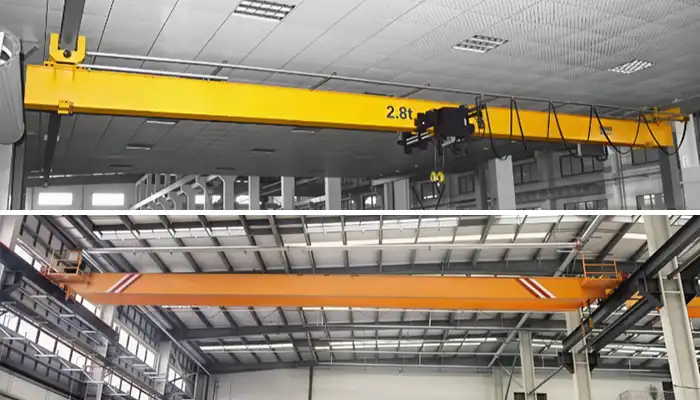
OEM Crane Manufacturing in China: A Guide for Overseas Buyers
Content Quick Link
Building a crane manufacturing business takes more than engineering know-how and a sales network. You also need production facilities, fabrication equipment, machining capability, skilled workers, reliable component suppliers, and a solid quality control system.
For many overseas crane companies, investing in every single step of production just doesn't make sense. Some already have local workshops and experienced engineers but prefer to buy hoists, end carriages, travel mechanisms, and other crane components from specialized manufacturers. Others want to widen their product range without building extra production lines.
That's where OEM crane manufacturing in China comes in. By teaming up with a Chinese crane manufacturer, an overseas company can outsource selected components, crane kits, or complete crane systems while still managing its own customers, brand, local projects, and after-sales service.
Market context: The global crane market was estimated at USD 43.43 billion in 2026, with a projected CAGR of 5.4% through 2030. The overhead crane segment alone accounts for roughly USD 5.3–6.2 billion. For overseas companies looking to capture share in this growing market without replicating capital-intensive production assets, OEM cooperation offers a practical path.
The cooperation can take different forms. A local crane manufacturer may import only the mechanical components and fabricate the bridge girders in its own workshop. A distributor may purchase complete overhead cranes under its own brand. An engineering company may order customized crane equipment for a specific industrial project.
The right arrangement depends on what your company already produces, what you want to sell, and which manufacturing processes are more practical to outsource.
What Is OEM Crane Manufacturing?
OEM stands for Original Equipment Manufacturer. In the crane industry, OEM manufacturing generally means a manufacturer produces equipment or components for another company, which then sells or supplies those products under its own brand or as part of its own projects. The overseas buyer and the Chinese factory agree on product design, technical specs, manufacturing scope, quality requirements, and branding arrangements before production begins. Depending on the cooperation, the buyer may provide complete manufacturing drawings, supply technical specifications, or work with the manufacturer's engineering team to develop a suitable product configuration.
How Does OEM Manufacturing Work in the Crane Industry?
Picture a local overhead crane manufacturer with its own customers, engineering staff, and steel fabrication workshop. Instead of making every component, it buys the following products from a Chinese OEM crane factory:
- Crane end carriages and wheel assemblies
- Electric wire rope hoists and hoist trolleys
- Crane travel mechanisms, motors, gearboxes, and brakes
- Electrical control systems and power supply equipment
The local company then fabricates the bridge girders, assembles the crane, installs it at the customer's factory, and provides local maintenance services. The imported components become part of a crane system supplied under the local company's brand.
Other OEM arrangements may involve supplying complete overhead cranes or gantry cranes according to the buyer's project requirements. The buyer can then handle local sales, project coordination, installation, and customer support according to the agreed responsibilities.
OEM, ODM, and Private Label: What's the Difference?
OEM, ODM, and private label are commonly used when discussing manufacturing cooperation. Suppliers don't always use these terms in exactly the same way, so buyers should confirm the actual arrangement rather than rely on the name alone.
| Business model | How it works | Crane industry example |
|---|---|---|
| OEM | The manufacturer produces equipment according to agreed customer drawings, specifications, or requirements. | Manufacturing overhead crane end carriages according to a customer's drawings and connection dimensions. |
| ODM | The manufacturer contributes or provides the product design and also handles production. | Developing a customized electric hoist or overhead crane based on the manufacturer's existing design. |
| Private label | The buyer sells the manufactured product under its own brand. | Supplying crane kits with the buyer's logo, nameplate, and agreed product documentation. |
These arrangements can overlap. For example, an overseas company may provide its own technical specifications, ask the Chinese factory to complete the engineering design, and sell the finished crane under its own brand.
Before placing an order, both parties should agree on who is responsible for design, drawing approval, manufacturing, branding, product conformity, and warranty.
Why Do Overseas Crane Companies Work with Chinese OEM Manufacturers?
Working with a Chinese crane manufacturer isn't just about getting a lower purchase price. For an established overseas crane company, the main benefit is often the ability to use external manufacturing capacity while keeping control of the local business.
Reduce Investment in Manufacturing Facilities
Producing a complete overhead crane requires different manufacturing capabilities. These may include steel cutting, welding, machining, wheel production, mechanical assembly, electrical installation, and testing.
A company that wants to manufacture every component in-house may need to invest in:
- Steel fabrication and welding equipment
- Large machining equipment and production tools
- Wheel and shaft machining facilities
- Hoist and trolley manufacturing facilities
- Electrical assembly and testing equipment
- Production space, skilled labor, and quality control personnel
Not every crane manufacturer needs to own all these facilities. A company can keep the production processes that make sense for its local operation and buy other components or assemblies from an experienced crane manufacturer in China.
For example, a company with a suitable steel fabrication workshop may prefer to manufacture bridge girders locally while importing end carriages, hoists, and travel mechanisms. This avoids the need to develop additional production lines for those components.
Reduce the Workload of Local Crane Manufacturing
Even companies with established manufacturing facilities may find it difficult to produce every crane component efficiently. Some products require specialized equipment, production experience, or a level of order volume that doesn't justify in-house manufacturing.
Outsourcing selected products can help local manufacturers concentrate on the work they already do well, such as:
- Bridge girder and gantry structure fabrication
- Crane assembly and installation
- Project engineering and customer coordination
- Electrical integration and site commissioning
- Maintenance and spare parts services
Meanwhile, a Chinese OEM manufacturer can supply agreed components, mechanisms, or complete equipment. The division of work should be based on production capability, cost, technical requirements, and delivery arrangements.
Expand Your Crane Product Range
A local manufacturer may have a strong business in single-girder overhead cranes but receive inquiries for double-girder cranes, gantry cranes, low-headroom hoists, or explosion-proof equipment.
Developing every new product internally takes time and may require additional engineering and manufacturing investment. OEM cooperation provides another way to expand the range.
Depending on the supplier's capabilities, overseas companies may source:
- Single-girder and double-girder overhead crane kits
- Electric wire rope hoists and chain hoists
- Double-girder hoist trolleys and open-winch mechanisms
- Gantry crane components and complete systems
- Explosion-proof and low-headroom crane equipment
- Customized lifting mechanisms and special crane assemblies
This arrangement can help a distributor or manufacturer respond to more customer requirements without developing every product from the beginning.
Obtain Customized Manufacturing and Engineering Support
Industrial crane projects rarely have identical requirements. Capacity, span, lifting height, duty classification, available headroom, power supply, operating environment, and installation conditions can all affect the final design.
A suitable OEM crane manufacturer should be able to review customer drawings and specifications and confirm whether the proposed product can be manufactured as required.
Common customization requirements include:
- Different lifting capacities, spans, and lifting heights
- Specific wheelbase and mounting dimensions
- Customized motor power, travel speed, and lifting speed
- Different voltage, frequency, and control configurations
- Low-headroom arrangements for buildings with limited clearance
- Heavy-duty mechanisms for frequent operation
- Special protection for dusty, humid, hot, or potentially explosive environments
Engineering support is particularly important when imported components must fit into an existing crane design or work with structures fabricated by the buyer.
Control Total Manufacturing and Purchasing Costs
Buying crane components from China may reduce certain production expenses, but the factory price alone doesn't determine whether the arrangement is economical.
Before deciding to import, compare the complete cost of both options:
- Local material, labor, and manufacturing expenses
- Imported component or crane kit prices
- International freight and export packaging
- Import duties, taxes, and customs clearance
- Local assembly, installation, and commissioning
- Spare parts, warranty, and after-sales support
Labor cost context: China's average production worker salary was approximately ¥82,626 per year (about ¥36.67/hour) as of 2026, with entry-level wages around ¥65,119. While Chinese labor costs have risen, the productivity-adjusted cost advantage remains significant. A comparative analysis of Tesla's Shanghai and Fremont plants—identical technology and product lines—found that Shanghai workers produced nearly 50 vehicles per person annually versus 20.8 in Fremont, while earning approximately 17% of their U.S. counterparts' wages. For crane manufacturing, which remains more labor-intensive than automotive assembly, this productivity-cost differential directly affects component pricing.
Order quantity also matters. Regular purchases of standardized components may be easier to manage than occasional orders of highly customized products. For some companies, local manufacturing remains the better option, especially when transportation costs are high or the product requires frequent site modifications.
The objective is to find a practical division of manufacturing work, not to import everything from China.
What Crane Products Can You Source from a Chinese OEM Manufacturer?
Overseas crane companies can source individual components, coordinated crane kits, or complete lifting equipment from Chinese manufacturers. The right supply scope depends on the buyer's own production facilities and the requirements of its customers.
Overhead Crane Components
Crane components are a common starting point for overseas manufacturers that already fabricate their own bridge girders.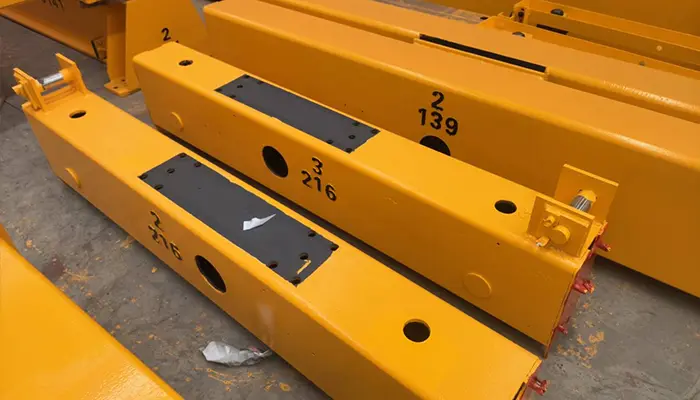 crane parts : overhead crane end carriages
Typical products include:
- End carriages and end trucks: Travel assemblies connecting the crane bridge girder to the runway system.
- Crane wheels and wheel blocks: Components selected according to wheel loads, rail profiles, operating conditions, and mounting arrangements.
- Travel mechanisms: Drive assemblies that move the bridge or trolley along its travel path.
- Motors, gearboxes, and brakes: Mechanical and electrical components selected according to the required performance and duty.
- Electrical control systems: Control panels, inverters, contactors, and related electrical equipment.
- Power supply systems: Conductor rails, festoon systems, and cable arrangements.
For example, a local crane manufacturer may fabricate a 10-ton double-girder overhead crane but purchase the end carriages, wheels, travel drives, and hoist trolley from China.
In this case, the connection dimensions, wheel loads, wheelbase, rail arrangement, and electrical interfaces must be confirmed before production. These details are essential for making the imported components compatible with the locally fabricated crane.
Electric Hoists and Trolley Assemblies
Hoists and trolleys are important products for crane manufacturers and distributors that don't operate their own lifting mechanism production lines.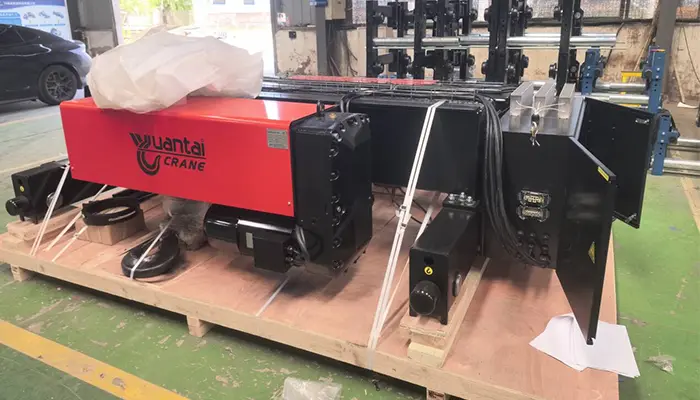 Electric hoist - European style double girder wire rope electric hoist
Products that may be available through OEM cooperation include:
- Electric wire rope hoists
- Electric chain hoists
- Low-headroom electric hoists
- Single-girder hoist trolleys & Double-girder hoist trolleys , Double Rail Crab Hoist Trolleys
- Open-winch lifting mechanisms
Selection should consider more than rated lifting capacity. Buyers should also confirm lifting height, lifting speed, trolley travel speed, duty classification, reeving arrangement, motor specifications, brake configuration, and installation dimensions.
For steel workshops, machinery factories, warehouses, and assembly plants, the required hoist configuration may differ considerably depending on the lifting frequency and type of load handled.
Overhead Crane Kits
An overhead crane kit is a coordinated supply of the main crane components and assemblies required for the buyer's manufacturing or assembly work.
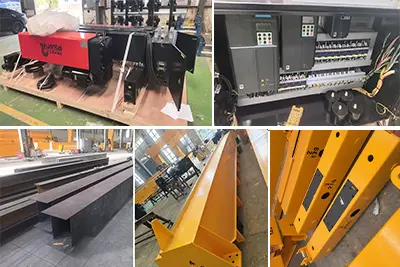 complete overhead crane kit and overhead crane kit without main girder
Depending on the agreement, a crane kit may include:
- End carriages and travel mechanisms
- Electric hoist or hoist trolley
- Crane motors, gearboxes, and brakes
- Electrical control panels and control equipment
- Conductor rails or cable festoon systems
- Connection components and agreed accessories
- Drawings and technical documentation
The main bridge girder may be supplied as part of the kit or fabricated locally by the buyer. Some buyers also arrange local painting, electrical integration, and final assembly.
Before ordering, ask the supplier for a detailed supply list. The term "complete crane kit" can mean different things between manufacturers. Confirm whether the quotation includes structural steel, electrical equipment, power supply, controls, installation accessories, and other required items.
Complete Overhead and Gantry Cranes
Companies without suitable fabrication or assembly facilities may prefer to purchase complete crane systems from a Chinese OEM overhead crane manufacturer.
Depending on the supplier's product range and engineering capability, these may include:
- Single-girder overhead cranes
- Double-girder overhead cranes
- European-style overhead cranes
- Gantry cranes and semi-gantry cranes
- Customized industrial overhead cranes
- Special lifting equipment for production lines
Complete crane supply can be suitable for machinery factories, steel processing plants, warehouses, precast concrete plants, automotive workshops, and other industrial facilities.
For project-based orders, the buyer should provide the building dimensions, runway information, crane capacity, span, lifting height, operating conditions, power supply, and applicable standards. The manufacturer can then review the requirements and define the equipment supply scope.
Customized and Special-Application Crane Equipment
Some industrial applications require more than a standard overhead crane configuration. A manufacturer may need special lifting mechanisms, environmental protection, or equipment designed for a particular production process.
Examples include:
- Foundry cranes: For handling ladles and other heavy loads in high-temperature environments.
- Explosion-proof cranes: For areas where the specified hazardous-area classification requires suitable explosion-protected equipment.
- Grab overhead cranes: For handling bulk materials such as coal, sand, grain, and mineral materials.
- Low-headroom cranes: For buildings where the available vertical clearance limits the hoist and trolley arrangement.
- Heavy-duty process cranes: For steel plants, metallurgical facilities, and production lines with frequent lifting cycles.
- Special lifting equipment: For handling coils, steel plates, machinery parts, moulds, and other non-standard loads.
For these products, the manufacturer needs to understand the actual application, load characteristics, operating cycle, site environment, and required safety provisions. The buyer should not select a special crane based on capacity alone.
Which OEM Cooperation Model Is Right for Your Crane Business?
Not every overseas company needs the same level of manufacturing support. Some buyers only need individual components, while others want a Chinese factory to produce the complete crane. There are several ways to organize the cooperation.
Comparison of OEM Cooperation Models
| Cooperation model | Chinese manufacturer's supply scope | Overseas company's responsibilities | Suitable buyers |
|---|---|---|---|
| Component sourcing | End carriages, hoists, trolleys, wheels, motors, and other components. | Local girder fabrication, crane assembly, installation, and service. | Established crane manufacturers. |
| Crane kit supply | Agreed crane components and coordinated assemblies. | Local structural fabrication if excluded, final assembly, installation, and commissioning. | Crane assembly companies and local fabricators. |
| Complete crane supply | Complete crane equipment according to the agreed technical scope. | Local sales, project coordination, installation, and after-sales support as agreed. | Distributors and engineering companies. |
| Private-label OEM | Agreed equipment manufactured with the buyer's branding arrangements. | Brand management, sales, customer relationships, and local support. | Crane brands and equipment distributors. |
| Customized project manufacturing | Specially configured equipment or assemblies for a specific project. | Project engineering coordination and local execution as agreed. | EPC contractors and industrial engineering companies. |
Import Components and Manufacture Cranes Locally
This model is suitable for companies that already have steel fabrication facilities and experience in crane assembly.
The overseas manufacturer can continue producing bridge girders and other structural parts while sourcing selected mechanical and electrical components from China.
For example, a local company may receive an order for a 20-ton double-girder overhead crane. It fabricates the main girders according to the approved drawings and purchases the end carriages, wheels, hoist trolley, travel mechanisms, and electrical equipment from its OEM supplier.
This arrangement allows the local company to retain control of structural fabrication, final assembly, installation, and customer service. It also reduces the need to manufacture every mechanical component in-house.
Import Crane Kits for Local Assembly
A crane kit provides a more coordinated supply arrangement than purchasing individual components from different suppliers.
The Chinese manufacturer supplies the agreed components and assemblies, while the overseas company handles the remaining work defined in the contract. This may include local girder fabrication, final assembly, electrical integration, installation, and commissioning.
This model can work well for crane assembly businesses that have suitable workshops, technical personnel, and local installation teams but don't want to manufacture every component themselves.
Before ordering, both parties should approve the drawings, connection dimensions, component list, electrical interfaces, and division of responsibilities. Otherwise, problems may arise when the imported components are fitted to locally fabricated structures.
Purchase Complete Cranes Under Your Own Brand
Distributors and companies planning to build their own crane brand may prefer complete crane OEM manufacturing.
The Chinese manufacturer produces the agreed crane equipment, while the overseas buyer manages its own market, customer relationships, sales channels, and local services.
Branding can cover the crane nameplate, logo, manuals, packaging, and other agreed product identification. The details should be confirmed before production, including which company is identified as the manufacturer and which party is responsible for the product's conformity and warranty.
Develop Customized Products Through Long-Term OEM Cooperation
Some companies begin by purchasing standard components and gradually expand the cooperation as their business grows.
For example, a local crane manufacturer may initially import end carriages and electric hoists. After confirming product quality and assembly compatibility, it may begin sourcing complete crane kits or customized lifting mechanisms.
Over time, both parties can establish standardized product configurations, approved drawings, repeat-order procedures, and agreed quality requirements. This makes future orders easier to manage and reduces the need to confirm every detail from the beginning.
How Does the OEM Crane Manufacturing Process Work?
A successful OEM order requires more than sending a product name and requesting a price. Both parties need to agree on the technical scope, manufacturing requirements, quality standards, and commercial terms before production starts.
Step 1: Define Your Product and Business Requirements
Start by identifying what your company wants to purchase and how the product will be used.
- Are you buying individual components, a crane kit, or a complete crane?
- Will the products be used in your own projects or resold to customers?
- Do you need standard products or customized configurations?
- What is the expected order quantity?
- Will you require repeat orders or long-term supply?
- Do you need products under your own brand?
Clear answers help the manufacturer understand the project and recommend an appropriate supply arrangement.
Step 2: Submit Drawings and Technical Specifications
For customized crane products, drawings and technical specifications are essential for an accurate quotation.
Depending on the product, the information may include:
- Rated lifting capacity, span, and lifting height
- Duty classification and expected operating frequency
- General arrangement and manufacturing drawings
- Wheel loads, wheelbase, and mounting dimensions
- Motor power, lifting speed, and travel speed
- Voltage, frequency, phase, and control requirements
- Operating temperature, humidity, dust, or hazardous-area classification
- Applicable design and product standards
For end carriages and other crane components, the buyer should also provide the required connection dimensions, rail details, wheel arrangement, and load information.
If complete drawings aren't available, provide as much information as possible, including reference photos, existing equipment details, and the intended application. The manufacturer's engineering team can review the available information and identify what else is needed.
Step 3: Engineering Review and Technical Confirmation
Before issuing a final quotation, the manufacturer should review the proposed design and confirm that the product can meet the stated requirements.
This review may cover:
- Design and manufacturing feasibility
- Structural and mechanical requirements
- Component selection and compatibility
- Mounting dimensions and connection interfaces
- Electrical configuration
- Operating conditions and duty requirements
- Applicable standards and documentation
For crane kits, the buyer should pay particular attention to the interface between imported components and locally fabricated structures. Approved drawings should clearly show the dimensions and connection details required for assembly.
Step 4: Confirm the Quotation and Commercial Agreement
Once the technical requirements are confirmed, both parties can agree on the commercial terms.
The quotation and purchase agreement should clearly state:
- Product description, model, and quantity
- Approved technical specifications and drawings
- Supply scope and excluded items
- Branding and documentation requirements
- Unit price and total order value
- Production lead time
- Packaging and shipping arrangements
- Payment terms and delivery terms
- Inspection, acceptance, and warranty conditions
Don't rely on a general product description when ordering customized equipment. The approved technical documents and agreed supply list should form part of the purchase arrangement.
Step 5: Arrange a Sample or Trial Order When Appropriate
For new OEM relationships, a sample order or small initial batch can help both parties check product compatibility and manufacturing quality before moving to larger orders.
Depending on the product, the buyer may check:
- Dimensions and mounting interfaces
- Material and manufacturing quality
- Assembly compatibility
- Motor and electrical specifications
- Functional performance
- Branding, nameplates, and packaging
A sample isn't necessary for every order. For customized or high-value crane systems, a drawing approval process and agreed inspection plan may be more appropriate.
Step 6: Manufacturing and Quality Inspection
After technical and commercial approval, production can begin.
Depending on the product, manufacturing may involve material preparation, cutting, welding, machining, mechanical assembly, electrical installation, painting, and testing.
The buyer should agree in advance which inspections are required and whether inspection records or third-party inspection will be needed. Any changes to approved drawings or specifications should be reviewed and accepted by both parties before implementation.
Step 7: Final Inspection, Packing, and Shipment
Before shipment, the finished products should be checked against the approved specifications and supply list.
Typical final checks may include:
- Product dimensions and identification
- Component configuration and quantity
- Assembly and workmanship
- Functional testing where applicable
- Required inspection and test records
- Packaging and protection for transportation
- Packing list and shipping documentation
For crane kits, components should be clearly identified and packed in a way that helps the buyer receive, sort, and assemble them at the destination workshop.
How to Choose a Reliable Chinese Crane OEM Manufacturer
Choosing an OEM supplier is different from purchasing a standard product from an online store. The manufacturer may become an important part of your production process, so its engineering capability, manufacturing quality, and ability to handle repeat orders all matter.
Check the Supplier's Actual Manufacturing Capability
Start by checking what the company produces in its own facilities and which processes are outsourced.
Questions worth asking include:
- Does the company have its own crane manufacturing workshop?
- Which products are manufactured in-house?
- What welding, machining, and assembly facilities are available?
- Does it have suitable testing equipment?
- Can it show manufacturing records or examples of similar products?
A supplier doesn't necessarily need to manufacture every component itself. What matters is whether it can manage the agreed production scope and maintain control over the quality of outsourced processes.
Evaluate Engineering and Customization Capability
OEM buyers often need products that differ from standard catalogue configurations. A reliable manufacturing partner should be able to understand technical drawings, review specifications, and communicate any design or manufacturing issues before production.
Check whether the supplier can:
- Work with customer-provided drawings
- Confirm mechanical interfaces and dimensions
- Adapt products to different electrical requirements
- Review special operating conditions
- Prepare manufacturing drawings for approval
- Manage drawing revisions and technical changes
Review Manufacturing and Quality Control
Ask how the supplier controls materials, welding, machining, assembly, and final inspection.
For example, a buyer purchasing overhead crane end carriages should pay attention to wheel dimensions, shaft and bearing arrangements, mounting interfaces, machining accuracy, and drive configuration.
A buyer purchasing electric hoists should check the rated capacity, lifting height, reeving arrangement, motor and brake configuration, operating duty, and functional test records.
Certification verification: Reputable Chinese crane manufacturers hold internationally recognized certifications. For European market access, CE marking under Machinery Directive 2006/42/EC is essential. Some suppliers also hold ISO 3834-2 welding quality certification—the highest level for fusion welding—and ISO 9001 quality management system certification issued by bodies such as TÜV Rheinland. When evaluating a supplier, request copies of current certificates and verify their validity and scope cover the specific products you intend to source.
Quality requirements should be specific to the product. A general statement that a factory follows strict quality control isn't a substitute for inspection criteria and documented results.
Check Export Experience and Technical Communication
OEM cooperation usually involves drawing reviews, specification confirmation, production updates, and documentation. Clear communication is important, particularly when the buyer and manufacturer use different languages and technical standards.
China's crane export track record: In September 2025 alone, China exported USD 110.7 million of gantry cranes (723 units), a year-on-year increase of 331% in value and 253% in volume. While cumulative January–September 2025 gantry crane exports declined in value terms, the volume increased, indicating broader adoption across markets. Top destinations included Singapore, Turkey, Bangladesh, Egypt, and Indonesia. This export breadth demonstrates that Chinese manufacturers are accustomed to serving diverse regulatory environments and technical requirements.
Check whether the supplier can prepare the required export documents, respond to technical questions, manage drawing revisions, and coordinate delivery to your destination country.
Consider Long-Term Supply Capability
A suitable OEM partner should be able to support more than the first order.
Consider its ability to maintain consistent product specifications, manage repeat orders, supply replacement parts, and provide technical support when questions arise during local assembly or operation.
For overseas crane manufacturers, repeat-order consistency can be just as important as the initial purchase price.
OEM Branding, Drawings, Intellectual Property, and Responsibilities
If you plan to sell Chinese-made cranes under your own brand, branding and technical responsibilities should be discussed before the order is placed. These matters are easier to agree on at the beginning than to resolve after manufacturing has started.
Can You Put Your Own Brand on Chinese-Made Cranes?
Many OEM arrangements allow the buyer's brand to appear on agreed products. Depending on the contract, this may include:
- Company logo and product nameplates
- Product labels and identification plates
- Operation and maintenance manuals
- Packaging and shipping marks
- Agreed product documentation
The buyer should provide the correct logo files, nameplate information, and branding instructions before production. Both parties should also confirm how the actual manufacturer and other required product information will be identified.
Who Owns the Product Drawings and Designs?
OEM orders may involve different types of technical documents:
- Customer-provided drawings: Drawings supplied by the buyer for manufacturing.
- Manufacturer's standard designs: Existing product designs and manufacturing documents developed by the supplier.
- Customized drawings: Drawings developed or modified for a particular customer or project.
- Jointly developed designs: Technical documents created through cooperation between both engineering teams.
Don't assume that paying for a customized product automatically transfers ownership of every drawing, design, or manufacturing method. The agreement should state who owns the documents, who may use them, and whether either party can share them with other companies.
Who Is Responsible for Product Quality and Warranty?
Responsibility depends on the supply arrangement. For example, a Chinese factory supplying end carriages may be responsible for manufacturing quality within the agreed specifications, while the overseas company is responsible for the locally fabricated bridge girder and final crane assembly.
For complete crane projects, responsibilities may be divided between manufacturing, installation, commissioning, operator training, maintenance, and local customer support.
The purchase agreement should define:
- Manufacturing quality and technical compliance
- Inspection and acceptance procedures
- Warranty coverage and claim procedures
- Spare parts supply
- Installation and commissioning responsibilities
- Responsibility for modifications or incorrect installation
Who Is Responsible for Certifications and Market Compliance?
Crane products may be subject to different design, safety, electrical, and conformity requirements depending on the destination market and intended application.
Before ordering, the buyer should identify the standards and documents required for the product and destination country. These may involve applicable ISO, EN, FEM, GB/T, CMAA, or local regulatory requirements, depending on the project.
Both parties should agree who is responsible for design compliance, testing, technical documentation, product marking, and any required conformity assessment. A certificate held by a supplier should not automatically be assumed to cover every customized product or market.
What Information Should You Prepare Before Contacting a Chinese OEM Crane Manufacturer?
A clear inquiry helps the manufacturer understand your business, identify the right products, and prepare a more accurate quotation. The information required depends on whether you are purchasing crane components, a kit, or a complete crane.
Company and Business Information
- Company name and destination country
- Business type: crane manufacturer, distributor, importer, or engineering contractor
- Current product range and manufacturing capabilities
- Intended OEM cooperation model
- Estimated order quantity and purchasing frequency
- Whether the products will be resold under your own brand
Product and Technical Requirements
- Product name, model, and required quantity
- Rated capacity, span, and lifting height, where applicable
- Duty classification and operating frequency
- Dimensions, wheelbase, and connection interfaces
- Motor, gearbox, brake, and electrical specifications
- Voltage, frequency, and phase
- Operating environment and special protection requirements
- Applicable technical standards
- Drawings, photos, or reference product information
Branding and Commercial Requirements
- Logo and nameplate requirements
- Packaging and product identification requirements
- Required manuals, drawings, and inspection documents
- Target delivery date
- Destination port or delivery location
- Expected annual demand or repeat-order plan
- Required payment and delivery terms
If you're not sure which components or cooperation model would suit your business, start by explaining what you currently manufacture and what you want to outsource. The supplier can then review the available information and discuss a practical supply scope.
Benefits of OEM Crane Manufacturing for Importers in Different Markets
The benefits of working with a Chinese OEM crane manufacturer depend on your local market and business model. Some importers need complete cranes, while others prefer crane kits and components for local assembly. Here are some practical advantages for businesses in different regions.
| Market | What Importers Can Source | Key Benefits |
|---|---|---|
| Southeast Asia (Indonesia, Vietnam, Philippines, Thailand, Malaysia) | Complete overhead cranes, gantry cranes and crane kits | Expand your crane product range. Serve growing industrial markets. Handle local assembly and installation without building a full manufacturing facility. |
| Middle East (UAE, Saudi Arabia, Qatar, Oman) | Heavy-duty cranes, explosion-proof cranes and customized crane systems | Supply cranes for demanding industrial applications. Serve oil and gas, steel and construction projects. Offer customized lifting solutions under your own brand. |
| Africa (Nigeria, Kenya, South Africa, Egypt, Ghana) | Standard cranes, crane kits, hoists and spare parts | Offer competitively priced crane products. Develop local assembly and installation services. Build additional revenue through spare parts and maintenance. |
| South America (Brazil, Chile, Peru, Colombia) | Overhead crane kits, gantry crane components and customized systems | Supply mining, steel and infrastructure projects. Source customized equipment for local requirements. Plan larger component orders to manage shipping costs. |
| Europe (Germany, Poland, Netherlands, UK, Italy) | Electric hoists, end carriages, travel mechanisms and crane components | Reduce component sourcing costs. Supplement existing manufacturing capacity. Focus local resources on engineering, assembly and customer service. |
| North America (USA, Canada, Mexico) | Crane kits, hoists, end carriages and mechanical or electrical components | Develop private-label crane products. Assemble equipment locally under your own brand. Maintain control over installation and after-sales service. |
| Australia and New Zealand | Heavy-duty overhead cranes, mining cranes and specialized lifting systems | Source customized equipment for mining and ports. Expand your range of heavy-duty crane products. Obtain technical documentation and testing records for local compliance. |
How Does This Benefit Your Crane Business?
You don't need to manufacture every crane component yourself. Your Chinese OEM partner handles production according to the agreed specifications, while your company focuses on sales, local engineering, assembly, installation and after-sales service.
Whether you are an established crane manufacturer, a distributor or an engineering company, OEM manufacturing gives you more flexibility to expand your product range and serve new customers without investing heavily in manufacturing facilities.
Frequently Asked Questions About OEM Crane Manufacturing in China
Answers to common questions about OEM crane manufacturing in China, covering definitions, private-label production, customer drawings, sourceable components, local assembly, individual component purchase, SME suitability, OEM vs. ODM, drawing ownership, quality checks, voltage customization, and quotation requirements.
What is an OEM crane manufacturer?
An OEM crane manufacturer produces cranes, crane components, or related equipment for another company according to agreed drawings, specifications, and requirements. The buyer may sell or supply the products under its own brand, depending on the agreement.
Can I sell Chinese-made overhead cranes under my own brand?
Yes, this can be arranged through a private-label or OEM manufacturing agreement. The parties should confirm logo use, nameplates, product documentation, manufacturer identification, warranty, and compliance responsibilities before production.
Can a Chinese crane factory manufacture products according to my drawings?
Many crane manufacturers accept customer drawings and technical specifications for customized production. The factory should review the drawings, confirm manufacturing feasibility, and obtain approval for any proposed changes before production.
What crane components can overseas manufacturers source from China?
Common products include end carriages, crane wheels, travel mechanisms, electric wire rope hoists, chain hoists, hoist trolleys, motors, gearboxes, brakes, control panels, and power supply systems. Some suppliers can also provide coordinated crane kits and complete crane systems.
Can I import crane kits and assemble the cranes locally?
Yes. A local crane manufacturer can purchase an agreed set of components and assemblies from China, then complete the remaining fabrication and assembly work locally. The supply scope, connection dimensions, electrical interfaces, and testing responsibilities should be confirmed in advance.
Can I purchase only end carriages, hoists, and travel mechanisms?
Yes. Overseas crane manufacturers can source individual components according to their production needs. Provide the required capacity, dimensions, wheel arrangement, mounting interfaces, duty requirements, and electrical specifications so the supplier can check compatibility.
Is OEM crane manufacturing suitable for small and medium-sized companies?
It can be suitable when the order quantity, product requirements, and manufacturing arrangement make commercial sense. Smaller companies may begin with standard components or a trial order before developing customized products or larger supply arrangements.
What is the difference between OEM and ODM crane manufacturing?
In general, OEM refers to manufacturing according to agreed customer requirements, while ODM involves the manufacturer's contribution to product design and development. Actual industry usage varies, so the buyer should define design ownership and responsibilities in the agreement.
Who owns the technical drawings for customized crane products?
Ownership depends on the origin of the drawings and the agreement between the parties. Customer-provided drawings, standard manufacturer designs, and jointly developed documents should be treated separately. Drawing ownership and permitted use should be stated in writing.
How can I check the quality of a Chinese OEM crane manufacturer?
Review its production facilities, engineering capabilities, manufacturing processes, inspection procedures, testing equipment, and experience with similar products. Request relevant quality records, verify certifications such as CE and ISO 3834, inspect the factory, or arrange a third-party inspection where appropriate.
Can a Chinese manufacturer customize cranes for different voltage and frequency requirements?
Many manufacturers can configure crane motors, electrical systems, and control equipment for different power supplies. Provide the required voltage, frequency, phase, control voltage, and applicable electrical standards when requesting a quotation.
What information is needed to obtain an OEM crane quotation?
Provide the product type, quantity, technical specifications, drawings or reference photos, destination country, branding requirements, and expected delivery date. For complete cranes, include capacity, span, lifting height, duty classification, building or runway information, and operating conditions.
Work with Yuantai Crane on Your OEM Manufacturing Requirements
If your company is looking for a Chinese OEM crane manufacturer, the first step is to identify which parts of your current production process you want to outsource.
You may need overhead crane end carriages for locally fabricated bridge girders, electric hoists and trolleys for your existing crane range, complete crane kits for local assembly, or customized overhead and gantry cranes for industrial projects.
Yuantai Crane works with overseas crane manufacturers, distributors, and engineering companies on crane equipment, components, and customized manufacturing requirements. The supply arrangement can be discussed according to your drawings, technical specifications, order quantity, and intended market.
To help our engineering team review your requirements, please provide:
- Your company profile and main business activities
- The crane products or components you want to source
- Drawings, technical specifications, or reference photos
- Estimated order quantity and expected purchasing frequency
- Your destination country and branding requirements
Whether you want to source individual crane components or develop a longer-term OEM manufacturing arrangement, we can review the requirements and discuss the appropriate supply scope.
Discuss Your OEM Crane Manufacturing Requirements
Send your drawings, product list, or project requirements to our engineering team for technical review and quotation.
Yuantai Crane – China Crane Manufacturer
Related Articles
Reference articles for overseas crane companies evaluating Chinese OEM manufacturing, covering cooperation models, kit vs. local manufacturing decisions, brand building, sourceable products, supplier selection, technical requirements, quality control, and order pricing.
Focus: Explain OEM manufacturing, how overseas companies cooperate with Chinese crane factories, what can be manufactured, and how the cooperation works.
Why it matters: Buyers need to understand whether they can use a Chinese factory as a manufacturing partner without building their own production facilities or giving up their local market and brand.
Target buyers: Local crane manufacturers, crane engineering companies, established crane distributors, and companies planning to launch their own crane product range.
Focus: Compare three business models: local manufacturing, importing complete cranes, and importing crane kits or major components for local assembly.
Why it matters: This is a practical investment decision. Buyers want to know which parts they should manufacture themselves and which parts are more suitable to source from China.
Focus: Private-label manufacturing, customer branding, nameplates, drawings, product specifications, packaging, warranty, and division of responsibilities.
Why it matters: Buyers may have their own customers and sales channels but lack the manufacturing capacity to produce every crane or component themselves. They need to know whether they can sell products under their own brand.
Focus: Explain the products buyers can source: end carriages, hoists, trolleys, travel mechanisms, wheels, motors, brakes, electrical systems, crane kits, and complete overhead and gantry cranes.
Why it matters: Many buyers know they want to source from China but are unsure how much of the crane manufacturing process they can outsource. This article helps them identify the products relevant to their business.
Focus: Factory capability, engineering team, manufacturing processes, welding and machining, assembly, testing, export experience, and supplier verification.
Why it matters: Overseas buyers face difficulty distinguishing a real manufacturer from a trading company or a supplier that outsources most of the work. They need evidence of manufacturing and engineering capability.
Focus: What buyers need to provide before production: GA drawings, capacity, span, lifting height, duty class, wheel loads, connection dimensions, motors, electrical requirements, operating environment, and applicable standards.
Why it matters: Incomplete specifications cause quotation delays, design changes, component mismatches, and problems during local assembly. This article helps buyers prepare a useful technical inquiry.
Focus: Incoming material inspection, welding, machining, component verification, assembly, functional testing, load testing where applicable, FAT, inspection reports, and third-party inspection.
Why it matters: The buyer may not be present during manufacturing. They need to know what evidence to request and how to check that the delivered products match the approved drawings and specifications.
Focus: How OEM prices are calculated, customization costs, minimum order quantities, sample orders, production lead times, export packaging, freight, Incoterms, payment terms, and warranty.
Why it matters: Buyers need to calculate the total purchasing cost, not just the factory quotation. They also need to understand whether their order volume and delivery requirements are practical.

Article by Bella ,who has been in the hoist and crane field since 2016. Bella provides overhead crane & gantry crane consultation services for clients who need a customized overhead travelling crane solution.Contact her to get free consultation.
Yuantai Cranes
Overhead Crane Manufacturer with CE, ISO, SGS, CNEX Certificates.
- Main Specifications - Capacity: 0.5–550 tons | Span: up to 40m | Speed: 0.8–12 m/min | Duty: A3–A7 | Power: 380–690V, 50/60Hz | Control: pendant/remote/cabin
- Full engineering: FEA/PLC/VFD + in-house build + global delivery + on-site support, for workshops, factories, EPC contractors, industrial projects, etc.
- Support: design, manufacturing, testing, service – end-to-end, customized lifting solutions worldwide.
How to Get an Accurate Crane Price for Your Application?
Tips: Copy the spec list, fill in your details, and paste it into the form on the right/ down-below for a quick price.
- Crane type:_____ . (e.g., overhead crane, gantry crane, jib crane)
- Max weight to lift:_____ tons. (e.g., 2t, 5t, 10t, 20t, 50t)
- Lifting height:_____ m. (How high does the hook need to reach?
- Workshop width (span):_____ m . (Distance between the two crane rails)
- Travel distance:_____ m . (How long does the crane need to move along the runway?)
- Control type:_____. (Pendant / remote / cabin Control)
- Power supply:_____. (Local voltage & frequency – e.g., 380V, 50Hz, 3-phase)
- What will it be used for?_____ (e.g., steel fabrication, concrete products, mold handling, general manufacturing, etc.)
- Any special requirements?_____ (e.g., extreme temperature, dusty or explosive environment, special paint color, etc.)
Just leave a message via the contact form and our hoist and crane engineer will contact you with in 24working hours.
Get Your Custom Quote–Quick & Easy
Fill in what you know. Skip what you don't – we'll help.Any question will be reply with 24 working hours