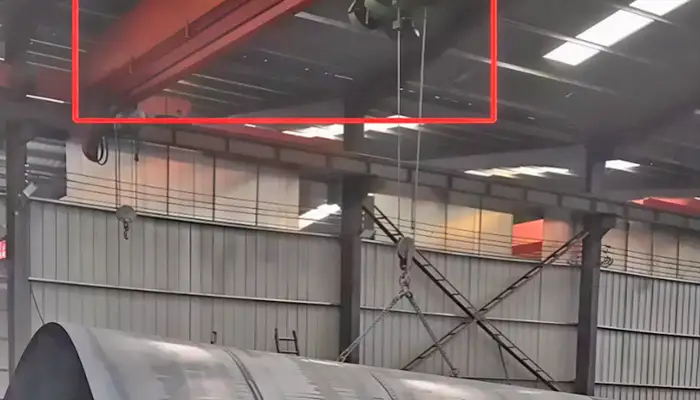
Overhead Crane Cost for a Silo Factory: Buyer's Price Guide
Content Quick Link
How Much Does an Overhead Crane System Cost for a Silo Factory?
If you're planning a silo manufacturing workshop or upgrading an existing one, the crane budget is usually one of the first numbers you need — and one of the hardest to pin down.
Capacity alone doesn't tell you much. A 10-ton crane lifting steel plates and a 10-ton crane lifting a rolled shell section can be very different machines at very different prices, because span, lifting height, duty class, hoist type, runway structure, and installation scope all move the number. Two quotes for "a 10-ton crane" can differ by 40% and both be correct — they're just quoting different scopes.
This guide walks through what actually drives the cost, what typical configurations look like for silo work, what should be in a complete quotation, and what to send a manufacturer so you get a real price instead of a placeholder.
What an Overhead Crane System Costs
There's no list price, because every silo plant has different bay dimensions, load weights, and production rhythms. But it helps to know what the money buys. A complete system usually breaks into five buckets:
| Cost Component | Typical Share of Project Cost | Notes |
|---|---|---|
| Crane equipment (girders, end carriages, hoist, motors, controls) | 45–60% | The largest single line item |
| Runway system (beams, rails, brackets, columns if new) | 15–25% | Often underestimated; can exceed crane cost in retrofit projects |
| Electrical supply and controls (conductor bar, festoon, panels) | 5–10% | Busbar vs. cable affects both price and reliability |
| Transport and export packaging | 3–8% | Sea freight and packing for international orders |
| Installation, testing, commissioning | 8–15% | Varies widely by region and site access |
Treat these percentages as planning guidance, not a quote. A retrofit into an existing building with adequate runway beams can sit at the low end of the runway share; a greenfield project needing new columns and foundations sits at the high end, sometimes higher.
One practical warning: a low crane price with the runway excluded is not a cheaper project. It's an incomplete one. Always compare total delivered-and-installed cost.
Typical Capacities for Silo Work
Crane capacity follows the heaviest thing you actually lift — not the average.
| Capacity | What It Typically Handles in a Silo Plant |
|---|---|
| 5 t | Individual plates, light components, general workshop handling |
| 10 t | Medium shell sections, steel structures, fabrication components |
| 15 t | Larger rolled shells, heavier structural assemblies |
| 20 t | Heavy shell sections, tank components, large fabrications |
| 30 t+ | Oversized assemblies, heavy industrial tank work, tandem-lift preparation |
In practice, most silo plants end up with a mix: 5–10 t cranes in cutting and light fabrication, 15–30 t in rolling and shell assembly, and 30–50 t in final assembly and dispatch if they build large tanks.
When you request a quote, give the maximum component weight plus the weight of the lifting attachment. A 12 t shell with a 1.5 t spreader beam needs a 15 t crane, not a 12 t one. Buyers who quote on average weight routinely end up re-buying.

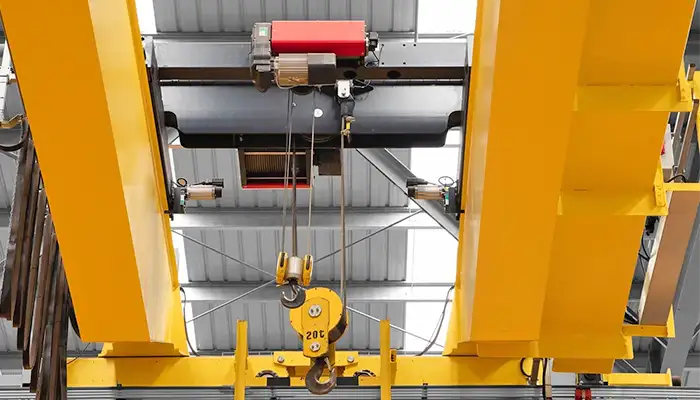

Single Girder vs. Double Girder — What the Price Difference Buys
| Single Girder | Double Girder | |
|---|---|---|
| Structure | One main girder | Two main girders |
| Hoist arrangement | Usually electric wire rope hoist under the girder | Trolley-mounted hoist between girders |
| Structural weight | Lower | Higher |
| Typical capacity range | Up to ~20 t (practical sweet spot 5–10 t) | 10 t and up, comfortable at 20–50 t |
| Hook height | Limited by girder depth | Better hook height for the same building |
| Relative price | Baseline | Typically 20–40% higher for the same capacity |
| Best fit in a silo plant | Cutting, plate prep, hopper fabrication | Shell assembly, heavy fabrication, dispatch |
The 20–40% premium for double girder is real, but so is what it buys: more hook height in the same building, better rigidity for precision shell alignment, and the ability to run a main and auxiliary hoist on one crane. In a shell assembly bay, that combination often pays for itself by removing a second crane from the layout.
European-Type vs. Standard Industrial Cranes
European-style cranes use compact hoists, optimized girder profiles, and VFD control as standard. The practical effects buyers care about:
- Lower dead weight and wheel loads — often 15–25% lighter than conventional designs at the same capacity, which can reduce runway beam and column costs. On a retrofit, this can be the difference between reinforcing the building and not.
- Better hook height — the compact hoist sits closer to the girder, freeing 300–600 mm of lift in the same headroom.
- Smoother control — VFD as standard gives the fine positioning shell work needs.
- Higher purchase price — typically 10–25% above a conventional crane of the same capacity.
The right comparison isn't the crane price tag. It's the crane plus the runway plus any building reinforcement. A lighter European crane on an existing structure sometimes wins on total cost even at a higher equipment price.
What Drives the Price Up or Down
Lifting Capacity and Real Load Weight
Capacity cascades through the whole design. Going from 10 t to 20 t typically means heavier girders, a larger hoist, bigger motors, heavier end carriages, larger wheels, and a higher duty classification — often a 50–80% price increase for the crane itself, before runway changes.
The load to design around is the maximum, not the average: plates, rolled shells, support rings, stiffeners, and partially assembled structures all count. Add the lifting attachment weight, and add a margin for future product growth. A crane sized at exactly today's maximum leaves no room to bid on larger silos next year.
Span
Span is the distance between runway rail centerlines, and it drives girder depth and weight quickly. As a rough rule, doubling the span at the same capacity can increase girder weight by 2.5–3×, because bending moment scales with span.
For silo plants, spans commonly run 15–30 m. Past about 25–28 m, girder weight climbs steeply and double girder becomes the more economical structure. When requesting a quote, give the actual rail-to-rail distance, not the building width — the difference is often 1–2 m and it matters.
Lifting Height and Headroom
Lifting height is the hook travel you need. In silo work that's set by the tallest component, the highest workstation, and clearance above both — typically 8–15 m in fabrication bays and 12–18 m in assembly and dispatch.
If the building is height-constrained, options include a low-headroom hoist, a different girder profile, or a European-style compact trolley. Each affects price, and each needs checking against the actual roof structure. Get the building section drawing to the crane engineer early — headroom problems are cheap to solve on paper and expensive to solve after the crane arrives.
Duty Class
Duty class tells the crane how hard it will work, and it changes the mechanical specification — motor insulation, brake size, gearbox rating, bearing life, and structural fatigue design.
| Duty Class (FEM / ISO) | Typical Silo Plant Use | Practical Effect |
|---|---|---|
| FEM 1Am / ISO M4 | Occasional handling, light fabrication | Lightest specification, lowest cost |
| FEM 2m / ISO M5 | Regular production, single or two shifts | Standard production crane |
| FEM 3m / ISO M6 | Multi-shift shell fabrication and assembly | Heavier components, higher price |
| FEM 4m+ / ISO M7+ | Continuous heavy-duty operation | Specialized design, significant premium |
The most common and most expensive mistake is buying M4 for a job that runs two shifts. The crane works, then wears out early, and the maintenance bill arrives long after the purchase decision is forgotten. Be honest about lifts per hour and shifts per week.
Hoist, Motors, and Electrical Package
The electrical and hoist package is where quotes often diverge most, because it's easy to specify "with remote control" and mean very different things.
Typical options and their cost effect:
- Hoist type: wire rope (standard for most silo work) vs. chain (lighter duty). Wire rope is the norm above 3–5 t.
- VFD on hoist and travel: adds roughly 8–15% to the electrical package, and pays back in positioning accuracy, reduced load swing, and longer brake life. For shell assembly, it's close to essential.
- Control: pendant (cheapest), radio remote (typically 3–8% adder), or cabin (significant adder, used where visibility demands it).
- Power supply: conductor bar (higher upfront, lower maintenance, better for long runways) vs. festoon cable (lower upfront, more wear).
- Safety package: overload protection, limit switches, anti-collision on shared runways, emergency stop. Some of this is standard; some is optional and should be explicitly confirmed.
Match the electrical specification to your actual supply — 380V, 400V, or 415V, 50 or 60 Hz, three-phase. A mismatch discovered at commissioning is an expensive surprise.
Environment
Silo plants are dusty and often hot, and sometimes coastal or corrosive.
- Dust: IP55 or better on electricals; consider IP65 in heavy welding-fume areas.
- Heat: motor insulation class and derating for ambient above 40°C.
- Humidity and corrosion: galvanized or painted structures, sealed enclosures, anti-condensation heaters.
- Explosion protection: if any area is classified hazardous, the crane must be designed for that classification — it is not a standard crane with a different motor. This is a specialist design and carries a significant premium.
What Should Be in a Complete Quotation
Quotes vary as much by scope as by price. Before comparing numbers, check what's actually included.
Crane equipment: main girder(s), end carriages, hoist or trolley, hoisting and travel motors, brakes, wheels, buffers, control cabinet, pendant or radio remote, limit switches, overload protection.
Runway system: runway beams, brackets, columns and foundations where new, rails, rail clips, alignment and installation, and power supply conductors. For a new building, runway design should be coordinated with the structural engineer from the start. For an existing building, the columns, foundations, and runway beams must be checked against the new crane loads — this is a structural engineering task, not a crane-supplier assumption.
Electrical: conductor bar or festoon system, control panels, VFDs, overload protection, emergency stop, travel limits.
Services: export packaging, inland transport, international freight, customs and duties, mechanical and electrical installation, load testing, commissioning, operator and maintenance training.
| Service Item | Typically Included? | What to Confirm |
|---|---|---|
| Crane equipment | Usually | Exact hoist model, motor brands, VFD scope |
| Runway beams and rails | Often optional | Whether supply-only or supplied and installed |
| Conductor bar / festoon | Often optional | Length, rating, and installation |
| Sea freight and packaging | Varies | Incoterm (FOB, CIF, DAP) |
| Installation | Often optional | Whether supervised or full crew |
| Load testing and commissioning | Often optional | Test standard and documentation |
| Training | Sometimes | Duration and language |
| Spare parts package | Rarely standard | Recommended first-year spares list |
A supplier quoting equipment only and a supplier quoting a full turnkey package are not comparable. Ask each to break out the scope line by line.
Costs by Production Area
Different bays in a silo plant need different cranes, and the price follows.
Plate handling and cutting. Lifting plates, stacks, and cut sections; positioning at cutting tables. Typically 3–10 t, single girder, with plate clamps or vacuum lifters. The attachment matters — vacuum lifters add cost but protect plate surfaces and speed up handling.
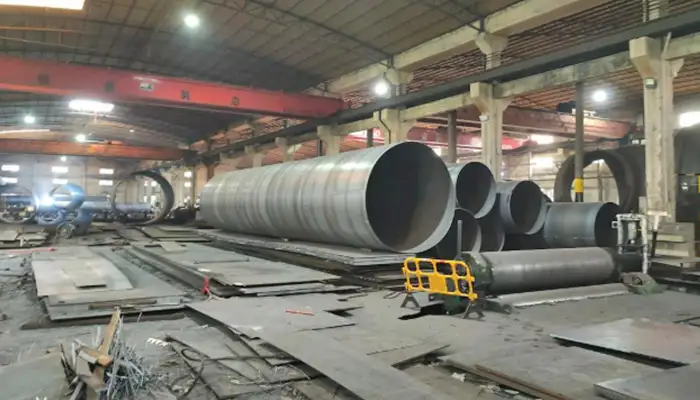
Shell rolling and welding. Moving rolled sections between rolls, weld stations, and storage. Typically 10–20 t, single or double girder depending on shell size. Lifting frames or spreader beams are usually needed to keep shells round; budget for them as part of the lifting system, not an afterthought.
Assembly and component installation. The heaviest and largest lifts — shells, roof structures, support rings, frames. Typically 20–50 t, double girder, with engineered multi-point lifting beams. This is where VFD and precision positioning earn their keep, and where tandem lifting may be considered for very large assemblies. Tandem lifting needs synchronized controls, a documented lift plan, and a runway designed for the concentrated loads — it is an engineering project, not a crane feature.
Finished product storage and loading. Moving finished sections to storage and onto trucks. Typically 10–50 t, double girder, with attention to lifting height for truck decks and runway length to reach the loading dock. For very large components that can't be handled indoors, an outdoor gantry crane is often the better and cheaper answer than trying to fit a bigger crane into the building.
How to Keep the Total Cost Down Without Cutting Corners
Size to the real maximum, not the average — and not the dream. An oversized crane costs more in structure, hoist, motors, and runway. An undersized one costs more in lost production and unsafe lifts. The right number is the heaviest realistic load plus attachment plus a modest growth margin.
Choose girder type by application, not by habit. Single girder for cutting, prep, and light fabrication. Double girder where capacity, hook height, precision, or duty demand it. Don't pay for double girder in a bay that lifts plates all day.
Plan crane quantity with the material flow. One crane can serve several stations in the same bay if the runway reaches them and lifts don't collide in time. Two cranes make sense when production areas run independently, lifts happen simultaneously, or transfer distances are long. A layout plan drawn before purchase routinely saves the cost of one crane.
Compare total cost of ownership, not sticker price. Motors, brakes, gearboxes, and controls differ in quality and service life. Ask about component brands, expected brake lining life, spare parts availability, and local service support. A crane that costs 10% less but needs a brake overhaul every year is not cheaper.
Get engineering input early. A manufacturer who reviews your layout, headroom, and existing structure before quoting will catch clearance problems, runway conflicts, and duty-class mismatches while they're still cheap to fix.
What to Send for an Accurate Quote
The single biggest reason quotes come back vague or wildly different is incomplete input. Send this and you'll get a real number.
| Information | Example |
|---|---|
| Crane quantity | 2 sets |
| Crane type preference | Double girder |
| Rated capacity | 16 t |
| Span (rail centerline to centerline) | 22.5 m |
| Lifting height | 9 m |
| Duty class | ISO M5 / FEM 2m |
| Workshop dimensions | 100 m × 30 m |
| Runway length | 100 m |
| Power supply | 380V / 50Hz / 3-phase |
| Control method | Radio remote |
| Application | Shell fabrication and assembly |
| Installation scope | Supply and install, or supply only |
Also useful:
- Maximum component weight and dimensions, with drawings if available
- Lifting attachment type and weight
- Lifts per hour and shifts per week
- Roof clearance and building section drawing
- Existing runway beam and column details, if retrofitting
- Delivery destination and required on-site date
A workshop layout drawing, a building section, and a few photos of the production area will do more for quote accuracy than any amount of email discussion.
Frequently Asked Questions
Answers to common questions about overhead crane cost and selection, covering 5-ton and 10-ton crane pricing, single vs. double girder cost differences, runway and installation scope, installation cost factors, crane quantity for silo factories, crane type selection for steel silo manufacturing, and installation in existing buildings.
How much does a 5-ton overhead crane cost?
It depends on span, lifting height, duty class, hoist type, and electrical package. A basic single girder crane for light fabrication sits at the low end; a VFD-equipped unit with radio control and a longer span sits higher. Give the manufacturer span, height, duty, and power supply to get a real figure.
How much does a 10-ton overhead crane system cost?
The crane alone and a complete system with runway, conductor bar, and installation are very different numbers. Ask for a line-item breakdown so you can see what the crane costs and what the surrounding system costs.
Is a double girder crane much more expensive than single girder?
Typically 20–40% more for the same capacity, more at longer spans. What you get is rigidity, hook height, precision, and the option of a main plus auxiliary hoist. In shell assembly bays that combination often removes the need for a second crane.
Does the price include runway beams and installation?
Often not. Some quotes are crane-only, some include runway and electrical, some are turnkey. Always compare scope, not just the total.
How much does installation cost?
It depends on crane size, installation height, site access, available lifting equipment, local labor rates, and whether mechanical and electrical work are both in scope. International projects add freight, customs, and sometimes a supervisory engineer rather than a full crew.
How many cranes does a silo factory need?
No fixed number. It depends on bay dimensions, how many lifts happen at once, and how material moves between stages. A useful starting point is one crane per 60–80 m of runway for moderate frequency, adjusted upward for high throughput or simultaneous operations.
Which crane is best for steel silo manufacturing?
Single girder for cutting, plate prep, and light fabrication; double girder for shell assembly, heavy fabrication, and dispatch. The final choice depends on capacity, span, lifting height, duty class, and attachment requirements — not on a general preference.
Can we install an overhead crane in an existing building without modification?
Sometimes. The columns, foundations, runway beams, headroom, and structural load capacity all need checking first. If the structure can't take the new crane loads, reinforcement or an independent support structure may be needed — and that cost belongs in the budget from day one.
What to Do Next
If you're budgeting a crane system for a silo plant, here's the practical sequence:
- List your heaviest components — weight, dimensions, and the lifting attachment you plan to use.
- Measure the actual bay — rail-to-rail span, runway length, and available headroom from floor to roof structure.
- Estimate lifts per hour and shifts per week — this sets the duty class and has a big effect on price.
- Sketch the material flow — which bay feeds which, and where lifts might happen at the same time.
- Send the package to two or three manufacturers and ask each for a line-item breakdown by scope.
- Compare total installed cost, including runway, electrical, installation, and any building work — not the crane price alone.
- Ask for the duty class and hoist model in writing so you're comparing like with like.
Yuantai Crane designs and supplies overhead crane systems for silo manufacturing and steel fabrication plants. Send your capacity, span, lifting height, duty requirement, workshop layout, and site conditions, and our engineering team will review the application and prepare a project-specific quotation with a clear scope breakdown.

Article by Bella ,who has been in the hoist and crane field since 2016. Bella provides overhead crane & gantry crane consultation services for clients who need a customized overhead travelling crane solution.Contact her to get free consultation.
Yuantai Cranes
Overhead Crane Manufacturer with CE, ISO, SGS, CNEX Certificates.
- Main Specifications - Capacity: 0.5–550 tons | Span: up to 40m | Speed: 0.8–12 m/min | Duty: A3–A7 | Power: 380–690V, 50/60Hz | Control: pendant/remote/cabin
- Full engineering: FEA/PLC/VFD + in-house build + global delivery + on-site support, for workshops, factories, EPC contractors, industrial projects, etc.
- Support: design, manufacturing, testing, service – end-to-end, customized lifting solutions worldwide.
How to Get an Accurate Crane Price for Your Application?
Tips: Copy the spec list, fill in your details, and paste it into the form on the right/ down-below for a quick price.
- Crane type:_____ . (e.g., overhead crane, gantry crane, jib crane)
- Max weight to lift:_____ tons. (e.g., 2t, 5t, 10t, 20t, 50t)
- Lifting height:_____ m. (How high does the hook need to reach?
- Workshop width (span):_____ m . (Distance between the two crane rails)
- Travel distance:_____ m . (How long does the crane need to move along the runway?)
- Control type:_____. (Pendant / remote / cabin Control)
- Power supply:_____. (Local voltage & frequency – e.g., 380V, 50Hz, 3-phase)
- What will it be used for?_____ (e.g., steel fabrication, concrete products, mold handling, general manufacturing, etc.)
- Any special requirements?_____ (e.g., extreme temperature, dusty or explosive environment, special paint color, etc.)
Just leave a message via the contact form and our hoist and crane engineer will contact you with in 24working hours.
Get Your Custom Quote–Quick & Easy
Fill in what you know. Skip what you don't – we'll help.Any question will be reply with 24 working hours