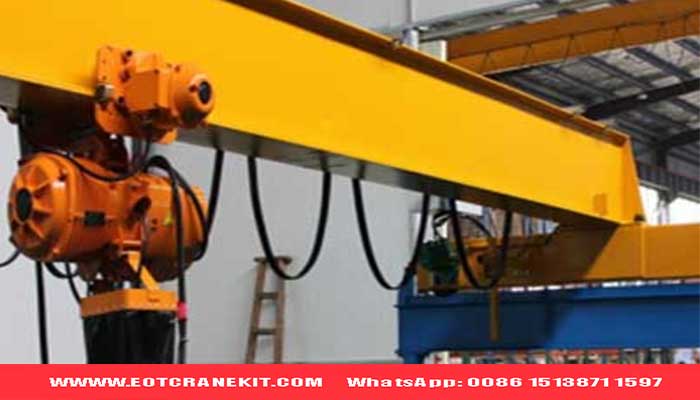
I-Beam Crane Girder: Capacity, Span & Selection Guide
Content Quick Link
I-beam crane girder is widely used for single girder overhead cranes, electric hoist cranes and light duty lifting systems. This guide explains I-beam capacity, span limits, rolled I-beam and welded I-girder design, and how to select the right crane beam for workshop and industrial applications.
I-Beam Crane Girder: Selection Guide, Capacity, Span and Applications for Single Girder Overhead Cranes
Choosing the Right I-Beam Girder for Your Overhead Crane Project
I-beam crane girder is commonly used for single girder overhead cranes, electric hoist cranes and light duty bridge crane systems. For many workshops and factories, it provides a practical solution for lifting equipment, machine parts, production materials and maintenance loads.
When selecting an I-beam crane girder, crane buyers normally need to check:
- Required lifting capacity
- Crane span
- Working frequency
- Hoist trolley type
- Building structure
- Future production requirements
A correctly selected I-beam girder helps ensure smooth trolley movement, stable lifting operation and a longer crane service life.
Typical applications include:
- Machine workshops
- Steel fabrication plants
- Automotive factories
- Maintenance areas
- Warehouses
- Equipment assembly lines
What Is an I-Beam Crane Girder?
An I-beam crane girder is the main bridge beam of a single girder overhead crane. The electric hoist trolley travels along the lower flange of the beam, while the girder supports the lifting load and transfers the force to the crane end trucks.
A complete I-beam crane girder system normally includes:
- I-beam or welded I-girder bridge beam
- Crane end carriages
- Electric hoist trolley
- Electrical travelling system
- Runway structure
The beam design directly affects:
- Crane load capacity
- Maximum span
- Trolley running stability
- Structural deflection
- Crane working life
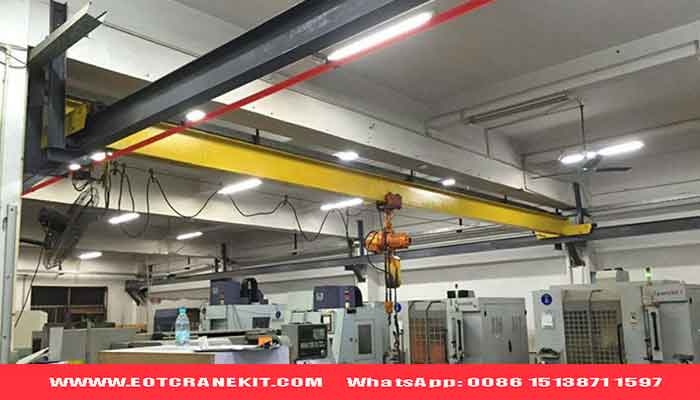
Single beam overhead cranes/ Eot crane with single girder & double girder top running design
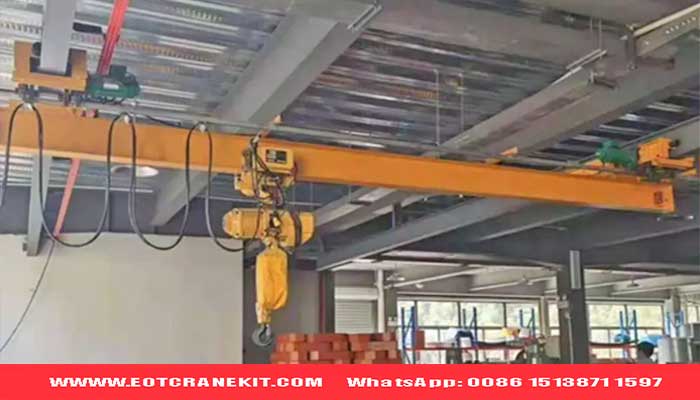
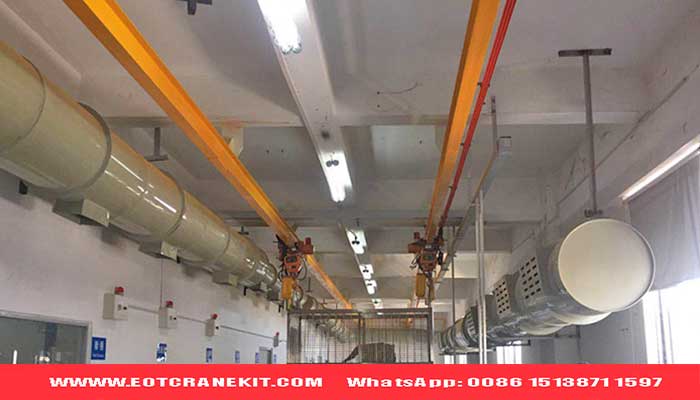
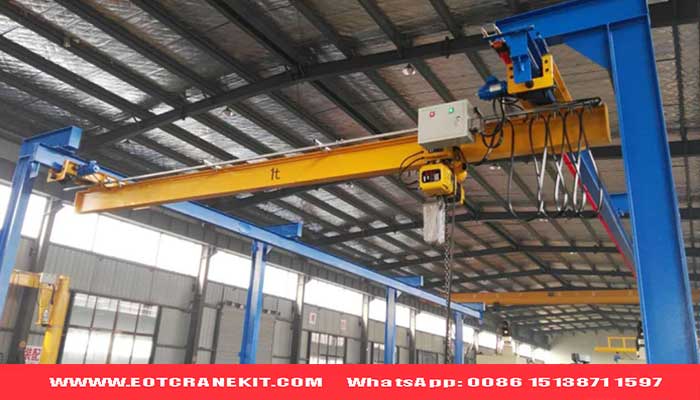
Freestanding i beam overhead crane
I-Beam Crane Girder Structure and Main Components
An I-beam girder consists of three main steel parts:
- Upper Flange—— The upper flange supports the compression force generated during lifting operation.
- Web Plate- The web plate connects the two flanges and carries shear force.
- Lower Flange-The lower flange provides the travelling surface for the electric hoist trolley.
For single girder overhead cranes, the lower flange width must match the trolley wheel design.
Important design parameters include:
| Parameter | Influence on Crane Performance |
|---|---|
| Beam height | Affects bending strength and span capability |
| Flange thickness | Affects local stress and trolley running |
| Web thickness | Affects shear strength |
| Section modulus | Determines bending resistance |
| Moment of inertia | Controls beam deflection |
Rolled I-Beam Section Properties (Illustrative Data)
The table below shows typical rolled sections used for light to medium-duty cranes. Final selection must be verified by structural calculation based on span, load, and duty cycle.
| Property | IPE 200 | IPE 300 | IPE 400 | HEB 300 | HEB 400 |
|---|---|---|---|---|---|
| Height (mm) | 200 | 300 | 400 | 300 | 400 |
| Flange Width (mm) | 100 | 150 | 180 | 300 | 300 |
| Web Thick. (mm) | 5.6 | 7.1 | 8.6 | 11 | 13.5 |
| Flange Thick. (mm) | 8.5 | 10.7 | 13.5 | 19 | 24 |
| Weight (kg/m) | 22.4 | 42.2 | 66.3 | 117 | 155 |
| Capacity (ton) | 0.5–1 | 1–3 | 3–5 | 5–8 | 8–10 |
| Max Span (m) | ≤ 6 | ≤ 8 | ≤ 10 | ≤ 12 | ≤ 12 |
Rolled I-Beam vs Welded I-Girder: Which One Should You Choose?
Crane buyers usually choose between a standard rolled I-beam and a fabricated welded I-girder.
The correct choice depends on crane capacity, span and working condition.
Rolled I-Beam Crane Girder
Rolled I-beam uses standard hot-rolled steel sections available from steel suppliers.
It is commonly used for:
- Small overhead cranes
- Manual lifting systems
- Electric chain hoist cranes
- Light workshop lifting
Typical application range:
| Item | Typical Data |
|---|---|
| Capacity | 0.5–5 ton |
| Span | 3–12 m |
| Duty Class | ISO A3–A4 |
| Hoist Type | Chain hoist / small wire rope hoist |
Advantages
- Lower material cost
- Short manufacturing time
- Simple installation
- Suitable for standard crane designs
Limitations
- Limited beam size options
- Not suitable for very long spans
- Not recommended for heavy duty operation
Example:
A 2 ton or 3 ton workshop crane with an 8 m span can often use a rolled I-beam girder if the steel section meets the required strength calculation.
Welded I-Girder Crane Beam
A welded I-girder is manufactured by welding steel plates into a customized I-shaped beam.
It is selected when standard rolled steel sections cannot meet the crane requirements.
Typical applications:
- 5 ton overhead crane
- 10 ton single girder EOT crane
- Long span workshop crane
- Production line lifting crane
Typical technical range:
| Item | Typical Data |
|---|---|
| Capacity | 5–20 ton |
| Span | 8–25 m |
| Steel Material | Q235B / Q355B |
| Beam Height | 300–1000 mm |
| Duty Class | ISO A3–A5 |
Welded I-Girder – Dimensions by Capacity (Transposed)
| 5t | 10t | 15t | 20t | |
|---|---|---|---|---|
| Span (m) | 10 | 15 | 18 | 20 |
| H (mm) | 400–500 | 600–700 | 700–850 | 850–1000+ |
| W (mm) | 200–250 | 250–300 | 300–350 | 350–400+ |
| tw (mm) | 8–10 | 10–12 | 12–16 | 16–20 |
| tf (mm) | 12–16 | 16–25 | 25–35 | 30–45+ |
| Grade | Q355B | Q355B | Q355B | Q355B |
Advantages
- Customized beam size
- Better control of deflection
- Suitable for larger spans
- Higher load capability
For example:
A 10 ton single girder overhead crane with a 15 m span normally requires a welded I-girder design instead of a standard rolled I-beam.
I-Beam Crane Girder Capacity Range
The capacity of an I-beam crane girder depends on:
- Beam section size
- Crane span
- Hoist trolley wheel load
- Working duty
- Lifting frequency
Typical selection:
| Crane Capacity | Common Girder Choice |
|---|---|
| 250 kg – 2 ton | Rolled I-beam |
| 2 ton – 5 ton | Rolled I-beam or welded I-girder |
| 5 ton – 15 ton | Welded I-girder |
| 15 ton – 20 ton | Customized welded structure |
For cranes above 20 tons, many projects use double girder cranes with box girder bridge structures.
I-Beam Crane Girder Span Range
Span is one of the most important factors when selecting a crane girder.
A longer span creates higher bending stress and beam deflection.
Typical span:
| Crane Type | Span Range |
|---|---|
| Small workshop crane | 3–10 m |
| Single girder overhead crane | 6–18 m |
| Customized welded I-girder crane | 18–25 m |
Example:
For a 12 m span single girder crane:
- The girder must support trolley movement
- Deflection must stay within design limits
- End carriage connection must handle travelling forces
Deflection Requirements & Calculation
Common deflection limits:
- L/700 for general lifting systems
- L/800 for standard overhead cranes
- L/1000 for applications requiring higher stiffness
Deflection formula (simplified):
δ = (5 × W × L³) / (384 × E × I)
Where:
- δ = maximum deflection (mm)
- W = total load on girder (N) – including hoist, trolley & lifted load
- L = span (mm)
- E = modulus of elasticity of steel = 210,000 N/mm²
- I = moment of inertia of beam section (mm⁴)
I-Beam Crane Trolley Compatibility
The trolley design must match the I-beam girder.
Common trolley types:
Electric Wire Rope Hoist Trolley
Used for:
- 1 ton crane
- 3 ton crane
- 5 ton crane
- 10 ton crane
Typical parameters:
| Parameter | Range |
|---|---|
| Travelling Speed | 20 m/min |
| Wheel Quantity | 4 wheels |
| Wheel Material | Forged steel |
| Control | Pendant / Radio remote |
Trolley Compatibility – Wheel Loads & Minimum Flange Width
| Capacity (ton) | Hoist Type | Wheels | Max Wheel Load (kN) | Min. Flange Width (mm) |
|---|---|---|---|---|
| 1 | Chain hoist | 2 or 4 | 5 – 10 | 60 – 80 |
| 3 | Wire rope hoist | 4 | 15 – 25 | 90 – 120 |
| 5 | Wire rope hoist | 4 | 25 – 40 | 120 – 150 |
| 10 | Wire rope hoist | 4 | 45 – 65 | 150 – 200 |
| 15 | Heavy-duty wire rope | 4 or 8 | 65 – 90 | 200 – 280 |
Electric Chain Hoist Trolley
Used for:
- Maintenance lifting
- Assembly workshops
- Small production areas
Advantages:
- Compact structure
- Low headroom
- Easy installation
Common Applications of I-Beam Overhead Cranes
Machine Manufacturing Workshops
Typical lifting tasks:
- Machine installation
- Component handling
- Maintenance work
Common crane range:
- Capacity: 1–10 ton
- Span: 6–15 m
Steel Fabrication Workshops
Applications:
- Steel structure movement
- Welding fixture handling
- Fabricated component lifting
Common crane range:
- Capacity: 3–15 ton
- Duty: ISO A4–A5
Equipment Maintenance Areas
Applications:
- Motor replacement
- Equipment repair
- Spare part lifting
Common crane range:
- Capacity: 500 kg–5 ton
I-Beam Girder vs Box Girder Crane
Many crane buyers compare I-beam cranes with box girder cranes.
| Item | I-Beam Girder | Box Girder |
|---|---|---|
| Structure | Open I section | Closed box section |
| Cost | Lower | Higher |
| Weight | Lower | Higher |
| Capacity | Light and medium duty | Medium and heavy duty |
| Span | Short and medium | Long span |
| Manufacturing | Simple | More fabrication work |
| Application | Workshops, maintenance | Steel plants, ports, heavy industry |
Choose I-Beam Girder When:
- Crane capacity is below 15 tons
- Workshop lifting is the main requirement
- Cost control is important
- Crane operation is moderate
Choose Box Girder When:
- Crane capacity is above 20 tons
- Span is very long
- Crane works continuously
- Higher duty class is required
How to Select an I-Beam Crane Girder?
Before ordering an I-beam crane system, provide the following information:
Crane Load Information
- Rated lifting capacity
- Maximum load weight
- Lifting height
- Working frequency
Building Information
- Crane span
- Runway length
- Available installation height
- Existing support structure
Operating Conditions
- Indoor or outdoor installation
- Working temperature
- Dust or corrosive environment
- Daily operating hours
ISO Duty Class – Service Conditions
| Class | Duty Level | Avg. Daily Use | Typical Application |
|---|---|---|---|
| A3 | Light | ≤ 2 hr | Maintenance, light assembly |
| A4 | Moderate | 2 – 4 hr | Machine workshops, general fab |
| A5 | Medium / Heavy | 4 – 8 hr | Steel fabrication, production lines |
| A6 | Heavy | 8 – 16 hr | Intensive industry, scrap yards |
| A7–A8 | Very Heavy / Continuous | >16 hr / 24/7 | Ports, mining, foundries |
I-Beam Crane Girder Technical Specification
| Specification | Typical Range |
|---|---|
| Product | I-Beam Crane Girder |
| Application | Single Girder Overhead Crane |
| Capacity | 0.5–20 ton |
| Span | 3–25 m |
| Steel Grade | Q235B / Q355B |
| Girder Type | Rolled I-Beam / Welded I-Girder |
| Hoist Type | Electric Wire Rope Hoist / Chain Hoist |
| Duty Class | ISO A3–A5 |
| Deflection | L/700–L/1000 |
| Power Supply | 380V/400V/415V 50Hz/60Hz |
Electro-Mechanical Data – Speeds & Protection
| Parameter | Standard Value | Notes |
|---|---|---|
| Lifting speed | 4 – 8 m/min | Up to 16 m/min with VFD option |
| Trolley travel speed | 10 – 20 m/min | VFD for smooth acceleration |
| Bridge travel speed | 20 – 40 m/min | Depends on end carriage motors |
| Control voltage | 24V / 36V / 110V / 220V AC/DC | Low-voltage control for safety |
| Protection class (IP) | IP54 (indoor) / IP55–IP65 (dusty/wet) | Higher IP for outdoor/harsh |
| Insulation class | F (standard) / H (high temp) | H for foundries & hot areas |
Frequently Asked Questions About I-Beam Crane Girder
What capacity can an I-beam crane girder handle?
An I-beam crane girder is commonly used for 0.5 ton to 15 ton single girder overhead cranes. With a customized welded I-girder design, it can be used for higher capacity cranes depending on the span, duty class and operating conditions.
Typical application range:
| Crane Capacity | Typical I-Beam Girder Application |
|---|---|
| 0.5–3 ton | Light duty workshop cranes |
| 3–10 ton | Factory overhead cranes and maintenance cranes |
| 10–15 ton | Single girder EOT cranes with welded I-girder |
| 15–20 ton | Customized I-girder design after calculation |
The actual capacity depends on:
- Crane span
- Beam size and height
- Steel grade
- Hoist trolley wheel load
- Working duty class
- Allowable beam deflection
Typical Yuantai Crane I-beam crane applications:
- Capacity: 1–15 ton
- Span: 6–18 m
- Working class: ISO A3–A5
- Hoist: Electric wire rope hoist or electric chain hoist
Is an I-beam suitable for overhead cranes?
Yes. I-beams are widely used for single girder overhead cranes, underhung cranes and electric hoist crane systems.
They are suitable for:
- Factory workshops
- Machine manufacturing plants
- Maintenance areas
- Warehouses
- Assembly lines
An I-beam crane girder is a good choice when:
- The crane capacity is light or medium duty
- The span is within normal workshop dimensions
- The crane does not operate continuously under heavy loads
Example:
A typical workshop crane:
- Capacity: 5 ton
- Span: 10–15 m
- Lifting height: 6–9 m
- Hoist: Electric wire rope hoist
can commonly use a welded I-girder single girder crane design.
Yuantai Crane selects the beam size based on the complete crane specification instead of only the lifting capacity. A 5 ton crane with a 6 m span and a 5 ton crane with an 18 m span may require different girder designs.
What is the difference between I-beam and box girder cranes?
The main difference is the bridge beam structure.
An I-beam crane uses an open steel beam, while a box girder crane uses a closed welded box structure.
| Item | I-Beam Crane Girder | Box Girder Crane |
|---|---|---|
| Structure | I-shaped steel section | Closed rectangular beam |
| Capacity | 0.5–20 ton | 5–550 ton |
| Span | Short and medium span | Medium and long span |
| Cost | Lower | Higher |
| Weight | Lighter | Heavier |
| Manufacturing | Simple | More fabrication work |
| Application | Workshops, factories | Steel plants, ports, heavy industry |
Choose an I-beam crane when:
- Capacity is below 15 tons
- General material handling is required
- Cost-effective lifting equipment is needed
Choose a box girder crane when:
- Capacity is above 20 tons
- Crane works frequently
- Long span is required
- Heavy industrial lifting is involved
Yuantai Crane commonly uses I-beam and welded I-girder structures for workshop cranes, while heavy-duty projects such as steel mills and power plants normally use double girder box beam cranes.
How do I choose the correct I-beam size for a crane?
The correct I-beam size depends on capacity, span, trolley load and working conditions.
Before selecting the girder size, check:
1. Crane Capacity
Example:
- 2 ton maintenance crane
- 5 ton workshop crane
- 10 ton production crane
Higher lifting capacity requires a stronger beam section.
2. Crane Span
Span directly affects beam strength and deflection.
Example:
A 5 ton crane with:
- 8 m span
requires a smaller girder compared with:
- 5 ton crane with 18 m span
3. Hoist Trolley Design
The I-beam flange must match the trolley running system.
Check:
- Trolley wheel load
- Wheel spacing
- Flange width
- Flange thickness
4. Working Duty Class
Crane working frequency affects the girder design.
Typical classes:
| Duty Class | Application |
|---|---|
| ISO A3–A4 | Maintenance and light workshop cranes |
| ISO A5 | General factory production cranes |
| FEM 2M–3M | Medium duty industrial cranes |
5. Structural Calculation
Before manufacturing, the crane girder should be checked for:
- Bending strength
- Shear strength
- Beam deflection
- Weld strength
- Fatigue requirements
Yuantai Crane engineers select the I-beam or welded I-girder size according to the customer's:
- Lifting requirements
- Factory layout
- Operating frequency
- Working environment
This ensures the crane beam matches the actual working condition and avoids using an unsuitable beam size.
What are the typical technical specifications of Yuantai I-beam crane girders?
| Parameter | Typical Range |
|---|---|
| Crane Type | Single Girder Overhead Crane |
| Capacity | 0.5–20 ton |
| Span | 3–25 m |
| Steel Grade | Q235B / Q355B |
| Girder Type | Rolled I-Beam / Welded I-Girder |
| Hoist Type | Electric Wire Rope Hoist / Chain Hoist |
| Working Class | ISO A3–A5 |
| Power Supply | 380V / 400V / 415V, 50Hz/60Hz |
| Deflection Requirement | L/700–L/1000 |
Why do customers choose Yuantai Crane for I-beam crane systems?
Yuantai Crane designs I-beam crane girders based on the actual lifting requirement, including:
- Crane capacity
- Span size
- Hoist model
- Duty classification
- Installation condition
Typical supplied applications include:
- Factory overhead cranes
- Workshop maintenance cranes
- Production line lifting cranes
- Equipment handling systems
For each project, Yuantai Crane provides the crane structure design, component matching and technical support to ensure the I-beam girder fits the customer's working conditions.

Article by Bella ,who has been in the hoist and crane field since 2016. Bella provides overhead crane & gantry crane consultation services for clients who need a customized overhead travelling crane solution.Contact her to get free consultation.
Yuantai Cranes
Overhead Crane Manufacturer with CE, ISO, SGS, CNEX Certificates.
- Main Specifications - Capacity: 0.5–550 tons | Span: up to 40m | Speed: 0.8–12 m/min | Duty: A3–A7 | Power: 380–690V, 50/60Hz | Control: pendant/remote/cabin
- Full engineering: FEA/PLC/VFD + in-house build + global delivery + on-site support, for workshops, factories, EPC contractors, industrial projects, etc.
- Support: design, manufacturing, testing, service – end-to-end, customized lifting solutions worldwide.
How to Get an Accurate Crane Price for Your Application?
Tips: Copy the spec list, fill in your details, and paste it into the form on the right/ down-below for a quick price.
- Crane type:_____ . (e.g., overhead crane, gantry crane, jib crane)
- Max weight to lift:_____ tons. (e.g., 2t, 5t, 10t, 20t, 50t)
- Lifting height:_____ m. (How high does the hook need to reach?
- Workshop width (span):_____ m . (Distance between the two crane rails)
- Travel distance:_____ m . (How long does the crane need to move along the runway?)
- Control type:_____. (Pendant / remote / cabin Control)
- Power supply:_____. (Local voltage & frequency – e.g., 380V, 50Hz, 3-phase)
- What will it be used for?_____ (e.g., steel fabrication, concrete products, mold handling, general manufacturing, etc.)
- Any special requirements?_____ (e.g., extreme temperature, dusty or explosive environment, special paint color, etc.)
Just leave a message via the contact form and our hoist and crane engineer will contact you with in 24working hours.
Get Your Custom Quote–Quick & Easy
Fill in what you know. Skip what you don't – we'll help.Any question will be reply with 24 working hours